
Verwandte Artikel zu Having Twins And More: A Parent's Guide to Multiple...
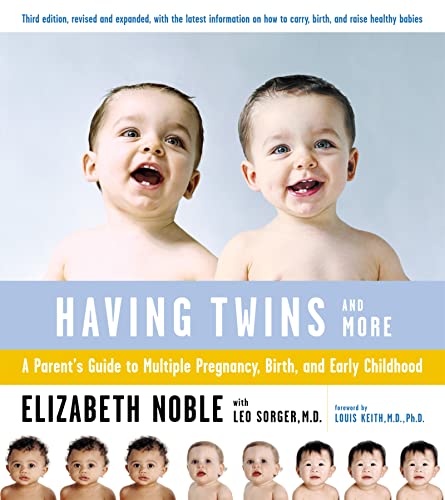
Having Twins And More: A Parent's Guide to Multiple Pregnancy, Birth, and Early Childhood: A Parent's Guide to Multiple Pregnancy, Birth, and Early ... Bestselling Resource for Expecting Families - Softcover
Inhaltsangabe
Now in a third edition, the best-selling guide on multiple births, Having Twins And More, covers everything from conception through childhood.
With ongoing advances in assisted reproduction, increasing numbers of women are having twins, triplets, and more, and they're having them later in life. Having Twins And More is the original source parents consult for guidance through the multiple birth experience.
For three decades Elizabeth Noble, a respected name in the field, has provided expectant parents with everything they need to make informed, safe choices and give birth to healthy babies. This comprehensive handbook emphasizes optimal health as well as physical and emotional adjustments to bearing and raising multiples, and it offers striking new insights into risks, complications, and treatments—candid information that is gathered only in this book.
Die Inhaltsangabe kann sich auf eine andere Ausgabe dieses Titels beziehen.
Über die Autorin bzw. den Autor
Elizabeth Noble is the author of seven books, including Essential Exercises for the Childbearing Year, Childbirth with Insight, and Having Your Baby by Donor Insemination. She is the founder of the Obstetrics and Gynecology Section of the American Physical Therapy Association, and of the Maternal and Child Health Center in Cambridge, Massachusetts.
Auszug. © Genehmigter Nachdruck. Alle Rechte vorbehalten.
Introduction
Thanks to the ongoing interest and support of you, my readers, this book
has been published in multiple editions! Almost a quarter-century has passed
since I was first asked questions about twins I couldn't answer, and I
promised I would research the topic for those couples. In the late 1970s, I
found not a single book for parents expecting multiples; and back then
triplets and higher-order multiples were infrequent. What a huge difference
today with a daunting array of resources, especially on the Internet!
The research I undertook in the 1970s for the first edition of this
book convinced me that many problems can be prevented or alleviated by
optimal prenatal care; that is, by the mother's commitment to a vigilant
program of nutrition, hydration, exercise, rest, and education. In the
decades since the first edition, evidence has continued to mount in support of
this view. The focus of Having Twins — and More, then and now, is on the
physiological and psychological dimensions of the experience. Learning
how mothers successfully carried normal-birth-weight babies to term
empowers other women to do the same. Such mothers can still be found
despite the preoccupation with pathology that has occurred with the
medicalization of childbearing in general, and of multiple pregnancies in
particular.
This ever-increasing medicalization is a direct result of the focus
on potential problems in litigious societies and has undermined women's
confidence in their ability to give birth. Blood plasma volume expansion
(causing low hemoglobin levels), hypertension (increasing arterial blood
flow), and altered glucose tolerance (making more carbohydrate available for
the babies) should be interpreted as signs of successful placental activity,
not disease processes! Yet expectant mothers (especially of multiples) are
aggressively treated for anemia, high blood pressure, and gestational
diabetes!
Prevention Is the Key: Health Care Is Self-Care
The privilege of working with childbearing couples for more than thirty years
has helped me to clarify what is important. In this book I tackle, rather than
avoid, controversies, without the usual suggestion that readers consult their
doctors. As an independent observer, I am not obliged to be politically
correct in order to obtain grant money or to keep an academic or clinical
position.
Being pregnant today, especially if "high risk," is full of challenges
that our grandmothers never considered. More than ever, parents need to be
thoroughly informed and empowered to make choices and take
responsibility for their decisions. They need guidance right from the start to
face confidently the months and years ahead.
One of the drawbacks of gaining knowledge and insight is that
feelings of reproach and guilt can emerge over prior events. "If only . . ." is a
natural, though not a constructive, reaction. When natural childbirth, breast-
feeding, and genital integrity, for example, are endorsed, mothers who did
otherwise may become regretful. Therefore, many health care professionals,
in the well-intentioned attempt to spare women such feelings, fail to
recommend unequivocally the practices that are clearly best for mother and
babies. I call this the "white bread" philosophy. To explain with an example:
whole grain bread is healthier than white bread, but it is not widely available.
Therefore, let us reassure the people who get the inevitable white bread in
the store, restaurant, hospital, airplane, and school that it is just as good.
This type of philosophy promotes mistaken ideas about pregnancy and birth:
bottle-feeding is the equivalent of breast-feeding, the "abdominal birth canal"
(Caesarean section) is just another way to give birth, and bed rest, like
white bread, must be acceptable if so many people partake of it! Such
reassurances have back-fired; outcomes have worsened as interventions in
pregnancies and births have increased, and breast-feeding remains a low
priority in our society. Mothers end up feeling guiltier than ever!
It helps to explore all possible facets of any health challenge and
to resist suggestions that a problem is "all in the mind," when the evidence
is clearly in the body! Such exploration may include the study of
complementary holistic therapies that address physical, mental, and
emotional aspects of childbearing. In her book Molecules of Emotion,
research scientist Candace Pert showed how a single thought can set off a
chain of reactions throughout the body. Evidence has convinced me of the
value of natural remedies such as homeopathy and herbal supplements
along with visualization and affirmations for treating both the emotional and
physical aspects of some medical problems.
According to the Food and Drug Administration (FDA), during the
five years spanning 1993 to 1998, federal, state, and local agencies
reported a total of only 184 deaths from using herbs and supplements (most
of which were associated with weight loss formulas). Contrast this with the
figures for pharmaceuticals, discussed below, which are responsible for
almost 100 times more deaths annually!
Nutrition remains paramount. A builder cannot construct a house
without all the supplies, right down to specific screws and nails. If extra
rooms are added, more supplies are needed. Amultiple pregnancy is the
same. A contractor hires subcontractors; parents of multiples need to
assemble a team of helpers who will optimize the outcome.
The Nocebo Effect: The "Evil Twin" of the Placebo Effect
The attitude of a health care provider that something is wrong and needs to
be fixed leads to anxiety and stress. Nocebo effects refer to symptoms that
occur when the suggestions, instructions, and expectations are negative, in
contrast with placebo effects that occur when intent and expectations are
positive.
Stress affects women in all walks of life, especially those who are
poor, hungry, beaten, or isolated, for example. However, anxieties about the
pregnancy, and especially an unplanned one, have been shown to be more
serious stressors for the unborn babies. We must realize the role of stress
as a cause as well as an effect in pregnancy complications.
Affluent expectant mothers may be exposed to more prenatal
anxiety because they can afford perinatologists and the latest fetal
surveillance technology. They receive a heavy dose of the nocebo effect
when maternity care providers anticipate problems. One woman felt as
though she had contracted a rare disease when her family doctor referred her
to an obstetrician.
Countless women can attest to the nocebo effect from the
disclosure of the multiple pregnancy or the genders of their multiples. For
example, triplets are seen on an ultrasound scan and the doctor enters the
room to talk about selective fetocide. Or the technician announces, "I'm
sorry to say, four boys." Many couples have felt their panic thermostat rise
because of an unclear test result, even when everything turns out to be fine.
New research in genetics has turned some of our theories around.
First, the Human Genome Project showed that we have only 34,000 genes
(experts had anticipated three times as many!). Also surprising was the
discovery that cells cannot program themselves: influences that switch
them on or off come from the environment. Ninety-five percent of us come into
the world with an intact genome permitting a healthy life. The causes of
disease in this majority have not been studied as intensely as have the
defective genes in the other 5 percent.
Furthermore,...
„Über diesen Titel“ kann sich auf eine andere Ausgabe dieses Titels beziehen.
Suchergebnisse für Having Twins And More: A Parent's Guide to Multiple...

Beispielbild für diese ISBN
Having Twins And More: A Parent's Guide to Multiple Pregnancy, Birth, and Early Childhood - The Original Bestselling Resource for Expecting Families
Anbieter: World of Books (was SecondSale), Montgomery, IL, USA
Verkäuferbewertung 5 von 5 Sternen

Zustand: Acceptable. Item in acceptable condition! Textbooks may not include supplemental items i.e. CDs, access codes etc. Artikel-Nr. 00106608757
Gebraucht kaufen
EUR 4,17
Versand gratis
Versand innerhalb von USA
Versand innerhalb von USA
Anzahl: 2 verfügbar
Beispielbild für diese ISBN
Having Twins And More: A Parent's Guide to Multiple Pregnancy, Birth, and Early Childhood - The Original Bestselling Resource for Expecting Families
Anbieter: World of Books (was SecondSale), Montgomery, IL, USA
Verkäuferbewertung 5 von 5 Sternen
Zustand: Good. Item in good condition. Textbooks may not include supplemental items i.e. CDs, access codes etc. Artikel-Nr. 00102431496
Gebraucht kaufen
EUR 4,17
Versand gratis
Versand innerhalb von USA
Versand innerhalb von USA
Anzahl: 3 verfügbar
Beispielbild für diese ISBN
Having Twins And More: A Parent's Guide to Multiple Pregnancy, Birth, and Early Childhood
Anbieter: Wonder Book, Frederick, MD, USA
Verkäuferbewertung 5 von 5 Sternen
Zustand: Good. Good condition. Artikel-Nr. M10I-00219
Gebraucht kaufen
EUR 4,86
Versand gratis
Versand innerhalb von USA
Versand innerhalb von USA
Anzahl: 1 verfügbar
Beispielbild für diese ISBN
Having Twins And More: A Parent's Guide to Multiple Pregnancy, Birth, and Early Childhood â" The Original Bestselling Resource for Expecting Families
Verlag:
Harvest (edition Subsequent), 2003
ISBN 10: 0618138730
ISBN 13: 9780618138739
Gebraucht
Paperback
Anbieter: BooksRun, Philadelphia, PA, USA
Verkäuferbewertung 5 von 5 Sternen
Paperback. Zustand: Very Good. Subsequent. It's a well-cared-for item that has seen limited use. The item may show minor signs of wear. All the text is legible, with all pages included. It may have slight markings and/or highlighting. Artikel-Nr. 0618138730-11-1
Gebraucht kaufen
EUR 5,46
Versand gratis
Versand innerhalb von USA
Versand innerhalb von USA
Anzahl: 1 verfügbar
Beispielbild für diese ISBN
Having Twins--And More: A Parent's Guide to Multiple Pregnancy, Birth, and Early Childhood
Anbieter: ThriftBooks-Atlanta, AUSTELL, GA, USA
Verkäuferbewertung 5 von 5 Sternen
Paperback. Zustand: Very Good. No Jacket. May have limited writing in cover pages. Pages are unmarked. ~ ThriftBooks: Read More, Spend Less. Artikel-Nr. G0618138730I4N00
Gebraucht kaufen
EUR 6,29
Versand gratis
Versand innerhalb von USA
Versand innerhalb von USA
Anzahl: 1 verfügbar
Beispielbild für diese ISBN
Having Twins--And More: A Parent's Guide to Multiple Pregnancy, Birth, and Early Childhood
Anbieter: ThriftBooks-Atlanta, AUSTELL, GA, USA
Verkäuferbewertung 5 von 5 Sternen
Paperback. Zustand: Good. No Jacket. Pages can have notes/highlighting. Spine may show signs of wear. ~ ThriftBooks: Read More, Spend Less. Artikel-Nr. G0618138730I3N00
Gebraucht kaufen
EUR 6,29
Versand gratis
Versand innerhalb von USA
Versand innerhalb von USA
Anzahl: 1 verfügbar
Beispielbild für diese ISBN
Having Twins and More : A Parent's Guide to Multiple Pregnancy, Birth, and Early Childhood
Verlag:
HarperCollins Publishers, 2003
ISBN 10: 0618138730
ISBN 13: 9780618138739
Gebraucht
Softcover
Anbieter: Better World Books: West, Reno, NV, USA
Verkäuferbewertung 5 von 5 Sternen
Zustand: Good. 3rd. Pages intact with minimal writing/highlighting. The binding may be loose and creased. Dust jackets/supplements are not included. Stock photo provided. Product includes identifying sticker. Better World Books: Buy Books. Do Good. Artikel-Nr. GRP73090230
Gebraucht kaufen
EUR 9,01
Versand gratis
Versand innerhalb von USA
Versand innerhalb von USA
Anzahl: 1 verfügbar
Beispielbild für diese ISBN
Having Twins and More : A Parent's Guide to Multiple Pregnancy, Birth, and Early Childhood
Verlag:
HarperCollins Publishers, 2003
ISBN 10: 0618138730
ISBN 13: 9780618138739
Gebraucht
Softcover
Anbieter: Better World Books, Mishawaka, IN, USA
Verkäuferbewertung 5 von 5 Sternen
Zustand: Good. 3rd. Pages intact with minimal writing/highlighting. The binding may be loose and creased. Dust jackets/supplements are not included. Stock photo provided. Product includes identifying sticker. Better World Books: Buy Books. Do Good. Artikel-Nr. GRP73090230
Gebraucht kaufen
EUR 9,01
Versand gratis
Versand innerhalb von USA
Versand innerhalb von USA
Anzahl: 1 verfügbar
Beispielbild für diese ISBN
Having Twins And More: A Parent's Guide to Multiple Pregnancy, Birth, and Early Childhood [Paperback] Noble, Elizabeth; Sorger, Leo and Keith, Louis G.
Anbieter: GridFreed, San Diego, CA, USA
Verkäuferbewertung 5 von 5 Sternen
Paperback. Zustand: New. In shrink wrap. Artikel-Nr. SDBOX1429-DB11032020-19
Neu kaufen
EUR 17,41
EUR 6,20 Versand
Versand innerhalb von USA
Versand innerhalb von USA
Anzahl: 1 verfügbar
Beispielbild für diese ISBN
Having Twins -- And More: A Parent's Guide to Multiple Pregnancy, Birth, and Early Childhood
Anbieter: Revaluation Books, Exeter, Vereinigtes Königreich
Verkäuferbewertung 5 von 5 Sternen
Paperback. Zustand: Brand New. 3rd sub edition. 560 pages. 9.00x7.75x1.50 inches. In Stock. Artikel-Nr. x-0618138730
Neu kaufen
EUR 43,47
EUR 14,79 Versand
Versand von Vereinigtes Königreich nach USA
Versand von Vereinigtes Königreich nach USA
Anzahl: 2 verfügbar