
Verwandte Artikel zu Kick Me: Adventures in Adolescence
Inhaltsangabe
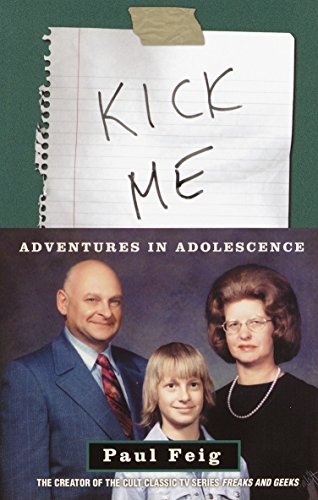
Written in side-splitting and often cringe-inducing detail, Paul Feig takes you in a time machine to a world of bombardment by dodge balls, ill-fated prom dates, hellish school bus rides, and other aspects of public school life that will keep you laughing in recognition and occasionally sighing in relief that you aren’t him. Kick Me is a nostalgic trip for the inner geek in all of us.
Die Inhaltsangabe kann sich auf eine andere Ausgabe dieses Titels beziehen.
Über die Autorin bzw. den Autor
Paul Feig is a movie and television writer, director, and producer. He is a two-time Emmy nominee and lives in Los Angeles.
Von der hinteren Coverseite
Written in side-splitting and often cringe-inducing detail, Paul Feig takes you in a time machine to a world of bombardment by dodge balls, ill-fated prom dates, hellish school bus rides, and other aspects of public school life that will keep you laughing in recognition and occasionally sighing in relief that you aren't him. Kick Me is a nostalgic trip for the inner geek in all of us.
Auszug. © Genehmigter Nachdruck. Alle Rechte vorbehalten.
WE STOOD IN LINE AT ELLIS ISLAND FOR THIS?
There is no God. . . I mean, there can’t be. Think about it. . . If there were, then things in life would have to be fair. There would be no suffering, there would be no war, there would be no poverty . . .
. . . and none of us would be born with last names that could make us the brunt of adolescent jokes for the entirety of our school careers.
In a truly just universe, no child’s last name would be Cox, Butz, or Seaman. No teenager would come from a family named the Hardins or the Balls. A young Richard Shaft wouldn’t have to come home from school crying each day. An underendowed Lisa Titwell wouldn’t beg her parents to let her finish her education at an all-girls’ school. And an adolescent Paul Feig wouldn’t have had to endure hearing the letters e and i constantly taken out of his last name and replaced with the letter a.
But, alas, I did.
It didn’t start out that way. Fortunately, or unfortunately, when I was in grade school, there was a TV commercial for Fig Newton cookies that featured a man dressed up in a giant fig costume who performed a jingle called “The Big Fig Newton.” He would dance and sing the words “Chewy, chewy, rich, and gooey in- side . . . Golden, flaky, tender, cakey outside.” At the same time, he performed a goofy, vaguely Egyptian-type dance, and then, after a few more product-endorsing verses, would wrap up his corporate caperings by saying “Here comes the tricky part,” whereupon he would stand on one leg and grandly sing, “The Big . . . Fig . . . New-tonnnnnnn!”
The commercial was very popular and something every kid in my school district strove to memorize in the hopes that he or she could then perform it in front of his or her peers and obtain big laughs. Because of this, and thanks to the free association of youth, I, Paul Feig, became known as “Fig Newton.”
At first, I hated it. I mean, who among us really is happy when we’re assigned a nickname? It’s never a situation where we get some cool handle like “The Big Hurt” or “The Yankee Clipper” or “Stud.” It’s always some lame, obvious play on our names, turning the once proud crest of our ancestors into something that either has to do with a body part, a reproductive organ, a mental shortcoming, or an insensitive term for a person who practices nontraditional sexual unions. The kids I grew up with could bend the most innocent name into something you wouldn’t want to be called, even if it was preceded by the phrase “and the Oscar goes to . . .” Names as harmless as Smith and Jones could easily be twisted into Smegma and Boner, and so the journey from Feig to Fig Newton was little more than a quick trip to the local humiliation mart.
The name spread fast and soon none of my peers could resist it. The greeting “Hey, Fig Newton” became so prevalent in my life that by the age of ten I didn’t even respond to my actual name. Paul Feig was someone from my past, a free spirit who had once played happily in his room, unaware that the world was filled with people who, unlike his mother and grandmother, didn’t think he was “The Boy Who Could Do No Wrong.” I was now Fig Newton, the kid who was known to burst into tears at the drop of a hat, who talked too loud and had trouble paying attention in class, and who had strange nervous tics like blinking his eyes, shaking the hair out of his face, and constantly tugging at the crotch of his pants because of a minor case of undiagnosed Tourette syndrome. No, Paul Feig was a private citizen, but Fig Newton was a walking target. And I wasn’t very pleased about it.
The irony was, as with many things in life, I had no idea how good I really had it until it was too late. It happened on the first day of junior high. I entered the building, fresh from seven relatively safe years in kindergarten and elementary school, and was feeling both nervous and excited about this upgrade in rank. To be a seventh grader didn’t just mean you were one year older than a sixth grader. It meant that you had gotten through the first and longest leg of your precollege journey. You’d done seven years of the basics and were deemed worthy to step up to the next level. Life was going to be less about reading drills and times tables and using your finger to put spaces between the words you wrote with oversize pencils and more about scholarly pursuits. Feeling wise and mature, I marched proudly into my new homeroom and sat down near some friends from grade school. The teacher came in, and my excitement at my new academic surroundings grew. He was a handsome, too-cool-to-be-teaching-junior-high-school guy in his early thirties named Mr. Parks. He was the only teacher I’d ever seen at that point in my life who had a beard, and his cool quotient grew immediately once word got out that he had a guitar in his office. Mr. Parks started to call off our names from an attendance sheet. All of my classmates answered in the standard twelve-year-old’s socially backward mumble of “Here” or “Present.” I wanted to be different. I wanted to celebrate my new life in junior high with a hale and hearty “Right here, Mr. Parks,” just to let him and the world know that I was going to be a force to be reckoned with. I could hardly contain my excitement as he worked his way through the Ds.
“Drabelski?”
“. . . here.”
“Drummond?”
“. . . yeah.”
When he got to Fazio, I knew that I would be next. I readjusted in my chair and took a breath, filling my diaphragm with a mouthful of air that was about to be transformed into my debut moment. Mr. Parks stared at the list, as if he were trying to figure something out. And then, uncertainly, he said my name.
Now, for the record, my family has always pronounced our last name “Feeg,” which has stirred a lot of debate among my parents’ peers. In some countries, citizens pronounce the second vowel in a pair, which would make our name come out as “F-eye-g.” In other lands, people make the first vowel the dominant sound, as my ancestors had chosen to do. Well, for some reason, the melee of pronunciation rules in Mr. Parks’s head made him take the squishy middle road through the world of articulation, and he tortured out a version of my name that sounded exactly like this:
“Paul . . . Fffff-aaa-ay-g?”
The laughter was deafening. In grade school, I had always attempted to make people laugh and had been semisuccessful at it, but suddenly I was getting the biggest reaction of my life and I hadn’t done anything. And, more importantly, I didn’t want it. Because I knew that it wasn’t the good kind of laughing. I wasn’t entertaining my classmates with a pithy set of observations about the fact that the cafeteria menu for that day featured something called “Ben Franklin Beans,” nor was I pressing the heels of my hands against my mouth and blowing hard, creating the always laugh-inducing monster fart sound. And the phrase “we’re not laughing at you, we’re laughing with you” wasn’t anywhere to be found. I looked around at my school chums, quite perplexed at the response, thinking that these laughs were far too big for a simple mistake in pronunciation. It was at that moment that some kid I didn’t know who was sitting a couple of rows away looked right at me and said, “Paul Fag?”
More laughs exploded, and I knew that I had just witnessed the birth of something horrible. It was bound to happen and, in all honesty, I don’t know why it didn’t happen...
„Über diesen Titel“ kann sich auf eine andere Ausgabe dieses Titels beziehen.
Suchergebnisse für Kick Me: Adventures in Adolescence

Beispielbild für diese ISBN
Kick Me: Adventures in Adolescence
Anbieter: World of Books (was SecondSale), Montgomery, IL, USA
Verkäuferbewertung 5 von 5 Sternen

Zustand: Acceptable. Item in good condition. Textbooks may not include supplemental items i.e. CDs, access codes etc. Artikel-Nr. 00068939437
Gebraucht kaufen
EUR 3,67
Versand gratis
Versand innerhalb von USA
Versand innerhalb von USA
Anzahl: 1 verfügbar
Beispielbild für diese ISBN
Kick Me: Adventures in Adolescence
Anbieter: World of Books (was SecondSale), Montgomery, IL, USA
Verkäuferbewertung 5 von 5 Sternen
Paperback. Zustand: Very Good. Written in side-splitting and often cringe-inducing detail, Paul Feig takes you in a time machine to a world of bombardment by dodge balls, ill-fated prom dates, hellish school bus rides, and other aspects of public school life that will keep you laughing in recognition and occasionally sighing in relief that you aren't him. Kick Me is a nostalgic trip for the inner geek in all of us. Artikel-Nr. 00104027299
Gebraucht kaufen
EUR 3,68
Versand gratis
Versand innerhalb von USA
Versand innerhalb von USA
Anzahl: 2 verfügbar
Beispielbild für diese ISBN
Kick Me Adventures in Adolesce
Anbieter: World of Books (was SecondSale), Montgomery, IL, USA
Verkäuferbewertung 5 von 5 Sternen
Zustand: Good. Item in good condition. Textbooks may not include supplemental items i.e. CDs, access codes etc. Artikel-Nr. 00104783970
Gebraucht kaufen
EUR 3,68
Versand gratis
Versand innerhalb von USA
Versand innerhalb von USA
Anzahl: 6 verfügbar
Beispielbild für diese ISBN
Kick Me: Adventures in Adolescence
Anbieter: BooksRun, Philadelphia, PA, USA
Verkäuferbewertung 5 von 5 Sternen
Paperback. Zustand: Very Good. 1. It's a well-cared-for item that has seen limited use. The item may show minor signs of wear. All the text is legible, with all pages included. It may have slight markings and/or highlighting. Artikel-Nr. 0609809431-11-1
Gebraucht kaufen
EUR 4,84
Versand gratis
Versand innerhalb von USA
Versand innerhalb von USA
Anzahl: 1 verfügbar
Beispielbild für diese ISBN
Kick Me : Adventures in Adolescence
Verlag:
Crown Publishing Group, The, 2002
ISBN 10: 0609809431
ISBN 13: 9780609809433
Gebraucht
Softcover
Erstausgabe
Anbieter: Better World Books, Mishawaka, IN, USA
Verkäuferbewertung 5 von 5 Sternen
Zustand: Good. 1st Edition. Former library copy. Pages intact with minimal writing/highlighting. The binding may be loose and creased. Dust jackets/supplements are not included. Includes library markings. Stock photo provided. Product includes identifying sticker. Better World Books: Buy Books. Do Good. Artikel-Nr. 4633117-6
Gebraucht kaufen
EUR 6,11
Versand gratis
Versand innerhalb von USA
Versand innerhalb von USA
Anzahl: 1 verfügbar
Beispielbild für diese ISBN
Kick Me : Adventures in Adolescence
Verlag:
Crown Publishing Group, The, 2002
ISBN 10: 0609809431
ISBN 13: 9780609809433
Gebraucht
Softcover
Erstausgabe
Anbieter: Better World Books: West, Reno, NV, USA
Verkäuferbewertung 5 von 5 Sternen
Zustand: Good. 1st Edition. Former library copy. Pages intact with minimal writing/highlighting. The binding may be loose and creased. Dust jackets/supplements are not included. Includes library markings. Stock photo provided. Product includes identifying sticker. Better World Books: Buy Books. Do Good. Artikel-Nr. 4633117-6
Gebraucht kaufen
EUR 6,11
Versand gratis
Versand innerhalb von USA
Versand innerhalb von USA
Anzahl: 1 verfügbar
Beispielbild für diese ISBN
Kick Me : Adventures in Adolescence
Verlag:
Crown Publishing Group, The, 2002
ISBN 10: 0609809431
ISBN 13: 9780609809433
Gebraucht
Softcover
Erstausgabe
Anbieter: Better World Books: West, Reno, NV, USA
Verkäuferbewertung 5 von 5 Sternen
Zustand: Very Good. 1st Edition. Pages intact with possible writing/highlighting. Binding strong with minor wear. Dust jackets/supplements may not be included. Stock photo provided. Product includes identifying sticker. Better World Books: Buy Books. Do Good. Artikel-Nr. 5534575-6
Gebraucht kaufen
EUR 6,11
Versand gratis
Versand innerhalb von USA
Versand innerhalb von USA
Anzahl: 1 verfügbar
Beispielbild für diese ISBN
Kick Me : Adventures in Adolescence
Verlag:
Crown Publishing Group, The, 2002
ISBN 10: 0609809431
ISBN 13: 9780609809433
Gebraucht
Softcover
Erstausgabe
Anbieter: Better World Books, Mishawaka, IN, USA
Verkäuferbewertung 5 von 5 Sternen
Zustand: Very Good. 1st Edition. Pages intact with possible writing/highlighting. Binding strong with minor wear. Dust jackets/supplements may not be included. Stock photo provided. Product includes identifying sticker. Better World Books: Buy Books. Do Good. Artikel-Nr. 5534575-6
Gebraucht kaufen
EUR 6,11
Versand gratis
Versand innerhalb von USA
Versand innerhalb von USA
Anzahl: 3 verfügbar
Beispielbild für diese ISBN
Kick Me: Adventures in Adolescence
Anbieter: Wonder Book, Frederick, MD, USA
Verkäuferbewertung 5 von 5 Sternen
Zustand: Very Good. Very Good condition. A copy that may have a few cosmetic defects. May also contain light spine creasing or a few markings such as an owner's name, short gifter's inscription or light stamp. Artikel-Nr. Y10A-03413
Gebraucht kaufen
EUR 6,35
Versand gratis
Versand innerhalb von USA
Versand innerhalb von USA
Anzahl: 2 verfügbar
Beispielbild für diese ISBN
Kick Me: Adventures in Adolescence
Verlag:
Crown Publishing Group (NY), 2002
ISBN 10: 0609809431
ISBN 13: 9780609809433
Gebraucht
Paperback
Anbieter: ThriftBooks-Dallas, Dallas, TX, USA
Verkäuferbewertung 5 von 5 Sternen
Paperback. Zustand: Very Good. No Jacket. May have limited writing in cover pages. Pages are unmarked. ~ ThriftBooks: Read More, Spend Less. Artikel-Nr. G0609809431I4N00
Gebraucht kaufen
EUR 6,67
Versand gratis
Versand innerhalb von USA
Versand innerhalb von USA
Anzahl: 1 verfügbar