
Verwandte Artikel zu Teacher Effectiveness Training: The Program Proven...
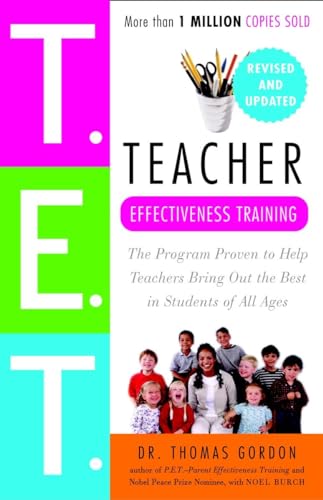
Teacher Effectiveness Training: The Program Proven to Help Teachers Bring Out the Best in Students of All Ages - Softcover
Inhaltsangabe
For nearly thirty years, Teacher Effectiveness Training, or the T.E.T. book, based on Dr. Thomas Gordon’s groundbreaking program, has taught hundreds of thousands of teachers around the world the skills they need to deal with the inevitable student discipline problems effectively and humanely.
Now revised and updated, T.E.T. can mean the difference between an unproductive, disruptive classroom and a cooperative, productive environment in which students flourish and teachers feel rewarded.
You will learn:
• What to do when students give you problems
• How to talk so that students will listen
• How to resolve conflicts so no one loses and no one gets hurt
• How to best help students when they’re having a problem
• How to set classroom rules so that far less enforcement is necessary
• How to increase teaching and learning time
Die Inhaltsangabe kann sich auf eine andere Ausgabe dieses Titels beziehen.
Über die Autorin bzw. den Autor
Dr. Thomas Gordon, a licensed clinical psychologist, has authored nine books, including Parent Effectiveness Training (P.E.T.) and Leader Effectiveness Training (L.E.T.). These books have sold more than six million copies worldwide. He was nominated for the Nobel Peace Prize three times and was a consultant to the White House Conference on Children. Dr. Gordon founded Gordon Training International (www.gordontraining.com), a human relations training organization with programs for parents, teachers, and businesspeople. Gordon Training International is based in Solana Beach, California, and has representatives in more than thirty countries around the world.
Von der hinteren Coverseite
For nearly thirty years, Teacher Effectiveness Training, or the T.E.T. book, based on Dr. Thomas Gordon's groundbreaking program, has taught hundreds of thousands of teachers around the world the skills they need to deal with the inevitable student discipline problems effectively and humanely.
Now revised and updated, T.E.T. can mean the difference between an unproductive, disruptive classroom and a cooperative, productive environment in which students flourish and teachers feel rewarded.
You will learn:
- What to do when students give you problems
- How to talk so that students will listen
- How to resolve conflicts so no one loses and no one gets hurt
- How to best help students when they're having a problem
- How to set classroom rules so that far less enforcement is necessary
- How to increase teaching and learning time
Aus dem Klappentext
For nearly thirty years, Teacher Effectiveness Training, or the T.E.T. book, based on Dr. Thomas Gordon s groundbreaking program, has taught hundreds of thousands of teachers around the world the skills they need to deal with the inevitable student discipline problems effectively and humanely.
Now revised and updated, T.E.T. can mean the difference between an unproductive, disruptive classroom and a cooperative, productive environment in which students flourish and teachers feel rewarded.
You will learn:
What to do when students give you problems
How to talk so that students will listen
How to resolve conflicts so no one loses and no one gets hurt
How to best help students when they re having a problem
How to set classroom rules so that far less enforcement is necessary
How to increase teaching and learning time
Auszug. © Genehmigter Nachdruck. Alle Rechte vorbehalten.
Teacher-Learner Relationships: The Missing Link
Teaching is a universal pursuit-everybody does it. Parents teach their children, employers teach their employees, coaches teach their players, wives teach their husbands (and vice versa), and, of course, professional teachers teach their students. This is a book about how teaching can become remarkably more effective than it usually is-about how it can bring more knowledge and maturity to learners while simultaneously cutting down on conflicts and creating more teaching time for teachers.
Although Teacher Effectiveness Training (T.E.T.) is a complete program for professionals, the methods and skills we offer here will increase the effectiveness of anyone who instructs.
Adults spend an amazing amount of time teaching young people. Some of that time is richly rewarding because helping children of any age learn new skills or acquire new insights is a joyous experience. It makes one feel good-as a parent, a teacher, or youth leader-to contribute to the growth of a child, to realize one has given something of oneself to enrich the life of another human being. It is exhilarating to watch a young person take from a teaching relationship something new that will expand his understanding of the world or add to his repertoire of skills.
But as everybody knows, teaching young people can also be terribly frustrating and fraught with disappointment. All too often, parents, teachers, and youth workers discover to their dismay that their enthusiastic desire to teach something worthwhile to young people somehow fails to engender an enthusiastic desire in their students to learn. Instead, those who endeavor to teach encounter stubborn resistance, low motivation, short attention spans, inexplicable disinterest, and often open hostility.
When young people, seemingly without reason, refuse to learn what adults are so unselfishly and altruistically willing to teach them, teaching is anything but exhilarating. In fact, it can be a miserable experience leading to feelings of inadequacy, hopelessness, sheer exasperation-and, too frequently, deep resentment toward the unwilling and ungrateful learner.
What makes the difference between teaching that works and teaching that fails, teaching that brings rewards and teaching that causes pain? Certainly, many different factors influence the outcome of one's efforts to teach another. But it is the thesis of this book that one factor contributes the most-namely, the degree of effectiveness of the teacher in establishing a particular kind of relationship with students.
It is the quality of the teacher-learner relationship that is crucial-more crucial, in fact, than what the teacher is teaching, how the teacher does it, or whom the teacher is trying to teach. How to achieve this effective quality is what this book is all about.
What's Crucial About the Teacher-Student Relationship
It is essential to zero in on the fact that teaching and learning are really two different functions-two separate and distinct processes. Not the least of the many differences between teaching and learning is that the process of teaching is carried out by one person while the process of learning goes on inside another. Obvious? Of course. But worth thinking about. Because if teaching-learning processes are to work effectively, a unique kind of relationship must exist between these two separate parties-some kind of a connection, link, or bridge between the teacher and the learner.
Much of this book therefore deals with the communication skills required by teachers to become effective in making those connections, creating those links, and building those bridges. These essential communication skills actually are not very complex—certainly not hard for any teacher to understand—although they require practice like any other skill, such as golf, skiing, singing, or playing a musical instrument. Nor do these critical communication skills place unusual demands on teachers to absorb vast amounts of knowledge about the "philosophy of education," "instructional methodologies," or "principles of child development."
On the contrary, the skills we shall describe and illustrate primarily involve talking-something most of us do very easily. Since talk can be destructive to human relationships as well as enhancing, talk can separate the teacher from students or move them closer together. Again, obvious. But again, worth further thought. For the effect that talk produces depends on the quality of the talk and on the teacher's selection of the most appropriate kind of talk for different kinds of situations.
Our instruction for teacher effectiveness, then, builds on top of elementary operations that teachers already perform every day. It is an additional set of skills, an extra sensitivity, an extra accomplishment.
Take praise as an example. Every teacher knows how to praise children. The teacher effectiveness training we offer builds from that point on. We will demonstrate how one kind of praising message will most likely cause students to feel terribly misunderstood and slyly manipulated, while a slightly different message has a high probability of making students see you as a person who is human and genuine, as well as a person who really cares.
Research-literally volumes of it-has shown how critical listening is in facilitating learning. Here again, every teacher, with a few unfortunate exceptions, is biologically equipped to listen and is well practiced in the act of listening to what kids communicate. Teachers do it every day. Yet what they think they hear is not necessarily what the learner is trying to communicate. Our kind of teacher effectiveness training will teach you a simple method by which you can check on the accuracy of your listening to make sure that what you hear is what the student really means. At the same time, it will prove to the student that you have not only heard him but have understood.
Parenthetically, we will also point out when it is very inappropriate to listen to kids. At certain times, when you are teaching them something in the classroom or at home and you find their behavior disruptive or unacceptable, the advice "Be a good listener" should be ignored. We will show you why at such times you must send your own strong message instead, confronting the children with how they are interfering with your rights-and we will demonstrate how you can send such a message with little risk of their feeling squelched, put down, or even defensive.
It seems necessary now to make an important disclaimer: This book is not about what teachers or parents should be teaching children and youth. That issue must be left to others far more experienced in designing curricula, formulating educational objectives, and making value judgments about what is important for young people to learn-at home and in school. In fact, opinions on such matters will vary from home to home, from school to school, and from one type of community to another.
Our training rests basically on the assumption that the quality of the teacher-learner relationship is crucial if teachers are to be effective in teaching anything-any kind of subject matter, any "content," any skills, any values or beliefs. History, math, English composition, literature, or chemistry-all can be made interesting and exciting to young people by a teacher who has learned how to create a relationship with students in which the needs of the teacher are respected by the students and the needs of the students are respected by the teacher.
Face it: even basketball, art, gymnastics, or sex education can be taught so that students are bored, turned off, and stubbornly resistant...
„Über diesen Titel“ kann sich auf eine andere Ausgabe dieses Titels beziehen.
Suchergebnisse für Teacher Effectiveness Training: The Program Proven...

Beispielbild für diese ISBN
Teacher Effectiveness Training: The Program Proven to Help Teachers Bring Out the Best in Students of All Ages
Anbieter: World of Books (was SecondSale), Montgomery, IL, USA
Verkäuferbewertung 5 von 5 Sternen

Paperback. Zustand: Very Good. For nearly thirty years, Teacher Effectiveness Training, or the T.E.T. book, based on Dr. Thomas Gordon's groundbreaking program, has taught hundreds of thousands of teachers around the world the skills they need to deal with the inevitable student discipline problems effectively and humanely. Now revised and updated, T.E.T. can mean the difference between an unproductive, disruptive classroom and a cooperative, productive environment in which students flourish and teachers feel rewarded. You will learn: * What to do when students give you problems * How to talk so that students will listen * How to resolve conflicts so no one loses and no one gets hurt * How to best help students when they're having a problem * How to set classroom rules so that far less enforcement is necessary * How to increase teaching and learning time. Artikel-Nr. 00106683485
Gebraucht kaufen
EUR 4,05
Versand gratis
Versand innerhalb von USA
Versand innerhalb von USA
Anzahl: 3 verfügbar
Beispielbild für diese ISBN
Teacher Effectiveness Training: The Program Proven to Help Teachers Bring Out the Best in Students of All Ages
Anbieter: World of Books (was SecondSale), Montgomery, IL, USA
Verkäuferbewertung 5 von 5 Sternen
Paperback. Zustand: Good. For nearly thirty years, Teacher Effectiveness Training, or the T.E.T. book, based on Dr. Thomas Gordon's groundbreaking program, has taught hundreds of thousands of teachers around the world the skills they need to deal with the inevitable student discipline problems effectively and humanely. Now revised and updated, T.E.T. can mean the difference between an unproductive, disruptive classroom and a cooperative, productive environment in which students flourish and teachers feel rewarded. You will learn: * What to do when students give you problems * How to talk so that students will listen * How to resolve conflicts so no one loses and no one gets hurt * How to best help students when they're having a problem * How to set classroom rules so that far less enforcement is necessary * How to increase teaching and learning time. Artikel-Nr. 00103451127
Gebraucht kaufen
EUR 4,05
Versand gratis
Versand innerhalb von USA
Versand innerhalb von USA
Anzahl: 4 verfügbar
Beispielbild für diese ISBN
Teacher Effectiveness Training: The Program Proven to Help Teachers Bring Out the Best in Students of All Ages
Anbieter: World of Books (was SecondSale), Montgomery, IL, USA
Verkäuferbewertung 5 von 5 Sternen
Paperback. Zustand: Fair. For nearly thirty years, Teacher Effectiveness Training, or the T.E.T. book, based on Dr. Thomas Gordon's groundbreaking program, has taught hundreds of thousands of teachers around the world the skills they need to deal with the inevitable student discipline problems effectively and humanely. Now revised and updated, T.E.T. can mean the difference between an unproductive, disruptive classroom and a cooperative, productive environment in which students flourish and teachers feel rewarded. You will learn: * What to do when students give you problems * How to talk so that students will listen * How to resolve conflicts so no one loses and no one gets hurt * How to best help students when they're having a problem * How to set classroom rules so that far less enforcement is necessary * How to increase teaching and learning time. Artikel-Nr. CIN0609809326A
Gebraucht kaufen
EUR 4,05
Versand gratis
Versand innerhalb von USA
Versand innerhalb von USA
Anzahl: 1 verfügbar
Beispielbild für diese ISBN
Teacher Effectiveness Training : The Program Proven to Help Teachers Bring Out the Best in Students of All Ages
Verlag:
Crown Publishing Group, The, 2003
ISBN 10: 0609809326
ISBN 13: 9780609809327
Gebraucht
Softcover
Anbieter: Better World Books, Mishawaka, IN, USA
Verkäuferbewertung 5 von 5 Sternen
Zustand: Good. rev Edition. Former library copy. Pages intact with minimal writing/highlighting. The binding may be loose and creased. Dust jackets/supplements are not included. Includes library markings. Stock photo provided. Product includes identifying sticker. Better World Books: Buy Books. Do Good. Artikel-Nr. 5311574-6
Gebraucht kaufen
EUR 6,18
Versand gratis
Versand innerhalb von USA
Versand innerhalb von USA
Anzahl: 1 verfügbar
Beispielbild für diese ISBN
Teacher Effectiveness Training : The Program Proven to Help Teachers Bring Out the Best in Students of All Ages
Verlag:
Crown Publishing Group, The, 2003
ISBN 10: 0609809326
ISBN 13: 9780609809327
Gebraucht
Softcover
Anbieter: Better World Books, Mishawaka, IN, USA
Verkäuferbewertung 5 von 5 Sternen
Zustand: Good. rev Edition. Pages intact with minimal writing/highlighting. The binding may be loose and creased. Dust jackets/supplements are not included. Stock photo provided. Product includes identifying sticker. Better World Books: Buy Books. Do Good. Artikel-Nr. 4287862-6
Gebraucht kaufen
EUR 6,18
Versand gratis
Versand innerhalb von USA
Versand innerhalb von USA
Anzahl: 1 verfügbar
Beispielbild für diese ISBN
Teacher Effectiveness Training : The Program Proven to Help Teachers Bring Out the Best in Students of All Ages
Verlag:
Crown Publishing Group, The, 2003
ISBN 10: 0609809326
ISBN 13: 9780609809327
Gebraucht
Softcover
Anbieter: Better World Books: West, Reno, NV, USA
Verkäuferbewertung 5 von 5 Sternen
Zustand: Good. rev Edition. Former library copy. Pages intact with minimal writing/highlighting. The binding may be loose and creased. Dust jackets/supplements are not included. Includes library markings. Stock photo provided. Product includes identifying sticker. Better World Books: Buy Books. Do Good. Artikel-Nr. 5311574-6
Gebraucht kaufen
EUR 6,18
Versand gratis
Versand innerhalb von USA
Versand innerhalb von USA
Anzahl: 1 verfügbar
Beispielbild für diese ISBN
Teacher Effectiveness Training: The Program Proven to Help Teachers Bring Out the Best in Students of All Ages
Verlag:
Crown Publishing Group (NY), 2003
ISBN 10: 0609809326
ISBN 13: 9780609809327
Gebraucht
Paperback
Anbieter: ThriftBooks-Atlanta, AUSTELL, GA, USA
Verkäuferbewertung 5 von 5 Sternen
Paperback. Zustand: Very Good. No Jacket. May have limited writing in cover pages. Pages are unmarked. ~ ThriftBooks: Read More, Spend Less. Artikel-Nr. G0609809326I4N00
Gebraucht kaufen
EUR 8,69
Versand gratis
Versand innerhalb von USA
Versand innerhalb von USA
Anzahl: 1 verfügbar
Beispielbild für diese ISBN
Teacher Effectiveness Training: The Program Proven to Help Teachers Bring Out the Best in Students of All Ages
Anbieter: WorldofBooks, Goring-By-Sea, WS, Vereinigtes Königreich
Verkäuferbewertung 5 von 5 Sternen
Paperback. Zustand: Very Good. The book has been read, but is in excellent condition. Pages are intact and not marred by notes or highlighting. The spine remains undamaged. Artikel-Nr. GOR003520718
Gebraucht kaufen
EUR 12,97
EUR 6,63 Versand
Versand von Vereinigtes Königreich nach USA
Versand von Vereinigtes Königreich nach USA
Anzahl: 4 verfügbar
Beispielbild für diese ISBN
Teacher Effectiveness Training: The Program Proven to Help Teachers Bring Out the Best in Students of All Ages
Verlag:
Crown Publishing Group (NY), 2003
ISBN 10: 0609809326
ISBN 13: 9780609809327
Gebraucht
paperback
Anbieter: Sell Books, Elland, YORKS, Vereinigtes Königreich
Verkäuferbewertung 5 von 5 Sternen
paperback. Zustand: Acceptable. Please see the condition note after this for details, if this is missing please consider Acceptable to mean poor quality that could include major staining, water damage, writing, missing dustjacket, etc etc. Our books are dispatched from a Yorkshire former cotton mill. We list via barcode/ISBN so please note that the images are stock images and may not be the exact copy you receive, furthermore the details about edition and year might not be accurate as many publishers reuse the same ISBN for multiple editions and as we simply scan a barcode or enter an ISBN we do not check the validity of the edition data when listing. If you're looking for an exact edition please don't order (at least not without checking with us first, although we don't always have time to check). We aim to dispatch prompty, the service used will depend on order value and book size. We can ship to most countries, see our shipping policies. Payment is via Abe only. Artikel-Nr. SBAB-mon0000061608
Gebraucht kaufen
EUR 13,76
EUR 9,18 Versand
Versand von Vereinigtes Königreich nach USA
Versand von Vereinigtes Königreich nach USA
Anzahl: 2 verfügbar
Beispielbild für diese ISBN
Teacher Effectiveness Training: The Program Proven to Help Teachers Bring Out the Best in Students of All Ages
Anbieter: medimops, Berlin, Deutschland
Verkäuferbewertung 5 von 5 Sternen
Zustand: good. Befriedigend/Good: Durchschnittlich erhaltenes Buch bzw. Schutzumschlag mit Gebrauchsspuren, aber vollständigen Seiten. / Describes the average WORN book or dust jacket that has all the pages present. Artikel-Nr. M00609809326-G
Gebraucht kaufen
EUR 17,44
EUR 10,00 Versand
Versand von Deutschland nach USA
Versand von Deutschland nach USA
Anzahl: 1 verfügbar