
Verwandte Artikel zu Invisible Frontier: Exploring the Tunnels, Ruins, and...
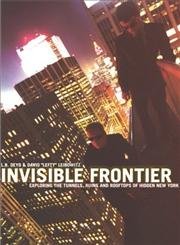
Invisible Frontier: Exploring the Tunnels, Ruins, and Rooftops of Hidden New York: The Jinx Book of Urban Exploration - Softcover
Inhaltsangabe
An adventure-filled guide to New York City's hidden secrets explores a vast urban wilderness that includes subway tunnels, the sewer system, abandoned aqueducts and buildings, the heights of its bridges, and other unusual landmarks. Original. 15,000 first printing.
Die Inhaltsangabe kann sich auf eine andere Ausgabe dieses Titels beziehen.
Über die Autorin bzw. den Autor
L. B. Deyo and David “Lefty” Leibowitz are the founders of Jinx: The Magazine of Global Urban Adventure(www.jinxmagazine.com). They live in New York City.
Aus dem Klappentext
ws of the city waits an invisible frontier a wilderness thriving in the deep places, woven through dead storm drains and live subway tunnels, coursing over third rails. This frontier waits in the walls of abandoned tenements, hides on the rooftops, infiltrates the bridges steel. It s a no-man s-land, fenced off with razor wire, marked by warning signs, persisting in shadow, hidden everywhere as a parallel dimension. Crowds hurry through the bright streets, insulated by pavement, never reflecting that beneath their feet or above their heads lurks a universe.
Led by its two founding agents, L. B. Deyo and David Lefty Leibowitz, Jinx is a stylish urban adventure out?t known for its daring if sometimes ridiculous forays into the hidden wonders that lurk above and beneath America s greatest city, New York. In Invisible Frontier L. B. and Lefty chronicle Jinx s dramatic if sometimes absurd exploration of a Dante-esque Ne
Auszug. © Genehmigter Nachdruck. Alle Rechte vorbehalten.
LEVIATHAN: THE CROTON AQUEDUCT
Mission: Croton Aqueduct, early summer 2001
Location: The Bronx
Goal: To walk to Manhattan from the Bronx, underground
Officers: Lefty Leibowitz, L. B. Deyo
Team: Gage, Special Agent Renée, Agent Bleach, Thiago El Rojo, Brazen, Nick Science, Salamander X
reported by t
L. B. Deyo
And as I stared through that obscurity,
I saw what seemed a cluster of great towers,
whereat I cried, "Master, what is this city?"
—Dante, The Inferno
In the shadows of the city waits an invisible frontier-a wilderness, thriving in the deep places, woven through dead storm drains and live subway tunnels, coursing over third rails. This frontier waits in the walls of abandoned tenements, it hides on the rooftops, and it infiltrates the bridges' steel. It's a no-man's-land, fenced off with razor wire, marked by warning signs, persisting in shadow, hidden everywhere as a parallel dimension. Crowds hurry through the bright streets, insulated by the pavement, never reflecting that beneath their feet lurks a universe.
EXPELLED
From the sidewalk, I hobble into fluorescent glare. Muscle spasms strum across my back; tendons snag like they're caught in a zipper. It's two a.m. I'm in a Twin Donut in the Bronx.
I raise a forearm to shield my eyes from the fluorescent lights, grab a chair, and sit. Seven agents follow me into the shop, back to the land of the living. Nobody smiles.
"Nick," I call out. "Who invented these lights? Fluorescent lights?"
Nick takes his place in the doughnut line, looking like I feel, splattered mud drying on his glasses. "Fluorescent lights." He nods, screwing in his face. "Tesla invented them. Nikola Tesla."
"Nikola Tesla." I slump toward the floor. My tie's too tight, strangling me, but I can't get it loose. I'm shivering. Sweat beads on my forehead, with the grime. "Damn the son of a bitch. Nikola Tesla. Tinkering bastard." I can't sit still, can't even bend my legs. I get up and take a place in line.
Pain forks through me, forcing my eyes shut. Visions burst across my eyelids, hypnagogic phantoms like the ones you see when you're trying to fall asleep. I see tunnels diminishing to blackness.
I open my eyes and only then do I notice the customers aren't eating. It's late, and there aren't many people here besides us, maybe eight or nine seated throughout. Every one of them is frozen, open-mouthed, staring at us.
"Excuse me," a woman says. She's having a cigarette, sitting with her friend at the table next to me. She's a little drunk, a little bleary-eyed, but she seems all right.
"Yes?"
"Do you mind if I ask"-the woman leans in slightly and blinks twice-"what you all been doing?"
Fair question. Here are eight agents fresh from the trenches, in a North Bronx Twin Donut Shop, wearing sunglasses at two in the morning on Puerto Rican Day. The men wear suits and ties; the two women wear cocktail dresses. Several of us have miners' helmets or headlamps. We're encrusted with mud and crystalline mineral deposits, and our shoes have lately been underwater.
"We were exploring the Old Croton Aqueduct," I tell her, "the original New York water supply line. It runs right beneath here."
"For real?" She squints. "You all look like a bunch of lawyers."
THE BODY
For by art is created that great LEVIATHAN called a COMMONWEALTH, or STATE (in Latin, CIVITAS), which is but an artificial man, though of greater stature and strength than the natural, for whose protection and defense it was intended; and in which the sovereignty is an artificial soul, as giving life and motion to the whole body.
—Thomas Hobbes, Leviathan
Social structures form at every level of scale, from the country village to the multinational corporation, from the conversation in a doughnut shop to the transcontinental alliance. Of all these structures, none is fitter, more adaptive, than the city.
It's a macrocosm of the human body, living through its anatomical processes. Its immune system attacks infection through police and emergency workers. Its circulatory system pumps goods throughout the marketplace in huge arteries; these fan out in every direction, branching into finer vessels and capillaries. The nerves of the city pulse with signals, animating, electrifying, communicating, and uniting millions of differentiated cells into an organism. As in a human, these systems are mostly automatic. Without the direction of a central executive, the city breathes and sweats, consumes and excretes.
Nikola Tesla understood that a place can be a living thing. Tesla was the inventor of the Tesla coil, an amplifier of electrical charge. With the Tesla coil he ionized the very air into a conductor, closing the circuit of a current to a slingshot loop, ramping up the voltage by a thousand times, which manifested itself in the slithering arc seen in Frankenstein laboratories. In 1899 Tesla built his largest coil, atop a two-hundred-foot tower, in the skies of Pikes Peak, Colorado. The Jovian engine came alive, hurling lightning bolts in every direction. It inspired the RKO Pictures logo and blacked out the city of Colorado Springs.
For months before he built the tower, Tesla spent his hours measuring the summit's inherent charge. He concluded that the earth itself was "literally alive with electrical vibrations." The tower's genius was to tap into
the conductivity of the mountain. Rather than generate power, Tesla's tower would derive it as an antenna receives its radio signal, passively accepting the system's energy. The result was the greatest electrical discharge yet harnessed by man, and it split the night sky.
Few modern cities benefit from Tesla's wisdom. In design, they squander natural vitality. Today's urban planners, impatient with growth and infatuated by theories, impose the limits of their own imaginations. They build soulless, congenitally defective abominations: Los Angeles; Phoenix; Houston; Toronto; Celebration, U.S.A. Failed experiments, bereft of life.
On the other hand, there is New York. The Empire City was designed as a simple grid, ensuring long vistas and fluid movement. As the blueprint came to life, and construction proceeded up the island, the grid worked as the lattices of a fence, allowing wild growth of vines and ivy through a loose and simple matrix. Like the interlocking pattern of Tesla's tower, the grid plan bridged the gap between the artificial order and natural chaos, shaping and focusing an explosion of energy. Over the centuries, the city has evolved into a New World Leviathan. Operation C-1609 would be Jinx's journey through the living body of New York.
The plan was laid out as a list of targets, each a badlands outpost, each offering its own empirical promise. We would proceed upward from the depths, from the intestine labyrinths of the aqueducts and subway lines, through condemned buildings and landmarks, up into the bridges and rooftops until we reached the top of the antenna on One World Trade Center, at more than 1,726 feet the closest place to heaven in New York.
For the first mission of our operation, Jinx set out to probe the city's guts, marching down into the mouth of New York. In the geometry of the tunnels we sought an evolutionary snapshot, a fossil record in progress. The goal was to explore as much of New York's water intake and drainage as we could without drowning. As water moves through the five boroughs, it mostly runs in prohibitively cramped steel pipes. To get our feet wet, we'd want the aqueducts that bring fresh water from up north, tunnels you could drive a car through. We picked the
Old Croton Aqueduct...
„Über diesen Titel“ kann sich auf eine andere Ausgabe dieses Titels beziehen.
Suchergebnisse für Invisible Frontier: Exploring the Tunnels, Ruins, and...

Beispielbild für diese ISBN
Invisible Frontier: The Jinx Book of Urban Exploration
Anbieter: World of Books (was SecondSale), Montgomery, IL, USA
Verkäuferbewertung 5 von 5 Sternen

Paperback. Zustand: Good. From the leaders in the burgeoning urban adventure scene, Jinx magazine, comes this extreme tour of New York City's unseen places - from its sewers and subway tunnels to the pinnacles of its bridges. From abandoned hospitals to epic graffiti murals to the roof of Grand Central Station and the enormous towers of the George Washington Bridge, Invisible Frontier offers a series of gripping true adventure stories and a fascinating trip through the seldom-chronicled aspects of a great city's history, technology and culture. Artikel-Nr. 00102039451
Gebraucht kaufen
EUR 4,81
Versand gratis
Versand innerhalb von USA
Versand innerhalb von USA
Anzahl: 2 verfügbar
Beispielbild für diese ISBN
Invisible Frontier: Exploring the Tunnels, Ruins, and Rooftops of Hidden New York
Verlag:
Three Rivers Press (edition 1), 2003
ISBN 10: 0609809318
ISBN 13: 9780609809310
Gebraucht
Paperback
Anbieter: BooksRun, Philadelphia, PA, USA
Verkäuferbewertung 5 von 5 Sternen
Paperback. Zustand: Very Good. 1. It's a well-cared-for item that has seen limited use. The item may show minor signs of wear. All the text is legible, with all pages included. It may have slight markings and/or highlighting. Artikel-Nr. 0609809318-11-1
Gebraucht kaufen
EUR 4,81
Versand gratis
Versand innerhalb von USA
Versand innerhalb von USA
Anzahl: 1 verfügbar
Beispielbild für diese ISBN
Invisible Frontier: Exploring the Tunnels, Ruins, and Rooftops of Hidden New York
Anbieter: Wonder Book, Frederick, MD, USA
Verkäuferbewertung 5 von 5 Sternen
Zustand: Very Good. Very Good condition. A copy that may have a few cosmetic defects. May also contain light spine creasing or a few markings such as an owner's name, short gifter's inscription or light stamp. Artikel-Nr. V14C-04227
Gebraucht kaufen
EUR 6,42
Versand gratis
Versand innerhalb von USA
Versand innerhalb von USA
Anzahl: 1 verfügbar
Beispielbild für diese ISBN
Invisible Frontier : Exploring the Tunnels, Ruins, and Rooftops of Hidden New York
Verlag:
Crown/Archetype, 2003
ISBN 10: 0609809318
ISBN 13: 9780609809310
Gebraucht
Softcover
Erstausgabe
Anbieter: Better World Books, Mishawaka, IN, USA
Verkäuferbewertung 5 von 5 Sternen
Zustand: Good. 1st Edition. Pages intact with minimal writing/highlighting. The binding may be loose and creased. Dust jackets/supplements are not included. Stock photo provided. Product includes identifying sticker. Better World Books: Buy Books. Do Good. Artikel-Nr. 13140752-75
Gebraucht kaufen
EUR 6,56
Versand gratis
Versand innerhalb von USA
Versand innerhalb von USA
Anzahl: 2 verfügbar
Beispielbild für diese ISBN
Invisible Frontier : Exploring the Tunnels, Ruins, and Rooftops of Hidden New York
Verlag:
Crown/Archetype, 2003
ISBN 10: 0609809318
ISBN 13: 9780609809310
Gebraucht
Softcover
Erstausgabe
Anbieter: Better World Books, Mishawaka, IN, USA
Verkäuferbewertung 5 von 5 Sternen
Zustand: Good. 1st Edition. Former library copy. Pages intact with minimal writing/highlighting. The binding may be loose and creased. Dust jackets/supplements are not included. Includes library markings. Stock photo provided. Product includes identifying sticker. Better World Books: Buy Books. Do Good. Artikel-Nr. 686831-6
Gebraucht kaufen
EUR 6,56
Versand gratis
Versand innerhalb von USA
Versand innerhalb von USA
Anzahl: 2 verfügbar
Beispielbild für diese ISBN
Invisible Frontier: Exploring the Tunnels, Ruins, and Rooftops of Hidden New York
Anbieter: ThriftBooks-Dallas, Dallas, TX, USA
Verkäuferbewertung 5 von 5 Sternen
Paperback. Zustand: Very Good. No Jacket. May have limited writing in cover pages. Pages are unmarked. ~ ThriftBooks: Read More, Spend Less. Artikel-Nr. G0609809318I4N00
Gebraucht kaufen
EUR 6,80
Versand gratis
Versand innerhalb von USA
Versand innerhalb von USA
Anzahl: 1 verfügbar
Beispielbild für diese ISBN
Invisible Frontier: Exploring the Tunnels, Ruins, and Rooftops of Hidden New York
Anbieter: ThriftBooks-Atlanta, AUSTELL, GA, USA
Verkäuferbewertung 5 von 5 Sternen
Paperback. Zustand: Very Good. No Jacket. May have limited writing in cover pages. Pages are unmarked. ~ ThriftBooks: Read More, Spend Less. Artikel-Nr. G0609809318I4N00
Gebraucht kaufen
EUR 6,80
Versand gratis
Versand innerhalb von USA
Versand innerhalb von USA
Anzahl: 1 verfügbar
Foto des Verkäufers
Invisible Frontier: The Jinx Book of Urban Exploration
Anbieter: WeBuyBooks, Rossendale, LANCS, Vereinigtes Königreich
Verkäuferbewertung 5 von 5 Sternen
paperback. Zustand: Very Good. Most items will be dispatched the same or the next working day. A copy that has been read, but is in excellent condition. Pages are intact and not marred by notes or highlighting. The spine remains undamaged. Artikel-Nr. rev4699068189
Gebraucht kaufen
EUR 2,31
EUR 6,02 Versand
Versand von Vereinigtes Königreich nach USA
Versand von Vereinigtes Königreich nach USA
Anzahl: 1 verfügbar
Beispielbild für diese ISBN
Invisible Frontier: The Jinx Book of Urban Exploration
Anbieter: WorldofBooks, Goring-By-Sea, WS, Vereinigtes Königreich
Verkäuferbewertung 5 von 5 Sternen
Paperback. Zustand: Very Good. The book has been read, but is in excellent condition. Pages are intact and not marred by notes or highlighting. The spine remains undamaged. Artikel-Nr. GOR002033200
Gebraucht kaufen
EUR 2,91
EUR 6,60 Versand
Versand von Vereinigtes Königreich nach USA
Versand von Vereinigtes Königreich nach USA
Anzahl: 1 verfügbar
Beispielbild für diese ISBN
Invisible Frontier: Exploring the Tunnels, Ruins, and Rooftops of Hidden New York: The Jinx Book of Urban Exploration
Anbieter: medimops, Berlin, Deutschland
Verkäuferbewertung 5 von 5 Sternen
Zustand: good. Befriedigend/Good: Durchschnittlich erhaltenes Buch bzw. Schutzumschlag mit Gebrauchsspuren, aber vollständigen Seiten. / Describes the average WORN book or dust jacket that has all the pages present. Artikel-Nr. M00609809318-G
Gebraucht kaufen
EUR 4,50
EUR 10,00 Versand
Versand von Deutschland nach USA
Versand von Deutschland nach USA
Anzahl: 1 verfügbar