
Verwandte Artikel zu Parent Effectiveness Training: The Proven Program for...
Inhaltsangabe
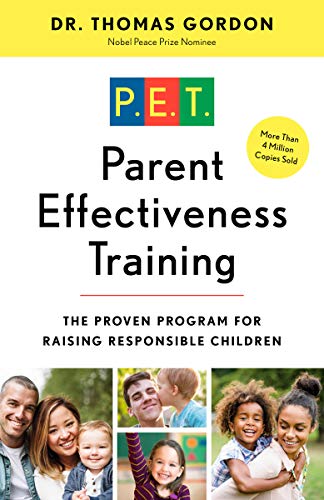
UPDATED 2019 EDITION • The pioneering book that’s guided millions of parents to more effectively resolve conflicts, communicate, and create loving relationships with their children—from Nobel Peace Prize nominee Dr. Thomas Gordon
P.E.T., or Parent Effectiveness Training, began in 1962 as the first national parent-training program to teach parents how to communicate more effectively with kids and offer step-by-step advice to resolve family conflicts so everybody wins. This beloved classic is the most studied, highly praised, and proven parenting program in the world—and it will work for you. Now revised and updated, this groundbreaking guide will show you:
• How to avoid being a permissive parent
• How to listen so kids will talk to you and talk so kids will listen to you
• How to teach your children to “own” their problems and to solve them
• How to apply the “No Lose” method to resolve conflicts
Using the timeless methods of P.E.T. will have immediate results: less fighting, fewer tantrums and lies, no need for punishment. Whether you have a toddler striking out for independence or a teenager who has already started rebelling, you’ll find P.E.T. a compassionate, effective way to instill responsibility and create a nurturing family environment in which your child will thrive.
Die Inhaltsangabe kann sich auf eine andere Ausgabe dieses Titels beziehen.
Über die Autorin bzw. den Autor
Dr. Thomas Gordon, a licensed psychologist, was the recipient of the 1999 American Psychological Foundation’s Gold Medal Award for Enduring Contribution to Psychology, the 2000 Lifetime Achievement Award from the California State Psychological Association, and the first recipient of the Career Achievement Award from the National Parenting Instructors Association. He was a consultant to the White House Conference on Children and the White House Fellows. Dr. Gordon was the author of eight books, including Leader Effectiveness Training (L.E.T.) and Teacher Effectiveness Training (T.E.T.). He was also nominated three times for the Nobel Peace Prize.
Von der hinteren Coverseite
lt;b>Parent Effectiveness Training, began almost forty years ago as the first national parent-training program to teach parents how to communicate more effectively with kids and offer step-by-step advice to resolving family conflicts so everybody wins. This beloved classic is the most studied, highly praised, and proven parenting program in the world -- and it will work for you. Now revised for the first time since its initial publication, this groundbreaking guide will show you:
How to avoid being a permissive parent
How to listen so kids will talk to you and talk so kids will listen to you
How to teach your children to "own" their problems and to solve them
How to use the "No-Lose" method to resolve conflicts
Using the timeless methods of P.E.T. will have immediate results: less fighting, fewer tantrums and lies, no need for punishment. Whether you have a toddler striking out fo
Aus dem Klappentext
lt;b>Parent Effectiveness Training, began almost forty years ago as the first national parent-training program to teach parents how to communicate more effectively with kids and offer step-by-step advice to resolving family conflicts so everybody wins. This beloved classic is the most studied, highly praised, and proven parenting program in the world -- and it will work for you. Now revised for the first time since its initial publication, this groundbreaking guide will show you:
How to avoid being a permissive parent
How to listen so kids will talk to you and talk so kids will listen to you
How to teach your children to "own" their problems and to solve them
How to use the "No-Lose" method to resolve conflicts
Using the timeless methods of P.E.T. will have immediate results: less fighting, fewer tantrums and lies, no need for punishment. Whether you have a toddler striking out fo
Auszug. © Genehmigter Nachdruck. Alle Rechte vorbehalten.
P.E.T. will be described in terms familiar to everyone, not in technical jargon. Some parents may find themselves initially disagreeing with some of these concepts, but very few will find themselves not understanding them.
Since readers will not be able to express their concerns face-to-face with an instructor, here are some questions and answers that may be helpful at the start.
question: Is this another permissive approach to raising children?
answer: Definitely not. Permissive parents get into as much trouble as overly strict parents, for their kids often turn out to be selfish, unmanageable, uncooperative, and inconsiderate of the needs of their parents.
question: Can one parent use this new approach effectively if the other sticks to the old approach?
answer: Yes and no. If only one parent starts to use this new approach, there will be a definite improvement in the relationship between that parent and the children. But the relationship between the other parent and the children may get worse. Far better then, for both parents to learn the new methods. Furthermore, when both parents try to learn this new approach together, they can help each other a great deal.
question: Will parents lose their influence over the children with this new approach? Will they abdicate the responsibility to give guidance and direction to their childrens' lives?
answer: As parents read the first chapters, they may get this impression. A book can only present a system step by step. The early chapters deal with ways to help children find their own solutions to problems they encounter. In these situations, the role of an effective parent will seem different--much more passive or "nondirective" than parents are accustomed to. Later chapters, however, deal with how to modify unacceptable behavior of children and how to influence them to be considerate of your needs as parents. In these situations, you will be shown specific ways of being an even more responsible parent--acquiring even more influence than you have now. It might be helpful to check the Table of Contents for the subjects covered in later chapters.
This book teaches parents a rather easy-to-learn method of encouraging kids to accept responsibility for finding their own solutions to their own problems, and illustrates how parents can put that method to work right away in the home. Parents who learn this method (called Active Listening) may experience what P.E.T.-trained parents have described:
"It's such a relief not to think I have to have all the answers to my children's problems."
"P.E.T. has made me have a much greater appreciation of the capacities of my children for solving their own problems."
"I was amazed at how the Active Listening method worked. My kids come up with solutions to their problems that are often far better than any I could have given them."
"I guess I've always been very uncomfortable about playing the role of God--feeling that I should be knowing what my kids should do when they have problems."
Today, thousands of adolescents have fired their parents, and for good reason as far as the kids are concerned.
"My mom doesn't understand kids my age."
"I just hate to go home and get lectured to every night."
"I never tell my parents anything; if I did they wouldn't understand."
"I wish my dad would get off my back."
"As soon as I can, I'm going to leave home--I can't stand their constantly hassling me about everything."
The parents of these kids are usually well aware of having lost their jobs, as evidenced by these statements made in our P.E.T. classes:
"I have absolutely no more influence over my sixteen-year-old boy."
"We've given up with Annie."
"Ricky won't ever eat with us, and he hardly ever says a word to us. Now he wants a room out in the garage."
"Mark is never home. And he'll never tell me where he goes or what he's doing. If I ever ask him, he tells me it's none of my business."
To me it is a tragedy that one of the potentially most intimate and satisfying relationships in life so often creates bad blood. Why do so many adolescents come to see their parents as "the enemy"? Why is there such a rift between parents and children? Why are parents and youth in our society literally at war with each other?
Chapter 14 will deal with these questions and show why it is unnecessary for kids to rebel and revolt against their parents. P.E.T. is revolutionary, yes, but not a method that invites revolution. Rather, it is a method that can help parents avoid being fired, can prevent war in the home, and bring parents and children closer rather than grouped against each other as hostile antagonists.
Parents who at first may be inclined to reject our methods as too revolutionary may find the motivation to study them with an open mind by reading the following excerpt from a history submitted by a mother and father after they had taken P.E.T.
"Bill, at sixteen, was our greatest problem. He was estranged. He was running wild and was completely irresponsible. He was getting his first D's and F's in school. He never came home at the agreed times, offering as excuses flat tires, broken watches, and empty gas tanks. We spied on him, he lied to us. We grounded him. We took away his license. We docked his allowance. Our conversations were full of recriminations. All to no avail. After one violent argument, he lay on the kitchen floor and kicked and screamed and shouted that he was going crazy. At that point we enrolled in Dr. Gordon's class for parents. Change did not come overnight . . . We never had felt like a unit, a warm and loving, deeply caring, family. This only came about after great changes in our attitudes and values. . . . This new idea of being a person--a strong, separate per- son, expressing his own values but not forcing them on another, but being a good model--this was the turning point. We had much greater influence. . . . From rebellion and fits of rage, from failure in school, Bill changed to an open, friendly, loving person who calls his parents 'two of my favorite people.' . . . He is finally back in the family. . . . I have a relationship with him I never believed possible, full of love and trust and independence. He is strongly internally motivated and, when each one of us is also, we really live and grow as a family."
Parents who learn to use our new ways of communicating their feelings are not likely to produce a child like the sixteen-year-old boy who sat in my office and announced with a straight face:
"I don't have to do anything around the house. Why should I? It's my parents' job to take care of me. They are legally required to. I didn't ask to be born, did I?"
When I heard what this young man said and obviously believed, I could not help but think, "What kind of persons are we producing if children are permitted to grow up with the attitude that the world owes them so much even though they give back so little? What kind of citizen are parents sending out into the world? What kind of society will these selfish human beings make?"
Almost without exception parents can be categorized roughly into three groups--the "winners," the "losers," and the "oscillators." Parents in the first group strongly defend and persuasively justify their right to exercise authority or power over the child. They believe in restricting, setting limits, demanding certain behaviors, giving commands, and expecting obedience. They use threats of punishment to influence the child to obey, and mete out punishments when he does not. When conflict arises...
„Über diesen Titel“ kann sich auf eine andere Ausgabe dieses Titels beziehen.
Suchergebnisse für Parent Effectiveness Training: The Proven Program for...

Beispielbild für diese ISBN
Parent Effectiveness Training: The Proven Program for Raising Responsible Children
Anbieter: World of Books (was SecondSale), Montgomery, IL, USA
Verkäuferbewertung 5 von 5 Sternen

Paperback. Zustand: Fair. UPDATED 2019 EDITION * The pioneering book that's guided millions of parents to more effectively resolve conflicts, communicate, and create loving relationships with their children--from Nobel Peace Prize nominee Dr. Thomas Gordon P.E.T., or Parent Effectiveness Training, began in 1962 as the first national parent-training program to teach parents how to communicate more effectively with kids and offer step-by-step advice to resolve family conflicts so everybody wins. This beloved classic is the most studied, highly praised, and proven parenting program in the world--and it will work for you. Now revised and updated, this groundbreaking guide will show you: * How to avoid being a permissive parent * How to listen so kids will talk to you and talk so kids will listen to you * How to teach your children to "own" their problems and to solve them * How to apply the "No Lose" method to resolve conflicts Using the timeless methods of P.E.T. will have immediate results: less fighting, fewer tantrums and lies, no need for punishment. Whether you have a toddler striking out for independence or a teenager who has already started rebelling, you'll find P.E.T. a compassionate, effective way to instill responsibility and create a nurturing family environment in which your child will thrive. Artikel-Nr. 00103749695
Gebraucht kaufen
EUR 3,72
Versand gratis
Versand innerhalb von USA
Versand innerhalb von USA
Anzahl: 7 verfügbar
Beispielbild für diese ISBN
Parent Effectiveness Training: The Proven Program for Raising Responsible Children
Anbieter: World of Books (was SecondSale), Montgomery, IL, USA
Verkäuferbewertung 5 von 5 Sternen
Paperback. Zustand: Good. UPDATED 2019 EDITION * The pioneering book that's guided millions of parents to more effectively resolve conflicts, communicate, and create loving relationships with their children--from Nobel Peace Prize nominee Dr. Thomas Gordon P.E.T., or Parent Effectiveness Training, began in 1962 as the first national parent-training program to teach parents how to communicate more effectively with kids and offer step-by-step advice to resolve family conflicts so everybody wins. This beloved classic is the most studied, highly praised, and proven parenting program in the world--and it will work for you. Now revised and updated, this groundbreaking guide will show you: * How to avoid being a permissive parent * How to listen so kids will talk to you and talk so kids will listen to you * How to teach your children to "own" their problems and to solve them * How to apply the "No Lose" method to resolve conflicts Using the timeless methods of P.E.T. will have immediate results: less fighting, fewer tantrums and lies, no need for punishment. Whether you have a toddler striking out for independence or a teenager who has already started rebelling, you'll find P.E.T. a compassionate, effective way to instill responsibility and create a nurturing family environment in which your child will thrive. Artikel-Nr. 00085197031
Gebraucht kaufen
EUR 3,72
Versand gratis
Versand innerhalb von USA
Versand innerhalb von USA
Anzahl: Mehr als 20 verfügbar
Beispielbild für diese ISBN
Parent Effectiveness Training: The Proven Program for Raising Responsible Children
Anbieter: BooksRun, Philadelphia, PA, USA
Verkäuferbewertung 5 von 5 Sternen
Paperback. Zustand: Very Good. It's a well-cared-for item that has seen limited use. The item may show minor signs of wear. All the text is legible, with all pages included. It may have slight markings and/or highlighting. Artikel-Nr. 0609806939-11-18
Gebraucht kaufen
EUR 4,88
Versand gratis
Versand innerhalb von USA
Versand innerhalb von USA
Anzahl: 1 verfügbar
Beispielbild für diese ISBN
Parent Effectiveness Training: The Proven Program for Raising Responsible Children
Anbieter: BooksRun, Philadelphia, PA, USA
Verkäuferbewertung 5 von 5 Sternen
Paperback. Zustand: Very Good. It's a well-cared-for item that has seen limited use. The item may show minor signs of wear. All the text is legible, with all pages included. It may have slight markings and/or highlighting. Artikel-Nr. 0609806939-11-1
Gebraucht kaufen
EUR 5,21
Versand gratis
Versand innerhalb von USA
Versand innerhalb von USA
Anzahl: 2 verfügbar
Beispielbild für diese ISBN
Parent Effectiveness Training: The Proven Program for Raising Responsible Children
Verlag:
Harmony (edition 30th edition), 2000
ISBN 10: 0609806939
ISBN 13: 9780609806937
Gebraucht
Paperback
Anbieter: BooksRun, Philadelphia, PA, USA
Verkäuferbewertung 5 von 5 Sternen
Paperback. Zustand: Fair. 30th edition. The item might be beaten up but readable. May contain markings or highlighting, as well as stains, bent corners, or any other major defect, but the text is not obscured in any way. Artikel-Nr. 0609806939-7-1
Gebraucht kaufen
EUR 5,31
Versand gratis
Versand innerhalb von USA
Versand innerhalb von USA
Anzahl: 1 verfügbar
Beispielbild für diese ISBN
Parent Effectiveness Training: The Proven Program for Raising Responsible Children
Anbieter: ThriftBooks-Dallas, Dallas, TX, USA
Verkäuferbewertung 5 von 5 Sternen
Paperback. Zustand: Good. No Jacket. Pages can have notes/highlighting. Spine may show signs of wear. ~ ThriftBooks: Read More, Spend Less. Artikel-Nr. G0609806939I3N00
Gebraucht kaufen
EUR 5,96
Versand gratis
Versand innerhalb von USA
Versand innerhalb von USA
Anzahl: 1 verfügbar
Beispielbild für diese ISBN
Parent Effectiveness Training: The Proven Program for Raising Responsible Children
Anbieter: ThriftBooks-Atlanta, AUSTELL, GA, USA
Verkäuferbewertung 5 von 5 Sternen
Paperback. Zustand: Very Good. No Jacket. May have limited writing in cover pages. Pages are unmarked. ~ ThriftBooks: Read More, Spend Less. Artikel-Nr. G0609806939I4N00
Gebraucht kaufen
EUR 5,96
Versand gratis
Versand innerhalb von USA
Versand innerhalb von USA
Anzahl: 4 verfügbar
Beispielbild für diese ISBN
Parent Effectiveness Training: The Proven Program for Raising Responsible Children
Anbieter: ThriftBooks-Phoenix, Phoenix, AZ, USA
Verkäuferbewertung 5 von 5 Sternen
Paperback. Zustand: Very Good. No Jacket. May have limited writing in cover pages. Pages are unmarked. ~ ThriftBooks: Read More, Spend Less. Artikel-Nr. G0609806939I4N00
Gebraucht kaufen
EUR 5,96
Versand gratis
Versand innerhalb von USA
Versand innerhalb von USA
Anzahl: 4 verfügbar
Beispielbild für diese ISBN
Parent Effectiveness Training: The Proven Program for Raising Responsible Children
Anbieter: ThriftBooks-Reno, Reno, NV, USA
Verkäuferbewertung 5 von 5 Sternen
Paperback. Zustand: Very Good. No Jacket. May have limited writing in cover pages. Pages are unmarked. ~ ThriftBooks: Read More, Spend Less. Artikel-Nr. G0609806939I4N00
Gebraucht kaufen
EUR 5,96
Versand gratis
Versand innerhalb von USA
Versand innerhalb von USA
Anzahl: 4 verfügbar
Beispielbild für diese ISBN
Parent Effectiveness Training: The Proven Program for Raising Responsible Children
Anbieter: ThriftBooks-Dallas, Dallas, TX, USA
Verkäuferbewertung 5 von 5 Sternen
Paperback. Zustand: Very Good. No Jacket. May have limited writing in cover pages. Pages are unmarked. ~ ThriftBooks: Read More, Spend Less. Artikel-Nr. G0609806939I4N00
Gebraucht kaufen
EUR 5,96
Versand gratis
Versand innerhalb von USA
Versand innerhalb von USA
Anzahl: 5 verfügbar