
Verwandte Artikel zu See Jane Win: The Rimm Report on How 1,000 Girls Became...
Inhaltsangabe
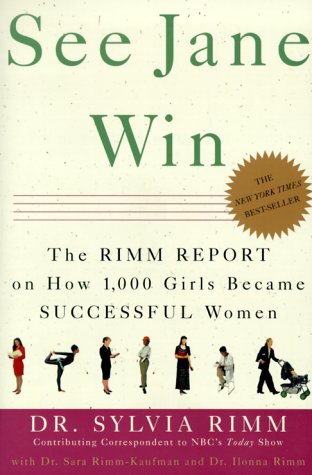
Draws on extensive research, including a detailed survey with more that one thousand successful women, to illuminate the secrets of feminine success and satisfaction and explains how parents can distill in their own daughters the same advantages. Reprint. 100,000 first printing.
Die Inhaltsangabe kann sich auf eine andere Ausgabe dieses Titels beziehen.
Über die Autorin bzw. den Autor
Dr. Sylvia Rimm is director of The Family Achievement Clinic at The Cleveland Clinic and a clinical professor at Case Western Reserve University School of Medicine. She is contributing correspondent to NBC's Today show, Disney's on-line child psychologist for family.com, host of the national radio show Family Talk with Sylvia Rimm, and author of a syndicated newspaper column on parenting. Dr. Rimm received her master's and doctoral degrees in educational psychology from the University of Wisconsin-Madison and is the author of several books, including Why Bright Kids Get Poor Grades, Raising Preschoolers, and How to Parent So Children Will Learn. A mother of four, she lives in Cleveland with her husband.
Dr. Sara Rimm-Kaufman is a research psychologist at the University of Virginia.
Dr. Ilonna Rimm is a pediatric oncology researcher.
Aus dem Klappentext
Noted child psychologist Sylvia Rimm, along with her daughters, a research psychologist and a pediatric oncology researcher, conducted a three-year survey of more than a thousand successful women to uncover what elements of their childhood and adolescence contributed to their success -- and how today's parents can give their own daughters the same advantages.
Should you encourage your daughter's competitive streak? How important are social skills? Does birth order make a difference? Based on extensive original research, See Jane Win provides invaluable information distilled from women in nontraditional and traditional fields, from medicine, science, law, politics, and business to arts, education, homemaking, and mental health. Here is informed advice on helping girls deal with middle-school grade decline; math anxiety; eating disorders; social insecurity; self-esteem and competition; the career/family balance; the glass ceiling; and more.
Auszug. © Genehmigter Nachdruck. Alle Rechte vorbehalten.
Research Finding #1
Both the American dream and the feminist dream are alive and well for the successful women who participated in our study. They have outperformed both their mothers and fathers in their educational attainments. Although less than a third of their mothers and less than half of their fathers completed college, almost all of the women had at least college degrees. A third had master's degrees, and another third had doctorates in the arts and sciences or a professional degree in medicine or law. The women in our study were not only successful but happy in their families and social relationships.
Guideline #1----Set high educational expectations for your daughters. Expect them to complete college and beyond, whether or not you did. Discuss careers with them, and expect them to have careers. Teach them that educational attainment is of the highest priority.
Research Finding #2
About 70 percent of the women believed that both their parents had high expectations for them. More than a third of the women indicated they felt pressure from parents, teachers, peers, and themselves, although for the most part they liked the pressure or at least didn't seem to mind it.
Guideline #2----Don't be too quick to back off if your daughters have to cope with some pressure. It's all part of learning resilience. Expect much from your daughters, and they will expect much of themselves. Coach them for success. Expectations are much more effective if both parents agree (whether or not they're married to each other). If you can't agree, having one parent who sets high expectations is much better than neither doing so. However, too much pressure can cause serious problems. Don't set unrealistically high expectations. If your daughter is experiencing symptoms of pressure, help her to make decisions about how to manage her time better or which activities to eliminate. If she reports too much pressure or begins to show physical symptoms, get professional help.
Research Finding #3
Although most of the successful women in the study were highly intelligent according to various measures, many described themselves as above average or even average in intellectual abilities. Most of the women invested considerable time in study and homework while in school. Motivation seemed at least as critical as ability.
Guideline #3----Help your daughters to understand that they don't need to be the smartest to feel smart, but assure them that you believe they are intelligent and that "airheads" don't make it but "brains" do. Studying does pay off. Help them to develop good study habits. Even perfectionism, if not too extreme, can lead to production and achievement. Assure your daughters that they won't wear their IQ score on their foreheads, and for the most part, they should not consider their IQ score a limitation as long as they are interested, motivated, and willing to persevere.
Research Finding #4
In choosing words to describe themselves as they were growing up, the women of the study chose "smart," "hard worker," and "independent" most often. Those descriptors were also chosen most by the women to describe their perceptions of how others saw them. "Happy," "mature," "adultlike," "creative," and "good little girl" were also mentioned frequently. There were various descriptors used by women in some careers, but "smart" and "hardworking" were constants for all careers.
Guideline #4----View your daughters as intelligent, good thinkers, and problem solvers. Value work. Be positive about your own work. Have family work projects. A work ethic and a love of accomplishment underlie motivation. Doing chores around the house, baby-sitting, running small businesses (such as lemonade stands), tutoring or teaching others, and working on creative projects will all build a sense of personal competence.
Research Finding #5
Many successful women described themselves as "sensitive," "kind," "shy," "emotional," "perfectionistic," and "self-critical." Very few used terms such as "troublemaker," "manipulative," "problem child," "rebellious," or even "fashion leader."
Guideline #5----Characteristics that are gender-stereotyped as female characteristics don't necessarily interfere with success. Assertiveness can be learned. On the other hand, if your daughter is having behavior or learning problems in school, take it seriously. Get the kind of professional assistance that will help her view herself as hardworking, smart, and independent.
Research Finding #6
Most of the successful women in our study, 79 percent, were educated in public schools; 16 percent attended parochial schools, and 5 percent went to independent schools. Comparable figures for the general population are 89 percent in public schools, 9 percent in parochial schools, and 2 percent in independent schools. Approximately twice as many of our successful women attended parochial and independent schools as do children in the overall population.
Attendance at same-gender schools and colleges was viewed favorably and positively by the women who attended those schools. Ten percent of the women attended all-female high schools. Thirteen percent attended women's colleges. Approximately 20 percent of the successful women admitted that boys and social life adversely affected their seriousness about school and learning during their middle- and high-school years. Specific teachers were frequently mentioned by these women as inspiring regardless of whether they attended public or private schools.
Guideline #6----Your daughters can be successful at public schools; however, there may be some advantages to parochial, independent, and all-girls schools. Consider the quality of the particular school, and carefully review your own economic priorities as well as your daughters' interests and needs when planning for your daughters' educational opportunities. The middle-school and high-school years may be a more important time than the elementary years to choose a special school if finances are limited. On the other hand, it may not be worth a financial sacrifice if your daughters are doing well at good public schools. Search for schools with dedicated and inspiring teachers. They may make a great difference for your daughters.
„Über diesen Titel“ kann sich auf eine andere Ausgabe dieses Titels beziehen.
Suchergebnisse für See Jane Win: The Rimm Report on How 1,000 Girls Became...

Beispielbild für diese ISBN
See Jane Win: The Rimm Report on How 1, 000 Girls Became Successful Women
Anbieter: World of Books (was SecondSale), Montgomery, IL, USA
Verkäuferbewertung 5 von 5 Sternen

Paperback. Zustand: Good. Artikel-Nr. 00097989708
Gebraucht kaufen
EUR 3,84
Versand gratis
Versand innerhalb von USA
Versand innerhalb von USA
Anzahl: 2 verfügbar
Beispielbild für diese ISBN
See Jane Win: The Rimm Report on How 1,000 Girls Became Successful Women
Verlag:
Three Rivers Press (edition Gift), 2000
ISBN 10: 0609805606
ISBN 13: 9780609805602
Gebraucht
Paperback
Anbieter: BooksRun, Philadelphia, PA, USA
Verkäuferbewertung 5 von 5 Sternen
Paperback. Zustand: Very Good. Gift. It's a well-cared-for item that has seen limited use. The item may show minor signs of wear. All the text is legible, with all pages included. It may have slight markings and/or highlighting. Artikel-Nr. 0609805606-11-6
Gebraucht kaufen
EUR 5,01
Versand gratis
Versand innerhalb von USA
Versand innerhalb von USA
Anzahl: 1 verfügbar
Beispielbild für diese ISBN
See Jane Win: The Rimm Report on How 1,000 Girls Became Successful Women
Verlag:
Three Rivers Press (edition Gift), 2000
ISBN 10: 0609805606
ISBN 13: 9780609805602
Gebraucht
Paperback
Anbieter: BooksRun, Philadelphia, PA, USA
Verkäuferbewertung 5 von 5 Sternen
Paperback. Zustand: Fair. Gift. The item might be beaten up but readable. May contain markings or highlighting, as well as stains, bent corners, or any other major defect, but the text is not obscured in any way. Artikel-Nr. 0609805606-7-18
Gebraucht kaufen
EUR 5,23
Versand gratis
Versand innerhalb von USA
Versand innerhalb von USA
Anzahl: 1 verfügbar
Beispielbild für diese ISBN
See Jane Win : The Rimm Report on How 1,000 Girls Became Successful Women
Verlag:
Crown Publishing Group, The, 2000
ISBN 10: 0609805606
ISBN 13: 9780609805602
Gebraucht
Softcover
Anbieter: Better World Books, Mishawaka, IN, USA
Verkäuferbewertung 5 von 5 Sternen
Zustand: Good. Gift. Former library copy. Pages intact with minimal writing/highlighting. The binding may be loose and creased. Dust jackets/supplements are not included. Includes library markings. Stock photo provided. Product includes identifying sticker. Better World Books: Buy Books. Do Good. Artikel-Nr. GRP89568404
Gebraucht kaufen
EUR 6,36
Versand gratis
Versand innerhalb von USA
Versand innerhalb von USA
Anzahl: 2 verfügbar
Beispielbild für diese ISBN
See Jane Win: The Rimm Report on How 1,000 Girls Became Successful Women
Anbieter: Wonder Book, Frederick, MD, USA
Verkäuferbewertung 5 von 5 Sternen
Zustand: Very Good. Very Good condition. A copy that may have a few cosmetic defects. May also contain light spine creasing or a few markings such as an owner's name, short gifter's inscription or light stamp. Artikel-Nr. L20P-01131
Gebraucht kaufen
EUR 6,43
Versand gratis
Versand innerhalb von USA
Versand innerhalb von USA
Anzahl: 1 verfügbar
Beispielbild für diese ISBN
See Jane Win: The Rimm Report on How 1,000 Girls Became Successful Women
Anbieter: Wonder Book, Frederick, MD, USA
Verkäuferbewertung 5 von 5 Sternen
Zustand: Good. Good condition. A copy that has been read but remains intact. May contain markings such as bookplates, stamps, limited notes and highlighting, or a few light stains. Artikel-Nr. X02H-01415
Gebraucht kaufen
EUR 6,43
Versand gratis
Versand innerhalb von USA
Versand innerhalb von USA
Anzahl: 1 verfügbar
Beispielbild für diese ISBN
See Jane Win: The Rimm Report on How 1,000 Girls Became Successful Women
Anbieter: ThriftBooks-Atlanta, AUSTELL, GA, USA
Verkäuferbewertung 5 von 5 Sternen
Paperback. Zustand: As New. No Jacket. Pages are clean and are not marred by notes or folds of any kind. ~ ThriftBooks: Read More, Spend Less. Artikel-Nr. G0609805606I2N00
Gebraucht kaufen
EUR 6,85
Versand gratis
Versand innerhalb von USA
Versand innerhalb von USA
Anzahl: 1 verfügbar
Beispielbild für diese ISBN
See Jane Win: The Rimm Report on How 1,000 Girls Became Successful Women
Anbieter: Robinson Street Books, IOBA, Binghamton, NY, USA
Verkäuferbewertung 4 von 5 Sternen

Paperback. Zustand: Very Good. Prompt Shipment, shipped in Boxes, Tracking PROVIDEDVery good, some creasing. Artikel-Nr. bing586rm4457
Gebraucht kaufen
EUR 12,42
EUR 8,48 Versand
Versand innerhalb von USA
Versand innerhalb von USA
Anzahl: 1 verfügbar
Beispielbild für diese ISBN
See Jane Win: The Rimm Report on How 1,000 Girls Became Successful Women
Anbieter: Revaluation Books, Exeter, Vereinigtes Königreich
Verkäuferbewertung 5 von 5 Sternen
Paperback. Zustand: Brand New. gift edition. 368 pages. 9.00x6.00x1.00 inches. In Stock. Artikel-Nr. 0609805606
Neu kaufen
EUR 30,74
EUR 11,80 Versand
Versand von Vereinigtes Königreich nach USA
Versand von Vereinigtes Königreich nach USA
Anzahl: 1 verfügbar