
Verwandte Artikel zu Angus
Inhaltsangabe
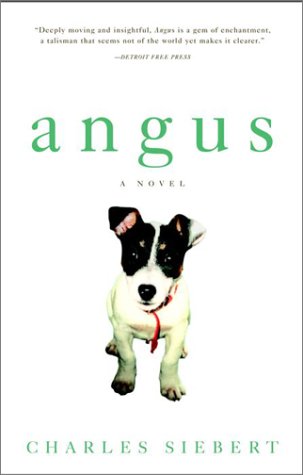
While Angus, a spunky Jack Russell terrier, lies wounded in the woods trying to crawl back to his owner's cabin, he recalls his rich life, in an entertaining "memoir" by the author of Wickerby. Reprint. 15,000 first printing.
Die Inhaltsangabe kann sich auf eine andere Ausgabe dieses Titels beziehen.
Aus dem Klappentext
ngus, Charles Siebert, author of the critically acclaimed memoir Wickerby: An Urban Pastoral, offers us a wry, poignant, and ultimately redemptive view of life and death as perceived through the heightened senses of one very brave, winsome, unforgettable Jack Russell terrier. At once poetic, thoroughly canine, and unsentimental, Angus is a brilliant feat of the imagination that illuminates our often ambiguous relationship with our fellow creatures, while delivering us to a fuller understanding of the forces that make us all one.
Auszug. © Genehmigter Nachdruck. Alle Rechte vorbehalten.
1
If I could lift myself and run again. If I could run here to the far wood's edge, where it has just happened, at night; run away from the very place I'll have to crawl back to now--and why? What is it, exactly, drawing me to those cabin lights?--lift myself and run here to the far wood's edge, directly beneath the bottom right corner star of the Big Dipper's ladle, where it all happened, I would.
"An--gus?" "An--gus?"
Cries. Theirs. Some deep. Some higher and thin. I heard them, not very long ago, but hazily, when it was already too late, when I had just awakened, I think, to find myself ruined like this, and numb, and the world so oddly pitched that I hadn't even begun to consider the long climb back out from among these trees through the side field under the Big Dipper toward the cabin lights where they, my owners, sit tonight.
It was already too late, and I so small and low, lying here among the trees behind the field of uncut grass, that they couldn't see me. Not the way they each came outside and looked, so tentative, into darkness, calling toward the woods, calling out across the night in my general direction but still standing so firmly behind whatever boundary it is that you have, and that never existed for me: darkness and the woods and their mind-mate, fear.
Can you stand, can you even imagine it anymore? Did you ever know it at all: full-fathom fearlessness and the feel of charging away from your own lit windows into the night, charging off on a scent, purely, and the urge that it stirs. Go. Go. And further, and on, with nothing holding you back, no worry, not a second, not even a first, thought--thought that leads to fear and fear to worries and these to clouded thoughts, like the fence-snagged sheep hair of atmosphere that drags tonight in a blue wind about the planet.
Peepers. I hear the peepers down at the back pond and crickets. I hear the maddening, mounting measures of mosquito drone mercifully erased now by the swooping bats. So many stars out, swimming, flowing, endlessly, through the Dipper's bottomless cup. Atoms, everywhere. I see, but I can't stop them. I'm coming apart. I'm little more now than the sum of those peepers, sounding.
2
How did I come to this? I've never been one to look back. I've never known regret. That's your province, isn't it, the mind-mate of expectation? Something I'm not saddled with beyond the immediate kind: you go out the door. I hunker down and wait, mangling some prized possession of yours to ease my loneliness.
You sit around all day and stare off blankly through windows. I wait for you to finally get past your brains' alien entanglements and take me out for a walk.
You hover interminably above kitchen counters, blabbing, on and on, while I wait for you to finally put down the food bowl.
But as for long-term imaginings, the ability to get worked up over a possible future that doesn't at all resemble any one day: an endless series of filled food bowls, and of the best walks I've ever known, and ongoing nights in which you never leave me--hope, in other words, I wasn't even aware such a thing existed until now. Until, lying here at the edge of my own absence, I'm suddenly able to imagine in their faces the look of the hopes I've dashed.
I can't say how it happened. All I remember is a scent, rising, above all others, growing stronger as I ran toward it and then hard and sharp: a scissor-flash of fangs and my body going with the stars and the distant cabin lights into a swirl that, all at once, stopped with me, hard, against the earth, and the scent falling away, fading, far back into the forest.
"An--gus?"
Cries. Theirs.
Are they what stirred, what arrested me a while ago when I was slipping away? Are they what's keeping me here now, still snagged and adrift within the sphere of worry, when I was already well on my way, frictionless, around the next bend? And hasn't that always been the complaint about me, that I'm forever straining at the lead, trying to see what lies in store, just up ahead?
It's late. I'm cold. Peepers. Those pond peepers sounding, still, in the dark woods behind me, like mud-embedded stars, each peep a deep burst of light, one connecting to the next, and somehow, in their chorus, comprising my consciousness.
I'm beginning to see everything now, but backward, in recollection, as though my last flash forward into this forest is illuminating a final flashback: the things that I wasn't thinking when I charged out tonight; the steady train of events, from my life's very beginning, that lead, inevitably, here, to these dark woods, and the scissor fangs, and those far-off cabin lights where they sit now, in the warmth, leaning, I'm certain, for some indication of me.
3
Angus. They call me Angus. I go by and, when it suits me, come to, Angus. That's the name I was given one day nine months ago, the day that they suddenly appeared at Pollard's Combe and set off the chain of events that would eventually thrust me here, where I now lie at the dark edge of a new-world forest.
The thrust of chance. That's everything, isn't it, from the very beginning? One day, like one of those sudden rain squalls that were always sweeping in off the seas of my native England, you arrive, sideways, into atmosphere, a pair of eyes and attendant senses, receiving.
And the only questions are: Is it a covered, a framed part of a day that you've entered, or an open and a roofless one? Is there a bed, of any kind, or is it the hard ground of some disowned plot, a back alley somewhere within the streets and spires of cemented smells that you call a city?
Or the ground, perhaps, of a place far enough away from you and all of your buildings that at least there isn't the added burden of human pity to bear, and a creature can just crawl off and make its own way the best that it can.
Me, I got a bit of straw in the corner of a stone barn on a September morning eleven months ago, the barn of an old Devon cow farm situated at the far end of a long narrow lane that winds its way up out of the seaside village of Slapton. The road courses inland through miles of high tufted hedgerows that lead, eventually, down a steep grade to two stone pillars with a little sign in the grass before them: Pollard's Combe.
I can still see, still smell it--the sweet spoor of slow-spun earth beneath its own thick coat of grass. Pass through the pillars now, Angus, along the dirt road by the rubble-stone wood shelter on the right and, on the left, an ivy-covered stone wall that fronts the farmhouse of whitewashed granite, its lichenous-green slate roof topped with one small decorative gable above the front door and two stone chimneys, one at either end.
The road winds back behind the house up a steep hill past an open, flat-roofed car garage with a lone, wind-bent oak clawing back at the sky above it. Farther along, at the very top of the hill, a grain silo sits on the left and, opposite it, the cow barn where my mother first thrust and then licked me into light. There were three others beside me that morning. One never did move.
Do you recall, did you ever really know it, the full, drowning scent, like wet, rusted iron, of your own birth's blood? How is it that living things can have the smell of metal? Fish. Just today I bit a dead fish on the pond bank behind me here in the woods. Metal!
And the high-pitched taint of that--still on my tongue when, a short time later, I went up to the car that they always park here at the top of the cabin's entrance road, went up to it, why, I think because of the odd angle at which the sun was striking the windshield--that taint on my tongue married perfectly with the fishy one of the car's front bumper.
So tell me, then, where and what do we really come from? Atoms? Adrift? I feel...
„Über diesen Titel“ kann sich auf eine andere Ausgabe dieses Titels beziehen.
Suchergebnisse für Angus

Beispielbild für diese ISBN
Angus: A Novel
Anbieter: World of Books (was SecondSale), Montgomery, IL, USA
Verkäuferbewertung 5 von 5 Sternen

Zustand: Very Good. Item in very good condition! Textbooks may not include supplemental items i.e. CDs, access codes etc. Artikel-Nr. 00072830918
Gebraucht kaufen
EUR 3,15
Versand gratis
Versand innerhalb von USA
Versand innerhalb von USA
Anzahl: 1 verfügbar
Beispielbild für diese ISBN
Angus: A Novel
Anbieter: World of Books (was SecondSale), Montgomery, IL, USA
Verkäuferbewertung 5 von 5 Sternen
Zustand: Good. Item in good condition. Textbooks may not include supplemental items i.e. CDs, access codes etc. Artikel-Nr. 00072805687
Gebraucht kaufen
EUR 3,15
Versand gratis
Versand innerhalb von USA
Versand innerhalb von USA
Anzahl: 1 verfügbar
Beispielbild für diese ISBN
Angus
Verlag:
Crown Publishing Group, The, 2001
ISBN 10: 0609804685
ISBN 13: 9780609804681
Gebraucht
Softcover
Anbieter: Better World Books: West, Reno, NV, USA
Verkäuferbewertung 5 von 5 Sternen
Zustand: Very Good. Former library copy. Pages intact with possible writing/highlighting. Binding strong with minor wear. Dust jackets/supplements may not be included. Includes library markings. Stock photo provided. Product includes identifying sticker. Better World Books: Buy Books. Do Good. Artikel-Nr. 18188954-20
Gebraucht kaufen
EUR 6,04
Versand gratis
Versand innerhalb von USA
Versand innerhalb von USA
Anzahl: 1 verfügbar
Beispielbild für diese ISBN
Angus
Verlag:
Crown Publishing Group, The, 2001
ISBN 10: 0609804685
ISBN 13: 9780609804681
Gebraucht
Softcover
Anbieter: Better World Books, Mishawaka, IN, USA
Verkäuferbewertung 5 von 5 Sternen
Zustand: Good. Pages intact with minimal writing/highlighting. The binding may be loose and creased. Dust jackets/supplements are not included. Stock photo provided. Product includes identifying sticker. Better World Books: Buy Books. Do Good. Artikel-Nr. 37619281-75
Gebraucht kaufen
EUR 6,04
Versand gratis
Versand innerhalb von USA
Versand innerhalb von USA
Anzahl: 2 verfügbar
Beispielbild für diese ISBN
Angus
Verlag:
Crown Publishing Group, The, 2001
ISBN 10: 0609804685
ISBN 13: 9780609804681
Gebraucht
Softcover
Anbieter: Better World Books, Mishawaka, IN, USA
Verkäuferbewertung 5 von 5 Sternen
Zustand: Very Good. Pages intact with possible writing/highlighting. Binding strong with minor wear. Dust jackets/supplements may not be included. Stock photo provided. Product includes identifying sticker. Better World Books: Buy Books. Do Good. Artikel-Nr. 17518174-75
Gebraucht kaufen
EUR 6,04
Versand gratis
Versand innerhalb von USA
Versand innerhalb von USA
Anzahl: 1 verfügbar
Beispielbild für diese ISBN
Angus: A Novel
Anbieter: ThriftBooks-Atlanta, AUSTELL, GA, USA
Verkäuferbewertung 5 von 5 Sternen
Paperback. Zustand: Very Good. No Jacket. May have limited writing in cover pages. Pages are unmarked. ~ ThriftBooks: Read More, Spend Less. Artikel-Nr. G0609804685I4N00
Gebraucht kaufen
EUR 7,68
Versand gratis
Versand innerhalb von USA
Versand innerhalb von USA
Anzahl: 1 verfügbar
Beispielbild für diese ISBN
Angus: A Novel
Anbieter: ThriftBooks-Dallas, Dallas, TX, USA
Verkäuferbewertung 5 von 5 Sternen
Paperback. Zustand: Very Good. No Jacket. May have limited writing in cover pages. Pages are unmarked. ~ ThriftBooks: Read More, Spend Less. Artikel-Nr. G0609804685I4N00
Gebraucht kaufen
EUR 7,68
Versand gratis
Versand innerhalb von USA
Versand innerhalb von USA
Anzahl: 1 verfügbar
Beispielbild für diese ISBN
Angus: A Novel
Anbieter: medimops, Berlin, Deutschland
Verkäuferbewertung 5 von 5 Sternen
Zustand: good. Befriedigend/Good: Durchschnittlich erhaltenes Buch bzw. Schutzumschlag mit Gebrauchsspuren, aber vollständigen Seiten. / Describes the average WORN book or dust jacket that has all the pages present. Artikel-Nr. M00609804685-G
Gebraucht kaufen
EUR 4,37
EUR 10,00 Versand
Versand von Deutschland nach USA
Versand von Deutschland nach USA
Anzahl: 1 verfügbar