
Verwandte Artikel zu Out of It: A Cultural History of Intoxication
Inhaltsangabe
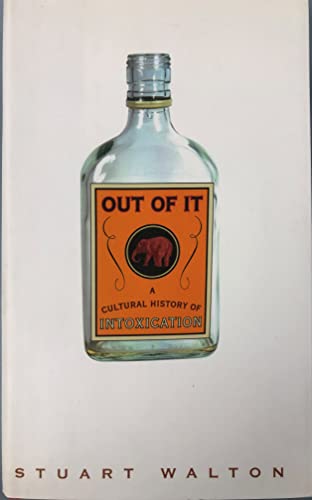
Offers a thought-provoking look at the role and use of intoxicating drugs in human society, from a historical, anthropological, sociological, and medical perspective, past and present. 20,000 first printing.
Die Inhaltsangabe kann sich auf eine andere Ausgabe dieses Titels beziehen.
Über die Autorin bzw. den Autor
STUART WALTON is a cultural historian, journalist, and the author of numerous books on the subject of wine and liquors.
Aus dem Klappentext
<i><br>“Who will ever relate the whole history of narcotica? It is almost the history of ‘culture,’ of our <br>so-called higher culture.”<br>―Friedrich Nietzsche, 1882</i><br><br>With Nietzsche’s question as his objective, Stuart Walton begins Out of It: A Cultural History of Intoxication―a heterodox and throughly engaging examination of intoxicants, from the more everyday substances of alcohol, caffeine, and tobacco to the illicit realm of opiates, amphetamines, and hallucinogens. More than a mere catalog of intoxicants, however, Walton’s book is a smart, wry look at why intoxication has always been a part of the human experience―from our earliest Stone Age rituals to the practices of the ancient Greeks and Romans, right on through the Victorian era and ending with a flourish in modern times―and more significantly, why the use of intoxicants is, and will continue to be, an essential part of being human. <br><br>Using gastronomy as an example, Walton illustrates that just as the study of food history was <br>relatively unheard of until the 1970s, so too “intoxicology” has yet to be recognized as a richly warranted field of study. Though intoxication may not be considered as essential to human existence as food, and carries the unjust stigma of criminality, Walton proposes that it is “an integral part of Western civilization, and that we would do better to accept and celebrate that fact instead of making it a matter of criminal sanctions and repression.”<br><br>The conclusions Walton draws cut across the grain of today’s prevailing attitudes and fuel an important and often neglected debate, ultimately establishing that intoxication is not only a fundamental human right but, in fact, a biological imperative.
Auszug. © Genehmigter Nachdruck. Alle Rechte vorbehalten.
Coming Up
Here is a modern recreational tale. Three young men get together on a Saturday night. Their backgrounds are culturally diverse, but all reasonably comfortable. None of them has a criminal record, or comes from what sociologists used to call a broken home. They are of mixed ages (24-35), nationalities and sexualities; one is a mutual friend of the two others, who have not previously met. Two of them have come through a succession of relatively smart office jobs, but are now trying their hands at being self-employed. The third has held a responsible position in the catering industry, but is currently unemployed.
Two of them begin the evening in the apartment that one of them rents. They drink a bottle of sparkling wine and a bottle of white wine. While drinking, they also get through two grams of cocaine, snorting it in lines two at a time about every twenty minutes. They meet the third in a bar later on, and drink several rounds--perhaps half a dozen--of spirits with mixers. At around 2 A.M., they go on to another late bar, where one of them knows that drugs can be bought quite easily. Within minutes, they are offered ecstasy by a complete stranger. Following some gentle haggling over the price, they buy two tablets.
Outside the bar, a group of elderly bikers is selling amphetamine. They buy two grams of that as well. Back at the flat, they divide the tablets into six fragments and take two each. There is a further half gram of cocaine to finish, and the two grams of amphetamine. Whilst ingesting the drugs, they drink a further six bottles of sparkling wine between them over the course of the night. At 10 A.M., without having slept, they venture out into town again and, after lolling on public benches for a while, go to a bar and embark on a round of bottled beers.
This is not exactly a typical weekend. It counts in the running narrative of their leisure time as something of a "blinder." None of them suffers much in the way of aftereffects. There is, to be sure, the sense of vacuumed-out listlessness that follows prolonged amphetamine intake. Two of them have acutely constricted sinuses, a compensation reaction to cocaine-snorting. None has an alcohol hangover. They are all fit and fully functioning again by Monday.
In a paneled room in the nether regions of one of Oxford University's more ancient colleges, a group of graduates and undergraduates that forms its illustrious debating society gathers. The room is lit solely by candlelight, lending the proceedings a vague air of masonic clandestinity, but only intended in the interest of a period feel, to evoke the time of the seventeenth-century poet-playwright after whom the society is named.
An oak cabinet, stained with age, and referred to as the Ark, is solemnly placed on the table around which the group is assembled. From it is drawn, with ecclesiastical reverence, a large two-handled pewter sconce. All eyes are trained on the president of the society as she fills this vessel to the brim with strong beer. Raising it above her head as if it were the Communion cup, she intones a Latin invocation of greeting to the foregathered company that ends with the solemn announcement, "Nunc est bibendum" ("Now is the time for drinking").
The sconce is then passed slowly around the table, each celebrant gripping it by both handles and uttering a Latin formula in honor of the household gods of the society's patron presence, before drinking a respectfully deep draught of the beer and handing it on.
Following this, a short talk on some agreeably nebulous moral theme is delivered--Honor, perhaps, or Forgiveness--and then the entire table sets to with a will, arguing over the points raised in convivial disarray, untrammeled by presidential intervention, and lubricated by copious quantities of wine and vintage port. At whatever time the room must be vacated, the members will totter away across the quadrangle, still disputing with each other in amiable inebriation, perhaps straggling into the nearest pub to continue their exchanges, assertions and refutations thickening the already smoke-dense air.
At such august institutions did many of Britain's parliamentarians once cut their debating teeth, thumping the drunken table to make their point about Pride or Altruism, quite as if it mattered. (In the mid-1980s, the group's president was herself the daughter of a Scottish member of the European Parliament.) But what particularly fascinated the parvenu guest, with his alternative haircut and redbrick degree, was the way in which drinking was not merely an incidental adjunct to make a lively evening the more commodious, but had been ceremonially incorporated into the ritual so integrally that teetotalers need not have applied. The Platonic dialogue flowed precisely from the sacred rite of intoxication, so that the meeting became a dialectical drinking-session, a far more dignified proceeding than colleagues getting slaughtered in the nearby Bull and Pennant were engaged in. Without alcohol, the society's disputations would have been aridly futile.
There are around two dozen subsidized bars in the British Houses of Parliament.
A pair of dining companions scrutinizes the menus in a smart, trendsetting restaurant in a European capital city. One has opted to begin with the tempura-battered strips of calf's liver with pomegranate cream dressing, and go on to herb-crusted rack of lamb with Provencale vegetables. For the other, it will be quail terrine with red-currant relish and rocket, and to follow, poached perch with a sauce of lemon and capers. Now for the tricky business.
That dressing on the liver might present problems for a light white wine, and without knowing precisely how sharp it will be, the choice is something of a matter of stumbling in the dark. A crisp New Zealand Sauvignon might stand up to it, and cut any residual oiliness in the batter, but then, what of the quail terrine? Surely that needs a meatier white, even a light red? The merits of a sturdy white Burgundy are discussed, but the proposal is soon relinquished. An excess of oak would suit neither dish. Eventually, a compromise bottle is found. The weight and extract in a grand cru Gewurztraminer from Alsace will cope with the battered liver, and is a gastronomically unimpeachable match with any kind of terrine. The first bottle can safely be ordered.
How, though, to find a vinous chameleon to blend with both red meat and white fish? That way, gustatory madness lies. Pinot Noir might suit a densely textured fish like tuna, but could crush the delicacy of a river fish, while lacking the tannic heft required to stand up to lamb. The rich buttery sauce with the perch will happily negotiate the fleshiness of a Barossa Valley Chardonnay, but even that wine, with its layers of oak and alcohol, is just too white for rare red meat. An apposite half bottle each would be the obvious answer, were the list not so lamentably deficient in them. After much fretful chewing of bread, and flipping of pages back and forth, the issue is imperfectly resolved in favor of a bottle of cru classe Pauillac, the gameplan being that the fish-eater will be left the lion's share of the Gewurztraminer to go with the perch (which means drinking the same wine with two courses, alas), but will nonetheless be able to help finish the claret with some cheese. Now the logistics of it must be explained to the sommelier, so that he doesn't overserve the Gewurztraminer to the lamb-eater during the hors d'oeuvre.
In certain wine circles, food and wine matching has reached the status of an investigative science. A wine periodical convokes a bunch of journalists and wine-makers to pick wines to go with a succession of dishes, the linking theme of which is strawberries. There is goat cheese with strawberries, swordfish with strawberries, duck livers with...
„Über diesen Titel“ kann sich auf eine andere Ausgabe dieses Titels beziehen.
Suchergebnisse für Out of It: A Cultural History of Intoxication

Beispielbild für diese ISBN
Out of It A Cultural History o
Anbieter: World of Books (was SecondSale), Montgomery, IL, USA
Verkäuferbewertung 5 von 5 Sternen

Zustand: Very Good. Item in very good condition! Textbooks may not include supplemental items i.e. CDs, access codes etc. Artikel-Nr. 00105315465
Gebraucht kaufen
EUR 5,51
Versand gratis
Versand innerhalb von USA
Versand innerhalb von USA
Anzahl: 1 verfügbar
Beispielbild für diese ISBN
Out of It: A Cultural History of Intoxication
Anbieter: ThriftBooks-Atlanta, AUSTELL, GA, USA
Verkäuferbewertung 5 von 5 Sternen
Hardcover. Zustand: Good. No Jacket. Missing dust jacket; Pages can have notes/highlighting. Spine may show signs of wear. ~ ThriftBooks: Read More, Spend Less. Artikel-Nr. G0609610449I3N01
Gebraucht kaufen
EUR 6,13
Versand gratis
Versand innerhalb von USA
Versand innerhalb von USA
Anzahl: 1 verfügbar
Beispielbild für diese ISBN
Out of It: A Cultural History of Intoxication
Verlag:
Crown (edition First Edition), 2002
ISBN 10: 0609610449
ISBN 13: 9780609610442
Gebraucht
Hardcover
Erstausgabe
Anbieter: BooksRun, Philadelphia, PA, USA
Verkäuferbewertung 5 von 5 Sternen
Hardcover. Zustand: Very Good. First Edition. With dust jacket. It's a well-cared-for item that has seen limited use. The item may show minor signs of wear. All the text is legible, with all pages included. It may have slight markings and/or highlighting. Artikel-Nr. 0609610449-11-1-29
Gebraucht kaufen
EUR 6,13
Versand gratis
Versand innerhalb von USA
Versand innerhalb von USA
Anzahl: 1 verfügbar
Beispielbild für diese ISBN
Out of It: A Cultural History of Intoxication
Anbieter: ThriftBooks-Dallas, Dallas, TX, USA
Verkäuferbewertung 5 von 5 Sternen
Hardcover. Zustand: Fair. No Jacket. Missing dust jacket; Readable copy. Pages may have considerable notes/highlighting. ~ ThriftBooks: Read More, Spend Less. Artikel-Nr. G0609610449I5N01
Gebraucht kaufen
EUR 6,13
Versand gratis
Versand innerhalb von USA
Versand innerhalb von USA
Anzahl: 1 verfügbar
Beispielbild für diese ISBN
Out of It : A Cultural History of Intoxication
Anbieter: Better World Books, Mishawaka, IN, USA
Verkäuferbewertung 5 von 5 Sternen
Zustand: Good. 1 Amer ed. Former library copy. Pages intact with minimal writing/highlighting. The binding may be loose and creased. Dust jackets/supplements are not included. Includes library markings. Stock photo provided. Product includes identifying sticker. Better World Books: Buy Books. Do Good. Artikel-Nr. 4415388-6
Gebraucht kaufen
EUR 6,36
Versand gratis
Versand innerhalb von USA
Versand innerhalb von USA
Anzahl: 2 verfügbar