
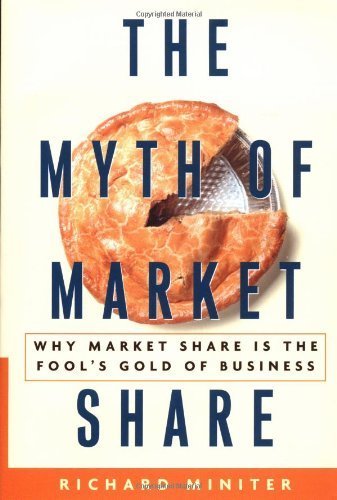
Verwandte Artikel zu The Myth of Market Share: Why Market Share Is the Fool's...
Inhaltsangabe
A journalist refutes the myth that market share is synonymous with profitability in a study that explains why companies need to rethink common business practice to come up with new strategies that allow for strong growth and profits without questionable practices in pursuit of market dominance. 25,000 first printing.
Die Inhaltsangabe kann sich auf eine andere Ausgabe dieses Titels beziehen.
Über die Autorin bzw. den Autor
Richard Miniter, formerly an editor for the Wall Street Journal Europe, is an award-winning business journalist. His work has been published in major newspapers, including the Wall Street Journal, New York Times, Washington Post, Sunday Times (London), and Australian Financial Review. Miniter lives in Brussels.
Aus dem Klappentext
Richard Miniter skewers the sacred cow of market share and debunks the conventional wisdom that corporate profits rise as you grab more territory in the marketplace.
Market share is the fool s gold of modern business. In reality, companies that maximize market share end up minimizing profits, while their smarter rivals earn higher returns. Three times out of four, on average, the most profitable firm is not the one with the largest slice of the market. Yet the myth of market share continues to hobble and kill great companies, while smaller competitors dig out real profits. Executives, entrepreneurs, investors, and regulators will learn why megamergers often fail, brand extensions wither, and stocks tumble. The Myth of Market Share also reveals a positive and proven strategy for transforming a company into a profit leader.
Richard Miniter recounts many cautionary tales of great companies that refused to change and outlines the practical plans of those that changed and flourished. Managers and investors will profit from knowing why Dell prospers by treating market share as a benchmark, not as a goal. Executives and entrepreneurs can retool their strategies by examining the case studies in this book, including Ryanair, an upstart Irish air carrier that transformed itself into the world s most profitable airline; International Paper, a manufacturing Goliath that tried to buy success; Boeing, the plane maker that pulled out of a steep dive by jettisoning its market share strategies; and DaimlerChrysler, the carmaker that stalled when it tried to be all things to all people.
By providing a road map for persuading doubtful colleagues and leading a company to profit leadership, The Myth of Market Share is an entertaining, historical review and leadership tutorial, delivering proven strategies for generating long-term profits and sustainable growth during these uncertain times.
From the eBook edition.
Auszug. © Genehmigter Nachdruck. Alle Rechte vorbehalten.
Chapter One
Fool's Gold: Why the Myth of Market Share Is Wrecking the World's Great Companies
In reading the history of nations, we find that, like individuals, they have their whims and their peculiarities; their seasons of excitement and recklessness, when they care not what they do. We find that whole communities suddenly fix their minds upon one object, and go mad in its pursuit; that millions of people become simultaneously impressed with one delusion, and run after it . . .
-Memoirs of Extraordinary Popular Delusions Charles Mackay (1841)
THE OBSESSION
Business leaders are gripped by the cult of size, the dogma of bigness.
They are mad for market share. Nearly every company is mesmerized by it. Keeping it, growing it, justifying it-try to talk to a senior executive without the subject coming up. "I can't predict the economy," Scott McNealey, the legendary chief executive of Sun Microsystems, told Barron's recently, "but we will gain share."
Nearly every time I meet with a CEO or senior executive, market share comes up. The reason is no mystery: Top executives know that they are measured by it, and they know that they measure their subordinates by it.
Market share is also an obsession among Wall Street analysts, institutional investors, financial journalists, growth-minded entrepreneurs, high-flying consultants, self-styled gurus, and almost everyone with a 401(k). It seems like a neat shorthand for understanding the value and growth potential of any stock or business plan. It is easy, deceptively easy-and, too often, wrong.
Why do so many people believe that market share naturally and inevitably leads to world-beating profits?
Most business schools are temples to market share and churn out more acolytes every year. The guy in the big corner office is always asking about it. On the conference call, the fund manager wants to know why share isn't growing. The consultants always seem to have a magic plan to produce more market share. And when was the last time you heard someone say that his business plan would succeed in reducing market share?
Like all dogmatic beliefs, followers explain away all of the contrary evidence or simply ignore what they cannot explain.
Periodically, a researcher will emerge with new evidence about market share and profits. Eyes weary from poring over earnings reports, the unwelcome prophet will say something like: "Market share is the fool's gold of business. It looks valuable and it takes a lot of hard work to get-but it is nearly worthless. It wastes time and money while the competition is digging out the real thing. It hobbles, cripples, and kills great companies!" And, like most prophets, he will be ignored.
Maybe the discouraged prophet will drop his yellow legal-size tablets on the ground, allowing us to read his notes: "The market-share obsession, based on flawed and outmoded theories, drags down corporate profits and pushes companies into costly moves. It makes companies bigger without making them more profitable." Sometimes it seems to coincide with profits; too often it does not.
This book is about two powerful ideas: the obsession of market share and the proven path to profits. Once decision makers understand the misguided role that market share plays in corporate strategy, this book will show them how some companies achieve strong growth and above-average profits, using techniques that have worked in a broad array of industries.
It will not make the true believers happy.
THE CULT OF SIZE
Let's start by looking into the world that really matters-the realm of results.
Consider the roll call of companies that achieved large shares of the market in their industry sector or dominated their line of business. Far from being dominant giants, many were sold, were acquired in hostile takeovers, or simply went bankrupt. And the rest? They remain ailing giants-respected behemoths whose executives mumble that Wall Street analysts don't understand their business or claim their sector is having a "cyclical downturn." Still others say they are just one more restructuring effort away from the golden age of profits and market dominance. Sure.
The following companies-in vastly different sectors-have only two things in common: They focused on market share and failed to earn as much money as their competitors.
*Amazon.com is a Brobdingnagian straight out of Jonathan Swift's Gulliver's Travels, which it probably sells more of than any other bookstore in the world. It is easily the nation's largest online book purveyor and moves more volumes than almost all of its bricks-and-mortar rivals. One small problem: Despite seven years of market-share growth, it didn't report a net profit until January 2002. The profit was tiny: $5 million on $1.12 billion in sales. Even that slim profit would have disappeared if the euro hadn't declined against the dollar, slashing some $16 million worth of its euro-denominated debt.
*DEC once had a large share of the minicomputer business. But profits slipped, as market share remained firm. DEC was rescued by Compaq. Now Compaq itself is in trouble. But Compaq's CEO, Michael Capellas, told Fortune magazine that he will not make DEC's mistakes; "We will cede market share to protect profits." Mr. Capellas must have learned something since March 1996 when he stated that he would sacrifice profit to build market share. But, in the end, Compaq couldn't transform itself into a profit-centered company. Old habits die hard. By 2001, Compaq was desperate to be acquired by Hewlett-Packard, a merger effort that soon led to a nasty proxy battle.
Even today's most successful companies could be more profitable if they cared less about market share.
*Wal-Mart, founded by the legendary Sam Walton, is hugely profitable. But, as a case study later in this chapter reveals, the company is focused on expanding into new markets-whether they are fully profitable or not. As a result, Wal-Mart is less profitable than its two smaller competitors, Family Dollar and Dollar General, from which investors earned more on a rate-of-return basis.
*3M, the maker of Scotch tape and Post-it notes, is gargantuan, a $15 billion business that towers over its competitors in nearly every product category. At least in size. Yet others earn more profit in many categories. "3M is a $25 billion business trapped inside a happy, fat $15 billion company," one consultant, who has worked with 3M for more than a decade, told me. 3M is too busy running after tomorrow's products to catch today's profits, too busy innovating to focus on selling and serving its customers. Less innovative rivals quickly move in, snatching sales that should have been 3M's. Innovation is good, but failing to fully exploit the profit potential of its new products in the name of market share hasn't helped 3M become the next GE.
IS BIGGER BETTER?
The more that one looks for evidence of big companies exploiting their market share and superior scale to earn outsize returns, the more one finds evidence to the contrary.
It appears that larger market share, by itself, doesn't equal larger profits. Although some companies have succeeded in exploiting the benefits of size, most have only become bigger.
Take the American banking sector. The biggest originator of home mortgages in the first half of 2000 was Chase Manhattan Mortgage. Was it the most profitable on a net earnings basis? Not by a long shot. The most profitable was Washington Mutual, the number five ranked lender, which earned $452 million. By contrast, Chase Manhattan Mortgage earned less than $123 million.
Why didn't Chase Manhattan do better?
Bankers are fond of saying that the cost of servicing a $100,000 mortgage is equal to the cost of...
„Über diesen Titel“ kann sich auf eine andere Ausgabe dieses Titels beziehen.
Suchergebnisse für The Myth of Market Share: Why Market Share Is the Fool's...

Beispielbild für diese ISBN
The Myth of Market Share: Why Market Share Is the Fool's Gold of Business (Crown Business Briefings)
Anbieter: World of Books (was SecondSale), Montgomery, IL, USA
Verkäuferbewertung 5 von 5 Sternen

Zustand: Good. Item in good condition. Textbooks may not include supplemental items i.e. CDs, access codes etc. Artikel-Nr. 00106337434
Gebraucht kaufen
EUR 3,41
Versand gratis
Versand innerhalb von USA
Versand innerhalb von USA
Anzahl: 1 verfügbar
Beispielbild für diese ISBN
The Myth of Market Share: Why Market Share Is the Fool's Gold of Business (Crown Business Briefings)
Verlag:
Crown Business (edition 1), 2002
ISBN 10: 0609609882
ISBN 13: 9780609609880
Gebraucht
Hardcover
Anbieter: BooksRun, Philadelphia, PA, USA
Verkäuferbewertung 5 von 5 Sternen
Hardcover. Zustand: Very Good. 1. With dust jacket. It's a well-cared-for item that has seen limited use. The item may show minor signs of wear. All the text is legible, with all pages included. It may have slight markings and/or highlighting. Artikel-Nr. 0609609882-11-1-29
Gebraucht kaufen
EUR 5,13
Versand gratis
Versand innerhalb von USA
Versand innerhalb von USA
Anzahl: 1 verfügbar
Beispielbild für diese ISBN
The Myth of Market Share: Why Market Share Is the Fool's Gold of Business (Crown Business Briefings)
Anbieter: ThriftBooks-Atlanta, AUSTELL, GA, USA
Verkäuferbewertung 5 von 5 Sternen
Hardcover. Zustand: Fair. No Jacket. Readable copy. Pages may have considerable notes/highlighting. ~ ThriftBooks: Read More, Spend Less. Artikel-Nr. G0609609882I5N00
Gebraucht kaufen
EUR 5,86
Versand gratis
Versand innerhalb von USA
Versand innerhalb von USA
Anzahl: 1 verfügbar
Beispielbild für diese ISBN
The Myth of Market Share: Why Market Share Is the Fool's Gold of Business (Crown Business Briefings)
Anbieter: ThriftBooks-Atlanta, AUSTELL, GA, USA
Verkäuferbewertung 5 von 5 Sternen
Hardcover. Zustand: Very Good. No Jacket. May have limited writing in cover pages. Pages are unmarked. ~ ThriftBooks: Read More, Spend Less. Artikel-Nr. G0609609882I4N00
Gebraucht kaufen
EUR 5,86
Versand gratis
Versand innerhalb von USA
Versand innerhalb von USA
Anzahl: 1 verfügbar
Beispielbild für diese ISBN
The Myth of Market Share: Why Market Share Is the Fool's Gold of Business (Crown Business Briefings)
Anbieter: Wonder Book, Frederick, MD, USA
Verkäuferbewertung 5 von 5 Sternen
Zustand: Good. Good condition. Very Good dust jacket. A copy that has been read but remains intact. May contain markings such as bookplates, stamps, limited notes and highlighting, or a few light stains. Artikel-Nr. V01B-05970
Gebraucht kaufen
EUR 6,32
Versand gratis
Versand innerhalb von USA
Versand innerhalb von USA
Anzahl: 1 verfügbar
Beispielbild für diese ISBN
The Myth of Market Share : Why Market Share Is the Fool's Gold of Business
Verlag:
Crown Publishing Group, The, 2002
ISBN 10: 0609609882
ISBN 13: 9780609609880
Gebraucht
Hardcover
Anbieter: Better World Books, Mishawaka, IN, USA
Verkäuferbewertung 5 von 5 Sternen
Zustand: Good. Pages intact with minimal writing/highlighting. The binding may be loose and creased. Dust jackets/supplements are not included. Stock photo provided. Product includes identifying sticker. Better World Books: Buy Books. Do Good. Artikel-Nr. 41736253-6
Gebraucht kaufen
EUR 8,21
Versand gratis
Versand innerhalb von USA
Versand innerhalb von USA
Anzahl: 1 verfügbar
Beispielbild für diese ISBN
The Myth of Market Share : Why Market Share Is the Fool's Gold of Business
Verlag:
Crown Publishing Group, The, 2002
ISBN 10: 0609609882
ISBN 13: 9780609609880
Gebraucht
Hardcover
Anbieter: Better World Books, Mishawaka, IN, USA
Verkäuferbewertung 5 von 5 Sternen
Zustand: Fine. Used book that is in almost brand-new condition. May contain a remainder mark. Better World Books: Buy Books. Do Good. Artikel-Nr. 53194030-6
Gebraucht kaufen
EUR 8,21
Versand gratis
Versand innerhalb von USA
Versand innerhalb von USA
Anzahl: 1 verfügbar