
Verwandte Artikel zu A Good Hard Kick in the Ass: Basic Training for Entrepreneur...
Inhaltsangabe
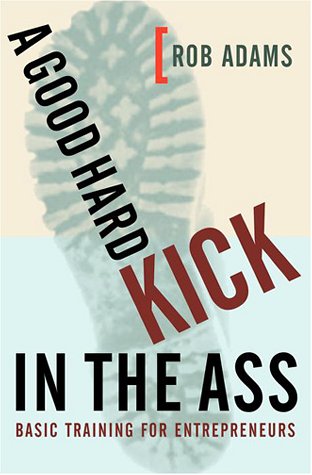
A hard-hitting handbook for would-be entrepreneurs offers straightforward advice and definitive guidelines on how to succeed in a highly competitive business environment. 25,000 first printing.
Die Inhaltsangabe kann sich auf eine andere Ausgabe dieses Titels beziehen.
Über die Autorin bzw. den Autor
Rob Adams is the founder and managing director of AV Labs, an early-stage venture fund providing financing, executive talent, and an acceleration process for technology startups. Prior to his venture career, he was a high-tech executive for eighteen years. He joined Lotus shortly after its IPO and was instrumental in launching Notes and 1-2-3 for Macintosh. He subsequently founded and was CEO of Business Matters, a venture-backed developer of financial forecasting and modeling products, and was an executive with Pervasive Software, a company he helped take public in 1997. For more information, visit www.avlabs.com.
Aus dem Klappentext
ob Adams helps entrepreneurs find true markets for their products, design solid business models, and hire great teams because that s what it takes to build a successful company. While this sounds self-evident, far too many entrepreneurs have forgotten these fundamentals. They ve been influenced by what Adams calls business porn, myths lingering like a bad hangover from the easy success days of the late 90s. These entrepreneurs believe a unique idea is the key to igniting a great business. They think their industry experience already makes them experts on customer needs. They have simplistic, self-defeating illusions about sales, marketing, financing, and more.
They say things like I have a million-dollar business idea for a new product. Wake up, says Adams: Good ideas are not scarce they re a dime a dozen. Businesses are successful not because of a unique idea but because of extraordinary execution. They offer a better, fas
Auszug. © Genehmigter Nachdruck. Alle Rechte vorbehalten.
First Kick
Good Ideas Are a Dime a Dozen
Nothing beats an ice-cold beer on a blazing hot day in Austin, Texas. And nothing leads entrepreneurs down more ratholes than the myth that good ideas are scarce. Both these facts were driven home to me one late summer evening, as I shared a round of draughts with Mike Turner and Mark McClain in the air-conditioned bar of Louie's 106, a local deal-making hot spot around the corner from our offices.
This was shortly after AV Labs got underway. Mike and Mark had started with us to pioneer the role of Venture Fellow, a position allowing experienced executives to mentor infant businesses while exploring their own startup ideas. Both ex-VPs at Tivoli Systems, they'd been hard at work trying to pinpoint an idea they could make fly in the marketplace. Together with Kevin Cunningham and Bill Kennedy, ex-Tivoli directors who'd agreed to be part of a new company, they'd been talking to people, researching the Internet, and reviewing industry analyst reports. So far, they hadn't found the right concept--but judging from the positive attitudes that flowed along with the cold beer that afternoon in Louie's, they were having a great time.
"We've coined a new term, Rob," said Mark, his gray eyes thoughtful behind wire-rimmed glasses. "Web-roaching."
"What's that?" I asked.
"We've been using the Internet to research different concepts. We've found out that the minute you hit on an idea you think is unique, four or five roaches scurry out from underneath a rock."
At that point Mike jumped in. "We thought we were really out there when we hit upon application firewalls. We figured, hey, what if you could fire up a Web-based application and partition it, then let different outsiders access only certain parts? We thought this was a really unique notion--until Kevin and I found five companies that were already doing it."
Now pretty fired up themselves, they told me they'd decided to pursue their one and only idea that seemed to be one-of-a-kind: the next great sensory input to the Internet. I must have looked confused (perhaps because I was). "Smell, Rob, smell," Mark explained. "Face it--we have sight, and we have sound. Now, the Internet needs smell. Our company will make it possible to point to something on the Internet and get an odor."
"Cool, huh?" said Mike, grinning as he watched the reaction on my face. Then they both started laughing. I was relieved to know these guys weren't serious about pursuing such an outlandish idea. Unique, undoubtedly, but totally off-the-wall. Of course nobody was doing this--and no wonder!
I knew Mike and Mark would soon find a way to put their talents to the entrepreneurial test. In the meantime, as we finished our beers, I promised to pass on any ideas that crossed my mind, and to watch for any interesting trends suggested by the press or analysts. You can imagine how we all laughed when, not long after, I plopped a Money magazine on the conference table at a meeting. In that issue, Money ran a story about a startup on the West Coast. That company's mission--you guessed it--was to provide olfactory input and output over the Internet.
Think your idea has to be unique? You're deluded.
If Mike and Mark's experience tells you anything, it should tell you this: There really is nothing new under the sun. You wouldn't believe how many would-be entrepreneurs believe otherwise. They come into our office and swear they've got some new, radically cool, killer idea. They expect us to be impressed. They're surprised, even offended, when we're not.
Even intelligent, aware, knowledgeable people--people like Mark and Mike--believe a good idea is like the Hope Diamond. A good idea, they think, is rare in its brilliance and perfection. It is utterly unique in the universe. To be successful, entrepreneurs are supposed to have an idea like that, aren't they?
No! The idea does not have to be unique. The idea itself is really not that big a deal.
It wasn't long before Mike and Mark perceived this for themselves. At Louie's that day, they'd already gotten a whiff (if you will) of the truth. I knew it was only a matter of time before they figured it out. I was right. "We spent a month," Mark now says, "trying to come up with an idea no one had thought of, something you couldn't find commercially. I have to say that honestly, it's hard to find, if not impossible. Ultimately, what we learned was, there is no new idea."
Mike, Mark, Kevin, and Bill went on to form Waveset Technologies, one of Austin's most promising startups. And--surprise, surprise--the idea they finally zeroed in on was similar to the firewall concept they'd discarded early on, when four or five "Web roaches" scurried out from underneath the rock. Using the Waveset solution, companies can give outside partners and customers Internet access to internal data and applications, while managing this access in a secure manner.
Unique? Not by a long shot. In fact, the Waveset team got wind of several competitors early on. (Those dang roaches, all over the place.) What distinguishes Waveset is not the idea. Something else entirely will propel this company beyond the competition. What's that? The team's execution intelligence. In this chapter, I will explore what I mean by "execution intelligence." You will learn an important lesson:
Good ideas are not scarce; what's rare is a team that can execute.
But before we dive in to that discussion, let's debunk the notion that good ideas are scarce, once and for all.
In love with your idea? Get over it. Ideas are commodities.
If you come see us at AV Labs, we'll be able to tell if you're wrapped around the axle on your idea. First, you'll ask us to sign a nondisclosure agreement. Then you'll claim you're going to be "first to market." Then you'll tell us you have "no competition." We'll probably continue to listen politely. But your credibility will be zero.
Let's talk a little bit about each of these entrepreneurial delusions--all sub-myths of the Big Lie that "a unique idea is the key to my success."
Want me to sign a nondisclosure? Instead, say: "I'm clueless."
If I had a nickel for every entrepreneur who's walked into my office and asked me to sign a nondisclosure agreement, I could chuck it all and move to Tahiti. Every time this happens, I see a huge red flag pop out of the top of their head: Warning! Careful! Don't go there!
Why is "Please sign a nondisclosure" such a turn-off to an investor? Because it screams out, "I'm stuck on my idea." We all have a finite amount of energy for anything. If you want a nondisclosure, that means you've spent way too much of your energy obsessing about the idea. It suggests you probably haven't thought enough about the team, which is what an investor is really interested in. It implies you haven't given much thought to your customers, or to the market. You've got stuck here: Nobody in the whole world has ever had a notion like mine. Which, plain and simple, tells me you probably haven't done your homework.
I'll say something like this: "Listen, if you think this is so unique, consider my 1:8:20 rule: For every entrepreneur with an idea in Austin, there are eight in Boston with the same idea, and twenty in the garages of Palo Alto (let alone the rest of Silicon Valley)."
My point is, ideas are far from scarce. They're a dime a dozen. They're mere commodities.
Nine times out of ten, even a cursory perusal of the Internet will prove this is so. Think you have a unique idea? C'mon, get off your rear end and do a simple Internet search, and just see what happens. Like...
„Über diesen Titel“ kann sich auf eine andere Ausgabe dieses Titels beziehen.
Suchergebnisse für A Good Hard Kick in the Ass: Basic Training for Entrepreneur...

Beispielbild für diese ISBN
A Good Hard Kick in the Ass: Basic Training for Entrepreneurs
Anbieter: World of Books (was SecondSale), Montgomery, IL, USA
Verkäuferbewertung 5 von 5 Sternen

Hardback. Zustand: Fair. Artikel-Nr. 00101425865
Gebraucht kaufen
EUR 4,57
Versand gratis
Versand innerhalb von USA
Versand innerhalb von USA
Anzahl: 1 verfügbar
Beispielbild für diese ISBN
A Good Hard Kick in the Ass: Basic Training for Entrepreneurs
Anbieter: World of Books (was SecondSale), Montgomery, IL, USA
Verkäuferbewertung 5 von 5 Sternen
Hardback. Zustand: Good. Artikel-Nr. 00103419112
Gebraucht kaufen
EUR 4,57
Versand gratis
Versand innerhalb von USA
Versand innerhalb von USA
Anzahl: 3 verfügbar
Beispielbild für diese ISBN
A Good Hard Kick in the Ass: Basic Training for Entrepreneurs
Verlag:
Crown Business (edition 1), 2002
ISBN 10: 0609609505
ISBN 13: 9780609609507
Gebraucht
Hardcover
Anbieter: BooksRun, Philadelphia, PA, USA
Verkäuferbewertung 5 von 5 Sternen
Hardcover. Zustand: Very Good. 1. With dust jacket. It's a well-cared-for item that has seen limited use. The item may show minor signs of wear. All the text is legible, with all pages included. It may have slight markings and/or highlighting. Artikel-Nr. 0609609505-8-1-29
Gebraucht kaufen
EUR 5,55
Versand gratis
Versand innerhalb von USA
Versand innerhalb von USA
Anzahl: 1 verfügbar
Beispielbild für diese ISBN
A Good Hard Kick in the Ass: Basic Training for Entrepreneurs
Anbieter: ThriftBooks-Atlanta, AUSTELL, GA, USA
Verkäuferbewertung 5 von 5 Sternen
Hardcover. Zustand: Very Good. No Jacket. Former library book; Missing dust jacket; May have limited writing in cover pages. Pages are unmarked. ~ ThriftBooks: Read More, Spend Less. Artikel-Nr. G0609609505I4N11
Gebraucht kaufen
EUR 6,14
Versand gratis
Versand innerhalb von USA
Versand innerhalb von USA
Anzahl: 1 verfügbar
Beispielbild für diese ISBN
A Good Hard Kick in the Ass: Basic Training for Entrepreneurs
Anbieter: ThriftBooks-Dallas, Dallas, TX, USA
Verkäuferbewertung 5 von 5 Sternen
Hardcover. Zustand: As New. No Jacket. Pages are clean and are not marred by notes or folds of any kind. ~ ThriftBooks: Read More, Spend Less. Artikel-Nr. G0609609505I2N00
Gebraucht kaufen
EUR 6,14
Versand gratis
Versand innerhalb von USA
Versand innerhalb von USA
Anzahl: 1 verfügbar
Beispielbild für diese ISBN
A Good Hard Kick in the Ass : Basic Training for Entrepreneurs
Verlag:
Crown Publishing Group, The, 2002
ISBN 10: 0609609505
ISBN 13: 9780609609507
Gebraucht
Hardcover
Erstausgabe
Anbieter: Better World Books, Mishawaka, IN, USA
Verkäuferbewertung 5 von 5 Sternen
Zustand: Very Good. 1st Edition. Pages intact with possible writing/highlighting. Binding strong with minor wear. Dust jackets/supplements may not be included. Stock photo provided. Product includes identifying sticker. Better World Books: Buy Books. Do Good. Artikel-Nr. 13167345-6
Gebraucht kaufen
EUR 6,37
Versand gratis
Versand innerhalb von USA
Versand innerhalb von USA
Anzahl: 2 verfügbar
Beispielbild für diese ISBN
A Good Hard Kick in the Ass: Basic Training for Entrepreneurs
Anbieter: WorldofBooks, Goring-By-Sea, WS, Vereinigtes Königreich
Verkäuferbewertung 5 von 5 Sternen
Paperback. Zustand: Very Good. The book has been read, but is in excellent condition. Pages are intact and not marred by notes or highlighting. The spine remains undamaged. Artikel-Nr. GOR006945017
Gebraucht kaufen
EUR 8,26
EUR 6,69 Versand
Versand von Vereinigtes Königreich nach USA
Versand von Vereinigtes Königreich nach USA
Anzahl: 2 verfügbar
Beispielbild für diese ISBN
A Good Hard Kick in the Ass: Basic Training for Entrepreneurs
Anbieter: Revaluation Books, Exeter, Vereinigtes Königreich
Verkäuferbewertung 5 von 5 Sternen
Hardcover. Zustand: Brand New. 1st edition. 290 pages. 10.00x6.50x1.25 inches. In Stock. Artikel-Nr. 0609609505
Neu kaufen
EUR 21,14
EUR 14,93 Versand
Versand von Vereinigtes Königreich nach USA
Versand von Vereinigtes Königreich nach USA
Anzahl: 1 verfügbar