
Verwandte Artikel zu What the Ceo Wants You to Know: How Your Company Really...
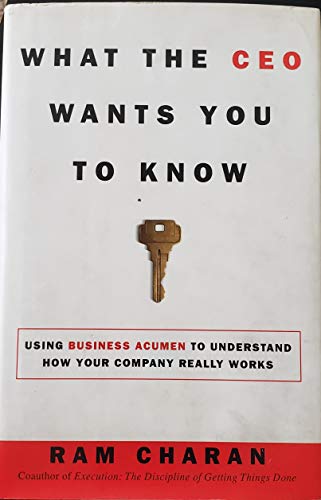
What the Ceo Wants You to Know: How Your Company Really Works: The Little Book of Big Business - Hardcover
Inhaltsangabe
An insider's guide to business describes how corporations work and reviews the critical elements of business success--growth, return on assets, rate of inventory turnover, understanding customers, and taking advantage of the changing marketplace. 75,000 first printing.
Die Inhaltsangabe kann sich auf eine andere Ausgabe dieses Titels beziehen.
Über die Autorin bzw. den Autor
Ram Charan is a highly sought adviser to CEOs and senior executives in companies ranging from start-ups to the Fortune 500, including GE, Ford, DuPont, EDS, Universal Studios, and Verizon. He is the author of Boards That Work and the coauthor of Every Business Is a Growth Business and E-Board Strategies. Dr. Charan has written numerous articles for Harvard Business Review and other publications, including the Fortune cover story "Why CEOs Fail."He has a D.B.A and an M.B.A. from Harvard Business School and has taught at Harvard and Northwestern. He won the best teacher award at Northwestern's Kellogg School and was recently elected a Fellow of the National Academy of Human Resources.
Aus dem Klappentext
The universal laws of business success . . . no matter whether you are selling fruit from a stand or running a Fortune 500 company.
Have you ever noticed that the business savvy of the world's best CEOs seems like a kind of street smarts? They sense where the opportunities are and how to take advantage of them. And their companies make money consistently, year after year.
How different is it to run a big company than to sell fruit from a cart or run a small shop in a village? In essence, not very, according to Ram Charan. From his childhood in India, where he worked in his family's shoe shop, to his education at Harvard Business School and his daily work advising many of the world's best CEOs, Ram understands business as few can.
The best CEOs have a knack for bringing the most complex business down to the fundamentals -- the same fundamentals of the family shoe shop. They have business acumen -- the ability to focus on the basics and make money for the company.
What the CEO Wants You to Know captures these insights and explains in clear, simple language how to do what great CEOs do instinctively and persistently:
* Understand the basic building blocks of a business and use them to figure out how your company makes money and operates as a total business.
* Decide what to do, despite the clutter of day-to-day business and the complexity of the real world.
Many people spend more than a hundred thousand dollars on an MBA without learning to pull these pieces of the puzzle together. Many others lack a formal business education and feel shut out from the executive suite. What the CEO Wants You to Know takes the mystery out of business and shows the secrets of success used by business legends like Jack Welch of GE.
Auszug. © Genehmigter Nachdruck. Alle Rechte vorbehalten.
Chapter 1
What Jack Welch and Street Vendors Share
The Essence of Business Thinking
Chances are that sometime in your life you passed through a city or town where people were selling goods from tables and carts right there on the street. Anywhere you go in the world, you can find street vendors hawking their wares. In Chicago, Mexico City, São Paulo, Bombay, Barcelona, San Francisco, New York. Anywhere.
If you bought something, you probably made your purchase quickly and went on your way. It didn't occur to you to talk to the street vendors about business. After all, what they do is very simple. What could you possibly learn from them?
But if you did talk with street vendors about how they make a living, you would notice something surprising. No matter where they live, what they sell, or what culture they come from, they talk about-and think about-their business in remarkably similar ways. They speak a universal language of business. They practice a universal law of business.
Even more surprising is that the street vendor's language is the same as Jack Welch's language (he's the chief executive officer of General Electric Company, named the best manager of the century by Fortune magazine) and Michael Dell's language (you've heard of Dell Computer) and Jac Nasser's language (CEO of Ford). It's the same as Jorma Ollila's (CEO of the Finnish company Nokia) and Nobuyuki Idei's (CEO of Sony).
In other words, when it comes to running a business successfully, the street vendor and the CEOs of some of the world's largest and most successful companies talk and think very much alike. There are differences, of course, between running a huge corporation and a small shop, and we'll get to those, but the fundamentals, or basics, of business are the same. People like Jack Welch, Michael Dell, and Jac Nasser manage and lead large numbers of people in huge, global organizations. They are often referred to as managers or leaders, but they think of themselves as businesspeople first, not unlike street vendors.
I know because I've been permitted to observe some of these business leaders and others like them firsthand. For more than three decades, I have had the privilege of working one-on-one with some of the most successful business leaders in the world, including Larry Bossidy, formerly of AlliedSignal; Dick Brown of EDS; John Cleghorn of Royal Bank of Canada; Chad Holliday of DuPont; Jac Nasser of Ford; John Reed, formerly of Citigroup; and Jack Welch of GE. I have seen the way their minds work, the way they cut through the largest and most complex issues to the fundamentals of business.
I learned those fundamentals as a child growing up in a small agricultural town in northern India. There I watched my father and uncle struggle to make a living selling shoes from their small shop, a joint family enterprise. With no experience and no formal training, they competed head to head against others in the town who were also trying to eke out a living. My family learned, and over time they built a name brand and earned the trust of the local farmers, who were their customers. Other shops have come and gone, but ours has flourished, and my nephews continue to run the shop to this day.
That shoe shop paid for my education and allowed me to venture far beyond my roots. At the age of nineteen, with an engineering degree in hand, I took a job at a gas utility company in Sydney, Australia. The CEO discovered that I had a nose for business, and I soon found myself devising marketing plans and pricing strategies instead of designing pipeline networks. My interest in business proved to be irrepressible, and that CEO encouraged me to go to Harvard Business School, where I earned an MBA and a doctorate, and where I later taught. Since then, I have had the opportunity to advise dozens of CEOs around the world and to teach business to thousands more.
In my early days of consulting, as I worked with businesses of different sizes, in different industries and different cultures, I was struck by the similarities among successful business leaders. I saw that regardless of the size or type of business, a good CEO had a way of bringing the most complex business down to the fundamentals-the same fundamentals I learned in the family shoe shop.
My experiences over the past few decades have convinced me beyond doubt that the same universal principles, or laws, underlie every business, from the street vendor's business, to the shoe shop, to the businesses run from the executive suites of the Fortune 50. The most successful business leaders never lose sight of the basics. Their intense focus on the fundamentals of business is, in fact, the secret to their success. Like the street vendor, they have a keen sense of how a business makes money. This ability to apply the universal laws of business is what I call business acumen.
Remember Your Roots
Many successful CEOs have had experiences early in their lives similar to that of a street vendor, giving root to their business thinking. Jac Nasser of Ford first made his living in his family's small business. Think of the challenges a small business owner faces. He has to decide what customers to try to attract and how to draw them in, what items to provide and how to price them, what raw ingredients to buy and how much to pay for them, what kind of atmosphere to offer and how to create it, and he has to put in long, long hours. If he makes a profit, saves some money, and has the right people around him, he can grow the business. Every decision matters.
The family business is where Jac Nasser learned the universal language of business and first tested his business acumen. He now speaks the same language at Ford, the second-largest automotive company in the world.
Do you speak the universal language of business? Do you understand the fundamental laws that underlie every business? Do you have business acumen?
Chances are, you've built your career in one area of your company, such as sales, finance, or production. These areas, generally known as business functions, are sometimes also called chimneys or silos. That's because most people take their first job at a corporation in one business function and move up within that function as they get promoted. Thus it appears as if they're moving vertically through a chimney or silo.
Such career tracks tend to narrow your perspective and influence the decisions and trade-offs you make every day. What's best for your department or function is not necessarily best for the company as a whole. You may be a top-notch professional-good at marketing or engineering or financial analysis-but are you really a businessperson? Regardless of your job, department, or chimney, you need to develop your business acumen.
As you learn to see your company as a total business and make decisions that enhance its overall performance, you will help make meetings less bureaucratic, more focused on the business issues. Time will go quickly, as it does when discussions are constructive and energizing. You'll get more excited about your job because you'll see that your suggestions and decisions help the business grow and prosper. You'll have a greater sense of purpose, and your capacity will increase.
Developing your business acumen will make you feel rejuvenated, like when you were a kid having fun making money for the first time-or like Michael Dell, who instinctively focused on the right things and created tremendous value for shareholders. Fifteen years ago, he was running a mail-order computer business out of his college dorm room. In June 2000, Dell Computer was worth some $130 billion.
When you learn to speak the universal language of business, you can have meaningful discussions with anyone in the company, at any level. You'll tear down the walls that separate you, a functional chimney...
„Über diesen Titel“ kann sich auf eine andere Ausgabe dieses Titels beziehen.
Weitere beliebte Ausgaben desselben Titels

Suchergebnisse für What the Ceo Wants You to Know: How Your Company Really...

Beispielbild für diese ISBN
What the CEO Wants You to Know
Anbieter: World of Books (was SecondSale), Montgomery, IL, USA
Verkäuferbewertung 5 von 5 Sternen

Zustand: Good. Item in good condition. Textbooks may not include supplemental items i.e. CDs, access codes etc. Artikel-Nr. 00057539345
Gebraucht kaufen
EUR 3,43
Versand gratis
Versand innerhalb von USA
Versand innerhalb von USA
Anzahl: Mehr als 20 verfügbar
Beispielbild für diese ISBN
What the CEO Wants You to Know : How Your Company Really Works
Anbieter: World of Books (was SecondSale), Montgomery, IL, USA
Verkäuferbewertung 5 von 5 Sternen
Zustand: Good. Item in good condition. Textbooks may not include supplemental items i.e. CDs, access codes etc. Artikel-Nr. 00061901445
Gebraucht kaufen
EUR 3,59
Versand gratis
Versand innerhalb von USA
Versand innerhalb von USA
Anzahl: Mehr als 20 verfügbar
Beispielbild für diese ISBN
What the CEO Wants You to Know : How Your Company Really Works
Anbieter: World of Books (was SecondSale), Montgomery, IL, USA
Verkäuferbewertung 5 von 5 Sternen
Zustand: Acceptable. Item in acceptable condition! Textbooks may not include supplemental items i.e. CDs, access codes etc. Artikel-Nr. 00098099292
Gebraucht kaufen
EUR 3,59
Versand gratis
Versand innerhalb von USA
Versand innerhalb von USA
Anzahl: 1 verfügbar
Beispielbild für diese ISBN
What the CEO Wants You to Know : How Your Company Really Works
Anbieter: World of Books (was SecondSale), Montgomery, IL, USA
Verkäuferbewertung 5 von 5 Sternen
Zustand: Very Good. Item in very good condition! Textbooks may not include supplemental items i.e. CDs, access codes etc. Artikel-Nr. 00106692155
Gebraucht kaufen
EUR 3,59
Versand gratis
Versand innerhalb von USA
Versand innerhalb von USA
Anzahl: 6 verfügbar
Beispielbild für diese ISBN
What the CEO Wants You to Know : How Your Company Really Works
Verlag:
Crown Business (edition 1), 2001
ISBN 10: 0609608398
ISBN 13: 9780609608395
Gebraucht
Hardcover
Anbieter: BooksRun, Philadelphia, PA, USA
Verkäuferbewertung 5 von 5 Sternen
Hardcover. Zustand: Very Good. 1. With dust jacket. It's a well-cared-for item that has seen limited use. The item may show minor signs of wear. All the text is legible, with all pages included. It may have slight markings and/or highlighting. Artikel-Nr. 0609608398-8-6-29
Gebraucht kaufen
EUR 4,62
Versand gratis
Versand innerhalb von USA
Versand innerhalb von USA
Anzahl: 1 verfügbar
Beispielbild für diese ISBN
What the CEO Wants You to Know : How Your Company Really Works
Anbieter: ThriftBooks-Atlanta, AUSTELL, GA, USA
Verkäuferbewertung 5 von 5 Sternen
Hardcover. Zustand: As New. No Jacket. Pages are clean and are not marred by notes or folds of any kind. ~ ThriftBooks: Read More, Spend Less. Artikel-Nr. G0609608398I2N00
Gebraucht kaufen
EUR 5,77
Versand gratis
Versand innerhalb von USA
Versand innerhalb von USA
Anzahl: 1 verfügbar
Beispielbild für diese ISBN
What the CEO Wants You to Know : How Your Company Really Works
Anbieter: ThriftBooks-Atlanta, AUSTELL, GA, USA
Verkäuferbewertung 5 von 5 Sternen
Hardcover. Zustand: Very Good. No Jacket. May have limited writing in cover pages. Pages are unmarked. ~ ThriftBooks: Read More, Spend Less. Artikel-Nr. G0609608398I4N00
Gebraucht kaufen
EUR 5,77
Versand gratis
Versand innerhalb von USA
Versand innerhalb von USA
Anzahl: 1 verfügbar
Beispielbild für diese ISBN
What the CEO Wants You to Know : How Your Company Really Works
Anbieter: ThriftBooks-Dallas, Dallas, TX, USA
Verkäuferbewertung 5 von 5 Sternen
Hardcover. Zustand: Very Good. No Jacket. Former library book; May have limited writing in cover pages. Pages are unmarked. ~ ThriftBooks: Read More, Spend Less. Artikel-Nr. G0609608398I4N10
Gebraucht kaufen
EUR 5,77
Versand gratis
Versand innerhalb von USA
Versand innerhalb von USA
Anzahl: 1 verfügbar
Beispielbild für diese ISBN
What the CEO Wants You to Know : How Your Company Really Works
Anbieter: ThriftBooks-Reno, Reno, NV, USA
Verkäuferbewertung 5 von 5 Sternen
Hardcover. Zustand: Very Good. No Jacket. May have limited writing in cover pages. Pages are unmarked. ~ ThriftBooks: Read More, Spend Less. Artikel-Nr. G0609608398I4N00
Gebraucht kaufen
EUR 5,77
Versand gratis
Versand innerhalb von USA
Versand innerhalb von USA
Anzahl: 1 verfügbar
Beispielbild für diese ISBN
What the CEO Wants You to Know : How Your Company Really Works
Anbieter: ThriftBooks-Phoenix, Phoenix, AZ, USA
Verkäuferbewertung 5 von 5 Sternen
Hardcover. Zustand: Very Good. No Jacket. May have limited writing in cover pages. Pages are unmarked. ~ ThriftBooks: Read More, Spend Less. Artikel-Nr. G0609608398I4N00
Gebraucht kaufen
EUR 5,77
Versand gratis
Versand innerhalb von USA
Versand innerhalb von USA
Anzahl: 1 verfügbar