
Verwandte Artikel zu The Babel Effect
Inhaltsangabe
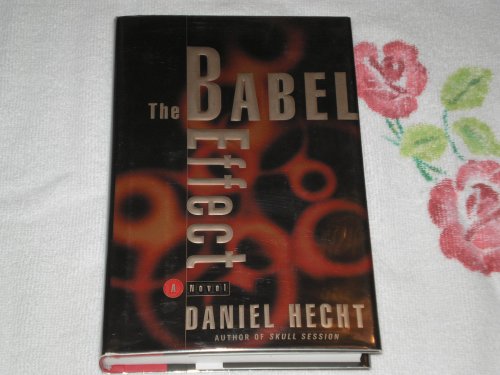
Is violence a virus? Can your genes make you a killer? Why are we so willing to hurt each other? In The Babel Effect, the husband-and-wife research team of Ryan and Jessamine McCloud are charged with answering these urgent questions. Beginning as a neurological study of murderers on death row, their research explodes into an investigation into the biomedical foundations of human history. The quest takes them from prison cells to research labs to war zones throughout the world and forces them to doubt their most basic assumptions about the human species, about themselves, and about their marriage.
Combining systems theory with modern epidemiology, they soon learn that our propensity for violence resembles a contagious disease. But is the human carnage of the last hundred years an ancient plague or a new nightmare? Can they identify the cause and find a cure? As their discoveries reveal frightening secrets about multinational corporations, clandestine military programs, and millennial religious cults, they realize that finding the answers depends on a still more urgent and terrifying question: Can they survive the search?
When an unknown enemy steals their data and abducts Jessamine, the FBI investigation stalls, and Ryan realizes that it is up to him alone to find his pregnant wife. He soon finds that to learn where she is, he must discover who she is - and confront the question of whether we can ever really know the one we love.
Die Inhaltsangabe kann sich auf eine andere Ausgabe dieses Titels beziehen.
Über die Autorin bzw. den Autor
Before becoming a writer, Daniel Hecht spent twenty years as a guitarist, a musical career that included albums on Windham Hill Records, concerts at Carnegie Hall, and international performance tours. His first novel, <b>Skull Session</b>, was published throughout the world to broad acclaim. He now lives in Vermont.
Aus dem Klappentext
imaginative depth and narrative power of Michael Crichton's Timeline or Jurassic Park, <b>The Babel Effect</b> is an electrifying, thinking person's thriller based on cutting-edge neurological and genetic research. From the author of the widely acclaimed <b>Skull Session</b>, <b>The Babel Effect</b> artfully brings the speculative thriller to new literary heights.<br><br>Is violence a virus? Can your genes make you a killer? Why are we so willing to hurt each other? In <b>The Babel Effect</b>, the brilliant husband-and-wife research team of Ryan and Jessamine McCloud are charged with answering these urgent questions. Beginning as a neurological study of murderers on death row, their research explodes into an investigation into the biomedical foundations of human history. The quest takes them from prison cells to research labs to war zones throughout the world and forces them to doubt their most basic assumptions about the human species, about themselves, and a
Auszug. © Genehmigter Nachdruck. Alle Rechte vorbehalten.
Chapter 1
Friday, May 3, 2001
Jess had been born with a hole in her heart-a ventricular septal defect. It had been surgically repaired when she was two years old, but Ryan often thought that in some ways it had never really closed: Thirty-six years later, she seemed to carry an opening in her heart, both a wound and a window. He could feel it in her now, as she came up behind him and wrapped her arms around his chest. In the pressure of her body against his back he could feel the deep gentle beat, an unexpected intimacy.
"All set," Leap announced happily. He rolled his chair over, bringing a wireless keyboard and mouse.
Marshall came to stand next to Jess, along with Silvia Sorbanelli and her colleagues from the American Forensic Psychology Association. Leap tapped a command. On the big monitor, what looked like a single raindrop fell onto a smooth surface, sending decaying ripples out from the center of the screen. Beautiful, tranquil, almost hypnotic.
"This is the most basic stage," Leap explained. "We started with a simple energy dispersion pattern, a ripple of energy moving outward from an epicenter."
Dr. Sorbanelli nodded appreciatively. "Nice graphics," she said. "Has this . . . system . . . got a name?"
"RAINDROP." Leap was looking happy, a proud father showing off his baby. "Not an acronym, just a little poetic license."
They were in the windowless control room of Leap's data-processing lab, back under the bluff at Genesis headquarters. Through a glass wall, they could see the RAID cabinets and other rack-mounted hardware of Argus, Leap's computer, LEDs blinking erratically. The air in the control room had a zoo smell because Leap kept his ferret, Sneaky Pete, in a cage on one of the counters.
Marshall had flown in from Stanford to join the Genesis people and Dr. Sorbanelli for the first of the death-row interviews and some further discussion of the forensic neuropsychology project. It was a good chance for the AFPA to get to know the Genesis organization on a more informal basis, so Jess had played hostess, walking Dr. Sorbanelli and her colleagues through the house and then down the long outside stairs to the offices. Finally they had come back here to Leap's subterranean lair to show off RAINDROP, now entering the wrap-up stage.
Silvia Sorbanelli had graying hair and patrician features appropriate to her towering reputation in neuropsychology. She had come with two associates: a pretty Asian woman with a quiet, self-effacing manner, and a man in his late fifties with penetrating eyes and a sharp little smile. Though Ryan hadn't caught his name, he kept thinking he should recognize that slab-cheeked face, more like a big-city ward boss or a Kremlin heavy than a scientist.
On the screen another drop fell, this time causing some splashes nearby as droplets flew and set up their own rings of ripples.
"The plot thickens." Leap leaned forward to point out the secondary splashes, chewing his gum rapidly. Nicotine gum, Ryan knew, and not because Leap had ever smoked-he just liked the buzz.
Jess explained: "The commission is from a consortium of state health departments-Utah, Colorado, Arizona, and New Mexico. Really, the impetus for the project came from the first incident, back in 1993-you remember, a mysterious disease outbreak in New Mexico, in the Four Corners region? Very high fatality rates?"
"Sure," Silvia Sorbanelli said. "The 'Navajo flu.'"
"Not very flattering to the Navajos, but yes, that's the one. Ultimately the bug was called the Sin Nombre virus-'No Name.' A previously unknown hantavirus that caused fever, swelling of the heart lining, and acute fluid buildup in the lungs."
"Didn't the CDC eventually trace the virus to mice?"
"Exactly-the southwestern deermouse. The virus was transmitted to humans through evaporated mouse urine. Another epidemic of the same bug cropped up in Argentina in 1996. Then the really bad one in Arizona, in '99-two hundred fatalities in two weeks. Still the rodent reservoir, but this time a form of the virus that could be transmitted from person to person-much more dangerous. There was real danger of nationwide dispersion."
Leap took his show to the next level. On the screen, the surface of the virtual water began to change. A map emerged, showing the lines of highways, wandering veins of rivers, blocks of city streets.
Ryan took up the role of tour guide: "So, after the '99 outbreak, the Four Corners states came to us and said, 'Give us a predictive tool, a way to model dispersion patterns for disease outbreaks-fast.' When the next epidemic comes, they want a way to jump all over the first few cases and predict the disease's spread with real accuracy. Something that'll give health departments the chance to take rapid response measures-inoculation, sanitation, quarantine, whatever."
On the screen, a drop fell onto the city map. This time, instead of neat rings, the ripples spread out in an irregular star-shaped pattern, drawn down the lines of streets, filling in blocks as they came to densely populated areas. Secondary droplets spattered here and there, setting off their own ripples.
"Jesus," the slab-cheeked man exclaimed. "Looks like a, a giant amoeba, eating-"
"Eating Phoenix, Arizona," Leap told him. "Yeah. But even this is still very rudimentary."
The AFPA people were unlikely to know the systems math, so Ryan explained. "The analogy to fluid dynamics works only to a point. Ultimately, to model it right, you've got to factor in anything that puts people into contact with each other or with the source of the virus. That means we have to plug in public transportation routes, commuting patterns, workplace contacts, school districts, church attendance, air service to other cities, product shipments-you name it. Thousands of variables."
Ryan covertly watched Marshall's response. RAINDROP was the product of a collaboration between Marsh's people and the Genesis team, but this was his first glimpse of the graphics. Now Marsh adjusted his wire-rimmed glasses, swept his hair back, leaned in eagerly, all indications he was pleased. A good sign-as director of research at the world-renowned Brandt Institute, Marshall Fahey wasn't easily impressed.
Dr. Sorbanelli nodded appreciatively, and her red-faced colleague looked impressed, too. Seeing his shark's grin, half-familiar, Ryan wondered again, Who the hell is this guy?
"Wouldn't have been possible only a few years ago," Leap said. "But now we've got the math and the demographic databases. Most of all, the computing capacity. Even my rig isn't up to the heavy stuff. We're designing this program for the national defense supercomputers at Sandia. But here we go-this is our re-creation of the actual outbreak of 1999."
Leap pecked around and the map expanded to include the whole central section of Arizona. The first drop fell on Phoenix, and the amoeba began grabbing the region with arms of different lengths and thicknesses. Abruptly, secondary splashes of different colors dimpled the map, also expanding until the screen became a scintillating mass of overlapping waves and rings in rainbow hues. Red dots began to speckle the scene: fatalities. They were all silent for a moment, drawn into the mesmerizing complexity of movement and color.
"By this point, we've entered the domain of chaos theory," Ryan said. "Can you bring in the phase-space graphics, Leap?"
Leap tinkered briefly, and the screen changed. Now a geometric figure danced in space, like a hollow wire sculpture made of thousands of graceful...
„Über diesen Titel“ kann sich auf eine andere Ausgabe dieses Titels beziehen.
Suchergebnisse für The Babel Effect

Beispielbild für diese ISBN
The Babel Effect
Anbieter: World of Books (was SecondSale), Montgomery, IL, USA
Verkäuferbewertung 5 von 5 Sternen

Zustand: Very Good. Item in very good condition! Textbooks may not include supplemental items i.e. CDs, access codes etc. Artikel-Nr. 00102355891
Gebraucht kaufen
EUR 5,69
Versand gratis
Versand innerhalb von USA
Versand innerhalb von USA
Anzahl: 1 verfügbar
Beispielbild für diese ISBN
The Babel Effect
Anbieter: World of Books (was SecondSale), Montgomery, IL, USA
Verkäuferbewertung 5 von 5 Sternen
Zustand: Good. Item in good condition. Textbooks may not include supplemental items i.e. CDs, access codes etc. Artikel-Nr. 00107109687
Gebraucht kaufen
EUR 5,69
Versand gratis
Versand innerhalb von USA
Versand innerhalb von USA
Anzahl: 1 verfügbar
Beispielbild für diese ISBN
The Babel Effect : A Novel
Verlag:
Crown Publishing Group, The, 2000
ISBN 10: 0609607294
ISBN 13: 9780609607299
Gebraucht
Hardcover
Erstausgabe
Anbieter: Better World Books, Mishawaka, IN, USA
Verkäuferbewertung 5 von 5 Sternen
Zustand: Good. 1st. Former library copy. Pages intact with minimal writing/highlighting. The binding may be loose and creased. Dust jackets/supplements are not included. Includes library markings. Stock photo provided. Product includes identifying sticker. Better World Books: Buy Books. Do Good. Artikel-Nr. GRP58736236
Gebraucht kaufen
EUR 6,92
Versand gratis
Versand innerhalb von USA
Versand innerhalb von USA
Anzahl: 3 verfügbar
Beispielbild für diese ISBN
The Babel Effect
Verlag:
Crown (edition First Edition), 2000
ISBN 10: 0609607294
ISBN 13: 9780609607299
Gebraucht
Hardcover
Erstausgabe
Anbieter: BooksRun, Philadelphia, PA, USA
Verkäuferbewertung 5 von 5 Sternen
Hardcover. Zustand: Very Good. First Edition. With dust jacket. It's a well-cared-for item that has seen limited use. The item may show minor signs of wear. All the text is legible, with all pages included. It may have slight markings and/or highlighting. Artikel-Nr. 0609607294-11-1-29
Gebraucht kaufen
EUR 7,15
Versand gratis
Versand innerhalb von USA
Versand innerhalb von USA
Anzahl: 1 verfügbar
Foto des Verkäufers
The Babel Effect
Verlag:
Crown, 2000
ISBN 10: 0609607294
ISBN 13: 9780609607299
Gebraucht
Hardcover
Erstausgabe
Signiert
Anbieter: ThriftBooksVintage, Tukwila, WA, USA
Verkäuferbewertung 5 von 5 Sternen
Hardcover. Zustand: Very Good. No Jacket. First Edition. First edition, first printing. SIGNED by the author. Minor shelf and handling wear, overall a clean solid copy with minimal signs of use. Binding is tight and structurally sound. Clean interior pages. Secure packaging for safe delivery. signed by author. Artikel-Nr. 1855558577
Gebraucht kaufen
EUR 21,13
Versand gratis
Versand innerhalb von USA
Versand innerhalb von USA
Anzahl: 1 verfügbar
Foto des Verkäufers
The Babel Effect
Verlag:
Crown, 2000
ISBN 10: 0609607294
ISBN 13: 9780609607299
Gebraucht
Hardcover
Erstausgabe
Signiert
Anbieter: ThriftBooksVintage, Tukwila, WA, USA
Verkäuferbewertung 5 von 5 Sternen
Hardcover. Zustand: Very Good. No Jacket. First Edition. First edition, first printing. SIGNED by the author. Minor shelf and handling wear, overall a clean solid copy with minimal signs of use. Binding is tight and structurally sound. Clean interior pages. Secure packaging for safe delivery. signed by author. Artikel-Nr. 1855558579
Gebraucht kaufen
EUR 21,13
Versand gratis
Versand innerhalb von USA
Versand innerhalb von USA
Anzahl: 1 verfügbar
Foto des Verkäufers
The Babel Effect
Verlag:
Crown, 2000
ISBN 10: 0609607294
ISBN 13: 9780609607299
Gebraucht
Hardcover
Erstausgabe
Signiert
Anbieter: ThriftBooksVintage, Tukwila, WA, USA
Verkäuferbewertung 5 von 5 Sternen
Hardcover. Zustand: Very Good. No Jacket. First Edition. First edition, first printing. SIGNED by the author. Minor shelf and handling wear, overall a clean solid copy with minimal signs of use. Binding is tight and structurally sound. Clean interior pages. Secure packaging for safe delivery. signed by author. Artikel-Nr. 1855558578
Gebraucht kaufen
EUR 21,13
Versand gratis
Versand innerhalb von USA
Versand innerhalb von USA
Anzahl: 1 verfügbar
Foto des Verkäufers
The Babel Effect
Verlag:
Crown Publishers, New York, 2001
ISBN 10: 0609607294
ISBN 13: 9780609607299
Gebraucht
Hardcover
Erstausgabe
Signiert
Anbieter: Between the Covers-Rare Books, Inc. ABAA, Gloucester City, NJ, USA
Verkäuferbewertung 5 von 5 Sternen
Hardcover. Zustand: Fine. Zustand des Schutzumschlags: Fine. First Edition. First edition. Fine in fine dustwrapper. Signed by the author. Although not marked in any way, this copy is from the distinguished modern first edition collection of Bruce Kahn. Signed. Artikel-Nr. 297829
Gebraucht kaufen
EUR 25,72
EUR 4,90 Versand
Versand innerhalb von USA
Versand innerhalb von USA
Anzahl: 1 verfügbar
Foto des Verkäufers
The Babel Effect; - 1st Edition/1st Printing
Verlag:
Crown Publishers, New York, 2001
ISBN 10: 0609607294
ISBN 13: 9780609607299
Gebraucht
Hardcover
Erstausgabe
Signiert
Anbieter: Books Tell You Why - ABAA/ILAB, Summerville, SC, USA
Verkäuferbewertung 2 von 5 Sternen

Hardcover. Zustand: Fine. Zustand des Schutzumschlags: Fine. First Edition; First Printing. A handsome first edition/first printing in Fine condition in Fine dust-jacket. Signed by author Daniel Hecht directly on the title page; is a novel set in a future world in which the human language has fragmented into dozens of dialects.When the protagonist, a linguistics student, is assigned to help document the dialects of a small, isolated village, he soon realizes that the village is in trouble. The villagers are unable to communicate with one another, and are slowly losing the ability to think and reason in their own language. The protagonist must use his linguistic skills to restore the village's lost culture and save it from disappearing forever.; 8vo; Signed by Author. Artikel-Nr. 17008
Gebraucht kaufen
EUR 36,74
Versand gratis
Versand innerhalb von USA
Versand innerhalb von USA
Anzahl: 1 verfügbar