
Verwandte Artikel zu Way We Lived Then: Recollections of a Well-Known Name...
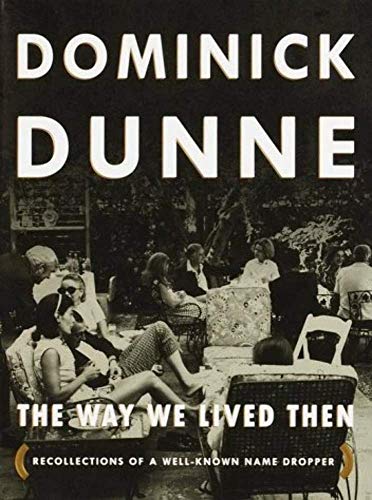
Way We Lived Then: Recollections of a Well-Known Name Dropper: The Recollections of a Well-Known Name Dropper - Hardcover
Inhaltsangabe
The best-selling author of Another City, Not My Own presents an entertaining scrapbook of his career in 1960s Hollywood, combining 150 black-and-white photographs and anecdotes to recapture the people and events that marked the era. 150,000 first printing.
Die Inhaltsangabe kann sich auf eine andere Ausgabe dieses Titels beziehen.
Über die Autorin bzw. den Autor
Dominick Dunne is the author of five best-selling novels and two collections of essays, as well as a Special Correspondent to Vanity Fair magazine. He lives in New York City and Hadlyme, Connecticut.
Aus dem Klappentext
revelatory text combines with more than two hundred photographs -- most of them taken by the author -- in a startling illustrated memoir that will both astonish and move you.
When Dominick Dunne lived and worked in Hollywood, he had it all: a beautiful family, a glamorous career, and the friendship of the talented and powerful. He also had a camera and loved to take pictures. These photographs, which Dunne carefully preserved in more than a dozen leatherbound scrapbooks -- along with invitations, telegrams, personal notes, and other memorabilia -- record the parties, the glittering receptions, the society weddings, and scenes from the everyday lives of the Dunnes and those they knew, including Jane Fonda, Frank Sinatra, Paul Newman, Roddy McDowall, Elizabeth Taylor, Natalie Wood, Brooke Hayward, Jennifer Jones, and David Selznick. You'll meet them all in this fascinating book -- captured in snapshots as these celebrities relax at poolside barbecues, gossip at cozy get-togethers and dance
Auszug. © Genehmigter Nachdruck. Alle Rechte vorbehalten.
When I was nine years old and growing up in Hartford, Connecticut, a city that I knew from the age of four would not be the city of my life, my aunt Harriet, my mother's sister, a maiden lady as well as a former Catholic nun who quit the convent--a subject that fascinated my brothers, sisters, and me, although it was a subject that was never discussed by my parents--took me on a trip out west that summer. Our first stop was Los Angeles. For me, it was a breathtaking experience. I had always been starstruck, one of those kids who preferred movie star magazines to baseball cards. I believed everything I read in them. I believed that Paulette Goddard did something unspeakable to the director Anatole Litvak under the nightclub table at Mocambo. I believed that Louis B. Mayer, the all-powerful head of MGM, had taken Paul Bern's suicide note--"Forgive me for last night," he wrote to his bride, Jean Harlow, MGM's great star--out of Jean's hands and destroyed it before the police got to the scene. I believed that Lana Turner had been discovered by Mervyn LeRoy at the counter of Schwab's, the famous drugstore on the Sunset Strip.
On the tour bus that took us to the movie star homes, I sat right next to the guide so I wouldn't miss anything; actually I knew more about the stars than the guide did, although he knew all their addresses. For years afterward I could remember their streets and their houses. Shirley Temple lived on Rockingham in Brentwood, just a few houses away from where O. J. Simpson lived years later at the time of the murders of Nicole Brown Simpson and Ronald Goldman; Deanna Durbin lived on Amalfi Drive in a house where Steve Bochco, the television mogul, later lived. Clark Gable and Carole Lombard lived in a house on the flats of Beverly Hills, right up to the time she was killed in an air crash while on a bond-selling tour in the early days of World War II; Mary Pickford lived at Pickfair, behind ducal gates, but you couldn't see her house from the street. Jean Harlow, who was soon to die at the age of twenty-six at the peak of her MGM stardom, lived in a big white movie star house on Beverly Glen. I remembered stuff like that.
We went to the Brown Derby for lunch and had Cobb salad, which was a specialty of the house. The Brown Derby was built in the shape of a derby. I already knew that Louella Parsons and Barbara Stanwyck often lunched there, but they weren't there that day, much to my disappointment. We went to Schwab's, and I tried to imagine on which stool Lana Turner had been sitting when she was discovered by Mervyn LeRoy. Schwab's was full of starlets drinking coffee at the counter, buying makeup, and reading what I learned were the trade papers, the Hollywood Reporter and Daily Variety. It was perfect. We stayed at the Ambassador Hotel on Wilshire Boulevard, which was at that time the best place to be staying. One night we had dinner at the Coconut Grove, the famous nightclub at the Ambassador, where glamorous women wore evening dresses and gardenia corsages. Eddie Duchin's orchestra played, and Eddie, who was in a white dinner jacket and had a deep tan, looked like a million bucks leading the band. The next day in the Ambassador pool, Eddie Duchin spoke to me. He was the first celebrity I ever talked to, and I can still remember the whole conversation. He told me I should put suntan lotion on my freckling shoulders. I was tongue-tied. I could only mumble, "Thank you." Later I learned that his wife had died after childbirth. Eddie Duchin's son, Peter, grew up to be a famous bandleader himself, as well as a friend. Peter's second wife, Brooke Hayward, appears in this book during the time of her earlier marriage to the actor Dennis Hopper.
The rest of the trip out west with Aunt Harriet was a bit of an anticlimax for me after my five days in Hollywood. I had fallen in love with a place. I knew that Los Angeles was going to play an important part in my life. I also knew with the certainty of a child with a vision that the day would come when I would walk in the front doors of the houses I had peered at from the tour bus window.
Hartford was a terrible letdown after Los Angeles. My family's position in Hartford then was perplexing to me, and I used to think that all of my problems would be solved if only I could be an Episcopalian. We were the big-deal Irish Catholic family in a WASP city. My brother, the writer John Gregory Dunne, once wrote that we'd gone from steerage to suburbs in three generations, which was pretty accurate. A school was named after my grandfather, Dominick Burns, who made his fortune in the grocery business and later became a bank president. I always played down the grocery part of his life and played up the bank president part, but the bucks came from the grocery store. He never forgot that he had been born poor, and giving to the poor was a mainstay of his life. My mother and my aunt sometimes feared there'd be nothing left if he kept giving away so much, but it was a source of great pride in our family when he was made a papal knight by Pope Pius XII for his philanthropic work for the poor of Hartford. My father was a famous heart surgeon, who had received medical acclaim for an operation on a twelve-year-old boy whose heart he held in his hand while removing a bullet. The boy lived.
„Über diesen Titel“ kann sich auf eine andere Ausgabe dieses Titels beziehen.
Suchergebnisse für Way We Lived Then: Recollections of a Well-Known Name...

Beispielbild für diese ISBN
The Way We Lived Then: The Recollections of a Well-Known Name Dropper
Anbieter: World of Books (was SecondSale), Montgomery, IL, USA
Verkäuferbewertung 5 von 5 Sternen

Hardback. Zustand: Good. Artikel-Nr. 00107246507
Gebraucht kaufen
EUR 5,98
Versand gratis
Versand innerhalb von USA
Versand innerhalb von USA
Anzahl: 12 verfügbar
Beispielbild für diese ISBN
The Way We Lived Then: The Recollections of a Well-Known Name Dropper
Anbieter: World of Books (was SecondSale), Montgomery, IL, USA
Verkäuferbewertung 5 von 5 Sternen
Hardback. Zustand: Very Good. Artikel-Nr. CIN0609603884VG
Gebraucht kaufen
EUR 5,98
Versand gratis
Versand innerhalb von USA
Versand innerhalb von USA
Anzahl: 1 verfügbar
Beispielbild für diese ISBN
The Way We Lived Then: The Recollections of a Well-Known Name Dropper
Anbieter: World of Books (was SecondSale), Montgomery, IL, USA
Verkäuferbewertung 5 von 5 Sternen
Hardback. Zustand: Fair. Artikel-Nr. 00102013772
Gebraucht kaufen
EUR 5,98
Versand gratis
Versand innerhalb von USA
Versand innerhalb von USA
Anzahl: 5 verfügbar
Beispielbild für diese ISBN
The Way We Lived Then : Recollections of a Well-Known Name Dropper
Anbieter: ThriftBooks-Reno, Reno, NV, USA
Verkäuferbewertung 5 von 5 Sternen
Hardcover. Zustand: Good. No Jacket. Pages can have notes/highlighting. Spine may show signs of wear. ~ ThriftBooks: Read More, Spend Less. Artikel-Nr. G0609603884I3N00
Gebraucht kaufen
EUR 5,99
Versand gratis
Versand innerhalb von USA
Versand innerhalb von USA
Anzahl: 2 verfügbar
Beispielbild für diese ISBN
The Way We Lived Then : Recollections of a Well-Known Name Dropper
Anbieter: ThriftBooks-Phoenix, Phoenix, AZ, USA
Verkäuferbewertung 5 von 5 Sternen
Hardcover. Zustand: Fair. No Jacket. Readable copy. Pages may have considerable notes/highlighting. ~ ThriftBooks: Read More, Spend Less. Artikel-Nr. G0609603884I5N00
Gebraucht kaufen
EUR 5,99
Versand gratis
Versand innerhalb von USA
Versand innerhalb von USA
Anzahl: 1 verfügbar
Beispielbild für diese ISBN
The Way We Lived Then : Recollections of a Well-Known Name Dropper
Anbieter: ThriftBooks-Atlanta, AUSTELL, GA, USA
Verkäuferbewertung 5 von 5 Sternen
Hardcover. Zustand: As New. No Jacket. Pages are clean and are not marred by notes or folds of any kind. ~ ThriftBooks: Read More, Spend Less. Artikel-Nr. G0609603884I2N00
Gebraucht kaufen
EUR 5,99
Versand gratis
Versand innerhalb von USA
Versand innerhalb von USA
Anzahl: 1 verfügbar
Beispielbild für diese ISBN
The Way We Lived Then : Recollections of a Well-Known Name Dropper
Anbieter: ThriftBooks-Dallas, Dallas, TX, USA
Verkäuferbewertung 5 von 5 Sternen
Hardcover. Zustand: Fair. No Jacket. Readable copy. Pages may have considerable notes/highlighting. ~ ThriftBooks: Read More, Spend Less. Artikel-Nr. G0609603884I5N00
Gebraucht kaufen
EUR 5,99
Versand gratis
Versand innerhalb von USA
Versand innerhalb von USA
Anzahl: 1 verfügbar
Beispielbild für diese ISBN
The Way We Lived Then : Recollections of a Well-Known Name Dropper
Anbieter: ThriftBooks-Reno, Reno, NV, USA
Verkäuferbewertung 5 von 5 Sternen
Hardcover. Zustand: Good. No Jacket. Missing dust jacket; Pages can have notes/highlighting. Spine may show signs of wear. ~ ThriftBooks: Read More, Spend Less. Artikel-Nr. G0609603884I3N01
Gebraucht kaufen
EUR 5,99
Versand gratis
Versand innerhalb von USA
Versand innerhalb von USA
Anzahl: 1 verfügbar
Beispielbild für diese ISBN
The Way We Lived Then : Recollections of a Well-Known Name Dropper
Anbieter: ThriftBooks-Dallas, Dallas, TX, USA
Verkäuferbewertung 5 von 5 Sternen
Hardcover. Zustand: Good. No Jacket. Missing dust jacket; Pages can have notes/highlighting. Spine may show signs of wear. ~ ThriftBooks: Read More, Spend Less. Artikel-Nr. G0609603884I3N01
Gebraucht kaufen
EUR 5,99
Versand gratis
Versand innerhalb von USA
Versand innerhalb von USA
Anzahl: 1 verfügbar
Beispielbild für diese ISBN
The Way We Lived Then : Recollections of a Well-Known Name Dropper
Anbieter: ThriftBooks-Atlanta, AUSTELL, GA, USA
Verkäuferbewertung 5 von 5 Sternen
Hardcover. Zustand: Fair. No Jacket. Missing dust jacket; Readable copy. Pages may have considerable notes/highlighting. ~ ThriftBooks: Read More, Spend Less. Artikel-Nr. G0609603884I5N01
Gebraucht kaufen
EUR 5,99
Versand gratis
Versand innerhalb von USA
Versand innerhalb von USA
Anzahl: 1 verfügbar