
Verwandte Artikel zu The Forest: A Novel
Inhaltsangabe
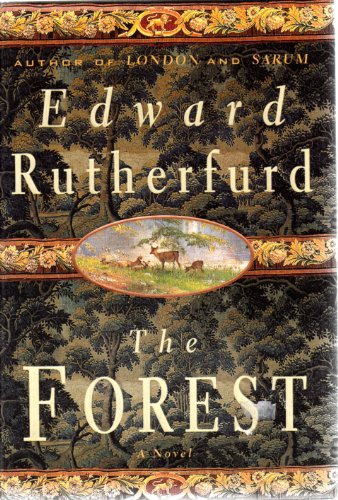
In The Forest, Edward Rutherfurd, whose greatly admired Sarum and London have captivated millions of readers, now unfolds the saga of nine turbulent centuries in the life of the quintessential English heartland: the New Forest.
The New Forest lies in a vast bowl scooped from England's southern coast. To its west runs the river Avon, from Sarum to the harbor at Christchurch, and to its east the port of Southampton. In the heart of the New Forest itself, some one hundred thousand acres of forest and heath sweep down to the Solent water and the Isle of Wight and overlook the English Channel just beyond.
From the time of the Norman Conquest to the present day, the New Forest has remained a mysterious, powerful, almost mythical place. It is here that Saxon and Norman kings rode forth with their hunting parties, and where William the Conqueror's son Rufus was mysteriously killed. The mighty oaks of the forest were used to build the ships for Admiral Nelson's navy, and the fishermen who lived in Christchurch and Lymington helped Sir Francis Drake fight off the Spanish Armada. The New Forest is the perfect backdrop for the families who people this epic story -- a story that makes clear the connections between the dark, dangerous, sensuous life of the primeval forest and the genteel life of Georgian and Regency society.
There are well-born ladies and lowly woodsmen, sailors and smugglers, witches and Cistercian monks, who live in the lovely abbey of Beaulieu. The Forest's Lady Adela is the cousin of Walter Tyrrell, who is blamed for the death of Rufus, son of the Conqueror. There is Brother Adam of Beaulieu, who is content with his service to God until a poaching incident puts him in contact with an intriguing young woman named Mary Furzey. There is the merchant Totton family of the harbor town of Lymington, and the Penruddocks and Lisles of Moyles Court. The feuds, wars, loyalties, and passions of many hundreds of years reach their climax in a crime that shatters the decorous society of Bath in the days of Jane Austen.
Edward Rutherfurd is a master storyteller whose sense of place and of character -- whether fictional or historical -- is at its most vibrant in The Forest. Like Sarum and London, it is a gripping novel of living history.
Die Inhaltsangabe kann sich auf eine andere Ausgabe dieses Titels beziehen.
Über die Autorin bzw. den Autor
Edward Rutherfurd was born in Salisbury, England, and educated at Cambridge University. His first novel, Sarum, was an instant international bestseller. His subsequent novels -- Russka and London -- were also highly acclaimed bestsellers here and abroad.
Auszug. © Genehmigter Nachdruck. Alle Rechte vorbehalten.
Excerpt
The Hunt
1099
The deer started. She trembled for a moment, then listened.
A grey-black spring night still lay like a blanket over the sky. Along the edgeof the wood, in the damp air, the peaty scent of the heath beyond mingled withthe faint mustiness of last year's fallen leaves. It was quiet, as if the wholeisland of Britain were waiting for something to happen in the silence before thedawn.
Then suddenly, a skylark started singing in the dark. Only he had seen the hintof paleness on the horizon.
The deer turned her head, not satisfied. Something was approaching.
Puckle made his way through the wood. There was no need to move silently. As hisfeet brushed the leaves or snapped a twig, he might have been mistaken for abadger, wild pig or some other denizen of the Forest.
Away on his left, the screech of a tawny owl careened through the dark tunnelsand sweeping arches of the oaks.
Puckle: was it his father, or his grandfather, or someone further back who hadbeen known by the name of Puckle? Puck: it was one of those strange old namesthat grew, mysteriously, out of the English landscape. Puck Hill: there wereseveral along the southern shores. Perhaps the name came from that. Or perhapsit was a diminutive: little Puck. Nobody knew. But having got one name, thefamily had never seemed to bother with any more. Old Puckle, young Puckle, theother Puckle: there was always a certain vagueness about which was which. Whenhe and his family had been kicked out of their hamlet by the servants of the newNorman king, they had wandered across the Forest and finally set up a ramshacklecamp by one of the streams that ran down to the River Avon at the Forest'swestern edge. Recently they had moved several miles south to another stream.
Puckle. The name suited him. Thickset, gnarled like an oak, his powerfulshoulders stooped forward as though he was pulling some great weight, he oftenworked with the charcoal burners. Even to the Forest people his comings andgoings were mysterious. Sometimes, when the firelight caught his oaken face inits reddish glow, he looked like a goblin. Yet the children would cluster roundhim when he came to the hamlets to make gates or wattle fences, which he didbetter than anyone else. They liked his quiet ways. Women found themselvesstrangely drawn to some deep inner heat they sensed in the woodsman. At his campby the water, there were always pigeons hanging, and the skin of a hare or someother small creature neatly stretched on pegs; or perhaps the remains of one ofthe trout who ventured up the little brown streams. Yet the forest animalshardly troubled to avoid him, almost as if they sensed that he was one of them.
As he moved through the darkness now, a rough leather jerkin covering his torso,his bare legs thrust into stout leather boots, he might have been a figure fromthe very dawn of time.
The deer remained, head raised. She had wandered a little apart from the rest ofthe group who were still feeding peacefully in the new spring grasses near thewoodland edge.
Though deer have good vision, and a highly developed sense of smell, it is ontheir hearing ? their outer ears being very large in relation to the skull ?that they often rely to detect danger, especially if it is downwind. Deer canpick up even the snap of a twig at huge distances. Already, she could tell thatPuckle's footsteps were moving away from her.
She was a fallow deer. There were three kinds of deer in the Forest. The greatred deer with their russet-brown coats were the ancient princes of the place.Then, in certain corners there were the curious roe deer ? delicate littlecreatures, hardly bigger than a dog. Recently, however, the Norman conquerorshad introduced a new and lovely breed: the elegant fallow deer.
She was nearly two years old. Her coat was patchy, prior to changing from itswinter mulberry colour to the summer camouflage ? a pale, creamy brown withwhite spots. Like almost all fallow deer, she had a white rump and ablack-fringed white tail. But for some reason nature had made her coat a littlepaler than was usual.
To another deer she would, almost certainly, have been identifiable without thispeculiarity: the hindquarter markings of every deer are subtly different fromthose of every other. Each carries, as it were, a coded marking as individual asa human fingerprint ? and far more visible. She was, therefore, already unique.But nature had added, perhaps for man's pleasure, this paleness as well. She wasa pretty animal. This year, at the autumn rutting season, she would find a mate.As long as the hunters did not kill her.
Her instincts warned her still to be cautious. She turned her head left andright, listening for other sounds. Then she stared. The dark trees turned intoshadows in the distant gloom. A little way off a fallen branch, stripped of itsbark, glimmered like a pair of antlers. Behind, a small hazel bush might havebeen an animal.
Things were not always what they seemed in the Forest. Long seconds passedbefore, satisfied at last, she slowly lowered her head.
And now the dawn chorus began. Out on the heather, a stone chat joined in with awhistling chatter from its perch on a gorse bush ? a faint spike of yellow inthe darkness. The light was breaking in the eastern sky. Now a warbler tried tointerrupt, its chinking trills filling the air; then a blackbird started flutingfrom the leafy trees. From somewhere behind the blackbird came the sharpdrilling of a woodpecker, in two short bursts on a bark drum; moments later, thegentle cooing of a turtle dove. And then, still in the darkness, followed thecuckoo, an echo floating down the woodland edge. Thus each proclaimed its littlekingdom before the time of mating in the spring.
Over the heath, rising higher and higher, the lark sang louder still, above themall. For he had glimpsed the rising sun.
Copyright © 2000 Edward Rutherfurd. All rights reserved.
ISBN: 0-609-60382-5
„Über diesen Titel“ kann sich auf eine andere Ausgabe dieses Titels beziehen.
Suchergebnisse für The Forest: A Novel

Beispielbild für diese ISBN
The Forest A Novel
Anbieter: World of Books (was SecondSale), Montgomery, IL, USA
Verkäuferbewertung 5 von 5 Sternen

Zustand: Good. Item in good condition. Textbooks may not include supplemental items i.e. CDs, access codes etc. Artikel-Nr. 00094374603
Gebraucht kaufen
EUR 4,16
Versand gratis
Versand innerhalb von USA
Versand innerhalb von USA
Anzahl: 15 verfügbar
Beispielbild für diese ISBN
The Forest A Novel
Anbieter: World of Books (was SecondSale), Montgomery, IL, USA
Verkäuferbewertung 5 von 5 Sternen
Zustand: Acceptable. Item in acceptable condition! Textbooks may not include supplemental items i.e. CDs, access codes etc. Artikel-Nr. 00090538913
Gebraucht kaufen
EUR 4,16
Versand gratis
Versand innerhalb von USA
Versand innerhalb von USA
Anzahl: 9 verfügbar
Beispielbild für diese ISBN
The Forest A Novel
Anbieter: World of Books (was SecondSale), Montgomery, IL, USA
Verkäuferbewertung 5 von 5 Sternen
Zustand: Good. Good condition ex-library book with usual library markings and stickers. Artikel-Nr. 00110313377
Gebraucht kaufen
EUR 4,16
Versand gratis
Versand innerhalb von USA
Versand innerhalb von USA
Anzahl: 1 verfügbar
Beispielbild für diese ISBN
The Forest
Anbieter: ThriftBooks-Atlanta, AUSTELL, GA, USA
Verkäuferbewertung 5 von 5 Sternen
Hardcover. Zustand: Good. No Jacket. Pages can have notes/highlighting. Spine may show signs of wear. ~ ThriftBooks: Read More, Spend Less. Artikel-Nr. G0609603825I3N00
Gebraucht kaufen
EUR 5,79
Versand gratis
Versand innerhalb von USA
Versand innerhalb von USA
Anzahl: 1 verfügbar
Beispielbild für diese ISBN
The Forest
Anbieter: ThriftBooks-Atlanta, AUSTELL, GA, USA
Verkäuferbewertung 5 von 5 Sternen
Hardcover. Zustand: Very Good. No Jacket. May have limited writing in cover pages. Pages are unmarked. ~ ThriftBooks: Read More, Spend Less. Artikel-Nr. G0609603825I4N00
Gebraucht kaufen
EUR 5,79
Versand gratis
Versand innerhalb von USA
Versand innerhalb von USA
Anzahl: 1 verfügbar
Beispielbild für diese ISBN
The Forest
Anbieter: ThriftBooks-Atlanta, AUSTELL, GA, USA
Verkäuferbewertung 5 von 5 Sternen
Hardcover. Zustand: Good. No Jacket. Missing dust jacket; Pages can have notes/highlighting. Spine may show signs of wear. ~ ThriftBooks: Read More, Spend Less. Artikel-Nr. G0609603825I3N01
Gebraucht kaufen
EUR 5,79
Versand gratis
Versand innerhalb von USA
Versand innerhalb von USA
Anzahl: 1 verfügbar
Beispielbild für diese ISBN
The Forest
Anbieter: ThriftBooks-Dallas, Dallas, TX, USA
Verkäuferbewertung 5 von 5 Sternen
Hardcover. Zustand: Good. No Jacket. Pages can have notes/highlighting. Spine may show signs of wear. ~ ThriftBooks: Read More, Spend Less. Artikel-Nr. G0609603825I3N00
Gebraucht kaufen
EUR 5,79
Versand gratis
Versand innerhalb von USA
Versand innerhalb von USA
Anzahl: 1 verfügbar
Beispielbild für diese ISBN
The Forest
Anbieter: ThriftBooks-Dallas, Dallas, TX, USA
Verkäuferbewertung 5 von 5 Sternen
Hardcover. Zustand: Good. No Jacket. Missing dust jacket; Pages can have notes/highlighting. Spine may show signs of wear. ~ ThriftBooks: Read More, Spend Less. Artikel-Nr. G0609603825I3N01
Gebraucht kaufen
EUR 5,79
Versand gratis
Versand innerhalb von USA
Versand innerhalb von USA
Anzahl: 1 verfügbar
Beispielbild für diese ISBN
The Forest
Anbieter: ThriftBooks-Dallas, Dallas, TX, USA
Verkäuferbewertung 5 von 5 Sternen
Hardcover. Zustand: Good. No Jacket. Former library book; Pages can have notes/highlighting. Spine may show signs of wear. ~ ThriftBooks: Read More, Spend Less. Artikel-Nr. G0609603825I3N10
Gebraucht kaufen
EUR 5,79
Versand gratis
Versand innerhalb von USA
Versand innerhalb von USA
Anzahl: 1 verfügbar
Beispielbild für diese ISBN
The Forest
Anbieter: ThriftBooks-Reno, Reno, NV, USA
Verkäuferbewertung 5 von 5 Sternen
Hardcover. Zustand: Very Good. No Jacket. Missing dust jacket; May have limited writing in cover pages. Pages are unmarked. ~ ThriftBooks: Read More, Spend Less. Artikel-Nr. G0609603825I4N01
Gebraucht kaufen
EUR 5,82
Versand gratis
Versand innerhalb von USA
Versand innerhalb von USA
Anzahl: 1 verfügbar