
Verwandte Artikel zu Pain: The Fifth Vital Sign
Inhaltsangabe
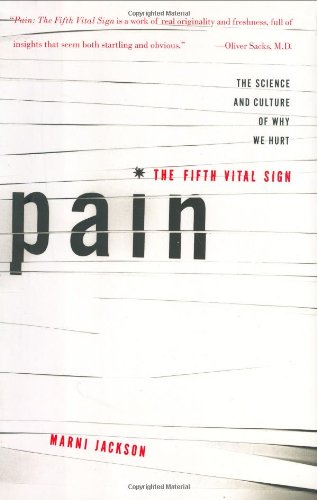
An innovative study of the nature, treatment, and meaning of pain explores modern medicine's changing attitude toward pain and what it means, chronicling the lives of patients who live with chronic pain, the work of pioneering pain researchers, and the professional experiences of doctors, nurses, scientists, and others. 20,000 first printing.
Die Inhaltsangabe kann sich auf eine andere Ausgabe dieses Titels beziehen.
Über die Autorin bzw. den Autor
MARNI JACKSON is the author of <b>The Mother Zone</b>. She lives in Toronto.
Aus dem Klappentext
ne experiences it, yet we have trouble talking about it and science has only recently begun to understand how it works. <b>Pain: The Fifth Vital Sign</b> is a groundbreaking inquiry into the nature, treatment, and definition of modern pain.<br><br>In the United States, there has been a recent campaign to treat pain as the fifth vital sign. Just as temperature, respiration, pulse, and blood pressure, the four traditional vital signs, must be charted, hospitals are now obliged to assess pain in their patients, too. If this indeed happens, it will be nothing less than groundbreaking―making pain far more visible.<br><br>But how has it come about that we spend $24 billion a year in North America on Tylenol, Advil, and the rest, and yet chronic pain is on the rise? Why is it that medicine can master intrauterine surgery but it can’t help people with bad backs or migraines? Pain is the number one reason why people go to the doctor’s office, and the number one reason they c
Auszug. © Genehmigter Nachdruck. Alle Rechte vorbehalten.
A MICROHISTORY OF PAIN
I have given a name to my pain, and call it "dog."
Friedrich Nietzsche, The Gay Science
Pain is the Sasquatch of science, never witnessed, only endlessly speculated on. We can't even agree on the species. Man or beast? A sensation or an idea? It doesn't help that ideas about the meanings of pain are double-barreled abstractions that soon drift away from the experience itself into an epistemological fog.
Our efforts to describe pain soon confront us with another small problem: How do we define the self? What particular nexus of mind, body, and soul is this modern "I" who feels the strange brew of modern pain?
I've been ruthlessly selective in this chapter, skipping over many names and en-tire centuries, to avoid disappearing down philosophical cul-de-sacs. But as I began to investigate the earliest ideas of pain, what struck me was that philosophy, medicine, and drama were once much closer in the way they viewed pain. It wasn't until Descartes came along in the seventeenth century with "proof" of the mind-body split, followed by the age of Enlightenment, that pain began to shed its emotional and social dimensions. One of the earliest definitions of tragedy, for instance, was human pain-as our exile into something that can be witnessed and pitied, but never shared.
Philoctetes, a play written by Sophocles in 409 b.c., is a story that pivots around the physical pain of its main character, who suffers from a wound that began as a snake bite. "Terrible it is, beyond words' reach" is how Philoctetes describes his condition. This inviolate, unspeakable aspect of human pain is what the drama tries to voice. "Philoctetes makes us feel the power of pain to reduce a life to utter emptiness and misery," author David Morris writes in The Culture of Pain. "It unweaves the self until the self is nothing but pain. The body in tragedy is not just something we possess like an identifying birthmark or robe or kingdom," Morris argues, "but what we are. It both deWnes us, and, fatally, limits us."
Aristotle was another astute observer of human dramas, including pain, and his writings on the subject turn out to have a rather modern flair. He defined pain as an emotion rather than a mechanical sensation. He characterized both pain and pleasure as "appetites" that drive us toward the objects of our desires and away from the things that hurt us. For Aristotle, pain was not only a sensory event in the body, but a subjective state, like longing and fear. He saw the human cost of pain, how it "upsets and destroys the nature of the person who feels it." Aristotle may not have understood physiology, but he accepted the idea that pain is an expression of who we are.
Our uncertainty about the province of pain is conveyed by the roots of the words we use for it. Pain is probably derived from the Latin word poena, meaning punishment, and the English word tends to connote physical pain. But the French word douleur, from the Latin dolor, refers to both physical and mental pain. The French word peine suggests punishment, but it can mean sorrow as well. Oddly enough, the Italian language has no word for ache, despite the fact that studies of pain expression in different cultures report that Italian women in labor are louder than women from other countries.
The concept of pain as punishment turns up most vividly in the biblical story of Job, a wealthy, upright man whose faith in God is tested by Satan in a series of terrible afflictions. First he loses his wealth, then he becomes an outcast from his community. Finally Satan pulls out all the stops and inflicts a "plague of boils" on Job. "He slashes open my kidneys and does not spare," says Job, describing Satan's work. "He pours out my gall on the ground." William Blake's illustration of this scene shows the figure of Job writhing on the ground, his hands arched back in pain, as a naked, burly Satan stands over him like a TV wrestler in triumph. Job's test of faith is the first example of the theme of bloody martyrdom that runs throughout Christianity. Pain is inseparable from faith and "the central Christian mystery of a being who suffers pain in order to redeem others," as Morris writes. It was the pain that Jesus Christ suffered on the cross that proved to us that God's son was human, too. Suffering pain is how faith is forged; transcending pain is a mark of sainthood. The image of St. Sebastian pierced with arrows, with upturned eyes, carries the message that a belief in a life beyond the body has the power to undo pain. The idea of pain as spiritual punishment is still deeply entrenched in our attitude that physical pain arrives as a kind of moral test of character and should be toughed out. The price of admission for being human, the story of Job reminds us, is this: expect boils.
Fast-forward to the Middle Ages, a time when it was hell to have a toothache, even though laudanum laced with opium was readily dispensed. One of the opiophiles of the era was the enlightened sixteenth-century practitioner Paracelsus. He was the original patient-centered physician. "Every physician must be rich in knowledge," he wrote in Man and His Body, "and not only of that which is written in books; his patients should be his book, they will never mislead him . . . and by them he will never be deceived. But he who is content with mere letters is like a dead man; and he is like a dead physician." We may be overdue for a Paracelsus revival.
The man most responsible for our modern misconception of "mental pain" versus "physical pain," however, was the seventeenth-century philosopher and scientist Rene Descartes. Although he is often blamed for the mind-body split that came to characterize Western thinking, in other ways, Descartes's investigation into pain was farsighted. In the treatise De l'homme, his hypothesis about pain pathways and the "delicate threads" that conduct pain signals, for instance, turned out to be a crude but correct notion of nerve fibers and neurotransmitters. But it was his theory of the transmission of pain signals that led to what is known as the "specificity theory" of pain-the notion of pain as one fixed pathway or center. This idea dominated the study of pain until the last thirty or forty years.
Descartes's theory was accompanied by a famous illustration of a rather hunchbacked naked man, eyes a-bulge, who appears to be stepping into a campfire. His foot is in the flame. "If for example fire comes near the foot," he wrote in 1640, "minute particles of this fire, which you know move at great velocity, have the power to set in motion the spot of skin on the foot which they touch, and by this means pulling on the delicate thread which is attached to the spot of the skin, they open up at the same instant the pore against which the delicate thread ends, just as by pulling on one end of a rope one makes to strike at the same instant a bell which hangs at the end."
Descartes has helpfully labeled the diagram. The sensation of pain (A) is perceived in the foot and then travels up to the "common sense center" (F) in the pineal gland, which interprets the signal as pain. This same stimulus-response model still defines our popular understanding of pain: The coffee table hits your toe, a sensation in the nerves then tugs at the bell-rope of the brain, which interprets this event as pain. No coffee table, no pain. But even in his time, Descartes had to defend this theory against critics. When it was pointed out to him that some amputees still feel pain in their missing limbs-phantom limb pain-he nimbly responded that the brain was just being tricked by false signals....
„Über diesen Titel“ kann sich auf eine andere Ausgabe dieses Titels beziehen.
Suchergebnisse für Pain: The Fifth Vital Sign

Beispielbild für diese ISBN
Pain: The Fifth Vital Sign
Anbieter: World of Books (was SecondSale), Montgomery, IL, USA
Verkäuferbewertung 5 von 5 Sternen

Zustand: Good. Good condition ex-library book with usual library markings and stickers. Artikel-Nr. 00108414846
Gebraucht kaufen
EUR 8,05
Versand gratis
Versand innerhalb von USA
Versand innerhalb von USA
Anzahl: 1 verfügbar
Beispielbild für diese ISBN
Pain : The Science and Culture of Why We Hurt
Verlag:
Crown Publishing Group, The, 2002
ISBN 10: 0609603752
ISBN 13: 9780609603758
Gebraucht
Hardcover
Anbieter: Better World Books: West, Reno, NV, USA
Verkäuferbewertung 5 von 5 Sternen
Zustand: Very Good. Pages intact with possible writing/highlighting. Binding strong with minor wear. Dust jackets/supplements may not be included. Stock photo provided. Product includes identifying sticker. Better World Books: Buy Books. Do Good. Artikel-Nr. 57821445-75
Gebraucht kaufen
EUR 8,21
Versand gratis
Versand innerhalb von USA
Versand innerhalb von USA
Anzahl: 1 verfügbar
Beispielbild für diese ISBN
Pain : The Science and Culture of Why We Hurt
Verlag:
Crown Publishing Group, The, 2002
ISBN 10: 0609603752
ISBN 13: 9780609603758
Gebraucht
Hardcover
Anbieter: Better World Books, Mishawaka, IN, USA
Verkäuferbewertung 5 von 5 Sternen
Zustand: Good. Former library copy. Pages intact with minimal writing/highlighting. The binding may be loose and creased. Dust jackets/supplements are not included. Includes library markings. Stock photo provided. Product includes identifying sticker. Better World Books: Buy Books. Do Good. Artikel-Nr. 4029071-6
Gebraucht kaufen
EUR 8,21
Versand gratis
Versand innerhalb von USA
Versand innerhalb von USA
Anzahl: 2 verfügbar
Beispielbild für diese ISBN
Pain: The Fifth Vital Sign: The Science and Culture of Why We Hurt
Anbieter: ThriftBooks-Atlanta, AUSTELL, GA, USA
Verkäuferbewertung 5 von 5 Sternen
Hardcover. Zustand: Fair. No Jacket. Readable copy. Pages may have considerable notes/highlighting. ~ ThriftBooks: Read More, Spend Less. Artikel-Nr. G0609603752I5N00
Gebraucht kaufen
EUR 11,64
Versand gratis
Versand innerhalb von USA
Versand innerhalb von USA
Anzahl: 1 verfügbar
Beispielbild für diese ISBN
Pain: the Fifth Vital Sign
Verlag:
Crown Publishers, New York, 2002
ISBN 10: 0609603752
ISBN 13: 9780609603758
Gebraucht
Hardcover
Erstausgabe
Anbieter: Abacus Bookshop, Pittsford, NY, USA
Verkäuferbewertung 5 von 5 Sternen
hardcover. Zustand: Fine copy in fine dust jacket. 1st. 8vo, 366 pp. Artikel-Nr. 025061
Gebraucht kaufen
EUR 8,97
EUR 3,48 Versand
Versand innerhalb von USA
Versand innerhalb von USA
Anzahl: 1 verfügbar