
Verwandte Artikel zu The Power of Pride: Stylemakers and Rulebreakers of...
Inhaltsangabe
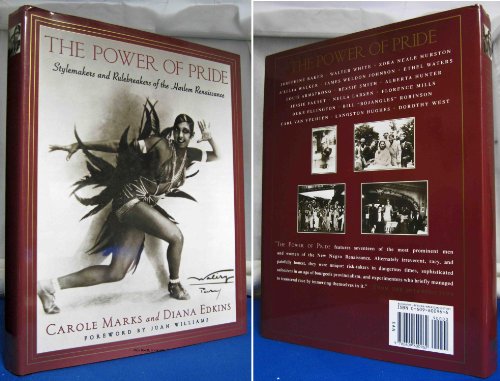
An enlightening overview of the Harlem Renaissance explores the literary and artistic movement that pioneered a new image of African-American culture and the diverse individuals who played key roles in it, including Langston Hughes, Duke Ellington, Josephine Baker, James Weldon Johnson, and Walter White. 25,000 first printing. Tour.
Die Inhaltsangabe kann sich auf eine andere Ausgabe dieses Titels beziehen.
Über die Autorin bzw. den Autor
<b>Carole Marks</b> is a professor of sociology and the director of Black America Studies at the University of Delaware. She is a former fellow at the W. E. B. Du Bois Institute at Harvard University and the author of Farewell, We're Good and Gone: The Great Black Migration as well as A History of African Americans of Delaware and Maryland's Eastern Shore. She lives in Newark, Delaware.<br><br><b>Diana Edkins</b> is a curator of photographic collections and exhibitions. Known for her exacting eye and thorough knowledge of photographic imagery, she coauthored The Power of Style and was the photographic editor for On the Edge: The First One Hundred Years of Vogue. Among other projects, she is currently the archivist for the Barnes Foundation. She lives in Westfield, New Jersey.
Aus dem Klappentext
ker -- Walter White -- Zora Neale Hurston -- A'Lelia Walker -- James Weldon Johnson -- Ethel Waters -- Louis Armstrong -- Bessie Smith -- Alberta Hunter -- Jessie Fauset -- Nella Larsen -- Florence Mills -- Duke Ellington -- Bill "Bojangles" Robinson -- Carl Van Vechten -- Langston Hughes -- Dorothy West<br><br>"The Power of Pride features seventeen of the most prominent men and women of the New Negro Renaissance. Alternately irreverent, racy, and painfully honest, they were unique: risk-takers in dangerous times, sophisticated salonières in an age of bourgeois provincialism, and experimenters who briefly managed to transcend race by immersing themselves in it." <br>--From the Introduction<br><br>The Harlem Renaissance was an electrifying period during which huge numbers of African Americans threw off the shackles of discrimination, exploitation, and poverty in the South and moved north. Heady with the feeling of li
„Über diesen Titel“ kann sich auf eine andere Ausgabe dieses Titels beziehen.
Suchergebnisse für The Power of Pride: Stylemakers and Rulebreakers of...

Beispielbild für diese ISBN
The Power of Pride: Stylemakers and Rulebreakers of the Harlem Renaissance
Anbieter: World of Books (was SecondSale), Montgomery, IL, USA
Verkäuferbewertung 5 von 5 Sternen

Hardback. Zustand: Good. Artikel-Nr. 00103452671
Gebraucht kaufen
EUR 9,50
Versand gratis
Versand innerhalb von USA
Versand innerhalb von USA
Anzahl: 1 verfügbar
Beispielbild für diese ISBN
The Power of Pride: Stylemakers and Rulebreakers of the Harlem Renaissance
Anbieter: World of Books (was SecondSale), Montgomery, IL, USA
Verkäuferbewertung 5 von 5 Sternen
Hardback. Zustand: Fair. Artikel-Nr. 00106802365
Gebraucht kaufen
EUR 9,50
Versand gratis
Versand innerhalb von USA
Versand innerhalb von USA
Anzahl: 1 verfügbar
Beispielbild für diese ISBN
The Power of Pride: Stylemakers and Rulebreakers of the Harlem Renaissance
Anbieter: ThriftBooks-Dallas, Dallas, TX, USA
Verkäuferbewertung 5 von 5 Sternen
Hardcover. Zustand: Very Good. No Jacket. Former library book; May have limited writing in cover pages. Pages are unmarked. ~ ThriftBooks: Read More, Spend Less. Artikel-Nr. G0609600966I4N10
Gebraucht kaufen
EUR 10,90
Versand gratis
Versand innerhalb von USA
Versand innerhalb von USA
Anzahl: 1 verfügbar
Beispielbild für diese ISBN
The Power of Pride: Stylemakers and Rulebreakers of the Harlem Renaissance
Anbieter: ThriftBooks-Atlanta, AUSTELL, GA, USA
Verkäuferbewertung 5 von 5 Sternen
Hardcover. Zustand: Fair. No Jacket. Readable copy. Pages may have considerable notes/highlighting. ~ ThriftBooks: Read More, Spend Less. Artikel-Nr. G0609600966I5N00
Gebraucht kaufen
EUR 10,90
Versand gratis
Versand innerhalb von USA
Versand innerhalb von USA
Anzahl: 1 verfügbar
Beispielbild für diese ISBN
The Power of Pride: Stylemakers and Rulebreakers of the Harlem Renaissance
Anbieter: Books From California, Simi Valley, CA, USA
Verkäuferbewertung 4 von 5 Sternen

hardcover. Zustand: Very Good. First Edition. First edition. Artikel-Nr. mon0003281202
Gebraucht kaufen
EUR 15,54
EUR 4,45 Versand
Versand innerhalb von USA
Versand innerhalb von USA
Anzahl: 1 verfügbar
Beispielbild für diese ISBN
The Power of Pride: Stylemakers and Rulebreakers of the Harlem Renaissance
Verlag:
Crown, New York, 1999
ISBN 10: 0609600966
ISBN 13: 9780609600962
Gebraucht
Hardcover
Erstausgabe
Anbieter: Argosy Book Store, ABAA, ILAB, New York, NY, USA
Verkäuferbewertung 5 von 5 Sternen
hardcover. Zustand: near fine. Zustand des Schutzumschlags: very good. First. Illustrated in black and white. 272 pages. Small 4to, red boards, d.w. (sunned). New York: Crown, (1999) A near fine copy-- sunned at edges-- in a very good dust wrapper. Forward by Juan Williams. Artikel-Nr. 312584
Gebraucht kaufen
EUR 17,22
EUR 5,35 Versand
Versand innerhalb von USA
Versand innerhalb von USA
Anzahl: 1 verfügbar
Foto des Verkäufers
THE POWER OF PRIDE, STYLEMAKERS AND RULEBREAKERS OF THE HARLEM RENAISSANCE
Verlag:
Crown Publishers, New York, 1999
ISBN 10: 0609600966
ISBN 13: 9780609600962
Gebraucht
Hardcover
Erstausgabe
Anbieter: Nick Bikoff, IOBA, Fairfield, NJ, USA
Verkäuferbewertung 5 von 5 Sternen
Hardcover. Zustand: Near Fine. Zustand des Schutzumschlags: Near Fine. First Edition. Clean red paper covered boards with gilt title on spine & Front cover. Endpaper decorated with 1932 Night Club Map of Harlem by E. Simms Campbell. Pictorial double title page. BW photograph illustrations. Clean & intact NF dust jacket. Josephine Baker; Ethel Waters; Louis Armstrong; Bessie Smith; Duke Ellington; Bill "Bojangles" Robinson, etc. Afro-American; BW Photograph Illustrations; 4to 11" - 13" tall; 272 pages. Artikel-Nr. 14663
Gebraucht kaufen
EUR 27,56
EUR 3,57 Versand
Versand innerhalb von USA
Versand innerhalb von USA
Anzahl: 1 verfügbar
Beispielbild für diese ISBN
The Power of Pride: Stylemakers and Rulebreakers of the Harlem Renaissance
Anbieter: Herons' Nest Books, Kings Langley, Vereinigtes Königreich
Verkäuferbewertung 5 von 5 Sternen
Hardcover. Zustand: Very Good. Artikel-Nr. 005442
Gebraucht kaufen
EUR 8,52
EUR 23,67 Versand
Versand von Vereinigtes Königreich nach USA
Versand von Vereinigtes Königreich nach USA
Anzahl: 1 verfügbar
Foto des Verkäufers
The Power of Pride: Stylemakers and Rulebreakers of the Harlem Renaissance
Verlag:
Crown Publications, 1999
ISBN 10: 0609600966
ISBN 13: 9780609600962
Gebraucht
Hardcover
Erstausgabe
Anbieter: Milbury Books, New Romney, Vereinigtes Königreich
Verkäuferbewertung 5 von 5 Sternen
Hardcover. Zustand: Near Fine. Zustand des Schutzumschlags: Very Good. 1st Edition. A very respectable 1st Impression copy with clean text & plates, no inscriptions and very little trace of use to board covers. The unclipped dust wrapper displays some fading to spine and just light traces of surface wear - overall very presentable. Please see five pictures attached. Artikel-Nr. ABE-1650551055252
Gebraucht kaufen
EUR 10,91
EUR 25,45 Versand
Versand von Vereinigtes Königreich nach USA
Versand von Vereinigtes Königreich nach USA
Anzahl: 1 verfügbar
Beispielbild für diese ISBN
The Power of Pride: Stylemakers and Rulebreakers of the Harlem Renaissance
Verlag:
Crown Publishers, New York, 1999
ISBN 10: 0609600966
ISBN 13: 9780609600962
Gebraucht
Hardcover
Erstausgabe
Signiert
Anbieter: Design Books, New York, NY, USA
Verkäuferbewertung 5 von 5 Sternen
Hard Cover. Zustand: Fine. Zustand des Schutzumschlags: Fine. First Edition. This is a fine hardcover copy in a fine dust jacket with no wear at all. Signed by both authors, Carole Marks and Diana Edkins, in ink on the title-page. Not inscribed to anyone, no other marks. Completely clean. Illustrated history of the Harlem Renaissance. Illustrated in black & white, sepia. 10" high X 8" wide, 272 pages. A fine, signed copy. This book will be securely packed and shipped with tracking. Signed by Author. Artikel-Nr. 013316
Gebraucht kaufen
EUR 41,34
EUR 4,01 Versand
Versand innerhalb von USA
Versand innerhalb von USA
Anzahl: 1 verfügbar