
Verwandte Artikel zu Lessons in Chemistry (Random House Large Print)
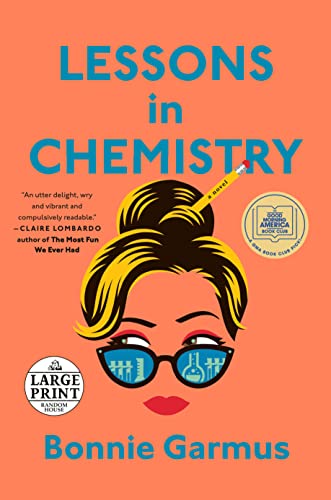
Inhaltsangabe
#1 GLOBAL BESTSELLER WITH MORE THAN 8 MILLION COPIES SOLD • Meet Elizabeth Zott: “a gifted research chemist, absurdly self-assured and immune to social convention” (The Washington Post) in 1960s California whose career takes a detour when she becomes the unlikely star of a beloved TV cooking show. • STREAM ON APPLE TV+
This novel is “irresistible, satisfying and full of fuel” (The New York Times Book Review) and “witty, sometimes hilarious...the Catch-22 of early feminism” (Stephen King, via Twitter).
A BEST BOOK OF THE YEAR: The New York Times, Washington Post, NPR, Oprah Daily, Entertainment Weekly, Newsweek
Chemist Elizabeth Zott is not your average woman. In fact, Elizabeth Zott would be the first to point out that there is no such thing as an average woman. But it’s the early 1960s and her all-male team at Hastings Research Institute takes a very unscientific view of equality. Except for one: Calvin Evans; the lonely, brilliant, Nobel–prize nominated grudge-holder who falls in love with—of all things—her mind. True chemistry results.
But like science, life is unpredictable. Which is why a few years later Elizabeth Zott finds herself not only a single mother, but the reluctant star of America’s most beloved cooking show Supper at Six. Elizabeth’s unusual approach to cooking (“combine one tablespoon acetic acid with a pinch of sodium chloride”) proves revolutionary. But as her following grows, not everyone is happy. Because as it turns out, Elizabeth Zott isn’t just teaching women to cook. She’s daring them to change the status quo.
Laugh-out-loud funny, shrewdly observant, and studded with a dazzling cast of supporting characters, Lessons in Chemistry is as original and vibrant as its protagonist.
Die Inhaltsangabe kann sich auf eine andere Ausgabe dieses Titels beziehen.
Über die Autorin bzw. den Autor
BONNIE GARMUS is a copywriter and creative director who has worked for a wide range of clients, in the US and abroad, focusing primarily on technology, medicine, and education. From Seattle, she currently lives in London with her husband and her dog, 99.
Auszug. © Genehmigter Nachdruck. Alle Rechte vorbehalten.
Chapter 1
November 1961
Back in 1961, when women wore shirtwaist dresses and joined garden clubs and drove legions of children around in seatbeltless cars without giving it a second thought; back before anyone knew there’d even be a sixties movement, much less one that its participants would spend the next sixty years chronicling; back when the big wars were over and the secret wars had just begun and people were starting to think fresh and believe everything was possible, the thirty-year-old mother of Madeline Zott rose before dawn every morning and felt certain of just one thing: her life was over.
Despite that certainty, she made her way to the lab to pack her daughter’s lunch.
Fuel for learning, Elizabeth Zott wrote on a small slip of paper before tucking it into her daughter’s lunch box. Then she paused, her pencil in midair, as if reconsidering. Play sports at recess but do not automatically let the boys win, she wrote on another slip. Then she paused again, tapping her pencil against the table. It is not your imagination, she wrote on a third. Most people are awful. She placed the last two on top.
Most young children can’t read, and if they can, it’s mostly words like “dog” and “go.” But Madeline had been reading since age three and, now, at age five, was already through most of Dickens.
Madeline was that kind of child--the kind who could hum a Bach concerto but couldn’t tie her own shoes; who could explain the earth’s rotation but stumbled at tic-tac-toe. And that was the problem. Because while musical prodigies are always celebrated, early readers aren’t. And that’s because early readers are only good at something others will eventually be good at, too. So being first isn’t special--it’s just annoying.
Madeline understood this. That’s why she made it a point each morning--after her mother had left and while her babysitter neighbor, Harriet, was busy--to extract the notes from the lunch box, read them, then store them with all the other notes that she kept in a shoebox in the back of her closet. Once at school she pretended to be like all the other kids: basically illiterate. To Madeline, fitting in mattered more than anything. And her proof was irrefutable: her mother had never fit in and look what happened to her.
It was there, in the Southern Californian town of Commons, where the weather was mostly warm, but not too warm, and the sky was mostly blue, but not too blue, and the air was clean because air just was back then, that she lay in her bed, eyes closed, and waited. Soon she knew there’d be a gentle kiss on her forehead, a careful tuck of covers about her shoulders, a murmuring of “Seize the day” in her ear. In another minute, she’d hear the start of a car engine, a crunch of tires as the Plymouth backed down the drive, a clunky shift from reverse to first. And then her permanently depressed mother would set off for the television studio where she would don an apron and walk out onto a set.
The show was called Supper at Six, and Elizabeth Zott was its indisputable star.
Chapter 2
Pine
Once a research chemist, Elizabeth Zott was a woman with flawless skin and an unmistakable demeanor of someone who was not average and never would be.
She was, as all good stars are, discovered. Although in Elizabeth’s case, there was no malt shop, no accidental bench sighting, no lucky introduction. Instead, it was theft--specifically food theft--that led to her discovery.
The story was simple: a child named Amanda Pine, who enjoyed food in a way some therapists consider significant, was eating Madeline’s lunch. This was because Madeline’s lunch was not average. While all the other children gummed their peanut butter and jelly sandwiches, Madeline opened her luncth box to find a thick slice of leftover lasagna, a side helping of buttery zucchini, an exotic kiwi cut into quarters, five pearly round cherry tomatoes, a tiny Morton salt shaker, two still-warm chocolate chip cookies, and a red plaid thermos full of ice-cold milk.
These contents were why everyone wanted Madeline’s lunch, Madeline included. But Madeline offered it to Amanda because friendship requires sacrifice, but also because Amanda was the only one in the entire school who didn’t make fun of the odd child Madeline already knew she was.
It wasn’t until Elizabeth noticed that Madeline’s clothes began to hang on her bony frame like bad drapes that she began to wonder what was going on. According to her calculations, Madeline’s daily intake was exactly what her daughter required for optimal development, making weight loss scientifically inconceivable. A growth spurt, then? No. She’d accounted for growth in her calculations. Early onset food disorder? Not likely. Madeline ate like a horse at dinner. Leukemia? Definitely not.
Elizabeth wasn’t an alarmist--she wasn’t the type who lay awake at night imagining her daughter was plagued by incurable disease. As a scientist, she always sought a sensible explanation, and the moment she met Amanda Pine, her little lips stained a pomodoro-sauce red, she knew she’d found it.
“Mr. Pine,” Elizabeth said, sweeping into the local television studio and past a secretary on a Wednesday afternoon, “I’ve been calling you for three days, and not once have you managed the courtesy of a return call. My name is Elizabeth Zott. I am Madeline Zott’s mother--our children attend Woody Elementary together--and I’m here to tell you that your daughter is offering my daughter friendship under false pretenses.” And because he looked confused, she added, “Your daughter is eating my daughter’s lunch.”
“L-lunch?” Walter Pine managed, as he took in the woman who stood resplendent before him, her white lab coat casting an aura of holy light save for one detail: the initials “E.Z.” emblazoned in red just above the pocket.
“Your daughter, Amanda,” Elizabeth charged again, “eats my daughter’s lunch. Apparently, it’s been going on for months.”
Walter could only stare. Tall and angular, with hair the color of burnt buttered toast pulled back and secured with a pencil, she stood, hands on hips, her lips unapologetically red, her skin luminous, her nose straight. She looked down at him like a battlefield medic assessing whether or not he was worth saving.
“And the fact that she pretends to be Madeline’s friend to get her lunch,” she continued, “is absolutely reprehensible.”
“Wh-who are you again?” stammered Walter.
“Elizabeth Zott!” she barked back. “Madeline Zott’s mother!”
Walter nodded, trying to understand. As a longtime producer of afternoon television, he knew drama. But this? He continued to stare. She was stunning. He was literally stunned by her. Was she auditioning for something?
“I’m sorry,” he finally said. “But all the nurse roles have been cast.”
“I beg your pardon?” she snapped.
There was a long pause.
“Amanda Pine,” she repeated.
He blinked. “My daughter? Oh,” he said, suddenly nervous. “What about her? Are you a doctor? Are you from the school?” He leapt to his feet.
“Good god, no,” Elizabeth replied. “I’m a chemist. I’ve come all the way over here from Hastings on my lunch hour because you’ve failed to return my calls.” And when he continued to look baffled, she clarified. “Hastings Research Institute? Where Groundbreaking Research...
„Über diesen Titel“ kann sich auf eine andere Ausgabe dieses Titels beziehen.
Suchergebnisse für Lessons in Chemistry (Random House Large Print)

Beispielbild für diese ISBN
Lessons in Chemistry A Novel R
Verlag:
Random House Large Print, 2022
ISBN 10: 0593556674
ISBN 13: 9780593556672
Gebraucht
Softcover
Anbieter: World of Books (was SecondSale), Montgomery, IL, USA
Verkäuferbewertung 5 von 5 Sternen

Zustand: Good. Item in good condition. Textbooks may not include supplemental items i.e. CDs, access codes etc. Artikel-Nr. 00107517254
Gebraucht kaufen
EUR 3,69
Versand gratis
Versand innerhalb von USA
Versand innerhalb von USA
Anzahl: 16 verfügbar
Beispielbild für diese ISBN
Lessons in Chemistry A Novel R
Verlag:
Random House Large Print, 2022
ISBN 10: 0593556674
ISBN 13: 9780593556672
Gebraucht
Softcover
Anbieter: World of Books (was SecondSale), Montgomery, IL, USA
Verkäuferbewertung 5 von 5 Sternen
Zustand: Very Good. Item in very good condition! Textbooks may not include supplemental items i.e. CDs, access codes etc. Artikel-Nr. 00109956872
Gebraucht kaufen
EUR 3,69
Versand gratis
Versand innerhalb von USA
Versand innerhalb von USA
Anzahl: 1 verfügbar
Foto des Verkäufers
Lessons in Chemistry: A Novel (Random House Large Print)
Verlag:
Random House Large Print, 2022
ISBN 10: 0593556674
ISBN 13: 9780593556672
Gebraucht
Softcover
Anbieter: Dream Books Co., Denver, CO, USA
Verkäuferbewertung 5 von 5 Sternen
Zustand: acceptable. This copy has clearly been enjoyedâ"expect noticeable shelf wear and some minor creases to the cover. Binding is strong, and all pages are legible. May contain previous library markings or stamps. Artikel-Nr. DBV.0593556674.A
Gebraucht kaufen
EUR 3,76
Versand gratis
Versand innerhalb von USA
Versand innerhalb von USA
Anzahl: 4 verfügbar
Foto des Verkäufers
Lessons in Chemistry: A Novel (Random House Large Print)
Verlag:
Random House Large Print, 2022
ISBN 10: 0593556674
ISBN 13: 9780593556672
Gebraucht
Softcover
Anbieter: Dream Books Co., Denver, CO, USA
Verkäuferbewertung 5 von 5 Sternen
Zustand: good. Gently used with minimal wear on the corners and cover. A few pages may contain light highlighting or writing, but the text remains fully legible. Dust jacket may be missing, and supplemental materials like CDs or codes may not be included. May be ex-library with library markings. Ships promptly! Artikel-Nr. DBV.0593556674.G
Gebraucht kaufen
EUR 3,76
Versand gratis
Versand innerhalb von USA
Versand innerhalb von USA
Anzahl: 3 verfügbar
Beispielbild für diese ISBN
Lessons in Chemistry (Random H
Verlag:
Random House Large Print, 2022
ISBN 10: 0593556674
ISBN 13: 9780593556672
Gebraucht
Softcover
Anbieter: World of Books (was SecondSale), Montgomery, IL, USA
Verkäuferbewertung 5 von 5 Sternen
Zustand: Good. Item in good condition and has highlighting/writing on text. Used texts may not contain supplemental items such as CDs, info-trac etc. Artikel-Nr. 00101422880
Gebraucht kaufen
EUR 5,26
Versand gratis
Versand innerhalb von USA
Versand innerhalb von USA
Anzahl: 1 verfügbar
Beispielbild für diese ISBN
Lessons in Chemistry (Random H
Verlag:
Random House Large Print, 2022
ISBN 10: 0593556674
ISBN 13: 9780593556672
Gebraucht
Softcover
Anbieter: World of Books (was SecondSale), Montgomery, IL, USA
Verkäuferbewertung 5 von 5 Sternen
Zustand: Good. Good condition ex-library book with usual library markings and stickers. Artikel-Nr. 00103537504
Gebraucht kaufen
EUR 5,32
Versand gratis
Versand innerhalb von USA
Versand innerhalb von USA
Anzahl: 1 verfügbar
Beispielbild für diese ISBN
Lessons in Chemistry
Verlag:
Random House Large Print Publishing, 2022
ISBN 10: 0593556674
ISBN 13: 9780593556672
Gebraucht
Paperback
Anbieter: ThriftBooks-Reno, Reno, NV, USA
Verkäuferbewertung 5 von 5 Sternen
Paperback. Zustand: Good. No Jacket. Missing dust jacket; Pages can have notes/highlighting. Spine may show signs of wear. ~ ThriftBooks: Read More, Spend Less. Artikel-Nr. G0593556674I3N01
Gebraucht kaufen
EUR 5,76
Versand gratis
Versand innerhalb von USA
Versand innerhalb von USA
Anzahl: 1 verfügbar
Beispielbild für diese ISBN
Lessons in Chemistry
Verlag:
Random House Large Print Publishing, 2022
ISBN 10: 0593556674
ISBN 13: 9780593556672
Gebraucht
Paperback
Anbieter: ThriftBooks-Phoenix, Phoenix, AZ, USA
Verkäuferbewertung 5 von 5 Sternen
Paperback. Zustand: Fair. No Jacket. Former library book; Readable copy. Pages may have considerable notes/highlighting. ~ ThriftBooks: Read More, Spend Less. Artikel-Nr. G0593556674I5N10
Gebraucht kaufen
EUR 5,76
Versand gratis
Versand innerhalb von USA
Versand innerhalb von USA
Anzahl: 4 verfügbar
Beispielbild für diese ISBN
Lessons in Chemistry
Verlag:
Random House Large Print Publishing, 2022
ISBN 10: 0593556674
ISBN 13: 9780593556672
Gebraucht
Paperback
Anbieter: ThriftBooks-Reno, Reno, NV, USA
Verkäuferbewertung 5 von 5 Sternen
Paperback. Zustand: Fair. No Jacket. Former library book; Readable copy. Pages may have considerable notes/highlighting. ~ ThriftBooks: Read More, Spend Less. Artikel-Nr. G0593556674I5N10
Gebraucht kaufen
EUR 5,76
Versand gratis
Versand innerhalb von USA
Versand innerhalb von USA
Anzahl: 5 verfügbar
Beispielbild für diese ISBN
Lessons in Chemistry
Verlag:
Random House Large Print Publishing, 2022
ISBN 10: 0593556674
ISBN 13: 9780593556672
Gebraucht
Paperback
Anbieter: ThriftBooks-Dallas, Dallas, TX, USA
Verkäuferbewertung 5 von 5 Sternen
Paperback. Zustand: Good. No Jacket. Pages can have notes/highlighting. Spine may show signs of wear. ~ ThriftBooks: Read More, Spend Less. Artikel-Nr. G0593556674I3N00
Gebraucht kaufen
EUR 5,76
Versand gratis
Versand innerhalb von USA
Versand innerhalb von USA
Anzahl: 18 verfügbar