
Verwandte Artikel zu Sold Out: How Broken Supply Chains, Surging Inflation,...
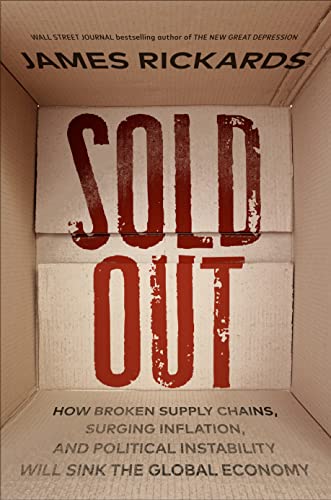
Sold Out: How Broken Supply Chains, Surging Inflation, and Political Instability Will Sink the Global Economy - Hardcover
Inhaltsangabe
From the man who predicted the worst economic crisis in US history comes Jim Rickards’ second prediction – the collapse of our global economy.
The supply chain crisis is coming to a head. Today, your favorite products are missing from store shelves, caught in supply chain limbo somewhere in the Pacific Ocean. But what does this supply chain disruption look like six months, or even three years, from now? While we hope that post-pandemic recovery will absolve these issues, the reality is that digital currency, meme stonks, and social media can’t solve the age-old problem of producing and moving physical goods across oceans and continents. According to Jim Rickards, consumer frustration is only the tip of a very large, menacing iceberg that threatens global economic collapse.
In Sold Out, Rickards shares his predictions for our post-pandemic future and outlines how consumers and business owners can get ahead of the collapse. You’ll learn how energy shortages in China – fueled by the trade war with Australia – are disrupting the steel market and forcing entire factories to shut down. You’ll also learn how rising inflation will ultimately lead to deflation in a few short years – as consumer spending eventually tanks due to higher taxes, excessive debt, and increased layoffs – and why such economic conditions will closely resemble the 1930s. Finally, Rickards will look at the future of money, including the erasure of the American dollar itself.
Our global economy faces unprecedented challenges in the next few months. But whether we sink or swim depends on how prepared we are – and what we do now to thwart the coming collapse.
Die Inhaltsangabe kann sich auf eine andere Ausgabe dieses Titels beziehen.
Über die Autorin bzw. den Autor
James Rickards is the Editor of Strategic Intelligence, a financial newsletter, and the bestselling author of The New Great Depression, Aftermath, The Road to Ruin, and many more. He is an investment advisor, lawyer, inventor, and economist, and has held senior positions at Citibank, Long-Term Capital Management, and Caxton Associates.
Auszug. © Genehmigter Nachdruck. Alle Rechte vorbehalten.
Chapter One
The Shelves Are Bare
One of the bedrock characteristics of disruptions is that they are almost never the result of a single failure. A large-scale disruption is usually the result of a confluence of several factors. . . . There are typically many signs that a disruption is about to take place.
-Yossi Sheffi
The Resilient Enterprise
The Endless Supply Chain
Supply chains are not part of the economy. They are the economy. It's impossible to think of any commodity, process, or finished product that's not part of a supply chain. This precept applies to natural resources and human artifacts. It applies to objects and intangibles. It applies to goods and services. We are immersed in supply chains. The irony is that we scarcely see them.
The term "supply chain" is just a name we give to a nexus of logistics, inputs, processes, transportation, packaging, distribution, marketing, customer relations, vendor relations, and human capital that in the aggregate supports the supply and demand for every physical, digital, intellectual, or artistic artifact on the planet and in space. The supply chain is everywhere.
Supply chain management has come so far in recent decades and resulted in such efficiencies that consumers take good delivery for granted. Amazon and Walmart are leaders in the efficient delivery of high-quality, low-cost products, yet they are hardly alone. Supply chain efficiencies have trickled down to the boutique retail level, where a proprietor can go online and easily track a shipment of carved trays from Thailand arriving by container cargo on its way to a regional distribution center. When we enter her store, we expect the trays to be available. When we shop at Amazon we expect next-day delivery to our door. We don't think any of this is special. We take it for granted.
Behind the scenes from the retail buyer's perspective is not only a long, complex supply chain but an army of assembly-line workers, dockworkers, crews, drivers, warehouse managers, and other logistics experts working to keep the supply chain moving. Links in the supply chain do break, but professionals prepare for such events with backup suppliers, alternate trucking lines, safety stock (extra inventory kept in case of disruptions), and other techniques to keep goods on shelves. Most of this is invisible to consumers. That's why supply chains are not well understood.
Still, most consumers have only rudimentary notions of how supply chains work, and few understand how extensive, complex, and vulnerable they are. If you go to the store to buy a loaf of bread, you know the bread did not mystically appear on the shelf. It was delivered by a local bakery, put on the shelf by a clerk, then you purchased it, carried it home, and served it with dinner. That's a succinct description of a simple supply chain-from baker to store to home.
That description barely scratches the surface. What about the truck driver who delivered the bread from the bakery to the store? Where did the bakery get the flour, yeast, and water needed to make the bread? What about the ovens used to bake the bread? When the bread was baked it was put in clear or paper wrappers of some sort. Who made the wrappers? When we ask those questions, we move from a simple supply chain to what's called the extended supply chain. This concept includes the suppliers to the suppliers, all the way back to the source of agricultural and mineral commodities.
Even that description of an extended supply chain is somewhat simplified in terms of a complete chain. The flour used for baking came from wheat. That wheat was grown on a farm and harvested with heavy equipment. The farmer hired labor, used water and fertilizer, and sent the wheat for processing and packaging before it got to the bakery.
The manufacturer who built the baker's oven has his own supply chain of steel, tempered glass, semiconductors, electrical circuits, and other inputs needed to build ovens. The ovens are either handcrafted (engineered to order) or mass produced (made to stock) in a factory that may use either assembly lines or separate manufacturing cells to get the job done. The factory requires inputs of electricity, natural gas, heating and ventilation systems, and skilled labor to turn out the ovens.
The store that sells the bread is on the receiving end of numerous separate supply chains. It also requires electricity, natural gas, heating and ventilation systems, and skilled labor to keep the doors open and keep merchandise in stock. The store has loading docks, back rooms for inventory, forklifts, and conveyor belts to move merchandise from truck to shelf. In the case of big-box stores such as Home Depot or Walmart, the store is a warehouse. The point of big-box stores is to cram so much merchandise under one roof that the seller can eliminate actual warehouses and distribution centers, thereby lowering supply chain costs to deliver what Walmart calls "everyday low prices."
Every link in the extended supply chain requires transportation. The farmer relies on trucks or rail for deliveries of seeds, fertilizers, equipment, and other inputs. The oven manufacturer also relies on trucks or rail for deliveries of its inputs of oven components. The bakery and the store rely mainly on trucks for deliveries of their ingredients or foodstuffs, including finished loaves of bread. The consumer relies on her automobile to go to the store and return home, to solve what logistics experts call the last mile problem. These transportation modes have their own supply chains, involving truck drivers, train engineers, highways, railroads, rail spurs, and energy supplies to keep trains and vehicles moving and keep deliveries on time.
This entire network (farms, factories, bakeries, stores, trucks, railroads, and consumers) relies on energy to keep working. The energy can come from nuclear reactors, coal-fired or natural gas-fired power plants, or renewable sources such as solar modules and wind turbines fed into a grid of high-tension wires, substations, transformers, and local lines to reach the end user.
Everything described above sits somewhere in a complex supply chain needed to produce one loaf of bread. Now, take everything else in the grocery store (fruits, vegetables, meat, poultry, fish, canned goods, coffee, condiments, and so on) and imagine the supply chains needed for each one of those products. Then take all the other stores in any shopping center (home goods, clothing, pharmacy, hardware, restaurants, sporting goods) and imagine all the goods and services available from those vendors and the supply chains behind each and every product. This thought experiment is not an exaggeration. In fact, this description of an extended supply chain is a grossly simplified description of an actual supply chain. A full description of the loaf-of-bread supply chain would reach back further (where do the seeds for the wheat come from?) and branch off in tangential directions (where do the bread wrappers originate?). A full description of the loaf-of-bread supply chain would also include choice of vendor analysis, quality control tests, and bulk purchase discounts, among other decision-tree branches. A full description could easily stretch to several hundred pages. Supply chain management manuals in large corporations are that long.
Another way to understand the complexity and pervasiveness of supply chains is to put yourself at the center of your own personal supply chain. This approach was suggested by Massachusetts Institute of Technology scholar Yossi Sheffi in his book The Resilient Enterprise. Sheffi's thought experiment goes something like this:
You wake up in the morning to the sound of an alarm clock. The clock may have been purchased at Walmart and made in China. You roll out of bed (rising from a Casper...
„Über diesen Titel“ kann sich auf eine andere Ausgabe dieses Titels beziehen.
Suchergebnisse für Sold Out: How Broken Supply Chains, Surging Inflation,...

Beispielbild für diese ISBN
Sold Out: How Broken Supply Chains, Surging Inflation, and Political Instability Will Sink the Global Economy
Anbieter: World of Books (was SecondSale), Montgomery, IL, USA
Verkäuferbewertung 5 von 5 Sternen

Hardback. Zustand: Good. Artikel-Nr. 00098419021
Gebraucht kaufen
EUR 3,96
Versand gratis
Versand innerhalb von USA
Versand innerhalb von USA
Anzahl: 7 verfügbar
Beispielbild für diese ISBN
Sold Out: How Broken Supply Chains, Surging Inflation, and Political Instability Will Sink the Global Economy
Anbieter: World of Books (was SecondSale), Montgomery, IL, USA
Verkäuferbewertung 5 von 5 Sternen
Hardback. Zustand: Very Good. Artikel-Nr. 00101446269
Gebraucht kaufen
EUR 3,96
Versand gratis
Versand innerhalb von USA
Versand innerhalb von USA
Anzahl: 5 verfügbar
Beispielbild für diese ISBN
Sold Out : How Broken Supply Chains, Surging Inflation, and Political Instability Will Sink the Global Economy
Verlag:
Penguin Publishing Group, 2022
ISBN 10: 0593542312
ISBN 13: 9780593542316
Gebraucht
Hardcover
Anbieter: Better World Books, Mishawaka, IN, USA
Verkäuferbewertung 5 von 5 Sternen
Zustand: Very Good. Pages intact with possible writing/highlighting. Binding strong with minor wear. Dust jackets/supplements may not be included. Stock photo provided. Product includes identifying sticker. Better World Books: Buy Books. Do Good. Artikel-Nr. 42340072-6
Gebraucht kaufen
EUR 6,17
Versand gratis
Versand innerhalb von USA
Versand innerhalb von USA
Anzahl: 1 verfügbar
Beispielbild für diese ISBN
Sold Out : How Broken Supply Chains, Surging Inflation, and Political Instability Will Sink the Global Economy
Verlag:
Penguin Publishing Group, 2022
ISBN 10: 0593542312
ISBN 13: 9780593542316
Gebraucht
Hardcover
Anbieter: Better World Books: West, Reno, NV, USA
Verkäuferbewertung 5 von 5 Sternen
Zustand: Very Good. Former library copy. Pages intact with possible writing/highlighting. Binding strong with minor wear. Dust jackets/supplements may not be included. Includes library markings. Stock photo provided. Product includes identifying sticker. Better World Books: Buy Books. Do Good. Artikel-Nr. 48990097-6
Gebraucht kaufen
EUR 6,17
Versand gratis
Versand innerhalb von USA
Versand innerhalb von USA
Anzahl: 1 verfügbar
Beispielbild für diese ISBN
Sold Out : How Broken Supply Chains, Surging Inflation, and Political Instability Will Sink the Global Economy
Verlag:
Penguin Publishing Group, 2022
ISBN 10: 0593542312
ISBN 13: 9780593542316
Gebraucht
Hardcover
Anbieter: Better World Books, Mishawaka, IN, USA
Verkäuferbewertung 5 von 5 Sternen
Zustand: Good. Former library copy. Pages intact with minimal writing/highlighting. The binding may be loose and creased. Dust jackets/supplements are not included. Includes library markings. Stock photo provided. Product includes identifying sticker. Better World Books: Buy Books. Do Good. Artikel-Nr. 42341576-75
Gebraucht kaufen
EUR 6,17
Versand gratis
Versand innerhalb von USA
Versand innerhalb von USA
Anzahl: 1 verfügbar
Beispielbild für diese ISBN
Sold Out : How Broken Supply Chains, Surging Inflation, and Political Instability Will Sink the Global Economy
Verlag:
Penguin Publishing Group, 2022
ISBN 10: 0593542312
ISBN 13: 9780593542316
Gebraucht
Hardcover
Anbieter: Better World Books, Mishawaka, IN, USA
Verkäuferbewertung 5 von 5 Sternen
Zustand: Good. Pages intact with minimal writing/highlighting. The binding may be loose and creased. Dust jackets/supplements are not included. Stock photo provided. Product includes identifying sticker. Better World Books: Buy Books. Do Good. Artikel-Nr. 45571160-6
Gebraucht kaufen
EUR 6,17
Versand gratis
Versand innerhalb von USA
Versand innerhalb von USA
Anzahl: 1 verfügbar
Beispielbild für diese ISBN
Sold Out : How Broken Supply Chains, Surging Inflation, and Political Instability Will Sink the Global Economy
Verlag:
Penguin Publishing Group, 2022
ISBN 10: 0593542312
ISBN 13: 9780593542316
Gebraucht
Hardcover
Anbieter: Better World Books, Mishawaka, IN, USA
Verkäuferbewertung 5 von 5 Sternen
Zustand: Very Good. Former library copy. Pages intact with possible writing/highlighting. Binding strong with minor wear. Dust jackets/supplements may not be included. Includes library markings. Stock photo provided. Product includes identifying sticker. Better World Books: Buy Books. Do Good. Artikel-Nr. 48990097-6
Gebraucht kaufen
EUR 6,17
Versand gratis
Versand innerhalb von USA
Versand innerhalb von USA
Anzahl: 3 verfügbar
Beispielbild für diese ISBN
Sold Out: How Broken Supply Chains, Surging Inflation, and Political Instability Will Sink the Global Economy
Anbieter: ThriftBooks-Dallas, Dallas, TX, USA
Verkäuferbewertung 5 von 5 Sternen
Hardcover. Zustand: Very Good. No Jacket. Former library book; May have limited writing in cover pages. Pages are unmarked. ~ ThriftBooks: Read More, Spend Less. Artikel-Nr. G0593542312I4N10
Gebraucht kaufen
EUR 6,37
Versand gratis
Versand innerhalb von USA
Versand innerhalb von USA
Anzahl: 1 verfügbar
Beispielbild für diese ISBN
Sold Out: How Broken Supply Chains, Surging Inflation, and Political Instability Will Sink the Global Economy
Anbieter: ThriftBooks-Dallas, Dallas, TX, USA
Verkäuferbewertung 5 von 5 Sternen
Hardcover. Zustand: Very Good. No Jacket. Missing dust jacket; May have limited writing in cover pages. Pages are unmarked. ~ ThriftBooks: Read More, Spend Less. Artikel-Nr. G0593542312I4N01
Gebraucht kaufen
EUR 6,37
Versand gratis
Versand innerhalb von USA
Versand innerhalb von USA
Anzahl: 1 verfügbar
Beispielbild für diese ISBN
Sold Out: How Broken Supply Chains, Surging Inflation, and Political Instability Will Sink the Global Economy
Anbieter: ThriftBooks-Atlanta, AUSTELL, GA, USA
Verkäuferbewertung 5 von 5 Sternen
Hardcover. Zustand: Good. No Jacket. Pages can have notes/highlighting. Spine may show signs of wear. ~ ThriftBooks: Read More, Spend Less. Artikel-Nr. G0593542312I3N00
Gebraucht kaufen
EUR 6,37
Versand gratis
Versand innerhalb von USA
Versand innerhalb von USA
Anzahl: 1 verfügbar