
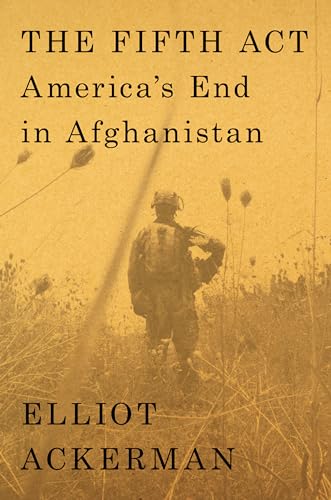
Verwandte Artikel zu The Fifth Act: America's End in Afghanistan
Inhaltsangabe
“The American betrayal of Afghanistan took twenty years. Elliot Ackerman, a participant and witness, tells the story with unsparing honesty in this intensely personal chronicle.” —George Packer
A powerful and revelatory eyewitness account of the American collapse in Afghanistan, its desperate endgame, and the war’s echoing legacy
Elliot Ackerman left the American military ten years ago, but his time in Afghanistan and Iraq with the Marines and later as a CIA paramilitary officer marked him indelibly. When the Taliban began to close in on Kabul in August 2021 and the Afghan regime began its death spiral, he found himself pulled back into the conflict. Afghan nationals who had worked closely with the American military and intelligence communities for years now faced brutal reprisal and sought frantically to flee the country with their families. The official US government evacuation effort was a bureaucratic failure that led to a humanitarian catastrophe. With former colleagues and friends protecting the airport in Kabul, Ackerman joined an impromptu effort by a group of journalists and other veterans to arrange flights and negotiate with both Taliban and American forces to secure the safe evacuation of hundreds. These were desperate measures taken during a desperate end to America's longest war. For Ackerman, it also became a chance to reconcile his past with his present.
The Fifth Act is an astonishing human document that brings the weight of twenty years of war to bear on a single week, the week the war ended. Using the dramatic rescue efforts in Kabul as his lattice, Ackerman weaves a personal history of the war's long progression, beginning with the initial invasion in the months after 9/11. It is a play in five acts, the fifth act being the story’s tragic denouement, a prelude to Afghanistan's dark future. Any reader who wants to understand what went wrong with the war’s trajectory will find a trenchant account here. But The Fifth Act also brings readers into close contact with a remarkable group of characters, American and Afghan, who fought the war with courage and dedication, and at great personal cost. Ackerman's story is a first draft of history that feels like a timeless classic.
Die Inhaltsangabe kann sich auf eine andere Ausgabe dieses Titels beziehen.
Über die Autorin bzw. den Autor
Elliot Ackerman is the New York Times bestselling author of the novels 2034, Red Dress In Black and White, Waiting for Eden, Dark at the Crossing, and Green on Blue, as well as the memoir Places and Names: On War, Revolution and Returning. His books have been nominated for the National Book Award, the Andrew Carnegie Medal in both fiction and nonfiction, and the Dayton Literary Peace Prize among others. He is both a former White House Fellow and Marine, and served five tours of duty in Iraq and Afghanistan, where he received the Silver Star, the Bronze Star for Valor, and the Purple Heart. He divides his time between New York City and Washington, D.C.
Auszug. © Genehmigter Nachdruck. Alle Rechte vorbehalten.
Scene I
Fort Story, 2002
The sand hill was called Loch Ness. It rose out of the Virginia coastal flats like the hump on that mythical dragon. Every conditioning hike at the Marine Corps Amphibious Reconnaissance School-known as ARS-ended with a sprint up Loch Ness. The instructors watched us closely, and if you stumbled or your rifle touched the sand like a crutch, they would push you down the hill and tell you to start again. Temperatures hovered in the nineties that summer. More than once I vomited in the sand. Most of us did. Years later, a friend of mine who graduated the course kept a glass Coke bottle filled with Loch Ness sand on the mantel above his fireplace. He said he kept it there as a reminder for when things in his own life got difficult. Written in black Sharpie on the bottle was the word Perspective.
Jack and I met at ARS not even a year after 9/11. The war was new then. No one understood how long it would last or where it would take us. We even worried we might miss it. I was a year from finishing college and had talked my way into attending the course, where we lived in a squat barracks atop the hill. Jack was about to take command of an elite force reconnaissance platoon. Every week or so, the instructors would give us a night or even a whole day off. We would drive into town in Jack's car, a beat-up, sand-brown Jeep Cherokee his parents had given him when he graduated college. Because I was only an ROTC midshipman and he was a commissioned officer-a first lieutenant-I called him sir. The Marine Corps is a funny place, the type of place where you call your friends sir.
Jack is a southerner, raised among the Blue Ridge Mountains. In college he minored in creative writing. He likes to talk about Faulkner and Walker Percy. He's a fan of the poet James L. Dickey. For years, Dickey worked in advertising. He wrote copy for Coca-Cola and Lay's potato chips while writing poetry after work. Later, Jack tells me something Dickey once said about writing poetry: "I was selling my soul to the devil all day and trying to buy it back at night." At ARS, Jack used to string a poncho around his bunk so he could read late into the night with a headlamp. He would keep his books stacked beneath his bed, alongside his combat boots. In Afghanistan, years later, guys would call him the American Pashtun. I think he liked this. He spent so much time in Afghanistan that the Musa Khel around Khost would eventually grant him tribal membership. Two decades ago, driving out the gate onto Route 60 toward Chili's or Applebee's, after days spent training in the Virginia woods, I remember the Steve Earle CD he would play. The album was 1995's Train a Comin' and the track was "Mercenary Song." It goes like this:
Me and old Bill there, we both come from Georgia
Met Hank out in New Mexico
We're bound for Durango to join Pancho Villa
We hear that he's paying in gold
I guess a man's got to do what he's best at
Ain't found nothing better so far
Been called mercenaries and men with no country
Just soldiers in search of a war
And we're bound for the border, we're soldiers of fortune
Well, we'll fight for no country, but we'll die for good pay
Under the flag of the greenback dollar
Or the peso down Mexico way
Neither one of us suspected our wars would go on for twenty years. That we would become like the professionals Steve Earle sang about. When the Taliban-led government refused to turn over Osama bin Laden after 9/11 and President Bush sent the first US combat troops into Afghanistan on October 7, 2001, it took only two months of fighting for the Taliban to collapse. The war-as we understood it then-had proven swift. The summer Jack and I met, the US-backed Islamic Republic of Afghanistan was formed, and even though bin Laden had escaped, the media was debating whether the time had come to declare victory in Afghanistan. This triumphal air soon vanished.
Of the many fatal mistakes made in our Afghan tragedy, the Bush administration would soon make the first: it would begin the war in Iraq. Within a year, Jack would be in Iraq leading a platoon during the invasion. Within two years, I would also be in Iraq, leading a platoon in Fallujah. Afghanistan is the older war, but for both of us Iraq was our first war; we deployed there first because Bush had made Afghanistan a second-tier priority. As the Iraq War raged, the lack of US focus in Afghanistan set conditions for the Taliban to reconstitute in neighboring Pakistan. By 2005, a Taliban-led insurgency reestablished itself in Afghanistan. President Bush's fixation on Iraq allowed this. What neither of us knew as we suffered through training in 2002 was that the Bush administration was laying an architecture that would sustain twenty years of war.
To wage war, America has always had to create a social construct to sustain it, from the colonial militias and French aid in the Revolution, to the introduction of the draft and the first-ever income tax to fund the Civil War, to the war bonds and industrial mobilization of the Second World War. In the past, a blend of taxation and conscription meant it was difficult for us to sustain war beyond several years. Neither citizens nor citizen soldiers had much patience for commanders, or commanders in chief, who muddled along. Take, for example, Washington reading Thomas Paine's The American Crisis as a plea to his disbanding army before they famously crossed the Delaware ("These are the times that try men's souls . . ."), or Lincoln, whose perceived mismanagement of the Civil War made his defeat in the 1864 presidential election a foregone conclusion to many, until Atlanta fell to the Union two months before the vote. The history of American warfare-even the "good" wars-is a history of our leaders desperately trying to preserve the requisite national will because Americans would not abide a costly, protracted war. This is no longer true.
After 9/11, in the opening act of the wars that followed, the Bush administration engineered a new type of war, one that is ahistorical-and seemingly without end. Never before had America engaged in a protracted conflict with an all-volunteer military that was funded through deficit spending. By the end of the Afghan War, our national debt hovered at around $28 trillion, with approximately $6 trillion being the bill for our post-9/11 wars, by far America's longest. In the aftermath of 9/11, there was no serious public debate about a war tax or a draft. Our leaders responded to those attacks by mobilizing our government and military, but when it came to citizens, President Bush said, "I have urged our fellow Americans to go about their lives." And so, by the summer of 2002, as Jack and I were listening to "Mercenary Song," the war effort had already moved to the shopping mall.
For those who fight in a never-ending war, you must choose to leave it or to finish it. A decade in, when I made this choice, it nearly ended my friendship with Jack. And that night, in Rome, I wonder if he's forgiven me when I ask him for one last favor in Afghanistan.
Scene II
Khost, 2011
The CIA base at Shkin is a satellite of Khost Base. The two are tucked into the high desert of the Hindu Kush. The CTPT that I advise in Shkin is several hundred troops strong. The CTPT at Khost is several thousand strong. For the past year, Jack has been riding a desk at Langley, having left the Marines for the CIA several years before. He oversees the schedule of who goes where in Afghanistan and when. He has taken good care of me and my career by placing me in Shkin. But his desk-riding is about to end. In a couple of months, he'll take over the mammoth task of overseeing what is-basically-a secret army at Khost Base. In preparation, he is flying in from the United States to get a...
„Über diesen Titel“ kann sich auf eine andere Ausgabe dieses Titels beziehen.
Suchergebnisse für The Fifth Act: America's End in Afghanistan

Beispielbild für diese ISBN
The Fifth ACT Americas End in
Anbieter: World of Books (was SecondSale), Montgomery, IL, USA
Verkäuferbewertung 5 von 5 Sternen

Zustand: Good. Item in good condition. Textbooks may not include supplemental items i.e. CDs, access codes etc. Artikel-Nr. 00092910433
Gebraucht kaufen
EUR 4,27
Versand gratis
Versand innerhalb von USA
Versand innerhalb von USA
Anzahl: 3 verfügbar
Foto des Verkäufers
The Fifth Act: America's End in Afghanistan
Anbieter: Dream Books Co., Denver, CO, USA
Verkäuferbewertung 5 von 5 Sternen
Zustand: good. Gently used with minimal wear on the corners and cover. A few pages may contain light highlighting or writing, but the text remains fully legible. Dust jacket may be missing, and supplemental materials like CDs or codes may not be included. May be ex-library with library markings. Ships promptly! Artikel-Nr. DBV.0593492048.G
Gebraucht kaufen
EUR 4,55
Versand gratis
Versand innerhalb von USA
Versand innerhalb von USA
Anzahl: 1 verfügbar
Beispielbild für diese ISBN
The Fifth ACT: America's End in Afghanistan
Anbieter: ThriftBooks-Atlanta, AUSTELL, GA, USA
Verkäuferbewertung 5 von 5 Sternen
Hardcover. Zustand: Very Good. No Jacket. Former library book; May have limited writing in cover pages. Pages are unmarked. ~ ThriftBooks: Read More, Spend Less. Artikel-Nr. G0593492048I4N10
Gebraucht kaufen
EUR 5,87
Versand gratis
Versand innerhalb von USA
Versand innerhalb von USA
Anzahl: 2 verfügbar
Beispielbild für diese ISBN
The Fifth ACT: America's End in Afghanistan
Anbieter: ThriftBooks-Dallas, Dallas, TX, USA
Verkäuferbewertung 5 von 5 Sternen
Hardcover. Zustand: Very Good. No Jacket. Former library book; May have limited writing in cover pages. Pages are unmarked. ~ ThriftBooks: Read More, Spend Less. Artikel-Nr. G0593492048I4N10
Gebraucht kaufen
EUR 5,87
Versand gratis
Versand innerhalb von USA
Versand innerhalb von USA
Anzahl: 1 verfügbar
Beispielbild für diese ISBN
The Fifth Act: America's End in Afghanistan
Anbieter: Wonder Book, Frederick, MD, USA
Verkäuferbewertung 5 von 5 Sternen
Zustand: Very Good. Very Good condition. Very Good dust jacket. A copy that may have a few cosmetic defects. May also contain light spine creasing or a few markings such as an owner's name, short gifter's inscription or light stamp. Artikel-Nr. G06E-01177
Gebraucht kaufen
EUR 6,33
Versand gratis
Versand innerhalb von USA
Versand innerhalb von USA
Anzahl: 1 verfügbar
Beispielbild für diese ISBN
The Fifth Act: America's End in Afghanistan
Anbieter: Wonder Book, Frederick, MD, USA
Verkäuferbewertung 5 von 5 Sternen
Zustand: As New. Like New condition. Like New dust jacket. A near perfect copy that may have very minor cosmetic defects. Artikel-Nr. H15O-01145
Gebraucht kaufen
EUR 6,33
Versand gratis
Versand innerhalb von USA
Versand innerhalb von USA
Anzahl: 2 verfügbar
Beispielbild für diese ISBN
The Fifth ACT: America's End in Afghanistan
Anbieter: ThriftBooks-Phoenix, Phoenix, AZ, USA
Verkäuferbewertung 5 von 5 Sternen
Hardcover. Zustand: Very Good. No Jacket. Former library book; May have limited writing in cover pages. Pages are unmarked. ~ ThriftBooks: Read More, Spend Less. Artikel-Nr. G0593492048I4N10
Gebraucht kaufen
EUR 6,59
Versand gratis
Versand innerhalb von USA
Versand innerhalb von USA
Anzahl: 1 verfügbar
Beispielbild für diese ISBN
The Fifth ACT: America's End in Afghanistan
Anbieter: ThriftBooks-Reno, Reno, NV, USA
Verkäuferbewertung 5 von 5 Sternen
Hardcover. Zustand: Fair. No Jacket. Readable copy. Pages may have considerable notes/highlighting. ~ ThriftBooks: Read More, Spend Less. Artikel-Nr. G0593492048I5N00
Gebraucht kaufen
EUR 6,59
Versand gratis
Versand innerhalb von USA
Versand innerhalb von USA
Anzahl: 1 verfügbar
Beispielbild für diese ISBN
The Fifth ACT: America's End in Afghanistan
Anbieter: ThriftBooks-Atlanta, AUSTELL, GA, USA
Verkäuferbewertung 5 von 5 Sternen
Hardcover. Zustand: Fair. No Jacket. Missing dust jacket; Readable copy. Pages may have considerable notes/highlighting. ~ ThriftBooks: Read More, Spend Less. Artikel-Nr. G0593492048I5N01
Gebraucht kaufen
EUR 6,59
Versand gratis
Versand innerhalb von USA
Versand innerhalb von USA
Anzahl: 1 verfügbar
Beispielbild für diese ISBN
The Fifth ACT: America's End in Afghanistan
Anbieter: ThriftBooks-Reno, Reno, NV, USA
Verkäuferbewertung 5 von 5 Sternen
Hardcover. Zustand: Good. No Jacket. Former library book; Pages can have notes/highlighting. Spine may show signs of wear. ~ ThriftBooks: Read More, Spend Less. Artikel-Nr. G0593492048I3N10
Gebraucht kaufen
EUR 6,59
Versand gratis
Versand innerhalb von USA
Versand innerhalb von USA
Anzahl: 1 verfügbar