
Verwandte Artikel zu A Documentary History of the United States (11th Edition)
Inhaltsangabe
“An indispensable contribution to the understanding of our heritage.” – Robert A. Caro
“This insightful collection will fascinate, delight, and challenge all who are interested in the progress of the American nation.”—Annette Gordon-Reed
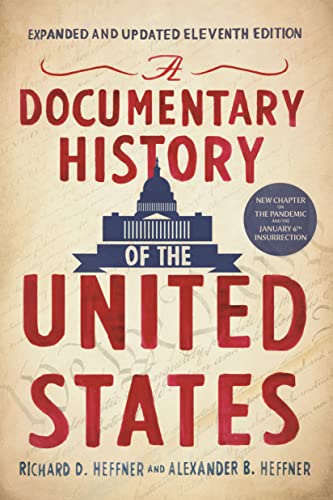
Here, in a single volume, are the documents (speeches, letters, tweets, Supreme Court decisions, and more) that have forged American history. This 11th edition is now updated with a new chapter on the COVID-19 pandemic, the January 6, 2021 insurrection, and the Biden presidency.
Accompanied by interpretations of their significance by noted historian Richard D. Heffner and journalist Alexander B. Heffner, the important documents in this book include:
• The Declaration of Independence
• The Constitution of the United States
• Frederick Douglass’ “What, to the Slave, is the Fourth of July?”
• The Monroe Doctrine
• The Emancipation Proclamation
• Woodrow Wilson’s War Message to Congress
• Franklin D. Roosevelt’s “Four Freedoms” speech
• John F. Kennedy’s inaugural address
• Martin Luther King, Jr.’s letter from the Birmingham City Jail
• The National Organization for Women (NOW) Statement of Purpose
• Roe v. Wade Supreme Court Decision
• Documents related to September 11 and the Iraq War
• Barack Obama’s “A More Perfect Union” speech
• Articles of Impeachment against Donald J. Trump
More Than One Million Copies Sold!
Die Inhaltsangabe kann sich auf eine andere Ausgabe dieses Titels beziehen.
Über die Autorin bzw. den Autor
Richard D. Heffner taught history and political science at the University of California, Sarah Lawrence College, the New School for Social Research, and NYU. University Professor of Communications and Public Policy at Rutgers, he also produced and moderated his prizewinning public television series, Richard Heffner's Open Mind, for fifty years.
Alexander B. Heffner is a journalist whose writing has appeared in The Wall Street Journal,The Washington Post, The Boston Globe, The Philadelphia Inquirer, USA Today, and Newsday among other leading publications. He has been interviewed about politics, education and stories in the news by PBS, C-SPAN, CNN and the BBC, among other national and local broadcast venues. He is the current host of Open Mind, the weekly PBS talk show.
Auszug. © Genehmigter Nachdruck. Alle Rechte vorbehalten.
1
A NEW NATION
What then is the American, this new man? . . . He is an American, who leaving behind him all his ancient prejudices and manners, receives new ones from the new mode of life he has embraced, the new government he obeys, and the new rank he holds. He becomes an American by being received in the broad lap of our great Alma Mater. Here individuals of all nations are melted into a new race of men, whose labours and posterity will one day cause great changes in the world. . . . The American is a new man, who acts upon new principles; he must therefore entertain new ideas, and form new opinions. From involuntary idleness, servile dependence, penury, and useless labour, he has passed to toils of a very different nature, rewarded by ample subsistence.-This is an American. . . .
Hector St. John de Cr�vecoeur, 1782.
Freed from the tyrannical economic, political, and ecclesiastical restraints of the Old World, and blessed with a bountiful environment whose rich and abundant resources, varied climate, and vast domain imbued in him an unquestioned faith in his own future, the American was in truth a "new man." Yet the roots of American society were firmly implanted in the great traditions of Western civilization, and ultimately American nationality was as heavily indebted to its European heritage of ideas and mode of life as it was to the new environment. Indeed, in its inception and its development, American colonial history was clearly a reflection of European experiences. The discovery of America resulted from the breakup of the feudal system, the rise of the nation-state, the revival of commerce, and the search for trade routes to the fabulous riches of the East. Later, the long process of English colonization of the New World was motivated both by the quest for free religious expression stemming largely from the Protestant Reformation of the sixteenth century, and by that desire for economic opportunity which had its origins in the middle-class business ethic peculiar to the modern Western world.
The final chapter of American colonial history was also written abroad, for the restrictive policies of British mercantilism provided an economic impetus to the American Revolution, just as the natural rights philosophy of the European Enlightenment set its ideological framework. Mercantilism, an economic arm of the rising nationalism of the seventeenth and eighteenth centuries, had as its major objectives national self-sufficiency and prosperity for the dominant merchant and banking class. A favorable balance of trade was particularly important to the mercantilist doctrine, for if more goods and services were sold abroad than were imported, gold and silver would come into the country, and the nation's total economic strength would be augmented rather than depleted. Each nation desired a favorable balance of trade, however, and so the great mercantilist powers of Europe soon turned to overseas possessions as a source of economic strength. For these colonies existed solely to be exploited by the mother country-to produce essential raw materials cheaply, to provide an unlimited market for surplus manufactured goods, and to offer a minimum of economic competition.
British colonial policy amply demonstrated the mother country's intention of molding her American possessions into this mercantilist pattern. To free her from dependence upon foreign nations for needed raw materials, the Navigation Acts of the seventeenth and eighteenth centuries listed various "enumerated commodities" (such as sugar, tobacco, indigo, and naval stores) which the colonials had to export to England alone. And in an effort to retain exclusive control of the rapidly growing American markets for British manufactured goods, all foreign commodities bound for the colonies were required to pass through England, where prohibitive export duties and freight and handling charges made transshipment intolerably expensive. Competition by the industrious colonists themselves was nearly eliminated through laws such as the Woolens Act (1699), the Hat Act (1732), and the Iron Act (1750), which prohibited or discouraged local efforts at manufacturing.
Though mercantilism benefited the colonists in certain respects-generous bounties, for instance, were paid for indigo and badly needed naval stores, and a monopoly of the English tobacco market was insured to the American producer-the economic well-being of the colonies was for the most part harshly subordinated to the needs of the mother country. Even the Southern settlements, whose staple crops-such as tobacco-well suited them for the colonial role, were hard pressed by the one-sided mercantilist system. And by the eve of the American Revolution, Thomas Jefferson estimated that a persistently unfavorable colonial balance of trade had placed at least half of the tobacco planters of Maryland and Virginia hopelessly in debt to British creditors. At the same time the various Navigation and Trade Acts attempted to restrict severely the trading, shipping, manufacturing, and other economic activities of the settlements in the North, where climate and soil were not capable of supporting the large-scale cultivation of staple crops for the home market. Yet the colonies prospered, at least in the New England and Middle Atlantic regions. Smuggling and other evasions of mercantilist measures were prevalent, and for long decades before the conclusion of the French and Indian War in 1763, the British were too thoroughly immersed in a bitter imperial rivalry with France to enforce their restrictive legislation.
With the defeat of France, however, the British were able to bring to an end the era of "salutary neglect" and to turn their full attention once again to strict enforcement of colonial policy. Besides, Parliament now strongly reasserted its right to legislate for colonials who had long known virtual independence and self-rule and who were well versed in the liberal philosophy of the eighteenth-century Enlightenment. Political discontent was thus added to economic dislocation, and economic grievances soon found expression in the loftiest principles of political liberty. Royal (and even Parliamentary) efforts to enforce mercantilist policies were damned as contrary not only to the rights of Englishmen, but to the "natural rights of man" as well, while the colonists' fundamental antipathy to taxation of any kind achieved immortality in the idealistic slogan "no taxation without representation." The British were unmoved by these protests and in rapid succession the Sugar Act (1764), the Currency Act (1764), the Stamp Act (1765), the Townshend Duties (1767), the Tea Act (1773), and the Intolerable Acts (1774) taxed and regulated the colonial economy and imposed the severest restrictions upon colonial self-government.
The colonists were quick to reply. A Stamp Act Congress met in October 1765 to denounce the hated tax on newspapers, magazines, commercial papers, and other documents, and an organization of patriots known as the Sons of Liberty directly forced the resignation of nearly all of the imperial stamp agents. American merchants agreed not to import British merchandise until the tax was repealed, and many persons stoutly refused to buy any stamps at all. Even though colonial pressures finally effected the repeal of the Stamp Tax, the tide of unrest continued to rise. Americans more and more frequently joined together to oppose imperial measures; and after British soldiers had fired into a jeering Boston mob (the "Boston Massacre" of March 1770), popular resentment increased tremendously. Nonimportation agreements, "Committees of Correspondence" (which Samuel Adams of Massachusetts organized to inform patriots throughout the colonies of current affairs), the "Boston Tea Party" of December 1773, and finally the First Continental Congress that met in Philadelphia in September...
„Über diesen Titel“ kann sich auf eine andere Ausgabe dieses Titels beziehen.
Suchergebnisse für A Documentary History of the United States (11th Edition)

Beispielbild für diese ISBN
A Documentary History of the United States
Anbieter: World of Books (was SecondSale), Montgomery, IL, USA
Verkäuferbewertung 5 von 5 Sternen

Paperback. Zustand: Good. Here, in a single volume, are the documents, speeches, and letters that have forged American history, now updated with new content such as Trumps inaugural address. Accompanied by interpretations of their significance by noted historian Richard D. Heffner and journalist Alexander Heffner, this book includes important documents such as: The complete text of the Declaration of Independence, the complete Constitution of the United States, the Monroe Doctrine, the Emancipation Proclamation, and many more. Artikel-Nr. 00110702378
Gebraucht kaufen
EUR 6,18
Versand gratis
Versand innerhalb von USA
Versand innerhalb von USA
Anzahl: 1 verfügbar
Beispielbild für diese ISBN
A Documentary History of the United States (11th Edition)
Anbieter: BookOutlet, Jefferson City, TN, USA
Verkäuferbewertung 5 von 5 Sternen
Paperback. Zustand: New. Paperback. Publisher overstock, may contain remainder mark on edge. Artikel-Nr. 9780593439340B
Beispielbild für diese ISBN
A Documentary History of the United States
Anbieter: Revaluation Books, Exeter, Vereinigtes Königreich
Verkäuferbewertung 5 von 5 Sternen
Paperback. Zustand: Brand New. 11 edition. 640 pages. 8.25x5.50x1.25 inches. In Stock. Artikel-Nr. __0593439341
Neu kaufen
EUR 17,46
EUR 14,54 Versand
Versand von Vereinigtes Königreich nach USA
Versand von Vereinigtes Königreich nach USA
Anzahl: 1 verfügbar
Beispielbild für diese ISBN
A Documentary History Of The United States
Verlag:
Bantam Doubleday Dell Publishing Group Inc, 2022
ISBN 10: 0593439341
ISBN 13: 9780593439340
Neu
Softcover
Anbieter: Kennys Bookstore, Olney, MD, USA
Verkäuferbewertung 5 von 5 Sternen
Zustand: New. 2022. 11th ed. Paperback. . . . . . Books ship from the US and Ireland. Artikel-Nr. V9780593439340
Neu kaufen
EUR 27,42
EUR 9,23 Versand
Versand innerhalb von USA
Versand innerhalb von USA
Anzahl: 15 verfügbar
Foto des Verkäufers
A Documentary History of the United States (11th Edition)
Anbieter: moluna, Greven, Deutschland
Verkäuferbewertung 5 von 5 Sternen
Zustand: New. Richard D. Heffner taught history and political science at the University of California, Sarah Lawrence College, the New School for Social Research, and NYU. University Professor of Communications and Public Policy at Rutgers, he also produced and mo. Artikel-Nr. 533810920
Neu kaufen
EUR 25,17
EUR 48,99 Versand
Versand von Deutschland nach USA
Versand von Deutschland nach USA
Anzahl: 1 verfügbar