
Verwandte Artikel zu Passing
Inhaltsangabe
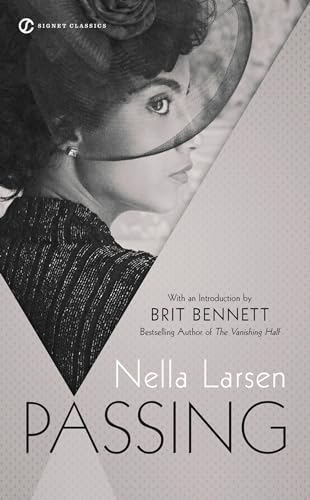
Nella Larsen’s fascinating exploration of race and identity—the inspiration for the Netflix film directed by Rebecca Hall, starring Tessa Thompson and Ruth Negga.
This Signet Classics edition of Passing includes an Introduction by Brit Bennett, the bestselling author of The Vanishing Half.
One of The Atlantic’s Great American Novels of the Past 100 Years
Irene Redfield is a Black woman living an affluent, comfortable life with her husband and children in the thriving neighborhood of Harlem in the 1920s. When she reconnects with her childhood friend Clare Kendry, who is similarly light-skinned, Irene discovers that Clare has been passing for a white woman after severing ties to her past—even hiding the truth from her racist husband.
Clare finds herself drawn to Irene’s sense of ease and security with her Black identity and longs for the community (and, increasingly, the woman) she lost. Irene is both riveted and repulsed by Clare and her dangerous secret, as Clare begins to insert herself—and her deception—into every part of Irene’s stable existence. First published in 1929, Larsen’s brilliant examination of the various ways in which we all seek to “pass,” is as timely as ever.
Die Inhaltsangabe kann sich auf eine andere Ausgabe dieses Titels beziehen.
Über die Autorin bzw. den Autor
Nella Larsen, one of the most acclaimed and influential writers of the Harlem Renaissance, was born Nellie Walker in Chicago on April 13, 1891. Her father was mixed-race, her mother was a Danish immigrant, and she struggled to find a community to which to belong. After working for some years as a nurse, primarily in the Bronx, Larsen became the first black woman to graduate from the New York Public Library School and worked in various branches before landing in Harlem, the center of African-American culture. She became active in Harlem's artistic community and wrote her first novel, Quicksand, published in 1928. A critical though not financial success, it was awarded a Bronze Medal by the Harmon Foundation in recognition of Distinguished Achievement Among Negroes in Literature. Her second novel, Passing, came out the following year. Larsen was the first African-American woman to receive the Guggenheim Fellowship for creative writing. Due to personal and professional struggles following a highly publicized divorce, Larsen had stopped writing by the end of the 1930s. She resumed work as a nurse until her death in 1964.
Born and raised in Southern California, Brit Bennett graduated from Stanford University and later earned her MFA in fiction at the University of Michigan. Her debut novel The Mothers was a New York Times bestseller, and her second novel The Vanishing Half was an instant #1 New York Times bestseller. She is a National Book Foundation 5 Under 35 honoree and in 2021, she was chosen as one of Time’s Next 100 Influential People. Her essays have been featured in The New Yorker, the New York Times Magazine, The Paris Review, and Jezebel.
Auszug. © Genehmigter Nachdruck. Alle Rechte vorbehalten.
CHAPTER ONE
It was the last letter in Irene Redfield's little pile of morning mail. After her other ordinary and clearly directed letters the long envelope of thin Italian paper with its almost illegible scrawl seemed out of place and alien. And there was, too, something mysterious and slightly furtive about it. A thin sly thing which bore no return address to betray the sender. Not that she hadn't immediately known who its sender was. Some two years ago she had one very like it in outward appearance. Furtive, but yet in some peculiar, determined way a little flaunting. Purple ink. Foreign paper of extraordinary size.
It had been, Irene noted, postmarked in New York the day before. Her brows came together in a tiny frown. The frown, however, was more from perplexity than from annoyance, though there was in her thoughts an element of both. She was wholly unable to comprehend such an attitude toward danger as she was sure the letter's contents would reveal; and she disliked the idea of opening and reading it.
This, she reflected, was of a piece with all that she knew of Clare Kendry. Stepping always on the edge of danger. Always aware, but not drawing back or turning aside. Certainly not because of any alarms or feeling of outrage on the part of others.
And for a swift moment Irene Redfield seemed to see a pale small girl sitting on a ragged blue sofa, sewing pieces of bright red cloth together, while her drunken father, a tall, powerfully built man, raged threateningly up and down the shabby room, bellowing curses and making spasmodic lunges at her which were not the less frightening because they were, for the most part, ineffectual. Sometimes he did manage to reach her. But only the fact that the child had edged herself and her poor sewing over to the farthermost corner of the sofa suggested that she was in any way perturbed by this menace to herself and her work.
Clare had known well enough that it was unsafe to take a portion of the dollar that was her weekly wage for the doing of many errands for the dressmaker who lived on the top floor of the building of which Bob Kendry was janitor. But that knowledge had not deterred her. She wanted to go to her Sunday school's picnic, and she had made up her mind to wear a new dress. So, in spite of certain unpleasantness and possible danger, she had taken the money to buy the material for that pathetic little red frock.
There had been, even in those days, nothing sacrificial in Clare Kendry's idea of life, no allegiance beyond her own immediate desire. She was selfish, and cold, and hard. And yet she had, too, a strange capacity of transforming warmth and passion, verging sometimes almost on theatrical heroics.
Irene, who was a year or more older than Clare, remembered that day that Bob Kendry had been brought home dead, killed in a silly saloon fight. Clare, who was at that time a scant fifteen years old, had just stood there with her lips pressed together, her thin arms folded across her narrow chest, staring down at the familiar pasty white face of her parent with a sort of disdain in her slanting black eyes. For a very long time she had stood like that, silent and staring. Then, quite suddenly, she had given way to a torrent of weeping, swaying her thin body, tearing at her bright hair, and stamping her small feet. The outburst had ceased as suddenly as it had begun. She glanced quickly about the bare room, taking everyone in, even the two policemen, in a sharp look of flashing scorn. And, in the next instant, she had turned and vanished through the door.
Seen across the long stretch of years, the thing had more the appearance of an outpouring of pent-up fury than of an overflow of grief for her dead father, though she had been, Irene admitted, fond enough of him in her own rather catlike way.
Catlike. Certainly that was the word which best described Clare Kendry, if any single word could describe her. Sometimes she was hard and apparently without feeling at all; sometimes she was affectionate and rashly impulsive. And there was about her an amazing soft malice, hidden well away until provoked. Then she was capable of scratching, and very effectively, too. Or, driven to anger, she would fight with a ferocity and impetuousness that disregarded or forgot any danger, superior strength, numbers, or other unfavorable circumstances. How savagely she had clawed those boys the day they had hooted her parent and sung a derisive rhyme, of their own composing, which pointed out certain eccentricities in his careening gait! And how deliberately she had-
Irene brought her thoughts back to the present, to the letter from Clare Kendry that she still held unopened in her hand. With a little feeling of apprehension, she very slowly cut the envelope, drew out the folded sheets, spread them, and began to read.
It was, she saw at once, what she had expected since learning from the postmark that Clare was in the city. An extravagantly phrased wish to see her again. Well, she needn't and wouldn't, Irene told herself, accede to that. Nor would she assist Clare to realize her foolish desire to return for a moment to that life which long ago, and of her own choice, she had left behind her.
She ran through the letter, puzzling out, as best she could, the carelessly formed words or making instinctive guesses at them.
". . . For I am lonely, so lonely . . . cannot help longing to be with you again, as I have never longed for anything before; and I have wanted many things in my life. . . . You can't know how in this pale life of mine I am all the time seeing the bright pictures of that other that I once thought I was glad to be free of. . . . It's like an ache, a pain that never ceases. . . ." Sheets upon thin sheets of it. And ending finally with, "and it's your fault, 'Rene dear. At least partly. For I wouldn't now, perhaps, have this terrible, this wild desire if I hadn't seen you that time in Chicago. . . ."
Brilliant red patches flamed in Irene Redfield's warm olive cheeks.
"That time in Chicago." The words stood out from among the many paragraphs of other words, bringing with them a clear, sharp remembrance, in which even now, after two years, humiliation, resentment, and rage were mingled.
CHAPTER TWO
This is what Irene Redfield remembered.
Chicago. August. A brilliant day, hot, with a brutal staring sun pouring down rays that were like molten rain. A day on which the very outlines of the buildings shuddered as if in protest at the heat. Quivering lines sprang up from baked pavements and wriggled along the shining car tracks. The automobiles parked at the curbs were a dancing blaze, and the glass of the shopwindows threw out a blinding radiance. Sharp particles of dust rose from the burning sidewalks, stinging the seared or dripping skins of wilting pedestrians. What small breeze there was seemed like the breath of a flame fanned by slow bellows.
It was on that day of all others that Irene set out to shop for the things which she had promised to take home from Chicago to her two small sons, Brian Junior and Theodore. Characteristically, she had put it off until only a few crowded days remained of her long visit. And only this sweltering one was free of engagements till the evening.
Without too much trouble she had got the mechanical aeroplane for Junior. But the drawing book, for which Ted had so gravely and insistently given her precise directions, had sent her in and out of five shops without success.
It was while she was on her way to a sixth place that right before her smarting eyes a man toppled over and became an inert crumpled heap on the scorching cement. About the lifeless figure a little crowd gathered. Was the man dead, or only faint?...
„Über diesen Titel“ kann sich auf eine andere Ausgabe dieses Titels beziehen.
Suchergebnisse für Passing

Foto des Verkäufers
Passing
Anbieter: Dream Books Co., Denver, CO, USA
Verkäuferbewertung 5 von 5 Sternen

Zustand: acceptable. This copy has clearly been enjoyedâ"expect noticeable shelf wear and some minor creases to the cover. Binding is strong, and all pages are legible. May contain previous library markings or stamps. Artikel-Nr. DBV.0593437845.A
Gebraucht kaufen
EUR 5,33
Versand gratis
Versand innerhalb von USA
Versand innerhalb von USA
Anzahl: 1 verfügbar
Beispielbild für diese ISBN
Passing
Verlag:
Signet Book, 2021
ISBN 10: 0593437845
ISBN 13: 9780593437841
Gebraucht
Mass Market Paperback
Anbieter: ThriftBooks-Atlanta, AUSTELL, GA, USA
Verkäuferbewertung 5 von 5 Sternen
Mass Market Paperback. Zustand: Fair. No Jacket. Readable copy. Pages may have considerable notes/highlighting. ~ ThriftBooks: Read More, Spend Less. Artikel-Nr. G0593437845I5N00
Gebraucht kaufen
EUR 6,04
Versand gratis
Versand innerhalb von USA
Versand innerhalb von USA
Anzahl: 6 verfügbar
Beispielbild für diese ISBN
Passing
Verlag:
Signet Book, 2021
ISBN 10: 0593437845
ISBN 13: 9780593437841
Gebraucht
Mass Market Paperback
Anbieter: ThriftBooks-Phoenix, Phoenix, AZ, USA
Verkäuferbewertung 5 von 5 Sternen
Mass Market Paperback. Zustand: Good. No Jacket. Pages can have notes/highlighting. Spine may show signs of wear. ~ ThriftBooks: Read More, Spend Less. Artikel-Nr. G0593437845I3N00
Gebraucht kaufen
EUR 6,04
Versand gratis
Versand innerhalb von USA
Versand innerhalb von USA
Anzahl: 6 verfügbar
Beispielbild für diese ISBN
Passing
Verlag:
Signet Book, 2021
ISBN 10: 0593437845
ISBN 13: 9780593437841
Gebraucht
Mass Market Paperback
Anbieter: ThriftBooks-Dallas, Dallas, TX, USA
Verkäuferbewertung 5 von 5 Sternen
Mass Market Paperback. Zustand: Very Good. No Jacket. May have limited writing in cover pages. Pages are unmarked. ~ ThriftBooks: Read More, Spend Less. Artikel-Nr. G0593437845I4N00
Gebraucht kaufen
EUR 6,04
Versand gratis
Versand innerhalb von USA
Versand innerhalb von USA
Anzahl: 2 verfügbar
Beispielbild für diese ISBN
Passing
Verlag:
Signet Book, 2021
ISBN 10: 0593437845
ISBN 13: 9780593437841
Gebraucht
Mass Market Paperback
Anbieter: ThriftBooks-Reno, Reno, NV, USA
Verkäuferbewertung 5 von 5 Sternen
Mass Market Paperback. Zustand: Good. No Jacket. Pages can have notes/highlighting. Spine may show signs of wear. ~ ThriftBooks: Read More, Spend Less. Artikel-Nr. G0593437845I3N00
Gebraucht kaufen
EUR 6,04
Versand gratis
Versand innerhalb von USA
Versand innerhalb von USA
Anzahl: 7 verfügbar
Beispielbild für diese ISBN
Passing
Verlag:
Signet Book, 2021
ISBN 10: 0593437845
ISBN 13: 9780593437841
Gebraucht
Mass Market Paperback
Anbieter: ThriftBooks-Dallas, Dallas, TX, USA
Verkäuferbewertung 5 von 5 Sternen
Mass Market Paperback. Zustand: Good. No Jacket. Pages can have notes/highlighting. Spine may show signs of wear. ~ ThriftBooks: Read More, Spend Less. Artikel-Nr. G0593437845I3N00
Gebraucht kaufen
EUR 6,04
Versand gratis
Versand innerhalb von USA
Versand innerhalb von USA
Anzahl: 7 verfügbar
Beispielbild für diese ISBN
Passing
Verlag:
Signet Book, 2021
ISBN 10: 0593437845
ISBN 13: 9780593437841
Gebraucht
Mass Market Paperback
Anbieter: ThriftBooks-Reno, Reno, NV, USA
Verkäuferbewertung 5 von 5 Sternen
Mass Market Paperback. Zustand: Fair. No Jacket. Former library book; Readable copy. Pages may have considerable notes/highlighting. ~ ThriftBooks: Read More, Spend Less. Artikel-Nr. G0593437845I5N10
Gebraucht kaufen
EUR 6,04
Versand gratis
Versand innerhalb von USA
Versand innerhalb von USA
Anzahl: 1 verfügbar
Beispielbild für diese ISBN
Passing
Verlag:
Signet Book, 2021
ISBN 10: 0593437845
ISBN 13: 9780593437841
Gebraucht
Mass Market Paperback
Anbieter: ThriftBooks-Atlanta, AUSTELL, GA, USA
Verkäuferbewertung 5 von 5 Sternen
Mass Market Paperback. Zustand: Good. No Jacket. Former library book; Pages can have notes/highlighting. Spine may show signs of wear. ~ ThriftBooks: Read More, Spend Less. Artikel-Nr. G0593437845I3N10
Gebraucht kaufen
EUR 6,04
Versand gratis
Versand innerhalb von USA
Versand innerhalb von USA
Anzahl: 1 verfügbar
Beispielbild für diese ISBN
Passing
Verlag:
Signet Book, 2021
ISBN 10: 0593437845
ISBN 13: 9780593437841
Gebraucht
Mass Market Paperback
Anbieter: ThriftBooks-Atlanta, AUSTELL, GA, USA
Verkäuferbewertung 5 von 5 Sternen
Mass Market Paperback. Zustand: Good. No Jacket. Pages can have notes/highlighting. Spine may show signs of wear. ~ ThriftBooks: Read More, Spend Less. Artikel-Nr. G0593437845I3N00
Gebraucht kaufen
EUR 6,04
Versand gratis
Versand innerhalb von USA
Versand innerhalb von USA
Anzahl: 7 verfügbar
Beispielbild für diese ISBN
Passing
Verlag:
Signet Book, 2021
ISBN 10: 0593437845
ISBN 13: 9780593437841
Gebraucht
Mass Market Paperback
Anbieter: ThriftBooks-Phoenix, Phoenix, AZ, USA
Verkäuferbewertung 5 von 5 Sternen
Mass Market Paperback. Zustand: Very Good. No Jacket. May have limited writing in cover pages. Pages are unmarked. ~ ThriftBooks: Read More, Spend Less. Artikel-Nr. G0593437845I4N00
Gebraucht kaufen
EUR 6,04
Versand gratis
Versand innerhalb von USA
Versand innerhalb von USA
Anzahl: 2 verfügbar