
Verwandte Artikel zu All That Is Wicked: A Gilded-Age Story of Murder and...
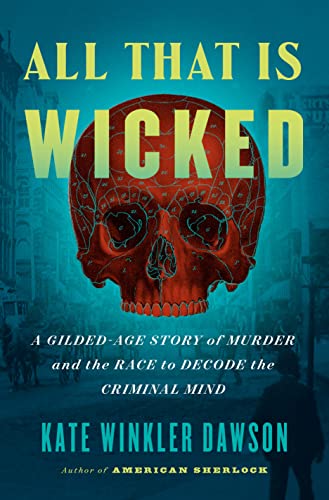
All That Is Wicked: A Gilded-Age Story of Murder and the Race to Decode the Criminal Mind - Hardcover
Inhaltsangabe
Acclaimed crime historian, podcaster, and author of American Sherlock Kate Winkler Dawson tells the thrilling story of Edward Rulloff—a serial murderer who was called “too intelligent to be killed”—and the array of 19th century investigators who were convinced his brain held the key to finally understanding the criminal mind.
Edward Rulloff was a brilliant yet utterly amoral murderer—some have called him a “Victorian-era Hannibal Lecter”—whose crimes spanned decades and whose victims were chosen out of revenge, out of envy, and sometimes out of necessity. From his humble beginnings in upstate New York to the dazzling salons and social life he established in New York City, at every turn Rulloff used his intelligence and regal bearing to evade detection and avoid punishment. He could talk his way out of any crime...until one day, Rulloff's luck ran out.
By 1871 Rulloff sat chained in his cell—a psychopath holding court while curious 19th-century "mindhunters" tried to understand what made him tick. From alienists (early psychiatrists who tried to analyze the source of his madness) to neurologists (who wanted to dissect his brain) to phrenologists (who analyzed the bumps on his head to determine his character), each one thought he held the key to understanding the essential question: is evil born or made? Eventually, Rulloff’s brain would be placed in a jar at Cornell University as the prize specimen of their anatomy collection...where it still sits today, slowly moldering in a dusty jar. But his story—and its implications for the emerging field of criminal psychology—were just beginning.
Expanded from season one of her hit podcast on the Exactly Right network (7 million downloads and growing), in All That Is Wicked Kate Winkler Dawson draws on hundreds of source materials and never-before-shared historical documents to present one of the first glimpses into the mind of a serial killer—a century before the term was coined—through the scientists whose work would come to influence criminal justice for decades to come.
Die Inhaltsangabe kann sich auf eine andere Ausgabe dieses Titels beziehen.
Über die Autorin bzw. den Autor
Kate Winkler Dawson is a seasoned documentary producer and crime historian whose work has appeared in The New York Times, WCBS News and ABC News Radio, PBS NewsHour, and Nightline. She is the creator of two hit podcasts: Tenfold More Wicked and Wicked Words. She is the author of American Sherlock: Murder, Forensics, and the Birth of American CSI, Death in the Air: The True Story of a Serial Killer, the Great London Smog, and the Strangling of a City and is a professor of journalism at The University of Texas at Austin.
Auszug. © Genehmigter Nachdruck. Alle Rechte vorbehalten.
Chapter One: The Author
“My devil had been long caged, he came out roaring.”
—Robert Louis Stevenson, Strange Case of Dr. Jekyll and Mr. Hyde, 1886
On Tuesday, January 10, 1871, the journalist shuddered from the briskness of the air. Edward Hamilton “Ham” Freeman peered down the corridor of the jail, a white two-story building with less than a dozen cells in Binghamton, New York (a town about 200 miles northwest of Manhattan). The sheriff escorted him through the darkness with only the feeble light of a kerosene lamp to guide their way. The stone walls smelled stale, like yeast in a wooden bucket that had molded after weeks of neglect, and the building was damp and cold even by the frigid norms of deep winter in Upstate New York. The heels of Ham’s smart leather shoes clicked along the floor. In just a few months he would turn 29 years old.
The guard directed Ham to a cell and slipped a key into the lock on an iron door. It swung open and there sat the journalist’s subject, the infamous killer. Ham had been a small-town newspaper reporter for much of his career, and he was always on the hunt for a prominent story, one that might showcase his writing chops. This meeting would provide him with a unique opportunity.
Condensation dripped down the jail cell’s walls, as the cold outside air blew through the cracks. As Ham offered the prisoner a handshake, his nervous voice echoed down the miserable halls. The criminal offered his own greeting: Edward Howard Rulloff. Despite the cheerless surroundings, Edward’s voice boomed with confidence.
Ham stood just feet from the murderer in the tiny cell. The newspaper editor felt some measure of fear now that he was finally alone with Edward, face to face, locked in a room with this infamous man. Ham squinted at the 51-year-old criminal’s dark hazel eyes, which were bloodshot from reading all night by inadequate light. But Ham also couldn't help feeling giddy at the opportunity ahead. Despite all that had been written about Edward – his mysterious past, his academic feats, even the murder of which he was now accused -- the killer had never told his own story. Now the notorious Edward Rulloff had selected Ham to record his intimate, personal history. It was a career-making opportunity.
It was also terrifying.
Ham had become intensely interested in Edward Rulloff — an enigma of a man described as “a monster imbued by the spirit of the devil” by some – as he’d observed the first few days of Edward’s criminal trial in 1871. At first, of course, his curiosity was merely for the scintillating story at hand. And it was very scintillating. Ham jotted down every detail of the case, each fact about how Edward had murdered a man during a botched robbery. It was a dreadful crime, and just one of many of which Edward was guilty.
Yet as the trial progressed, Ham began to feel some shred of empathy for the defendant. Maybe it was the way the beleaguered man continually leapt from his wooden chair after a particularly damning accusation, only to be reprimanded by his attorneys. There was something indignant, almost plaintive about his presence. Edward seemed utterly sure of himself, even in these dire circumstances. Ham was fascinated.
“I watched intensely every expression and every movement of the prisoner,” Ham would later write for the biography. “I did not, could not, keep my eyes off from him.”
With each day that had passed during the trial, Ham had felt more and more sorrow for the maligned genius who stewed just feet away from him.
“I took a painful, and melancholy interest in the trial, which increased as it progressed,” said Ham.
“I listened intently to every word he uttered when he rose oftentimes, despite the efforts of this counsel to keep him still, to speak on his own behalf.”
Ham would shifted uncomfortably on the wooden bench in the courtroom as rounds of applause erupted from hundreds of trial-watchers both inside and outside. Edward Rulloff’s trial was becoming a spectacle, and for days the throng challenged local sheriff’s deputies to keep order. Ham described the audience’s outbursts as “crude” to his friends. Throughout the trial, the author sat directly behind Edward, and the man on trial seemed to take a particular interest in him. However, Ham wasn’t the only observer who was intrigued by the accused murderer.
“A large portion of the audience was composed of ladies, hundreds of whom stood patiently for hours listening with seemingly unwearied interest to the details of evidence, with the outlines of which they had long been familiar,” wrote New York Times reporter Edward Crapsey. Ham, too, observed the women in modest country dresses who crowded the courtroom.
“Crowds attended the trial,” wrote Ham, “a great portion of them being women, many of whom would early in the morning make their appearance before the closed doors of the court room, bringing their dinners that they might not, by their absence, lose their place.”
For generations, women have been the dominant consumers of true crime; in current times most readers, listeners, or viewers of these crime stories are female. Experts say many women hope to learn from the mistakes of victims, to absorb themselves in a world they hope to never enter. In some cases, they change their behavior based on that knowledge—they’re more skeptical of male suitors and more cautious about venturing out alone. This was certainly the case with the audience of mostly proper ladies in Binghamton in 1871.
Edward Rulloff certainly wouldn’t be described as “plain” in looks, but he fell slightly short of “striking” or “devilishly handsome.” Yet there was an element of danger that drew these women to his trial every day. To them, Rulloff was irresistible — a riddle that might never be solved, a threat kept just out of reach. They flocked to the courtroom each day, sitting with legs politely crossed at the ankles as the gruesome details of the trial unfolded.
Hamilton Freeman certainly understood the allure of Edward Rulloff. The author was himself quite handsome, with short, brown hair parted on the right, a long, pointed noise, a brow and a mouth that seemed to always remain in a grimace. Ham was the archetype of a small-town newspaper owner and editor – a hardworking local man who also secretly craved national recognition. His weekly paper, the Democratic Leader, was considered the leading source of local information in Broome County, New York; it covered everything from politics to gossip to crop prices. Ham Freeman was considered a capable, if somewhat unremarkable (and occasionally politically biased), journalist.
"He was a good writer, strongly partisan, perhaps, at times, yet his leaders were always interesting and refreshing,” read a journal in 1900 about Binghamton’s history. “(Hamilton) was (and still is) well informed on all subjects pertaining to Binghamton history, for he came from one of our respected old families.”
Ham’s family was prominent in nearby Lisle, New York, a village just twenty miles from Binghamton. His father was a successful lumber merchant, and after his death, young Hamilton moved to Binghamton for school. With his bright, active mind (and respectable pedigree), Ham quickly earned a reputation as a critical thinker with intellectual capabilities and education far beyond most of the folks in that small village. Ham’s penchant for scholarship and family connections led him into the newspaper business...
„Über diesen Titel“ kann sich auf eine andere Ausgabe dieses Titels beziehen.
Suchergebnisse für All That Is Wicked: A Gilded-Age Story of Murder and...

Beispielbild für diese ISBN
All That Is Wicked A GildedAge
Anbieter: World of Books (was SecondSale), Montgomery, IL, USA
Verkäuferbewertung 5 von 5 Sternen

Zustand: Good. Good condition ex-library book with usual library markings and stickers. Artikel-Nr. 00105614586
Gebraucht kaufen
EUR 3,93
Versand gratis
Versand innerhalb von USA
Versand innerhalb von USA
Anzahl: 4 verfügbar
Foto des Verkäufers
All That Is Wicked: A Gilded-Age Story of Murder and the Race to Decode the Criminal Mind
Anbieter: Dream Books Co., Denver, CO, USA
Verkäuferbewertung 5 von 5 Sternen
Zustand: acceptable. This copy has clearly been enjoyedâ"expect noticeable shelf wear and some minor creases to the cover. Binding is strong, and all pages are legible. May contain previous library markings or stamps. Artikel-Nr. DBV.0593420063.A
Gebraucht kaufen
EUR 3,94
Versand gratis
Versand innerhalb von USA
Versand innerhalb von USA
Anzahl: 1 verfügbar
Beispielbild für diese ISBN
All That Is Wicked A GildedAge
Anbieter: World of Books (was SecondSale), Montgomery, IL, USA
Verkäuferbewertung 5 von 5 Sternen
Zustand: Good. Good condition ex-library book with usual library markings and stickers. Artikel-Nr. 00101184554
Gebraucht kaufen
EUR 4,02
Versand gratis
Versand innerhalb von USA
Versand innerhalb von USA
Anzahl: 1 verfügbar
Beispielbild für diese ISBN
All That Is Wicked A GildedAge
Anbieter: World of Books (was SecondSale), Montgomery, IL, USA
Verkäuferbewertung 5 von 5 Sternen
Zustand: Good. Item in good condition. Textbooks may not include supplemental items i.e. CDs, access codes etc. Artikel-Nr. 00099240652
Gebraucht kaufen
EUR 5,53
Versand gratis
Versand innerhalb von USA
Versand innerhalb von USA
Anzahl: 1 verfügbar
Beispielbild für diese ISBN
All That Is Wicked: A Gilded-Age Story of Murder and the Race to Decode the Criminal Mind
Anbieter: ThriftBooks-Atlanta, AUSTELL, GA, USA
Verkäuferbewertung 5 von 5 Sternen
Hardcover. Zustand: Very Good. No Jacket. May have limited writing in cover pages. Pages are unmarked. ~ ThriftBooks: Read More, Spend Less. Artikel-Nr. G0593420063I4N00
Gebraucht kaufen
EUR 5,93
Versand gratis
Versand innerhalb von USA
Versand innerhalb von USA
Anzahl: 1 verfügbar
Beispielbild für diese ISBN
All That Is Wicked: A Gilded-Age Story of Murder and the Race to Decode the Criminal Mind
Anbieter: ThriftBooks-Reno, Reno, NV, USA
Verkäuferbewertung 5 von 5 Sternen
Hardcover. Zustand: Very Good. No Jacket. May have limited writing in cover pages. Pages are unmarked. ~ ThriftBooks: Read More, Spend Less. Artikel-Nr. G0593420063I4N00
Gebraucht kaufen
EUR 5,93
Versand gratis
Versand innerhalb von USA
Versand innerhalb von USA
Anzahl: 1 verfügbar
Beispielbild für diese ISBN
All That Is Wicked: A Gilded-Age Story of Murder and the Race to Decode the Criminal Mind
Anbieter: ThriftBooks-Reno, Reno, NV, USA
Verkäuferbewertung 5 von 5 Sternen
Hardcover. Zustand: Good. No Jacket. Missing dust jacket; Pages can have notes/highlighting. Spine may show signs of wear. ~ ThriftBooks: Read More, Spend Less. Artikel-Nr. G0593420063I3N01
Gebraucht kaufen
EUR 5,93
Versand gratis
Versand innerhalb von USA
Versand innerhalb von USA
Anzahl: 1 verfügbar
Beispielbild für diese ISBN
All That Is Wicked: A Gilded-Age Story of Murder and the Race to Decode the Criminal Mind
Anbieter: ThriftBooks-Phoenix, Phoenix, AZ, USA
Verkäuferbewertung 5 von 5 Sternen
Hardcover. Zustand: Very Good. No Jacket. Former library book; May have limited writing in cover pages. Pages are unmarked. ~ ThriftBooks: Read More, Spend Less. Artikel-Nr. G0593420063I4N10
Gebraucht kaufen
EUR 5,93
Versand gratis
Versand innerhalb von USA
Versand innerhalb von USA
Anzahl: 2 verfügbar
Beispielbild für diese ISBN
All That Is Wicked: A Gilded-Age Story of Murder and the Race to Decode the Criminal Mind
Anbieter: ThriftBooks-Atlanta, AUSTELL, GA, USA
Verkäuferbewertung 5 von 5 Sternen
Hardcover. Zustand: Good. No Jacket. Former library book; Pages can have notes/highlighting. Spine may show signs of wear. ~ ThriftBooks: Read More, Spend Less. Artikel-Nr. G0593420063I3N10
Gebraucht kaufen
EUR 5,93
Versand gratis
Versand innerhalb von USA
Versand innerhalb von USA
Anzahl: 1 verfügbar
Beispielbild für diese ISBN
All That Is Wicked: A Gilded-Age Story of Murder and the Race to Decode the Criminal Mind
Anbieter: ThriftBooks-Atlanta, AUSTELL, GA, USA
Verkäuferbewertung 5 von 5 Sternen
Hardcover. Zustand: Very Good. No Jacket. Former library book; May have limited writing in cover pages. Pages are unmarked. ~ ThriftBooks: Read More, Spend Less. Artikel-Nr. G0593420063I4N10
Gebraucht kaufen
EUR 5,93
Versand gratis
Versand innerhalb von USA
Versand innerhalb von USA
Anzahl: 3 verfügbar