
Verwandte Artikel zu How to Be an Antiracist
Inhaltsangabe
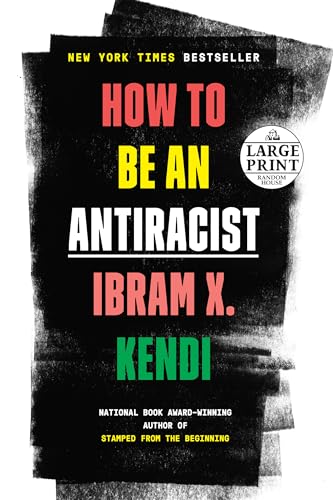
#1 NEW YORK TIMES BESTSELLER • From the National Book Award–winning author of Stamped from the Beginning comes a “groundbreaking” (Time) approach to understanding and uprooting racism and inequality in our society—and in ourselves.
“The most courageous book to date on the problem of race in the Western mind.”—The New York Times (Editors’ Choice)
ONE OF THE BEST BOOKS OF THE YEAR—The New York Times Book Review, Time, NPR, The Washington Post, Shelf Awareness, Library Journal, Publishers Weekly, Kirkus Reviews
Antiracism is a transformative concept that reorients and reenergizes the conversation about racism—and, even more fundamentally, points us toward liberating new ways of thinking about ourselves and each other. At its core, racism is a powerful system that creates false hierarchies of human value; its warped logic extends beyond race, from the way we regard people of different ethnicities or skin colors to the way we treat people of different sexes, gender identities, and body types. Racism intersects with class and culture and geography and even changes the way we see and value ourselves. In How to Be an Antiracist, Kendi takes readers through a widening circle of antiracist ideas—from the most basic concepts to visionary possibilities—that will help readers see all forms of racism clearly, understand their poisonous consequences, and work to oppose them in our systems and in ourselves.
Kendi weaves an electrifying combination of ethics, history, law, and science with his own personal story of awakening to antiracism. This is an essential work for anyone who wants to go beyond the awareness of racism to the next step: contributing to the formation of a just and equitable society.
Die Inhaltsangabe kann sich auf eine andere Ausgabe dieses Titels beziehen.
Über die Autorin bzw. den Autor
Dr. Ibram X. Kendi is the Andrew W. Mellon Professor in the Humanities at Boston University and the founding director of the BU Center for Antiracist Research. He is a contributing writer at The Atlantic and a CBS News racial justice contributor. He is the host of the new action podcast Be Antiracist. Dr. Kendi is the author of many highly acclaimed books including Stamped from the Beginning: The Definitive History of Racist Ideas in America, which won the National Book Award for Nonfiction, making him the youngest-ever winner of that award. He has also produced five straight #1 New York Times bestsellers, including How to Be an Antiracist, Antiracist Baby, and Stamped: Racism, Antiracism, and You, co-authored by Jason Reynolds. In 2020, Time magazine named Dr. Kendi one of the 100 most influential people in the world. He was awarded a 2021 MacArthur Fellowship, popularly known as the Genius Grant.
Auszug. © Genehmigter Nachdruck. Alle Rechte vorbehalten.
MY RACIST INTRODUCTION
I despised suits and ties. For seventeen years I had been surrounded by suit-wearing, tie-choking, hat-flying church folk. My teenage wardrobe hollered the defiance of a preacher’s kid.
It was January 17, 2000. More than three thousand Black people—with a smattering of White folks—arrived that Monday morning in their Sunday best at the Hylton Memorial Chapel in Northern Virginia. My parents arrived in a state of shock. Their floundering son had somehow made it to the final round of the Prince William County Martin Luther King Jr. oratorical contest.
I didn’t show up with a white collar under a dark suit and matching dark tie like most of my competitors. I sported a racy golden-brown blazer with a slick black shirt and bright color-streaked tie underneath. The hem of my baggy black slacks crested over my creamy boots. I’d already failed the test of respectability before I opened my mouth, but my parents, Carol and Larry, were all smiles nonetheless. They couldn’t remember the last time they saw me wearing a tie and blazer, however loud and crazy.
But it wasn’t just my clothes that didn’t fit the scene. My competitors were academic prodigies. I wasn’t. I carried a GPA lower than 3.0; my SAT score barely cracked 1000. Colleges were recruiting my competitors. I was riding the high of having received surprise admission letters from the two colleges I’d halfheartedly applied to.
A few weeks before, I was on the basketball court with my high school team, warming up for a home game, cycling through layup lines. My father, all six foot three and two hundred pounds of him, emerged from my high school gym’s entrance. He slowly walked onto the basketball court, flailing his long arms to get my attention—and embarrassing me before what we could call the “White judge.”
Classic Dad. He couldn’t care less what judgmental White people thought about him. He rarely if ever put on a happy mask, faked a calmer voice, hid his opinion, or avoided making a scene. I loved and hated my father for living on his own terms in a world that usually denies Black people their own terms. It was the sort of defiance that could have gotten him lynched by a mob in a different time and place—or lynched by men in badges today.
I jogged over to him before he could flail his way right into our layup lines. Weirdly giddy, he handed me a brown manila envelope.
“This came for you today.”
He motioned me to open the envelope, right there at half-court as the White students and teachers looked on.
I pulled out the letter and read it: I had been admitted to Hampton University in southern Virginia. My immediate shock exploded into unspeakable happiness. I embraced Dad and exhaled. Tears mixed with warm-up sweat on my face. The judging White eyes around us faded.
I thought I was stupid, too dumb for college. Of course, intelligence is as subjective as beauty. But I kept using “objective” standards, like test scores and report cards, to judge myself. No wonder I sent out only two college applications: one to Hampton and the other to the institution I ended up attending, Florida A&M University. Fewer applications meant less rejection—and I fully expected those two historically Black universities to reject me. Why would any university want an idiot on their campus who can’t understand Shakespeare? It never occurred to me that maybe I wasn’t really trying to understand Shakespeare and that’s why I dropped out of my English II International Baccalaureate class during my senior year. Then again, I did not read much of anything in those years.
Maybe if I’d read history then, I’d have learned about the historical significance of the new town my family had moved to from New York City in 1997. I would have learned about all those Confederate memorials surrounding me in Manassas, Virginia, like Robert E. Lee’s dead army. I would have learned why so many tourists trek to Manassas National Battlefield Park to relive the glory of the Confederate victories at the Battles of Bull Run during the Civil War. It was there that General Thomas J. Jackson acquired his nickname, “Stonewall,” for his stubborn defense of the Confederacy. Northern Virginians kept the stonewall intact after all these years. Did anyone notice the irony that at this Martin Luther King Jr. oratorical contest, my free Black life represented Stonewall Jackson High School?
The delightful event organizers from Delta Sigma Theta sorority, the proud dignitaries, and the competitors were all seated on the pulpit. (The group was too large to say we were seated in the pulpit.) The audience sat in rows that curved around the long, arched pulpit, giving room for speakers to pace to the far sides of the chapel while delivering their talks; five stairs also allowed us to descend into the crowd if we wanted.
The middle schoolers had given their surprisingly mature speeches. The exhilarating children’s choir had sung behind us. The audience sat back down and went silent in anticipation of the three high school orators.
I went first, finally approaching the climax of an experience that had already changed my life. From winning my high school competition months before to winning “best before the judges” at a countywide competition weeks before—I felt a special rainstorm of academic confidence. If I came out of the experience dripping with confidence for college, then I’d entered from a high school drought. Even now I wonder if it was my poor sense of self that first generated my poor sense of my people. Or was it my poor sense of my people that inflamed a poor sense of myself? Like the famous question about the chicken and the egg, the answer is less important than the cycle it describes. Racist ideas make people of color think less of themselves, which makes them more vulnerable to racist ideas. Racist ideas make White people think more of themselves, which further attracts them to racist ideas.
I thought I was a subpar student and was bombarded by messages—from Black people, White people, the media—that told me that the reason was rooted in my race . . . which made me more discouraged and less motivated as a student . . . which only further reinforced for me the racist idea that Black people just weren’t very studious . . . which made me feel even more despair or indifference . . . and on it went. At no point was this cycle interrupted by a deeper analysis of my own specific circumstances and shortcomings or a critical look at the ideas of the society that judged me—instead, the cycle hardened the racist ideas inside me until I was ready to preach them to others.
I remember the MLK competition so fondly. But when I recall the racist speech I gave, I flush with shame.
“What would be Dr. King’s message for the millennium? Let’s visualize an angry seventy-one-year-old Dr. King . . .” And I began my remix of King’s “I Have a Dream” speech.
It was joyous, I started, our emancipation from enslavement. But “now, one hundred thirty-five years later, the Negro is still not free.”
I was already thundering, my tone angry, more Malcolm than Martin.
“Our youth’s minds are still in captivity!”
I did not say our youth’s minds are in captivity of racist ideas, as I would say now.
“They think it’s okay to be those who are most feared in our society!” I said, as if it was their fault they...
„Über diesen Titel“ kann sich auf eine andere Ausgabe dieses Titels beziehen.
Suchergebnisse für How to Be an Antiracist

Beispielbild für diese ISBN
How to Be an Antiracist
Anbieter: World of Books (was SecondSale), Montgomery, IL, USA
Verkäuferbewertung 5 von 5 Sternen

Zustand: Good. Item in good condition. Textbooks may not include supplemental items i.e. CDs, access codes etc. Artikel-Nr. 00108044390
Gebraucht kaufen
EUR 3,88
Versand gratis
Versand innerhalb von USA
Versand innerhalb von USA
Anzahl: 3 verfügbar
Beispielbild für diese ISBN
How to Be an Antiracist
Anbieter: World of Books (was SecondSale), Montgomery, IL, USA
Verkäuferbewertung 5 von 5 Sternen
Zustand: Good. Item in good condition. Textbooks may not include supplemental items i.e. CDs, access codes etc. Artikel-Nr. 00093348288
Gebraucht kaufen
EUR 4,16
Versand gratis
Versand innerhalb von USA
Versand innerhalb von USA
Anzahl: 9 verfügbar
Beispielbild für diese ISBN
How to Be an Antiracist
ISBN 10: 0593396804
ISBN 13: 9780593396803
Gebraucht
Paperback
Anbieter: BooksRun, Philadelphia, PA, USA
Verkäuferbewertung 5 von 5 Sternen
Paperback. Zustand: Very Good. Large type / Large print. It's a well-cared-for item that has seen limited use. The item may show minor signs of wear. All the text is legible, with all pages included. It may have slight markings and/or highlighting. Artikel-Nr. 0593396804-8-6
Gebraucht kaufen
EUR 5,31
Versand gratis
Versand innerhalb von USA
Versand innerhalb von USA
Anzahl: 1 verfügbar
Beispielbild für diese ISBN
How to Be an Antiracist
Anbieter: ThriftBooks-Atlanta, AUSTELL, GA, USA
Verkäuferbewertung 5 von 5 Sternen
Paperback. Zustand: Good. No Jacket. Pages can have notes/highlighting. Spine may show signs of wear. ~ ThriftBooks: Read More, Spend Less. Artikel-Nr. G0593396804I3N00
Gebraucht kaufen
EUR 6,18
Versand gratis
Versand innerhalb von USA
Versand innerhalb von USA
Anzahl: 1 verfügbar
Beispielbild für diese ISBN
How to Be an Antiracist
Anbieter: ThriftBooks-Atlanta, AUSTELL, GA, USA
Verkäuferbewertung 5 von 5 Sternen
Paperback. Zustand: Good. No Jacket. Former library book; Pages can have notes/highlighting. Spine may show signs of wear. ~ ThriftBooks: Read More, Spend Less. Artikel-Nr. G0593396804I3N10
Gebraucht kaufen
EUR 6,18
Versand gratis
Versand innerhalb von USA
Versand innerhalb von USA
Anzahl: 1 verfügbar
Beispielbild für diese ISBN
How to Be an Antiracist
Anbieter: ThriftBooks-Dallas, Dallas, TX, USA
Verkäuferbewertung 5 von 5 Sternen
Paperback. Zustand: Fair. No Jacket. Former library book; Readable copy. Pages may have considerable notes/highlighting. ~ ThriftBooks: Read More, Spend Less. Artikel-Nr. G0593396804I5N10
Gebraucht kaufen
EUR 6,18
Versand gratis
Versand innerhalb von USA
Versand innerhalb von USA
Anzahl: 1 verfügbar
Beispielbild für diese ISBN
How to Be an Antiracist
Anbieter: Better World Books, Mishawaka, IN, USA
Verkäuferbewertung 5 von 5 Sternen
Zustand: Good. Former library copy. Pages intact with minimal writing/highlighting. The binding may be loose and creased. Dust jackets/supplements are not included. Includes library markings. Stock photo provided. Product includes identifying sticker. Better World Books: Buy Books. Do Good. Artikel-Nr. 19250387-6
Gebraucht kaufen
EUR 6,33
Versand gratis
Versand innerhalb von USA
Versand innerhalb von USA
Anzahl: 7 verfügbar
Beispielbild für diese ISBN
How to Be an Antiracist
Anbieter: Better World Books, Mishawaka, IN, USA
Verkäuferbewertung 5 von 5 Sternen
Zustand: Good. Pages intact with minimal writing/highlighting. The binding may be loose and creased. Dust jackets/supplements are not included. Stock photo provided. Product includes identifying sticker. Better World Books: Buy Books. Do Good. Artikel-Nr. 39983930-75
Gebraucht kaufen
EUR 6,33
Versand gratis
Versand innerhalb von USA
Versand innerhalb von USA
Anzahl: 1 verfügbar
Beispielbild für diese ISBN
How to Be an Antiracist
Anbieter: Better World Books: West, Reno, NV, USA
Verkäuferbewertung 5 von 5 Sternen
Zustand: Good. Former library copy. Pages intact with minimal writing/highlighting. The binding may be loose and creased. Dust jackets/supplements are not included. Includes library markings. Stock photo provided. Product includes identifying sticker. Better World Books: Buy Books. Do Good. Artikel-Nr. 19250387-6
Gebraucht kaufen
EUR 6,33
Versand gratis
Versand innerhalb von USA
Versand innerhalb von USA
Anzahl: 4 verfügbar
Beispielbild für diese ISBN
How to Be an Antiracist
Anbieter: Better World Books, Mishawaka, IN, USA
Verkäuferbewertung 5 von 5 Sternen
Zustand: Very Good. Former library copy. Pages intact with possible writing/highlighting. Binding strong with minor wear. Dust jackets/supplements may not be included. Includes library markings. Stock photo provided. Product includes identifying sticker. Better World Books: Buy Books. Do Good. Artikel-Nr. 40042184-6
Gebraucht kaufen
EUR 6,33
Versand gratis
Versand innerhalb von USA
Versand innerhalb von USA
Anzahl: 1 verfügbar