
Verwandte Artikel zu Surviving Autocracy
Inhaltsangabe
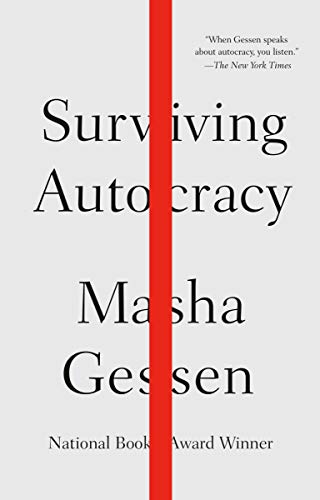
“When Gessen speaks about autocracy, you listen.” —The New York Times
“A reckoning with what has been lost in the past few years and a map forward with our beliefs intact.” —Interview
As seen on MSNBC’s Morning Joe and heard on NPR’s All Things Considered: the bestselling, National Book Award–winning journalist offers an essential guide to understanding, resisting, and recovering from the ravages of our tumultuous times.
This incisive book provides an essential guide to understanding and recovering from the calamitous corrosion of American democracy over the past few years. Thanks to the special perspective that is the legacy of a Soviet childhood and two decades covering the resurgence of totalitarianism in Russia, Masha Gessen has a sixth sense for the manifestations of autocracy—and the unique cross-cultural fluency to delineate their emergence to Americans. Gessen not only anatomizes the corrosion of the institutions and cultural norms we hoped would save us but also tells us the story of how a short few years changed us from a people who saw ourselves as a nation of immigrants to a populace haggling over a border wall, heirs to a degraded sense of truth, meaning, and possibility. Surviving Autocracy is an inventory of ravages and a call to account but also a beacon to recovery—and to the hope of what comes next.
Die Inhaltsangabe kann sich auf eine andere Ausgabe dieses Titels beziehen.
Über die Autorin bzw. den Autor
Masha Gessen is the author of eleven other books, including the National Book Award–winning The Future Is History: How Totalitarianism Reclaimed Russia and The Man Without a Face: The Unlikely Rise of Vladimir Putin. A staff writer at The New Yorker and the recipient of numerous awards, including Guggenheim and Carnegie fellowships, Gessen teaches at Bard College and lives in New York City.
Von der hinteren Coverseite
From a bestselling, National Book Award-winning journalist, an essential guide to understanding, resisting, and recovering from the ravages of our tumultuous times.
In the run-up to the 2016 election, Masha Gessen stood out from other journalists for the ability to convey the ominous significance of Donald Trump's speech and behavior, unprecedented in a national candidate. Within forty-eight hours of his victory, the essay "Autocracy: Rules for Survival" had gone viral, and Gessen's coverage of his norm-smashing presidency became essential reading for a citizenry struggling to wrap their heads around the unimaginable. Thanks to the special perspective that is the legacy of a Soviet childhood and two decades covering the resurgence of totalitarianism in Russia, Gessen has a sixth sense for signs of autocracy-and the unique cross-cultural fluency to delineate its emergence to Americans. This incisive book provides an indispensable overview of the calamitous trajectory of the past few years. Gessen not only highlights the corrosion of the media, the judiciary, and the cultural norms we hoped would save us but also tells us the story of how a short few years have changed us, from a people who saw ourselves as a nation of immigrants to a populace haggling over a border wall, heirs to a degraded sense of truth, meaning, and possibility. Surviving Autocracy is an inventory of ravages but also a beacon to recovery-or to enduring, and resisting, an ongoing assault.
Auszug. © Genehmigter Nachdruck. Alle Rechte vorbehalten.
1.
What Do We Call It?
It could have been any week of the Trump presidency-a week when he kept contradicting the government's experts on the COVID-19 pandemic, or a week when he was railing against Supreme Court justices, or a week when he humiliated his own cabinet members in public. Take one week in October 2019. It was a month into the impeachment inquiry in Congress and just over a thousand days into Donald Trump's presidency. The acting ambassador to Ukraine, William B. Taylor, Jr., testified about waging a losing battle against Trump and his people to pursue a foreign agenda consistent with government policy and practice. House Republicans stormed a closed impeachment-inquiry hearing in a bizarre direct action of Congress members against congressional practice. Trump's personal attorney William Consovoy argued in court that his client was immune from any prosecution-including, hypothetically, for murdering someone in the middle of Fifth Avenue-as long as he was president. And on Friday morning, The New York Times website had two headlines stacked on the left side of the home page. The top one reported that the Justice Department had launched a criminal probe into its own investigation of Russian interference in the 2016 election. The headline directly below announced that the secretary of education, Betsy DeVos, had been found in contempt of court for continuing-in direct contravention of judicial decisions-to collect student-loan payments from former students of defunct for-profit colleges. The government seemed to be at war with itself on every front.
Trumpian news has a way of being shocking without being surprising. Every one of the events of that week was, in itself, staggering: an assault on the senses and the mental faculties. Together, they were just more of the same. Trump had beaten the government, the media, and the very concept of politics into a state beyond recognition. In part by habit and in part out of a sense of necessity, we continued to report the news and consume the news-this presidency produced more headlines per unit of time than any other-but at the end of each of his thousand days of presidency we seemed hardly closer to understanding what was happening to us.
The difficulty with absorbing the news lies, in part, in the words we use, which have a way of rendering the outrageous ordinary. The secretary of education was held in contempt, and this astounding event was narrated in normalizing newspaper prose: probably the strongest description called it an "exceedingly rare judicial rebuke of a Cabinet secretary." This could not begin to describe the drama of a cabinet member remaining unrepentant for her agency's seizure of assets from people whom it had been ordered by the courts to leave in peace-sixteen thousand people. And even when we could find the words to describe the exceptional, barely imaginable nature of Trumpian stories, that approach could not scale. How could we talk about a series of nearly inconceivable events that had become routine? How do we describe the confrontation of existing government institutions with a presidential apparatus that wants to destroy them?
I found some possible answers in the work of Hungarian sociologist B‡lint Magyar. In struggling to define and describe what had happened in his country, Magyar had realized that the language of both the media and the academy was not up to the task. After the Eastern Bloc collapsed in 1989, both local and Western commentators adopted the language of liberal democracy to describe what was happening in the region. They talked about elections and legitimacy, rule of law and public opinion. Their language reflected their assumptions and their limitations: they assumed that their countries would become liberal democracies-this seemed the inevitable outcome of the Cold War; and they had no other language at their disposal anyway. But if we use the wrong language, we cannot describe what we are seeing. If we use the language developed for describing fish, we cannot very well describe an elephant: words like "gills," "scales," and "fins" will not get us very far.
When some of the post-Soviet societies developed in unexpected ways, language impaired our ability to understand the process. We talked about whether they had a free press, for example, or free and fair elections. But noting that they did not, as Magyar has said, is akin to saying that the elephant cannot swim or fly: it doesn't tell us much about what the elephant is. Now the same thing was happening in the United States; we were using the language of political disagreement, judicial procedure, or partisan discussion to describe something that was crushing the system that such terminology was invented to describe.
Magyar spent about a decade devising a new model, and a new language, to describe what was happening in his country. He coined the term "mafia state," and described it as a specific, clan-like system in which one man distributes money and power to all other members. He then developed the concept of autocratic transformation, which proceeds in three stages: autocratic attempt, autocratic breakthrough, and autocratic consolidation. It occurred to me that these were words that American culture could now borrow, in an appropriate symbolic reversal of 1989: these terms appear to describe our reality better than any words in the standard American political lexicon. Magyar had analyzed the signs and circumstances of this process in post-Communist countries and proposed a detailed taxonomy. But how it might happen in the United States was uncharted territory.
2.
Waiting for the Reichstag Fire
Immediately following the November 2016 election, the defeated majority of Americans who had voted for Hillary Clinton seemed to split into two camps, distinguished by the degree to which they were panicked. One camp was exemplified by outgoing president Barack Obama, whose goal, in the days after the vote, seemed to be to reassure Americans that life would go on. On November 9, he gave a short, dignified talk in which he made three points-most memorably, that the sun had risen that morning.
Yesterday, before votes were tallied, I shot a video that some of you may have seen in which I said to the American people, regardless of which side you were on in the election, regardless of whether your candidate won or lost, the sun would come up in the morning.
And that is one bit of prognosticating that actually came true. The sun is up.
Obama acknowledged his "significant differences" with Trump but said that his phone conversation with the president-elect in the wee hours had reassured him that in the end, Democrats and Republicans, he and Trump, had shared goals.
We all want what's best for this country. That's what I heard in Mr. Trump's remarks last night. That's what I heard when I spoke to him directly. And I was heartened by that. That's what the country needs-a sense of unity, a sense of inclusion, a respect for our institutions, our way of life, rule of law, and respect for each other.
Obama finished on an optimistic note.
The point, though, is that we all go forward, with a presumption of good faith in our fellow citizens, because that presumption of good faith is essential to a vibrant and functioning democracy. That's how this country has moved forward for two hundred forty years. It's how we've pushed boundaries and promoted freedom around the world. That's how we've expanded the rights of our founding to reach all of our citizens. It's how we have come this far. And that's why I'm confident that this incredible journey that we're on, as Americans, will go...
„Über diesen Titel“ kann sich auf eine andere Ausgabe dieses Titels beziehen.
Suchergebnisse für Surviving Autocracy

Foto des Verkäufers
Surviving Autocracy
Anbieter: Dream Books Co., Denver, CO, USA
Verkäuferbewertung 5 von 5 Sternen

Zustand: acceptable. This copy has clearly been enjoyedâ"expect noticeable shelf wear and some minor creases to the cover. Binding is strong, and all pages are legible. May contain previous library markings or stamps. Artikel-Nr. DBV.0593332245.A
Gebraucht kaufen
EUR 4,38
Versand gratis
Versand innerhalb von USA
Versand innerhalb von USA
Anzahl: 1 verfügbar
Beispielbild für diese ISBN
Surviving Autocracy
Anbieter: World of Books (was SecondSale), Montgomery, IL, USA
Verkäuferbewertung 5 von 5 Sternen
Zustand: Good. Item in good condition. Textbooks may not include supplemental items i.e. CDs, access codes etc. Artikel-Nr. 00107900946
Gebraucht kaufen
EUR 5,69
Versand gratis
Versand innerhalb von USA
Versand innerhalb von USA
Anzahl: 3 verfügbar
Beispielbild für diese ISBN
Surviving Autocracy
Anbieter: ThriftBooks-Phoenix, Phoenix, AZ, USA
Verkäuferbewertung 5 von 5 Sternen
Paperback. Zustand: Very Good. No Jacket. May have limited writing in cover pages. Pages are unmarked. ~ ThriftBooks: Read More, Spend Less. Artikel-Nr. G0593332245I4N00
Gebraucht kaufen
EUR 5,91
Versand gratis
Versand innerhalb von USA
Versand innerhalb von USA
Anzahl: 1 verfügbar
Beispielbild für diese ISBN
Surviving Autocracy
Anbieter: ThriftBooks-Reno, Reno, NV, USA
Verkäuferbewertung 5 von 5 Sternen
Paperback. Zustand: Very Good. No Jacket. May have limited writing in cover pages. Pages are unmarked. ~ ThriftBooks: Read More, Spend Less. Artikel-Nr. G0593332245I4N00
Gebraucht kaufen
EUR 5,91
Versand gratis
Versand innerhalb von USA
Versand innerhalb von USA
Anzahl: 1 verfügbar
Beispielbild für diese ISBN
Surviving Autocracy
Anbieter: ThriftBooks-Dallas, Dallas, TX, USA
Verkäuferbewertung 5 von 5 Sternen
Paperback. Zustand: Very Good. No Jacket. May have limited writing in cover pages. Pages are unmarked. ~ ThriftBooks: Read More, Spend Less. Artikel-Nr. G0593332245I4N00
Gebraucht kaufen
EUR 5,91
Versand gratis
Versand innerhalb von USA
Versand innerhalb von USA
Anzahl: 1 verfügbar
Beispielbild für diese ISBN
Surviving Autocracy
Anbieter: ThriftBooks-Atlanta, AUSTELL, GA, USA
Verkäuferbewertung 5 von 5 Sternen
Paperback. Zustand: Very Good. No Jacket. Former library book; May have limited writing in cover pages. Pages are unmarked. ~ ThriftBooks: Read More, Spend Less. Artikel-Nr. G0593332245I4N10
Gebraucht kaufen
EUR 5,91
Versand gratis
Versand innerhalb von USA
Versand innerhalb von USA
Anzahl: 1 verfügbar
Beispielbild für diese ISBN
Surviving Autocracy
Anbieter: ThriftBooks-Atlanta, AUSTELL, GA, USA
Verkäuferbewertung 5 von 5 Sternen
Paperback. Zustand: Very Good. No Jacket. May have limited writing in cover pages. Pages are unmarked. ~ ThriftBooks: Read More, Spend Less. Artikel-Nr. G0593332245I4N00
Gebraucht kaufen
EUR 5,91
Versand gratis
Versand innerhalb von USA
Versand innerhalb von USA
Anzahl: 1 verfügbar
Beispielbild für diese ISBN
Surviving Autocracy
Anbieter: Wonder Book, Frederick, MD, USA
Verkäuferbewertung 5 von 5 Sternen
Zustand: As New. Like New condition. A near perfect copy that may have very minor cosmetic defects. Artikel-Nr. J05Q-0050
Gebraucht kaufen
EUR 6,20
Versand gratis
Versand innerhalb von USA
Versand innerhalb von USA
Anzahl: 1 verfügbar
Beispielbild für diese ISBN
Surviving Autocracy
Anbieter: BookOutlet, Jefferson City, TN, USA
Verkäuferbewertung 5 von 5 Sternen
Paperback. Zustand: New. Paperback. Publisher overstock, may contain remainder mark on edge. Artikel-Nr. 9780593332245B
Neu kaufen
EUR 5,31
EUR 2,80 Versand
Versand innerhalb von USA
Versand innerhalb von USA
Anzahl: Mehr als 20 verfügbar
Beispielbild für diese ISBN
Surviving Autocracy
Anbieter: Books From California, Simi Valley, CA, USA
Verkäuferbewertung 4 von 5 Sternen

paperback. Zustand: Very Good. Artikel-Nr. mon0003653202
Gebraucht kaufen
EUR 4,43
EUR 4,30 Versand
Versand innerhalb von USA
Versand innerhalb von USA
Anzahl: 1 verfügbar