
Verwandte Artikel zu Broad Band: The Untold Story of the Women Who Made...
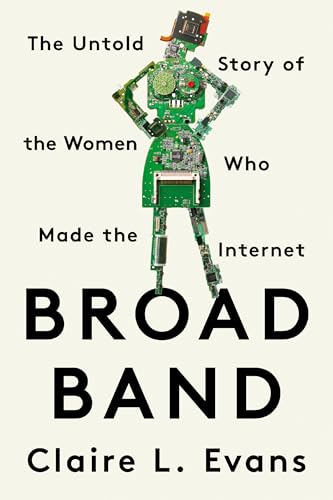
Inhaltsangabe
If you loved Hidden Figures or The Rise of the Rocket Girls, you'll love Claire Evans' breakthrough book on the women who brought you the internet--written out of history, until now.
"This is a radically important, timely work," says Miranda July, filmmaker and author of The First Bad Man. The history of technology you probably know is one of men and machines, garages and riches, alpha nerds and brogrammers--but from Ada Lovelace, who wrote the first computer program in the Victorian Age, to the cyberpunk Web designers of the 1990s, female visionaries have always been at the vanguard of technology and innovation.
In fact, women turn up at the very beginning of every important wave in technology. They may have been hidden in plain sight, their inventions and contributions touching our lives in ways we don't even realize, but they have always been part of the story.
VICE reporter and YACHT lead singer Claire L. Evans finally gives these unsung female heroes their due with her insightful social history of the Broad Band, the women who made the internet what it is today.
Seek inspiration from Grace Hopper, the tenacious mathematician who democratized computing by leading the charge for machine-independent programming languages after World War II. Meet Elizabeth "Jake" Feinler, the one-woman Google who kept the earliest version of the Internet online, and Stacy Horn, who ran one of the first-ever social networks on a shoestring out of her New York City apartment in the 1980s.
Join the ranks of the pioneers who defied social convention to become database poets, information-wranglers, hypertext dreamers, and glass ceiling-shattering dot com-era entrepreneurs. This inspiring call to action shines a light on the bright minds whom history forgot, and shows us how they will continue to shape our world in ways we can no longer ignore.
Welcome to the Broad Band. You're next.
Die Inhaltsangabe kann sich auf eine andere Ausgabe dieses Titels beziehen.
Über die Autorin bzw. den Autor
Claire L. Evans is a writer and musician. She is the singer and coauthor of the pop group YACHT, and the founding editor of Terraform, VICE's science-fiction vertical. She is the former futures editor of Motherboard, and a contributor to VICE, the Guardian, WIRED, and Aeon; previously, she was a contributor to Grantland and wrote National Geographic's popular culture and science blog, Universe. She is an advisor to design students at Art Center College of Design and a member of the cyberfeminist collective Deep Lab. She lives in Los Angeles.
Auszug. © Genehmigter Nachdruck. Alle Rechte vorbehalten.
Chapter One
A Computer Wanted
It's 1892 in New York City. In January, an immigration processing center called Ellis Island opened for business. In March, in Springfield, Massachusetts, a YMCA instructor desperate to keep a class of stir-crazy youngsters entertained indoors hosted the first public game of "basket ball." But the winter is over, and it's the first of May, just shy of spring, just shy of the twentieth century. It's before the screen, the mouse, the byte, the pixel, and one hundred years before my Dell, but there's a strange notice in the classified pages of the New York Times.
"A Computer Wanted," it says.
This ad is the first instance of the word "computer" in print. It wasn't placed by an indiscreet time-traveler, someone trapped in the Gilded Age and jonesing for the familiar glow of their MacBook. It was placed by the United States Naval Observatory in Washington, DC, which was by then several decades into a mathematical astronomy project: calculating, by hand, the positions of the sun, stars, moon, and planets across the night sky. The observatory's directors were not in the market, that spring, to buy a computer. They were looking to hire one.
For close to two hundred years, a computer was a job. As in someone who computes, or performs computations, for a living. Had one been browsing the Times that May Day in 1892 and decided to answer the classified ad, they'd soon be taking an algebra test. The Naval Observatory job was cushy, relatively: those who lived nearby worked in a cozy, informal office in Cambridge, far from the observatory itself, which was perched on a bluff above the Potomac. They clocked five-hour days, charting the skies from individual tables by a roaring fire, pausing often to discuss the scientific ideas of the day. The rest worked from home, from detailed mathematical plans they received in the mail. Computing, as one historian has noted, was the original cottage industry.
Every day, these computers-much as computers do today-would chip away at complicated, large-scale math problems. They wouldn't do it alone. Our new hire would be part of a team: everyone crunching their share of the numbers, some correcting each other's work for extra income. With pen and paper alone, the Naval Observatory team would chart the skies, just as other computing offices throughout the Western world would advance ballistics, maritime navigation, or pure mathematics. They wouldn't receive much individual credit, but whatever the problem was, they'd have been instrumental in solving it.
Computing offices were thinking factories. The nineteenth-century British mathematician Charles Babbage, whose desire to calculate by steam led to important early developments in mechanical computing, called what the human computing offices of his time did "mental labor." He considered it work one did with the brain, just as hammering a nail is work one does with the arm. Indeed, computing was the grunt labor of organized science; before they were made obsolete, human computers prepared ballistics trajectories for the United States Army, cracked Nazi codes at Bletchley Park, crunched astronomical data at Harvard, and assisted numerical studies of nuclear fission on the Manhattan Project. Despite the diversity of their work, human computers had one thing in common. They were women.
Mostly, anyway. The Naval Observatory hired only one female computer for its Nautical Almanac Office, although she was by far the most famous among them: Maria Mitchell, a Quaker from Nantucket Island, who had won a medal from the king of Denmark before she was thirty for discovering a new comet in the night sky. It came to be known as "Miss Mitchell's Comet." At the observatory, Mitchell calculated the ephemeris of Venus, being, as her supervisor told her, the only computer fair enough to tackle the fairest of the planets.
Her presence as a woman in a computing group was unusual for its time, but it would only become less so. Maria Mitchell discovered her comet only a year before the Seneca Falls Conference on the Rights of Women, which was largely organized by Quaker activists. Her church was the sole religious denomination allowing women to preach to its congregations, and Maria's father, an amateur astronomer, lobbied aggressively for her accomplishments to be recognized. Before the end of the twentieth century, computing would become largely the purview of women. Female mental laborers, breaking intractable problems down into numerical steps much as machines tackle problems today, ushered in an era of large-scale scientific research.
By the mid-twentieth century, computing was so much considered a woman's job that when computing machines came along, evolving alongside and largely independently from their human counterparts, mathematicians would guesstimate their horsepower by invoking "girl-years," and describe units of machine labor as equivalent to one "kilogirl." This is the story of the kilogirls. It begins, as the most beautiful patterns do, with a loom.
The Spider Work
The loom is a simple technology, but in the warp and weft of thread lies the weaving of all technologically literate society. Textiles are central to the business of being human, and like software, they are encoded with meaning. Every cloth is a record of its weaving, an interconnected matrix of skills, time, materials, and personnel. As the British cultural theorist Sadie Plant observes, "the visible pattern" of any cloth "is integral to the process which produced it; the program and the pattern are continuous." This process, of course, historically concerns women. Around looms, in sewing circles, in ancient Egypt and China, and in southeastern Europe five centuries before Christianity, women have woven clothing, shelter, the materials of writing, even currency.
Like many accepted patterns, this was disrupted by the Industrial Revolution, when a French weaver, Joseph-Marie Jacquard, proposed a new way to create textile patterns. Unlike a traditional loom, singularly animated by its weaver's ingenuity, Jacquard's invention produced remarkably complex textiles from patterns punched into paper cards, reproducible and consistent beyond a margin of human error. The resulting damask, brocade, and quilted matelassŽ became highly coveted all over Europe, but the impact of Jacquard's loom went far beyond industrial textile production: his punched cards, which separated pattern from process for the first time in history, would eventually find their way into the earliest computers. Patterns encoded on paper, which computer scientists later called "programs," could dictate numbers as easily as thread.
The Jacquard loom put skilled laborers out of work. Some took out their anger on the frames of the new machines, claiming as a folk hero the apocryphal Ned Ludd, a weaver said to have smashed a pair of stocking-frames at the end of the previous century. We use the term Luddite now in the pejorative, to describe anyone with an unreasonable aversion to technology, but the cause was not unpopular in its time. Even Lord Byron sympathized. In his maiden speech to the House of Lords in 1812, he defended the organized framebreakers by comparing the results of a Jacquard loom's mechanical weaving to "spider-work." Privately, he worried that, in his sympathy for the...
„Über diesen Titel“ kann sich auf eine andere Ausgabe dieses Titels beziehen.
Suchergebnisse für Broad Band: The Untold Story of the Women Who Made...

Beispielbild für diese ISBN
Broad Band: The Untold Story of the Women Who Made the Internet
Anbieter: World of Books (was SecondSale), Montgomery, IL, USA
Verkäuferbewertung 5 von 5 Sternen

Paperback. Zustand: Good. If you loved Hidden Figures or The Rise of the Rocket Girls, you'll love Claire Evans' breakthrough book on the women who brought you the internet--written out of history, until now. "This is a radically important, timely work," says Miranda July, filmmaker and author of The First Bad Man. The history of technology you probably know is one of men and machines, garages and riches, alpha nerds and brogrammers--but from Ada Lovelace, who wrote the first computer program in the Victorian Age, to the cyberpunk Web designers of the 1990s, female visionaries have always been at the vanguard of technology and innovation. In fact, women turn up at the very beginning of every important wave in technology. They may have been hidden in plain sight, their inventions and contributions touching our lives in ways we don't even realize, but they have always been part of the story. VICE reporter and YACHT lead singer Claire L. Evans finally gives these unsung female heroes their due with her insightful social history of the Broad Band, the women who made the internet what it is today. Seek inspiration from Grace Hopper, the tenacious mathematician who democratized computing by leading the charge for machine-independent programming languages after World War II. Meet Elizabeth "Jake" Feinler, the one-woman Google who kept the earliest version of the Internet online, and Stacy Horn, who ran one of the first-ever social networks on a shoestring out of her New York City apartment in the 1980s. Join the ranks of the pioneers who defied social convention to become database poets, information-wranglers, hypertext dreamers, and glass ceiling-shattering dot com-era entrepreneurs. This inspiring call to action shines a light on the bright minds whom history forgot, and shows us how they will continue to shape our world in ways we can no longer ignore. Welcome to the Broad Band. You're next. Artikel-Nr. 00097768719
Gebraucht kaufen
EUR 4,81
Versand gratis
Versand innerhalb von USA
Versand innerhalb von USA
Anzahl: 5 verfügbar
Beispielbild für diese ISBN
Broad Band: The Untold Story of the Women Who Made the Internet
Anbieter: World of Books (was SecondSale), Montgomery, IL, USA
Verkäuferbewertung 5 von 5 Sternen
Paperback. Zustand: Very Good. If you loved Hidden Figures or The Rise of the Rocket Girls, you'll love Claire Evans' breakthrough book on the women who brought you the internet--written out of history, until now. "This is a radically important, timely work," says Miranda July, filmmaker and author of The First Bad Man. The history of technology you probably know is one of men and machines, garages and riches, alpha nerds and brogrammers--but from Ada Lovelace, who wrote the first computer program in the Victorian Age, to the cyberpunk Web designers of the 1990s, female visionaries have always been at the vanguard of technology and innovation. In fact, women turn up at the very beginning of every important wave in technology. They may have been hidden in plain sight, their inventions and contributions touching our lives in ways we don't even realize, but they have always been part of the story. VICE reporter and YACHT lead singer Claire L. Evans finally gives these unsung female heroes their due with her insightful social history of the Broad Band, the women who made the internet what it is today. Seek inspiration from Grace Hopper, the tenacious mathematician who democratized computing by leading the charge for machine-independent programming languages after World War II. Meet Elizabeth "Jake" Feinler, the one-woman Google who kept the earliest version of the Internet online, and Stacy Horn, who ran one of the first-ever social networks on a shoestring out of her New York City apartment in the 1980s. Join the ranks of the pioneers who defied social convention to become database poets, information-wranglers, hypertext dreamers, and glass ceiling-shattering dot com-era entrepreneurs. This inspiring call to action shines a light on the bright minds whom history forgot, and shows us how they will continue to shape our world in ways we can no longer ignore. Welcome to the Broad Band. You're next. Artikel-Nr. 00103526036
Gebraucht kaufen
EUR 4,81
Versand gratis
Versand innerhalb von USA
Versand innerhalb von USA
Anzahl: 1 verfügbar
Foto des Verkäufers
Broad Band: The Untold Story of the Women Who Made the Internet
Anbieter: Dream Books Co., Denver, CO, USA
Verkäuferbewertung 5 von 5 Sternen
Zustand: good. Gently used with minimal wear on the corners and cover. A few pages may contain light highlighting or writing, but the text remains fully legible. Dust jacket may be missing, and supplemental materials like CDs or codes may not be included. May be ex-library with library markings. Ships promptly! Artikel-Nr. DBV.0593329449.G
Gebraucht kaufen
EUR 4,82
Versand gratis
Versand innerhalb von USA
Versand innerhalb von USA
Anzahl: 1 verfügbar
Beispielbild für diese ISBN
Broad Band: The Untold Story of the Women Who Made the Internet
Anbieter: ThriftBooks-Dallas, Dallas, TX, USA
Verkäuferbewertung 5 von 5 Sternen
Paperback. Zustand: Very Good. No Jacket. May have limited writing in cover pages. Pages are unmarked. ~ ThriftBooks: Read More, Spend Less. Artikel-Nr. G0593329449I4N00
Gebraucht kaufen
EUR 6,87
Versand gratis
Versand innerhalb von USA
Versand innerhalb von USA
Anzahl: 1 verfügbar
Beispielbild für diese ISBN
Broad Band: The Untold Story of the Women Who Made the Internet
Anbieter: ThriftBooks-Atlanta, AUSTELL, GA, USA
Verkäuferbewertung 5 von 5 Sternen
Paperback. Zustand: Good. No Jacket. Pages can have notes/highlighting. Spine may show signs of wear. ~ ThriftBooks: Read More, Spend Less. Artikel-Nr. G0593329449I3N00
Gebraucht kaufen
EUR 6,87
Versand gratis
Versand innerhalb von USA
Versand innerhalb von USA
Anzahl: 1 verfügbar
Beispielbild für diese ISBN
Broad Band: The Untold Story of the Women Who Made the Internet
Anbieter: ThriftBooks-Atlanta, AUSTELL, GA, USA
Verkäuferbewertung 5 von 5 Sternen
Paperback. Zustand: Very Good. No Jacket. May have limited writing in cover pages. Pages are unmarked. ~ ThriftBooks: Read More, Spend Less. Artikel-Nr. G0593329449I4N00
Gebraucht kaufen
EUR 6,87
Versand gratis
Versand innerhalb von USA
Versand innerhalb von USA
Anzahl: 1 verfügbar
Beispielbild für diese ISBN
Broad Band: The Untold Story of the Women Who Made the Internet
Anbieter: ThriftBooks-Dallas, Dallas, TX, USA
Verkäuferbewertung 5 von 5 Sternen
Paperback. Zustand: Good. No Jacket. Missing dust jacket; Pages can have notes/highlighting. Spine may show signs of wear. ~ ThriftBooks: Read More, Spend Less. Artikel-Nr. G0593329449I3N01
Gebraucht kaufen
EUR 6,87
Versand gratis
Versand innerhalb von USA
Versand innerhalb von USA
Anzahl: 1 verfügbar
Beispielbild für diese ISBN
Broad Band: The Untold Story of the Women Who Made the Internet
Anbieter: ThriftBooks-Atlanta, AUSTELL, GA, USA
Verkäuferbewertung 5 von 5 Sternen
Paperback. Zustand: Good. No Jacket. Former library book; Pages can have notes/highlighting. Spine may show signs of wear. ~ ThriftBooks: Read More, Spend Less. Artikel-Nr. G0593329449I3N10
Gebraucht kaufen
EUR 6,87
Versand gratis
Versand innerhalb von USA
Versand innerhalb von USA
Anzahl: 1 verfügbar
Beispielbild für diese ISBN
Broad Band : The Untold Story of the Women Who Made the Internet
Verlag:
Penguin Publishing Group, 2020
ISBN 10: 0593329449
ISBN 13: 9780593329443
Gebraucht
Softcover
Anbieter: Better World Books, Mishawaka, IN, USA
Verkäuferbewertung 5 von 5 Sternen
Zustand: Good. Former library copy. Pages intact with minimal writing/highlighting. The binding may be loose and creased. Dust jackets/supplements are not included. Includes library markings. Stock photo provided. Product includes identifying sticker. Better World Books: Buy Books. Do Good. Artikel-Nr. 40516087-75
Gebraucht kaufen
EUR 7,02
Versand gratis
Versand innerhalb von USA
Versand innerhalb von USA
Anzahl: 2 verfügbar
Beispielbild für diese ISBN
Broad Band : The Untold Story of the Women Who Made the Internet
Verlag:
Penguin Publishing Group, 2020
ISBN 10: 0593329449
ISBN 13: 9780593329443
Gebraucht
Softcover
Anbieter: Better World Books, Mishawaka, IN, USA
Verkäuferbewertung 5 von 5 Sternen
Zustand: Fine. Used book that is in almost brand-new condition. May contain a remainder mark. Better World Books: Buy Books. Do Good. Artikel-Nr. 45556772-75
Gebraucht kaufen
EUR 7,02
Versand gratis
Versand innerhalb von USA
Versand innerhalb von USA
Anzahl: 2 verfügbar