
Verwandte Artikel zu Helgoland: Making Sense of the Quantum Revolution
Inhaltsangabe
Named a Best Book of 2021 by the Financial Times and a Best Science Book of 2021 by The Guardian
“Rovelli is a genius and an amazing communicator… This is the place where science comes to life.” ?Neil Gaiman
“One of the warmest, most elegant and most lucid interpreters to the laity of the dazzling enigmas of his discipline...[a] momentous book” ?John Banville, The Wall Street Journal
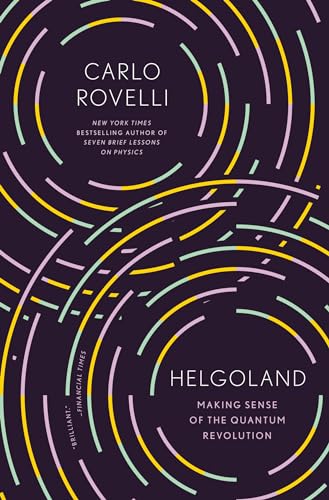
A startling new look at quantum theory, from the New York Times bestselling author of Seven Brief Lessons on Physics, The Order of Time, and Anaximander.
One of the world's most renowned theoretical physicists, Carlo Rovelli has entranced millions of readers with his singular perspective on the cosmos. In Helgoland, he examines the enduring enigma of quantum theory. The quantum world Rovelli describes is as beautiful as it is unnerving.
Helgoland is a treeless island in the North Sea where the twenty-three-year-old Werner Heisenberg made the crucial breakthrough for the creation of quantum mechanics, setting off a century of scientific revolution. Full of alarming ideas (ghost waves, distant objects that seem to be magically connected, cats that appear both dead and alive), quantum physics has led to countless discoveries and technological advancements. Today our understanding of the world is based on this theory, yet it is still profoundly mysterious.
As scientists and philosophers continue to fiercely debate the meaning of the theory, Rovelli argues that its most unsettling contradictions can be explained by seeing the world as fundamentally made of relationships rather than substances. We and everything around us exist only in our interactions with one another. This bold idea suggests new directions for thinking about the structure of reality and even the nature of consciousness.
Rovelli makes learning about quantum mechanics an almost psychedelic experience. Shifting our perspective once again, he takes us on a riveting journey through the universe so we can better comprehend our place in it.
Die Inhaltsangabe kann sich auf eine andere Ausgabe dieses Titels beziehen.
Über die Autorinnen und Autoren
Carlo Rovelli is a theoretical physicist who has made significant contributions to the physics of space and time. He has worked in Italy and the United States and currently directs the quantum gravity research group of the Centre de Physique Théorique in Marseille, France. His books, including Seven Brief Lessons on Physics, The Order of Time, and Helgoland, are international bestsellers that have been translated into more than fifty languages.
Carlo Rovelli is a theoretical physicist who has made significant contributions to the physics of space and time. He has worked in Italy and the United States, and is currently directing the Quantum Gravity research group of the Centre de Physique Théorique in Marseille, France. His books Seven Brief Lessons on Physics, Reality Is Not What It Seems, and The Order of Time are international bestsellers that have been translated into more than forty languages.
Auszug. © Genehmigter Nachdruck. Alle Rechte vorbehalten.
I
A STRANGELY BEAUTIFUL INTERIOR
How a young German physicist
arrived at an idea that was very
strange indeed, but described
the world remarkably well-and
the great confusion that followed.
The Absurd Idea of the Young Heisenberg: Observables
It was around three o'clock in the morning when the final results of my calculations were before me. I felt profoundly shaken. I was so agitated that I could not sleep. I left the house and began walking slowly in the dark. I climbed on a rock overlooking the sea at the tip of the island, and waited for the sun to come up . . .
I have often wondered what the thoughts and emotions of the young Heisenberg must have been as he clambered over that rock overlooking the sea, on the barren and windswept North Sea island of Helgoland, facing the vastness of the waves and awaiting the sunrise, after having been the first to glimpse one of the most vertiginous of Nature's secrets ever looked upon by humankind. He was twenty-three.
He was on the island seeking relief from the allergy that afflicted him. Helgoland-the name means Sacred Island-has virtually no trees, and very little pollen. ("Heligoland with its one tree," as James Joyce has it in Ulysses.) Perhaps the legends of the dreadful pirate Stšrtebeker hiding on the island, which Heisenberg loved as a boy, were in his mind as well. But Heisenberg's main reason for being there was to immerse himself in the problem with which he was obsessed, the burning issue handed to him by Niels Bohr. He slept little and spent his time in solitude, trying to calculate something that would justify Bohr's incomprehensible rules. Every so often, he would take a break to climb over the island's rocks or learn by heart poetry from Goethe's West-Eastern Divan, the collection in which Germany's greatest poet sings his love for Islam.
Niels Bohr was already a renowned scientist. He had written formulas, simple but strange, that predicted the properties of chemical elements even before measuring them. They predicted, for instance, the frequency of light emitted by elements when heated: the color they assume. This was a remarkable achievement. The formulas, however, were incomplete: they did not give, for instance, the intensity of the emitted light.
But above all, these formulas had about them something that was truly absurd. They assumed, for no good reason, that the electrons in atoms orbited around the nucleus only on certain precise orbits, at certain precise distances from the nucleus, with certain precise energies-before magically "leaping" from one orbit to another. The first quantum leaps. Why only these orbits? Why these incongruous "leaps" from one orbit to another? What force could possibly cause such bizarre behavior as this?
The atom is the building block of everything. How does it work? How do the electrons move inside it? The scientists of the beginning of the century had been pondering these questions for more than a decade, without getting anywhere.
Like a Renaissance master painter in his studio, Bohr had gathered around him in Copenhagen the very best young physicists he could find, to work together on the mysteries of the atom. Among them was the brilliant Wolfgang Pauli-Heisenberg's extremely intelligent, pretty arrogant friend and former classmate. But Pauli had recommended Heisenberg to the great Bohr, saying that to make any real progress, he was needed. Bohr had taken the advice, and in the autumn of 1924 had brought Heisenberg to Copenhagen from Gšttingen, where he was working as an assistant to the physicist Max Born. Heisenberg had spent a few months in long discussions with Bohr, in Copenhagen, in front of blackboards covered with formulas. The young apprentice and the master had taken long walks together in the mountains, talking about the enigmas of the atom; about physics and philosophy.
Heisenberg had steeped himself in the problem. It had become his obsession. Like the others, he had tried everything. Nothing worked. There seemed to be no reasonable force capable of guiding the electrons on Bohr's strange orbits, and in his peculiar leaps. And yet those orbits and those leaps really did lead to good predictions of atomic phenomena. Confusion.
Desperation pushes us to look for extreme solutions. On that island in the North Sea, in complete solitude, Heisenberg resolved to explore radical ideas.
It was with radical ideas, after all, that twenty years earlier Einstein had astonished the world. Einstein's radicalism had worked. Pauli and Heisenberg were enamored of his physics. Einstein for them was a legend. Had the time perhaps come, they asked themselves, to hazard as radical a step, to escape from the impasse regarding electrons in atoms? Could they be the ones to take it? In your twenties, you can dream freely.
Einstein had shown that even our most rooted convictions can be wrong. What seems most obvious to us now might turn out not to be correct. Abandoning assumptions that seem self-evident can lead to greater understanding. Einstein had taught that everything should be based on what we see, not on what we assume to exist.
Pauli repeated these ideas to Heisenberg. The two young men had drunk deep of this poisoned honey. They had been following the discussions on the relation between reality and experience that ran through Austrian and German philosophy at the beginning of the century. Ernst Mach, who had exerted a decisive influence on Einstein, insisted that knowledge had to be based solely on observations, freed of any implicit "metaphysical" assumption. These were the ingredients coming together in the young Heisenberg's thinking, like the chemical components of an explosive, as he isolated himself on Helgoland in the summer of 1925.
And here he had the idea. An idea that could only be had with the unfettered radicalism of the young. The idea that would transform physics in its entirety-together with the whole of science and our very conception of the world. An idea, I believe, that humanity has not yet fully absorbed.
Heisenberg's leap is as daring as it is simple. No one has been able to find the force capable of causing the bizarre behavior of electrons? Fine, let's stop searching for this new force. Let's use instead the force we are familiar with: the electric force that binds the electron to the nucleus. We cannot find new laws of motion to account for Bohr's orbits and his "leaps"? Fine, let's stick with the laws of motion that we're familiar with, without altering them.
Let's change, instead, our way of thinking about the electron. Let's give up describing its movement. Let's describe only what we can observe: the light it emits. Let's base everything on quantities that are observable. This is the idea.
Heisenberg attempts to recalculate the behavior of the electron using quantities we observe: the frequency and amplitude of emitted light.
We can observe the effects of the electron's leaps from one of Bohr's orbits to another. Heisenberg replaces the physical variables (numbers) with tables of numbers that have the orbits of departure in their rows and the orbits of arrival in their columns. Each entry of the table stands in a row and in a column: it describes the leap from one orbit to another. He spends his time on the island trying to use these tables to calculate something that could justify Bohr's rules. He doesn't get much sleep. But he fails to do the math for the electron in the atom: too difficult. He tries to account for a simpler...
„Über diesen Titel“ kann sich auf eine andere Ausgabe dieses Titels beziehen.
Suchergebnisse für Helgoland: Making Sense of the Quantum Revolution

Beispielbild für diese ISBN
Helgoland: Making Sense of the Quantum Revolution
Verlag:
Riverhead Books (edition Reprint), 2022
ISBN 10: 0593328892
ISBN 13: 9780593328897
Gebraucht
Paperback
Anbieter: BooksRun, Philadelphia, PA, USA
Verkäuferbewertung 5 von 5 Sternen

Paperback. Zustand: Fair. Reprint. The item might be beaten up but readable. May contain markings or highlighting, as well as stains, bent corners, or any other major defect, but the text is not obscured in any way. Artikel-Nr. 0593328892-7-1-13
Gebraucht kaufen
EUR 7,95
Versand gratis
Versand innerhalb von USA
Versand innerhalb von USA
Anzahl: 1 verfügbar
Beispielbild für diese ISBN
Helgoland: Making Sense of the Quantum Revolution
Anbieter: BookOutlet, Jefferson City, TN, USA
Verkäuferbewertung 5 von 5 Sternen
Paperback. Zustand: New. Paperback. Publisher overstock, may contain remainder mark on edge. Artikel-Nr. 9780593328897B
Beispielbild für diese ISBN
Helgoland: Making Sense of the Quantum Revolution
Anbieter: World of Books (was SecondSale), Montgomery, IL, USA
Verkäuferbewertung 5 von 5 Sternen
Paperback. Zustand: Good. Named a Best Book of 2021 by the Financial Times and a Best Science Book of 2021 by The Guardian "Rovelli is a genius and an amazing communicator. This is the place where science comes to life." ―Neil Gaiman "One of the warmest, most elegant and most lucid interpreters to the laity of the dazzling enigmas of his discipline.[a] momentous book" ―John Banville, The Wall Street Journal A startling new look at quantum theory, from the New York Times bestselling author of Seven Brief Lessons on Physics, The Order of Time, and Anaximander. One of the world's most renowned theoretical physicists, Carlo Rovelli has entranced millions of readers with his singular perspective on the cosmos. In Helgoland, he examines the enduring enigma of quantum theory. The quantum world Rovelli describes is as beautiful as it is unnerving. Helgoland is a treeless island in the North Sea where the twenty-three-year-old Werner Heisenberg made the crucial breakthrough for the creation of quantum mechanics, setting off a century of scientific revolution. Full of alarming ideas (ghost waves, distant objects that seem to be magically connected, cats that appear both dead and alive), quantum physics has led to countless discoveries and technological advancements. Today our understanding of the world is based on this theory, yet it is still profoundly mysterious. As scientists and philosophers continue to fiercely debate the meaning of the theory, Rovelli argues that its most unsettling contradictions can be explained by seeing the world as fundamentally made of relationships rather than substances. We and everything around us exist only in our interactions with one another. This bold idea suggests new directions for thinking about the structure of reality and even the nature of consciousness. Rovelli makes learning about quantum mechanics an almost psychedelic experience. Shifting our perspective once again, he takes us on a riveting journey through the universe so we can better comprehend our place in it. Artikel-Nr. 00109772514
Gebraucht kaufen
EUR 10,94
Versand gratis
Versand innerhalb von USA
Versand innerhalb von USA
Anzahl: 2 verfügbar
Beispielbild für diese ISBN
Helgoland: Making Sense of the Quantum Revolution
Verlag:
Riverhead Books May 2022, 2022
ISBN 10: 0593328892
ISBN 13: 9780593328897
Gebraucht
Paper Back
Anbieter: Eagle Eye Books, Decatur, GA, USA
Verkäuferbewertung 4 von 5 Sternen

Paper Back. Zustand: Used. Artikel-Nr. 889884
Gebraucht kaufen
EUR 9,03
EUR 3,50 Versand
Versand innerhalb von USA
Versand innerhalb von USA
Anzahl: 1 verfügbar
Beispielbild für diese ISBN
Helgoland
Anbieter: Roundabout Books, Greenfield, MA, USA
Verkäuferbewertung 4 von 5 Sternen
Paperback. Zustand: New. Condition Notes: New from the publisher. Artikel-Nr. 1418152
Beispielbild für diese ISBN
Helgoland: Making Sense of the Quantum Revolution
Anbieter: Revaluation Books, Exeter, Vereinigtes Königreich
Verkäuferbewertung 5 von 5 Sternen
Paperback. Zustand: Brand New. reprint edition. 233 pages. 7.50x5.00x1.00 inches. In Stock. Artikel-Nr. xi0593328892
Neu kaufen
EUR 19,49
EUR 11,63 Versand
Versand von Vereinigtes Königreich nach USA
Versand von Vereinigtes Königreich nach USA
Anzahl: 1 verfügbar
Beispielbild für diese ISBN
Helgoland: Making Sense of the Quantum Revolution
Anbieter: Kennys Bookstore, Olney, MD, USA
Verkäuferbewertung 5 von 5 Sternen
Zustand: New. 2022. Paperback. . . . . . Books ship from the US and Ireland. Artikel-Nr. V9780593328897
Neu kaufen
EUR 23,28
EUR 9,22 Versand
Versand innerhalb von USA
Versand innerhalb von USA
Anzahl: 1 verfügbar
Foto des Verkäufers
Helgoland : Making Sense of the Quantum Revolution
Verlag:
Penguin Publishing Group Mai 2022, 2022
ISBN 10: 0593328892
ISBN 13: 9780593328897
Neu
Taschenbuch
Anbieter: AHA-BUCH GmbH, Einbeck, Deutschland
Verkäuferbewertung 5 von 5 Sternen
Taschenbuch. Zustand: Neu. Neuware - Named a Best Book of 2021 by the Financial Times and a Best Science Book of 2021 by The Guardian 'Rovelli is a genius and an amazing communicator. This is the place where science comes to life.' ?Neil Gaiman 'One of the warmest, most elegant and most lucid interpreters to the laity of the dazzling enigmas of his discipline.[a] momentous book' ?John Banville, The Wall Street Journal A startling new look at quantum theory, from the New York Times bestselling author of Seven Brief Lessons on Physics, The Order of Time, and Anaximander. One of the world's most renowned theoretical physicists, Carlo Rovelli has entranced millions of readers with his singular perspective on the cosmos. In Helgoland, he examines the enduring enigma of quantum theory. The quantum world Rovelli describes is as beautiful as it is unnerving. Helgoland is a treeless island in the North Sea where the twenty-three-year-old Werner Heisenberg made the crucial breakthrough for the creation of quantum mechanics, setting off a century of scientific revolution. Full of alarming ideas (ghost waves, distant objects that seem to be magically connected, cats that appear both dead and alive), quantum physics has led to countless discoveries and technological advancements. Today our understanding of the world is based on this theory, yet it is still profoundly mysterious. As scientists and philosophers continue to fiercely debate the meaning of the theory, Rovelli argues that its most unsettling contradictions can be explained by seeing the world as fundamentally made of relationships rather than substances. We and everything around us exist only in our interactions with one another. This bold idea suggests new directions for thinking about the structure of reality and even the nature of consciousness. Rovelli makes learning about quantum mechanics an almost psychedelic experience. Shifting our perspective once again, he takes us on a riveting journey through the universe so we can better comprehend our place in it. Artikel-Nr. 9780593328897
Neu kaufen
EUR 23,11
EUR 35,00 Versand
Versand von Deutschland nach USA
Versand von Deutschland nach USA
Anzahl: 1 verfügbar
Foto des Verkäufers
Helgoland: Making Sense of the Quantum Revolution
Anbieter: moluna, Greven, Deutschland
Verkäuferbewertung 5 von 5 Sternen
Kartoniert / Broschiert. Zustand: New. Über den AutorCarlo Rovelli is a theoretical physicist who has made significant contributions to the physics of space and time. He has worked in Italy and the United States and currently directs the quantum gravity research g. Artikel-Nr. 567906511
Neu kaufen
EUR 18,50
EUR 48,99 Versand
Versand von Deutschland nach USA
Versand von Deutschland nach USA
Anzahl: 3 verfügbar