
Inhaltsangabe
"As lyrical as it is epic, Across So Many Seas reminds us that while the past may be another country, it's also a living, breathing song of sadness and joy that helps define who we are." --Alan Gratz, New York Times bestselling author of Refugee
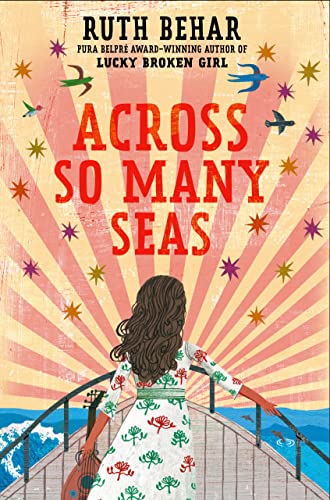
Spanning over 500 years, Pura Belpré Award winner Ruth Behar's epic novel tells the stories of four girls from different generations of a Jewish family, many of them forced to leave their country and start a new life.
In 1492, during the Spanish Inquisition, Benvenida and her family are banished from Spain for being Jewish, and must flee the country or be killed. They journey by foot and by sea, eventually settling in Istanbul.
Over four centuries later, in 1923, shortly after the Turkish war of independence, Reina’s father disowns her for a small act of disobedience. He ships her away to live with an aunt in Cuba, to be wed in an arranged marriage when she turns fifteen.
In 1961, Reina’s daughter, Alegra, is proud to be a brigadista, teaching literacy in the countryside for Fidel Castro. But soon Castro’s crackdowns force her to flee to Miami all alone, leaving her parents behind.
Finally, in 2003, Alegra’s daughter, Paloma, is fascinated by all the journeys that had to happen before she could be born. A keeper of memories, she’s thrilled by the opportunity to learn more about her heritage on a family trip to Spain, where she makes a momentous discovery.
Though many years and many seas separate these girls, they are united by a love of music and poetry, a desire to belong and to matter, a passion for learning, and their longing for a home where all are welcome. And each is lucky to stand on the shoulders of their courageous ancestors.
Die Inhaltsangabe kann sich auf eine andere Ausgabe dieses Titels beziehen.
Über die Autorin bzw. den Autor
Ruth Behar (ruthbehar.com), the Pura Belpré Award-winning author of Lucky Broken Girl and Letters from Cuba, was born in Havana, Cuba, grew up in New York, and has also lived in Spain and Mexico. Her work also includes poetry, memoir, and the acclaimed travel books An Island Called Home and Traveling Heavy. She was the first Latina to win a MacArthur "Genius" Grant, and other honors include a John Simon Guggenheim Fellowship and being named a "Great Immigrant" by the Carnegie Corporation. An anthropology professor at the University of Michigan, she lives in Ann Arbor, Michigan.
Auszug. © Genehmigter Nachdruck. Alle Rechte vorbehalten.
Part One
Benvenida
1492
1
The Proclamation
The sound of trumpets coming from the direction of our town gates tears me from sleep, my dreams forgotten as I jolt out of bed.
My whole family dresses quickly as the sun begins to rise. Then I follow Mother and Father and my brothers, Isaac and Jacob, to the Plaza Mayor.
“Hurry, Benvenida,” Mother says, turning around. “Don’t dawdle. We don’t want to miss any announcements.”
Hearing my name usually makes me smile—as the youngest and only girl of the family, I was named Benvenida because everyone welcomed me when I was born.
But today is not a day for smiles.
The cobblestoned path, glistening from the morning dew, is slippery under my feet. It is strange to be out this early, but the familiar scent of almond sweets that perfumes our town calms me.
As we join the hundreds of townspeople gathered in the Plaza Mayor, we watch the solemn procession approach.At the front marches a line of Catholic priests carrying the green cross of the Holy Office of the Inquisition. Behind them, soldiers with swords at their sides.
The sun shines brightly, but the last gasp of winter air makes the day feel chilly. I draw closer to Mother to stay warm.
“Mother, what is happening? Why must we be here?”
She whispers, “The rumor is that King Fernando and Queen Isabel will now insist on uniting the kingdom under the Catholic faith, which means things will get even worse for us as Jews. Let’s hope that rumor is false.”
We wait as the officer at arms, dressed in a black robe and white collar, takes his place at the center of the Plaza Mayor and unrolls a parchment. Slowly he reads aloud a proclamation, shouting in Spanish:
“On this day, the thirty-first of March of the year 1492, we order all Jews and Jewesses, regardless of age, who live in our kingdoms and lordships . . . that by the end of the month of July of the present year, they depart from all of these our realms and lordships . . . And whoever disobeys us and does not leave within this time and is to be found in any place in our kingdom will be sentenced to death by hanging . . .”
A gasp arises from the crowd.
I can see the Jews around me lowering their eyes at the indignity.
Echoing in my heart, those words . . . death by hanging . . .
I shake with fear as we head home, hardly believing what I’ve just heard.
2
Expulsion
Father closes the door swiftly the minute we arrive home, and we all slip into the kitchen, the room farthest from the street, where we can speak without being heard by neighbors.
“You know what they’re calling for?” Father asks Mother, clutching his chest.
“Expulsion,” she replies solemnly.
“What does expulsion mean?” I ask.
Isaac, who is fifteen and knows the answers to most anything, says, “It means we Jews are to be thrown out of the kingdom. We have to leave by the end of July—that’s only four months.”
“How can that be? Hasn’t our family lived in Toledo for hundreds of years? Don’t we belong here?”
“Yes, we do belong here,” says Jacob, who knows almost as much as Isaac, just having celebrated his bar mitzvah. “But they will only let us stay if we convert to Catholicism.”
"And that we will never do!” I exclaim.
I’ve heard Father say this many times, even though in our own family there are converts, called conversos. To Father’s great shame, his two sisters and their families accepted baptism to the Catholic faith. “I thank the Lord that our parents are no longer alive, for they would cry without end for my sisters,” Father had said when they began to wear crosses around their necks.
Life would be easier if we converted, though. Around us are family, friends, and neighbors who gave up being Jewish in the hope that they wouldn’t stand out as different.
The friends I played with as a small child, two sisters called Susanah and Deborah, no longer speak to me. Yet not so long ago, the three of us were best friends. We ate together, prayed together, dreamed together. As little girls, we chased one another on the streets, skinning our knees, and kissing one another’s wounds so they’d heal.
At first, after they converted, I thought I’d done something to make them angry. I tried to ask for forgiveness by giving them candied figs.
“Stay away!” they yelled. “We can’t be friends with you until you stop being a Jew.”
And I yelled back, “Then we shall never be friends!”
I pitied them for turning against their own religion and forsaking our traditions. I wondered what that must feel like and wrote a poem about it:
I fear for all
who hide their faith.
Do their tears burn
as they fall down their cheeks?
Poems come into my head all the time, and I usually try to write them down. I am fortunate Mother comes from a family of book printers and has taught me to read and write in Hebrew and Spanish. I even know a little Arabic, because Mother shared with me the verses of Qasmuna, the Jewish poet who once lived in Granada—the land that King Fernando and Queen Isabel seized a few months ago from the Moors. I’m dark-eyed just like you, and lonely, Qasmuna wrote—and it felt like she was talking to me. However, I must not speak about these things, because females are not supposed to read, but Father respects Mother’s family background and doesn’t object to her teaching me. Writing poems, though, is a high art, which he thinks is best left to men.
Now Father pulls at his robe so sharply that the fabric rips. Then he breaks into a song, borrowed from a psalm, a tune so sad tears come to all of our eyes.
Be merciful unto me, O God, be merciful unto me:
for my soul trusts in you.
In the shadow of your wings
will I make my refuge
until these calamities shall be overcome.
Soon I join him and feel the wings of the song lifting me.
I accompany my singing with the tambourine, and the music fills the air with the hope and courage we need so badly at this moment.
“Stop singing, stop singing. My heart is hurting,” Mother says, looking at Father and me with a pained face.
“I am sorry, querida,” Father says. “It is how I express myself. And Benvenida sings like a nightingale, doesn’t she?”
He wipes away the tears from his eyes, and I wipe mine too, though a part of me is happy hearing Father’s compliment. Father is a hazan—he sings the songs of our prayers, at synagogue and at home, and he has taught me how to sing too.
I’m not allowed to sing in the synagogue because I’m a girl, but at home I raise my voice and sing proudly.
On the day we leave Toledo, I fear I will be speechless. How will I say goodbye to...
„Über diesen Titel“ kann sich auf eine andere Ausgabe dieses Titels beziehen.
Weitere beliebte Ausgaben desselben Titels

Suchergebnisse für Across So Many Seas

Beispielbild für diese ISBN
Across So Many Seas
Verlag:
Nancy Paulsen Books (edition ), 2024
ISBN 10: 0593323408
ISBN 13: 9780593323403
Gebraucht
Hardcover
Anbieter: BooksRun, Philadelphia, PA, USA
Verkäuferbewertung 5 von 5 Sternen

Hardcover. Zustand: Very Good. With dust jacket. It's a well-cared-for item that has seen limited use. The item may show minor signs of wear. All the text is legible, with all pages included. It may have slight markings and/or highlighting. Artikel-Nr. 0593323408-11-1-29
Gebraucht kaufen
EUR 5,01
Versand gratis
Versand innerhalb von USA
Versand innerhalb von USA
Anzahl: 1 verfügbar
Beispielbild für diese ISBN
Across So Many Seas
Anbieter: ThriftBooks-Reno, Reno, NV, USA
Verkäuferbewertung 5 von 5 Sternen
Hardcover. Zustand: Very Good. No Jacket. Former library book; May have limited writing in cover pages. Pages are unmarked. ~ ThriftBooks: Read More, Spend Less. Artikel-Nr. G0593323408I4N10
Gebraucht kaufen
EUR 6,87
Versand gratis
Versand innerhalb von USA
Versand innerhalb von USA
Anzahl: 2 verfügbar
Beispielbild für diese ISBN
Across So Many Seas
Anbieter: ThriftBooks-Atlanta, AUSTELL, GA, USA
Verkäuferbewertung 5 von 5 Sternen
Hardcover. Zustand: Very Good. No Jacket. Former library book; May have limited writing in cover pages. Pages are unmarked. ~ ThriftBooks: Read More, Spend Less. Artikel-Nr. G0593323408I4N10
Gebraucht kaufen
EUR 6,87
Versand gratis
Versand innerhalb von USA
Versand innerhalb von USA
Anzahl: 2 verfügbar
Beispielbild für diese ISBN
Across So Many Seas
Anbieter: ThriftBooks-Dallas, Dallas, TX, USA
Verkäuferbewertung 5 von 5 Sternen
Hardcover. Zustand: Very Good. No Jacket. Former library book; May have limited writing in cover pages. Pages are unmarked. ~ ThriftBooks: Read More, Spend Less. Artikel-Nr. G0593323408I4N10
Gebraucht kaufen
EUR 6,87
Versand gratis
Versand innerhalb von USA
Versand innerhalb von USA
Anzahl: 2 verfügbar
Beispielbild für diese ISBN
Across So Many Seas
Anbieter: ThriftBooks-Dallas, Dallas, TX, USA
Verkäuferbewertung 5 von 5 Sternen
Hardcover. Zustand: Good. No Jacket. Pages can have notes/highlighting. Spine may show signs of wear. ~ ThriftBooks: Read More, Spend Less. Artikel-Nr. G0593323408I3N00
Gebraucht kaufen
EUR 6,87
Versand gratis
Versand innerhalb von USA
Versand innerhalb von USA
Anzahl: 1 verfügbar
Beispielbild für diese ISBN
Across So Many Seas
Anbieter: ThriftBooks-Phoenix, Phoenix, AZ, USA
Verkäuferbewertung 5 von 5 Sternen
Hardcover. Zustand: Very Good. No Jacket. Former library book; May have limited writing in cover pages. Pages are unmarked. ~ ThriftBooks: Read More, Spend Less. Artikel-Nr. G0593323408I4N10
Gebraucht kaufen
EUR 6,87
Versand gratis
Versand innerhalb von USA
Versand innerhalb von USA
Anzahl: 2 verfügbar
Beispielbild für diese ISBN
Across So Many Seas
Anbieter: ThriftBooks-Atlanta, AUSTELL, GA, USA
Verkäuferbewertung 5 von 5 Sternen
Hardcover. Zustand: Very Good. No Jacket. Missing dust jacket; May have limited writing in cover pages. Pages are unmarked. ~ ThriftBooks: Read More, Spend Less. Artikel-Nr. G0593323408I4N01
Gebraucht kaufen
EUR 6,87
Versand gratis
Versand innerhalb von USA
Versand innerhalb von USA
Anzahl: 1 verfügbar
Beispielbild für diese ISBN
Across So Many Seas
Anbieter: BookOutlet, Jefferson City, TN, USA
Verkäuferbewertung 5 von 5 Sternen
Hardcover. Zustand: New. Hardcover. Publisher overstock, may contain remainder mark on edge. Artikel-Nr. 9780593323403B
Neu kaufen
EUR 4,94
EUR 2,84 Versand
Versand innerhalb von USA
Versand innerhalb von USA
Anzahl: Mehr als 20 verfügbar
Beispielbild für diese ISBN
Across So Many Seas
Verlag:
Penguin Young Readers Group, 2024
ISBN 10: 0593323408
ISBN 13: 9780593323403
Gebraucht
Hardcover
Anbieter: Better World Books, Mishawaka, IN, USA
Verkäuferbewertung 5 von 5 Sternen
Zustand: Good. Former library copy. Pages intact with minimal writing/highlighting. The binding may be loose and creased. Dust jackets/supplements are not included. Includes library markings. Stock photo provided. Product includes identifying sticker. Better World Books: Buy Books. Do Good. Artikel-Nr. 50886863-6
Gebraucht kaufen
EUR 9,62
Versand gratis
Versand innerhalb von USA
Versand innerhalb von USA
Anzahl: 1 verfügbar
Beispielbild für diese ISBN
Across So Many Seas
Verlag:
Penguin Young Readers Group, 2024
ISBN 10: 0593323408
ISBN 13: 9780593323403
Gebraucht
Hardcover
Anbieter: Better World Books, Mishawaka, IN, USA
Verkäuferbewertung 5 von 5 Sternen
Zustand: Good. Pages intact with minimal writing/highlighting. The binding may be loose and creased. Dust jackets/supplements are not included. Stock photo provided. Product includes identifying sticker. Better World Books: Buy Books. Do Good. Artikel-Nr. 53853466-6
Gebraucht kaufen
EUR 9,62
Versand gratis
Versand innerhalb von USA
Versand innerhalb von USA
Anzahl: 1 verfügbar