
Verwandte Artikel zu Medusa's Ankles: Selected Stories
Inhaltsangabe
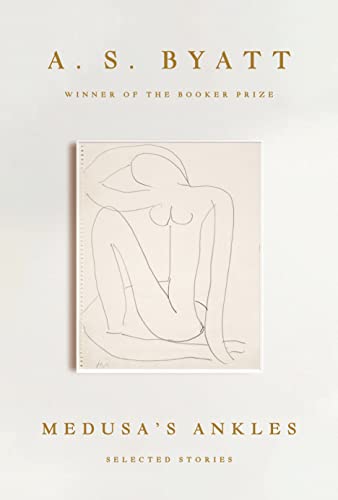
A ravishing, luminous selection of short stories from the prize-winning imagination of A. S. Byatt, "a storyteller who could keep a sultan on the edge of his throne for a thousand and one nights" (The New York Times Book Review). With an introduction by David Mitchell, best-selling author of Cloud Atlas
Mirrors shatter at the hairdresser's when a middle-aged client explodes in rage. Snow dusts the warm body of a princess, honing it into something sharp and frosted. Summer sunshine flickers on the face of a smiling child who may or may not be real.
Medusa's Ankles celebrates the very best of A. S. Byatt's short fiction, carefully selected from a lifetime of writing. Peopled by artists, poets, and fabulous creatures, the stories blaze with creativity and color. From ancient myth to a British candy factory, from a Chinese restaurant to a Mediterranean swimming pool, from a Turkish bazaar to a fairy-tale palace, Byatt transports her readers beyond the veneer of the ordinary—even beyond the gloss of the fantastical—to places rich and strange and wholly unforgettable.
Die Inhaltsangabe kann sich auf eine andere Ausgabe dieses Titels beziehen.
Über die Autorin bzw. den Autor
A. S. BYATT is the author of numerous novels, including The Children’s Book, The Biographer’s Tale, and Possession, which was awarded the Booker Prize. She has also written two novellas, published together as Angels & Insects, five collections of short stories, and several works of nonfiction. A distinguished critic and author, and the recipient of the 2016 Erasmus Prize for her “inspiring contribution to ‘life writing,’” she lives in London.
Auszug. © Genehmigter Nachdruck. Alle Rechte vorbehalten.
THE DJINN IN THE NIGHTINGALE’S EYE
Once upon a time, when men and women hurtled through the air on metal wings, when they wore webbed feet and walked on the bottom of the sea, learning the speech of whales and the songs of the dolphins, when pearly-fleshed and jewelled apparitions of Texan herdsmen and houris shimmered in the dusk on Nicaraguan hillsides, when folk in Norway and Tasmania in dead of winter could dream of fresh strawberries, dates, guavas, and passion fruits and find them spread next morning on their tables, there was a woman who was largely irrelevant, and therefore happy.
Her business was storytelling, but she was no ingenious queen in fear of the shroud brought in with the dawn, nor was she a naquibolmalek to usher a shah through the gates of sleep, nor an ashik, a lover-minstrel singing songs of Mehmet the Conqueror and the sack of Byzantium, nor yet a holy dervish in short skin trousers and skin skullcap, brandishing axe or club and making its shadow terrible. She was no meddah, telling incredible tales in the Ottoman court or the coffeehouses by the market. She was merely a narratologist, a being of secondary order, whose days were spent hunched in great libraries scrying, interpreting, decoding the fairy tales of childhood and the vodka posters of the grown-up world, the unending romances of golden coffee drinkers, and the impeded couplings of doctors and nurses, dukes and poor maidens, horsewomen and musicians. Sometimes also, she flew. In her impoverished youth she had supposed that scholarship was dry, dusty and static, but now she knew better. Two or three times a year she flew to strange cities, to China, Mexico, and Japan, to Transylvania, Bogotá, and the South Seas, where narratologists gathered like starlings, parliaments of wise fowls, telling stories about stories.
At the time when my story begins the green sea was black, sleek as the skins of killer whales, and the sluggish waves were on fire, with dancing flames and a great curtain of stinking smoke. The empty deserts were seeded with skulls, and with iron canisters, containing death. Pestilence crept invisibly from dune to dune. In those days men and women, including narratologists, were afraid to fly east, and their gatherings were diminished. Nevertheless our narratologist, whose name was Gillian Perholt, found herself in the air, between London and Ankara. Who can tell if she travelled because she was English and stolid and could not quite imagine being blasted out of the sky, or because, although she was indeed an imaginative being, and felt an appropriate measure of fear, she could not resist the idea of the journey above the clouds, above the minarets of Istanbul, and the lure of seeing the Golden Horn, the Bosphorus, and the shores of Europe and Asia face to face? Flying is statistically safer than any other travel, Gillian Perholt told herself, and surely at this time, only slightly less safe, statistically only a little less.
She had a phrase for the subtle pleasures of solitary air travel. She spoke it to herself like a charm as the great silver craft detached itself from its umbilical tube at Heathrow, waddled like an albatross across the tarmac and went up, up, through grey curtains of English rain, a carpet of woolly iron-grey English cloud, a world of swirling vapour, trailing its long limbs and scarves past her tiny porthole, in the blue and gold world that was always there, above the grey, always. “Floating redundant” she said to herself, sipping champagne, nibbling salted almonds, whilst all round her spread the fields of heaven, white and rippling, glistening and gleaming, rosy and blue in the shadows, touched by the sun with steady brightness. “Floating redundant,” she murmured blissfully as the vessel banked and turned and a disembodied male voice spoke in the cabin, announcing that there was a veil of water vapour over France but that that would burn off, and then they would see the Alps, when the time came. “Burn off” was a powerful term, she thought, rhetorically interesting, for water does not burn and yet the sun’s heat reduces this water to nothing; I am in the midst of fierce forces. I am nearer the sun than any woman of my kind, any ancestress of mine, can ever have dreamed of being, I can look in his direction and stay steadily here, floating redundant.
The phrase was, of course, not her own; she was, as I have said, a being of a secondary order. The phrase was John Milton’s, plucked from the air, or the circumambient language, at the height of his powers, to describe the beauty of the primordial coils of the insinuating serpent in the Paradise garden. Gillian Perholt remembered the very day these words had first coiled into shape and risen in beauty from the page, and struck at her, unsuspecting as Eve. There she was, sixteen years old, a golden-haired white virgin with vague blue eyes (she pictured herself so) and there on the ink-stained desk in the dust was the battered emerald-green book, ink-stained too, and secondhand, scribbled across and across by dutiful or impatient female fingers, and everywhere was a smell, still drily pungent, of hot ink and linoleum and dust if not ashes, and there he was, the creature, insolent and lovely before her.
not with indented wave, Prone on the ground, as since, but on his rear, Circular base of rising folds, that towered Fold above fold a surging maze, his head Crested aloft and carbuncle his eyes;
With burnished neck of verdant gold, erect Amidst his circling spires, that on the grass Floated redundant: pleasing was his shape, And lovely.
And for an instant Gillian Perholt had seen, brilliant and swaying, not the snake Eve had seen in the garden, nor yet the snake that had risen in the dark cave inside the skull of blind John Milton, but a snake, the snake, the same snake, in some sense, made of words and visible to the eye. So, as a child, from time to time, she had seen wolves, bears, and small grey men, standing between her and the safety of the door, or her father’s sleeping Sunday form in an armchair. But I digress, or am about to digress. I called up the snake (I saw him too, in my time) to explain Dr. Perholt’s summing-up of her own state.
In those days she had been taught to explain “floating redundant” as one of Milton’s magical fusings of two languages—“floating,” which was Teutonic and to do with floods, and “redundant,” which was involved and Latinate, and to do with overflowings. Now she brought to it her own wit, a knowledge of the modern sense of “redundant,” which was to say, superfluous, unwanted, unnecessary, let go. “I’m afraid we shall have to let you go,” employers said, everywhere, offering freedom to reluctant Ariels, as though the employees were captive sprites, only too anxious to rush uncontrolled into the elements. Dr. Perholt’s wit was only secondarily to do with employment, however. It was primarily to do with her sex and age, for she was a woman in her fifties, past childbearing, whose two children were adults now, had left home and had left England, one for Saskatchewan and one for São Paulo, from where they communicated little, for they were occupied with children of their own. Dr. Perholt’s husband also had left home, had left Dr. Perholt, had removed himself after two years of soul-searching, two years of scurrying in and out of his/their home, self-accusation, irritability, involuntary impotence, rejection of lovingly cooked food, ostentatious display of concealed messages, breathed phone calls when Dr. Perholt appeared to be sleeping, missed dinner engagements, mysterious dips in the balance at the bank, bouts of evil-smelling breath full of brandy and stale smoke, also of odd-smelling skin, with touches of alien sweat,...
„Über diesen Titel“ kann sich auf eine andere Ausgabe dieses Titels beziehen.
Suchergebnisse für Medusa's Ankles: Selected Stories

Beispielbild für diese ISBN
Medusa's Ankles: Selected Stories
Anbieter: World of Books (was SecondSale), Montgomery, IL, USA
Verkäuferbewertung 5 von 5 Sternen

Zustand: Good. Item in good condition. Textbooks may not include supplemental items i.e. CDs, access codes etc. Artikel-Nr. 00105751375
Gebraucht kaufen
EUR 3,96
Versand gratis
Versand innerhalb von USA
Versand innerhalb von USA
Anzahl: 3 verfügbar
Beispielbild für diese ISBN
Medusa's Ankles: Selected Stories
Anbieter: ThriftBooks-Atlanta, AUSTELL, GA, USA
Verkäuferbewertung 5 von 5 Sternen
Hardcover. Zustand: Very Good. No Jacket. Former library book; May have limited writing in cover pages. Pages are unmarked. ~ ThriftBooks: Read More, Spend Less. Artikel-Nr. G0593321588I4N10
Gebraucht kaufen
EUR 6,14
Versand gratis
Versand innerhalb von USA
Versand innerhalb von USA
Anzahl: 1 verfügbar
Beispielbild für diese ISBN
Medusa's Ankles: Selected Stories
Anbieter: ThriftBooks-Phoenix, Phoenix, AZ, USA
Verkäuferbewertung 5 von 5 Sternen
Hardcover. Zustand: Very Good. No Jacket. Former library book; May have limited writing in cover pages. Pages are unmarked. ~ ThriftBooks: Read More, Spend Less. Artikel-Nr. G0593321588I4N10
Gebraucht kaufen
EUR 6,14
Versand gratis
Versand innerhalb von USA
Versand innerhalb von USA
Anzahl: 1 verfügbar
Beispielbild für diese ISBN
Medusa's Ankles: Selected Stories
Anbieter: Wonder Book, Frederick, MD, USA
Verkäuferbewertung 5 von 5 Sternen
Zustand: Very Good. Very Good condition. Very Good dust jacket. A copy that may have a few cosmetic defects. May also contain light spine creasing or a few markings such as an owner's name, short gifter's inscription or light stamp. Artikel-Nr. Y11M-00653
Gebraucht kaufen
EUR 6,27
Versand gratis
Versand innerhalb von USA
Versand innerhalb von USA
Anzahl: 1 verfügbar
Beispielbild für diese ISBN
Medusa's Ankles : Selected Stories
Verlag:
Knopf Doubleday Publishing Group, 2021
ISBN 10: 0593321588
ISBN 13: 9780593321584
Gebraucht
Hardcover
Anbieter: Better World Books, Mishawaka, IN, USA
Verkäuferbewertung 5 von 5 Sternen
Zustand: Good. Pages intact with minimal writing/highlighting. The binding may be loose and creased. Dust jackets/supplements are not included. Stock photo provided. Product includes identifying sticker. Better World Books: Buy Books. Do Good. Artikel-Nr. 47748291-6
Gebraucht kaufen
EUR 6,35
Versand gratis
Versand innerhalb von USA
Versand innerhalb von USA
Anzahl: 1 verfügbar
Beispielbild für diese ISBN
Medusa's Ankles : Selected Stories
Verlag:
Knopf Doubleday Publishing Group, 2021
ISBN 10: 0593321588
ISBN 13: 9780593321584
Gebraucht
Hardcover
Anbieter: Better World Books, Mishawaka, IN, USA
Verkäuferbewertung 5 von 5 Sternen
Zustand: Very Good. Former library copy. Pages intact with possible writing/highlighting. Binding strong with minor wear. Dust jackets/supplements may not be included. Includes library markings. Stock photo provided. Product includes identifying sticker. Better World Books: Buy Books. Do Good. Artikel-Nr. 40731181-6
Gebraucht kaufen
EUR 6,35
Versand gratis
Versand innerhalb von USA
Versand innerhalb von USA
Anzahl: 1 verfügbar
Beispielbild für diese ISBN
Medusa's Ankles : Selected Stories
Verlag:
Knopf Doubleday Publishing Group, 2021
ISBN 10: 0593321588
ISBN 13: 9780593321584
Gebraucht
Hardcover
Anbieter: Better World Books, Mishawaka, IN, USA
Verkäuferbewertung 5 von 5 Sternen
Zustand: Good. Former library copy. Pages intact with minimal writing/highlighting. The binding may be loose and creased. Dust jackets/supplements are not included. Includes library markings. Stock photo provided. Product includes identifying sticker. Better World Books: Buy Books. Do Good. Artikel-Nr. 40629814-6
Gebraucht kaufen
EUR 6,35
Versand gratis
Versand innerhalb von USA
Versand innerhalb von USA
Anzahl: 1 verfügbar
Beispielbild für diese ISBN
Medusa's Ankles: Selected Stories
Anbieter: WorldofBooks, Goring-By-Sea, WS, Vereinigtes Königreich
Verkäuferbewertung 5 von 5 Sternen
Paperback. Zustand: Very Good. The book has been read, but is in excellent condition. Pages are intact and not marred by notes or highlighting. The spine remains undamaged. Artikel-Nr. GOR013571146
Gebraucht kaufen
EUR 5,55
EUR 6,53 Versand
Versand von Vereinigtes Königreich nach USA
Versand von Vereinigtes Königreich nach USA
Anzahl: 5 verfügbar
Beispielbild für diese ISBN
Medusa's Ankles: Selected Stories (First U.S. Edition)
Verlag:
Knopf, New York, 2021
ISBN 10: 0593321588
ISBN 13: 9780593321584
Gebraucht
Hardcover
Erstausgabe
Anbieter: Dan Pope Books, West Hartford, CT, USA
Verkäuferbewertung 5 von 5 Sternen
Hardcover. Zustand: Fine. Zustand des Schutzumschlags: Fine. 1st Edition. First United States edition. First printing. Hardbound. Fine in a fine jacket. A clean tight copy, with publisher's price intact on front jacket flap ($28.00). Some slight wear at head of spine. Comes with archival-quality mylar jacket protector. Smoke-free. Ships in well padded box. Artikel-Nr. Fiction-B-2022-1
Gebraucht kaufen
EUR 22,43
EUR 3,92 Versand
Versand innerhalb von USA
Versand innerhalb von USA
Anzahl: 1 verfügbar
Beispielbild für diese ISBN
Medusa's Ankles: Selected Stories
Anbieter: Revaluation Books, Exeter, Vereinigtes Königreich
Verkäuferbewertung 5 von 5 Sternen
Hardcover. Zustand: Brand New. 464 pages. 9.75x7.00x1.50 inches. In Stock. Artikel-Nr. 0593321588
Neu kaufen
EUR 35,78
EUR 14,58 Versand
Versand von Vereinigtes Königreich nach USA
Versand von Vereinigtes Königreich nach USA
Anzahl: 1 verfügbar