
Verwandte Artikel zu Think Again: The Power of Knowing What You Don't...
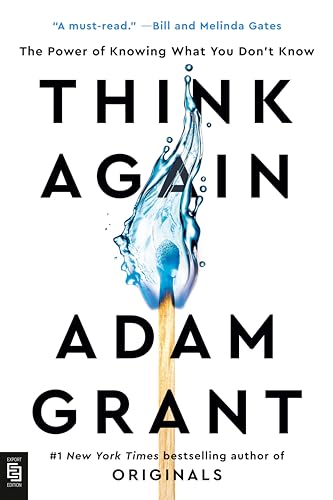
Inhaltsangabe
#1 New York Times Bestseller
“THIS. This is the right book for right now. Yes, learning requires focus. But, unlearning and relearning requires much more—it requires choosing courage over comfort. In Think Again, Adam Grant weaves together research and storytelling to help us build the intellectual and emotional muscle we need to stay curious enough about the world to actually change it. I’ve never felt so hopeful about what I don’t know.”
—Brené Brown, Ph.D., #1 New York Times bestselling author of Dare to Lead
The #1 New York Times bestselling author of Hidden Potential, Originals, and Give and Take examines the critical art of rethinking: learning to question your opinions and open other people's minds, which can position you for excellence at work and wisdom in life
Intelligence is usually seen as the ability to think and learn, but in a rapidly changing world, there's another set of cognitive skills that might matter more: the ability to rethink and unlearn. In our daily lives, too many of us favor the comfort of conviction over the discomfort of doubt. We listen to opinions that make us feel good, instead of ideas that make us think hard. We see disagreement as a threat to our egos, rather than an opportunity to learn. We surround ourselves with people who agree with our conclusions, when we should be gravitating toward those who challenge our thought process. The result is that our beliefs get brittle long before our bones. We think too much like preachers defending our sacred beliefs, prosecutors proving the other side wrong, and politicians campaigning for approval--and too little like scientists searching for truth. Intelligence is no cure, and it can even be a curse: being good at thinking can make us worse at rethinking. The brighter we are, the blinder to our own limitations we can become.
Organizational psychologist Adam Grant is an expert on opening other people's minds--and our own. As Wharton's top-rated professor and the bestselling author of Originals and Give and Take, he makes it one of his guiding principles to argue like he's right but listen like he's wrong. With bold ideas and rigorous evidence, he investigates how we can embrace the joy of being wrong, bring nuance to charged conversations, and build schools, workplaces, and communities of lifelong learners. You'll learn how an international debate champion wins arguments, a Black musician persuades white supremacists to abandon hate, a vaccine whisperer convinces concerned parents to immunize their children, and Adam has coaxed Yankees fans to root for the Red Sox. Think Again reveals that we don't have to believe everything we think or internalize everything we feel. It's an invitation to let go of views that are no longer serving us well and prize mental flexibility over foolish consistency. If knowledge is power, knowing what we don't know is wisdom.
Die Inhaltsangabe kann sich auf eine andere Ausgabe dieses Titels beziehen.
Über die Autorin bzw. den Autor
Adam Grant is an organizational psychologist at Wharton, where he has been the top-rated professor for seven straight years. He is one of TED's most popular speakers, his books have sold millions of copies, his talks have been viewed more than 25 million times, and his podcast WorkLife with Adam Grant has topped the charts. His pioneering research has inspired people to rethink fundamental assumptions about motivation, generosity, and creativity. He has been recognized as one of the world's ten most influential management thinkers and Fortune's 40 Under 40, and has received distinguished scientific achievement awards from the American Psychological Association and the National Science Foundation. Adam received his B.A. from Harvard and his Ph.D. from the University of Michigan, and he is a former Junior Olympic springboard diver. He lives in Philadelphia with his wife and their three children.
Von der hinteren Coverseite
"Think Again is a must-read for anyone who wants to create a culture of learning and exploration, whether at home, at work, or at school... In an increasingly divided world, the lessons in this book are more important than ever."
--Bill and Melinda Gates
The bestselling author of Give and Take and Originals examines the critical art of rethinking: learning to question your opinions and open other people's minds, which can position you for excellence at work and wisdom in life
Intelligence is usually seen as the ability to think and learn, but in a rapidly changing world, there's another set of cognitive skills that might matter more: the ability to rethink and unlearn. In our daily lives, too many of us favor the comfort of conviction over the discomfort of doubt. We listen to opinions that make us feel good, instead of ideas that make us think hard. We see disagreement as a threat to our egos, rather than an opportunity to learn. We surround ourselves with people who agree with our conclusions, when we should be gravitating toward those who challenge our thought process. The result is that our beliefs get brittle long before our bones. We think too much like preachers defending our sacred beliefs, prosecutors proving the other side wrong, and politicians campaigning for approval--and too little like scientists searching for truth. Intelligence is no cure, and it can even be a curse: being good at thinking can make us worse at rethinking. The brighter we are, the blinder to our own limitations we can become.
Organizational psychologist Adam Grant is an expert on opening other people's minds--and our own. As Wharton's top-rated professor and the bestselling author of Originals and Give and Take, he makes it one of his guiding principles to argue like he's right but listen like he's wrong. With bold ideas and rigorous evidence, he investigates how we can embrace the joy of being wrong, bring nuance to charged conversations, and build schools, workplaces, and communities of lifelong learners. You'll learn how an international debate champion wins arguments, a Black musician persuades white supremacists to abandon hate, a vaccine whisperer convinces concerned parents to immunize their children, and Adam has coaxed Yankees fans to root for the Red Sox. Think Again reveals that we don't have to believe everything we think or internalize everything we feel. It's an invitation to let go of views that are no longer serving us well and prize mental flexibility over foolish consistency. If knowledge is power, knowing what we don't know is wisdom.
Auszug. © Genehmigter Nachdruck. Alle Rechte vorbehalten.
Chapter 1
A Preacher, a Prosecutor, a Politician, and a Scientist Walk into Your Mind
Progress is impossible without change; and those who cannot change their minds cannot change anything.
-George Bernard Shaw
You probably don't recognize his name, but Mike Lazaridis has had a defining impact on your life. From an early age, it was clear that Mike was something of an electronics wizard. By the time he turned four, he was building his own record player out of Legos and rubber bands. In high school, when his teachers had broken TVs, they called Mike to fix them. In his spare time, he built a computer and designed a better buzzer for high school quiz-bowl teams, which ended up paying for his first year of college. Just months before finishing his electrical engineering degree, Mike did what so many great entrepreneurs of his era would do: he dropped out of college. It was time for this son of immigrants to make his mark on the world.
Mike's first success came when he patented a device for reading the bar codes on movie film, which was so useful in Hollywood that it won an Emmy and an Oscar for technical achievement. That was small potatoes compared to his next big invention, which made his firm the fastest-growing company on the planet. Mike's flagship device quickly attracted a cult following, with loyal customers ranging from Bill Gates to Christina Aguilera. "It's literally changed my life," Oprah Winfrey gushed. "I cannot live without this." When he arrived at the White House, President Obama refused to relinquish his to the Secret Service.
Mike Lazaridis dreamed up the idea for the BlackBerry as a wireless communication device for sending and receiving emails. As of the summer of 2009, it accounted for nearly half of the U.S. smartphone market. By 2014, its market share had plummeted to less than 1 percent.
When a company takes a nosedive like that, we can never pinpoint a single cause of its downfall, so we tend to anthropomorphize it: BlackBerry failed to adapt. Yet adapting to a changing environment isn't something a company does-it's something people do in the multitude of decisions they make every day. As the cofounder, president, and co-CEO, Mike was in charge of all the technical and product decisions on the BlackBerry. Although his thinking may have been the spark that ignited the smartphone revolution, his struggles with rethinking ended up sucking the oxygen out of his company and virtually extinguishing his invention. Where did he go wrong?
Most of us take pride in our knowledge and expertise, and in staying true to our beliefs and opinions. That makes sense in a stable world, where we get rewarded for having conviction in our ideas. The problem is that we live in a rapidly changing world, where we need to spend as much time rethinking as we do thinking.
Rethinking is a skill set, but it's also a mindset. We already have many of the mental tools we need. We just have to remember to get them out of the shed and remove the rust.
Second Thoughts
With advances in access to information and technology, knowledge isn't just increasing. It's increasing at an increasing rate. In 2011, you consumed about five times as much information per day as you would have just a quarter century earlier. As of 1950, it took about fifty years for knowledge in medicine to double. By 1980, medical knowledge was doubling every seven years, and by 2010, it was doubling in half that time. The accelerating pace of change means that we need to question our beliefs more readily than ever before.
This is not an easy task. As we sit with our beliefs, they tend to become more extreme and more entrenched. I'm still struggling to accept that Pluto may not be a planet. In education, after revelations in history and revolutions in science, it often takes years for a curriculum to be updated and textbooks to be revised. Researchers have recently discovered that we need to rethink widely accepted assumptions about such subjects as Cleopatra's roots (her father was Greek, not Egyptian, and her mother's identity is unknown); the appearance of dinosaurs (paleontologists now think some tyrannosaurs had colorful feathers on their backs); and what's required for sight (blind people have actually trained themselves to "see"-sound waves can activate the visual cortex and create representations in the mind's eye, much like how echolocation helps bats navigate in the dark). Vintage records, classic cars, and antique clocks might be valuable collectibles, but outdated facts are mental fossils that are best abandoned.
We're swift to recognize when other people need to think again. We question the judgment of experts whenever we seek out a second opinion on a medical diagnosis. Unfortunately, when it comes to our own knowledge and opinions, we often favor feeling right over being right. In everyday life, we make many diagnoses of our own, ranging from whom we hire to whom we marry. We need to develop the habit of forming our own second opinions.
Imagine you have a family friend who's a financial adviser, and he recommends investing in a retirement fund that isn't in your employer's plan. You have another friend who's fairly knowledgeable about investing, and he tells you that this fund is risky. What would you do?
When a man named Stephen Greenspan found himself in that situation, he decided to weigh his skeptical friend's warning against the data available. His sister had been investing in the fund for several years, and she was pleased with the results. A number of her friends had been, too; although the returns weren't extraordinary, they were consistently in the double digits. The financial adviser was enough of a believer that he had invested his own money in the fund. Armed with that information, Greenspan decided to go forward. He made a bold move, investing nearly a third of his retirement savings in the fund. Before long, he learned that his portfolio had grown by 25 percent.
Then he lost it all overnight when the fund collapsed. It was the Ponzi scheme managed by Bernie Madoff.
Two decades ago my colleague Phil Tetlock discovered something peculiar. As we think and talk, we often slip into the mindsets of three different professions: preachers, prosecutors, and politicians. In each of these modes, we take on a particular identity and use a distinct set of tools. We go into preacher mode when our sacred beliefs are in jeopardy: we deliver sermons to protect and promote our ideals. We enter prosecutor mode when we recognize flaws in other people's reasoning: we marshal arguments to prove them wrong and win our case. We shift into politician mode when we're seeking to win over an audience: we campaign and lobby for the approval of our constituents. The risk is that we become so wrapped up in preaching that we're right, prosecuting others who are wrong, and politicking for support that we don't bother to rethink our own views.
When Stephen Greenspan and his sister made the choice to invest with Bernie Madoff, it wasn't because they relied on just one of those mental tools. All three modes together contributed to their ill-fated decision. When his sister told him about the money she and her friends had made, she was preaching about the merits of the fund. Her confidence led Greenspan to prosecute the friend who warned him against investing, deeming the friend guilty of "knee-jerk cynicism." Greenspan was in politician mode when he let his desire for approval sway him toward a yes-the financial adviser was a family friend whom he liked and wanted to please.
Any of us could have fallen into those traps. Greenspan says that he should've known better, though, because he happens to be an expert on gullibility. When he decided to go ahead with the investment, he had almost finished writing a book on why...
„Über diesen Titel“ kann sich auf eine andere Ausgabe dieses Titels beziehen.
Suchergebnisse für Think Again: The Power of Knowing What You Don't...

Beispielbild für diese ISBN
Think Again
Anbieter: Better World Books, Mishawaka, IN, USA
Verkäuferbewertung 5 von 5 Sternen

Zustand: Good. Pages intact with minimal writing/highlighting. The binding may be loose and creased. Dust jackets/supplements are not included. Stock photo provided. Product includes identifying sticker. Better World Books: Buy Books. Do Good. Artikel-Nr. 46480826-6
Gebraucht kaufen
EUR 12,78
Versand gratis
Versand innerhalb von USA
Versand innerhalb von USA
Anzahl: 1 verfügbar
Beispielbild für diese ISBN
Think Again
Anbieter: Better World Books, Mishawaka, IN, USA
Verkäuferbewertung 5 von 5 Sternen
Zustand: Very Good. Former library copy. Pages intact with possible writing/highlighting. Binding strong with minor wear. Dust jackets/supplements may not be included. Includes library markings. Stock photo provided. Product includes identifying sticker. Better World Books: Buy Books. Do Good. Artikel-Nr. 51543783-6
Gebraucht kaufen
EUR 12,78
Versand gratis
Versand innerhalb von USA
Versand innerhalb von USA
Anzahl: 1 verfügbar
Beispielbild für diese ISBN
Think Again: the Power of Knowing What You Don't Know
Anbieter: WorldofBooks, Goring-By-Sea, WS, Vereinigtes Königreich
Verkäuferbewertung 5 von 5 Sternen
Paperback. Zustand: Very Good. The book has been read, but is in excellent condition. Pages are intact and not marred by notes or highlighting. The spine remains undamaged. Artikel-Nr. GOR011798977
Gebraucht kaufen
EUR 24,38
EUR 6,63 Versand
Versand von Vereinigtes Königreich nach USA
Versand von Vereinigtes Königreich nach USA
Anzahl: 1 verfügbar
Foto des Verkäufers
Think Again
Anbieter: Bookbot, Prague, Tschechien
Verkäuferbewertung 5 von 5 Sternen
Softcover. Zustand: Fine. Leichte Kratzer / Abnutzungen / Druckstellen; Leichte Verschmutzung / Farbtonveranderung. Intelligence is often viewed as the ability to think and learn, but in today's fast-paced world, the skills of rethinking and unlearning may be even more crucial. Many of us prefer the comfort of conviction over the discomfort of doubt, seeking out opinions that validate our beliefs rather than challenging them. This leads to brittle beliefs and a mindset akin to preachers or politicians, rather than scientists in search of truth. High intelligence can ironically make us blind to our own limitations, as we become more entrenched in our views. Organizational psychologist Adam Grant, a leading expert in opening minds, emphasizes the importance of arguing confidently while listening with humility. Through compelling examples, he demonstrates how to embrace the joy of being wrong, navigate difficult conversations, and foster environments that encourage lifelong learning. Stories of an international debate champion, a musician changing minds, and a vaccine advocate illustrate the power of persuasion and understanding. Ultimately, this work encourages us to let go of outdated beliefs and prioritize mental flexibility, reminding us that true wisdom lies in recognizing what we don't know. Artikel-Nr. 61ac8952-0040-4edd-8faf-99bf8a5be135
Gebraucht kaufen
EUR 26,28
EUR 18,99 Versand
Versand von Tschechien nach USA
Versand von Tschechien nach USA
Anzahl: 1 verfügbar
Beispielbild für diese ISBN
Think Again: the Power of Knowing What You Don't Know
Anbieter: AwesomeBooks, Wallingford, Vereinigtes Königreich
Verkäuferbewertung 5 von 5 Sternen
paperback. Zustand: Very Good. Think Again: the Power of Knowing What You Don't Know This book is in very good condition and will be shipped within 24 hours of ordering. The cover may have some limited signs of wear but the pages are clean, intact and the spine remains undamaged. This book has clearly been well maintained and looked after thus far. Money back guarantee if you are not satisfied. See all our books here, order more than 1 book and get discounted shipping. . Artikel-Nr. 7719-9780593298749
Gebraucht kaufen
EUR 42,92
EUR 4,88 Versand
Versand von Vereinigtes Königreich nach USA
Versand von Vereinigtes Königreich nach USA
Anzahl: 1 verfügbar
Foto des Verkäufers
Think Again: The Power of Knowing What You Don't Know : The Power of Knowing What You Don't Know
Verlag:
Penguin Publishing Group, 2021
ISBN 10: 0593298748
ISBN 13: 9780593298749
Gebraucht
paperback
Anbieter: AHA-BUCH GmbH, Einbeck, Deutschland
Verkäuferbewertung 5 von 5 Sternen
paperback. Zustand: Sehr gut. Gebraucht - Sehr gut SG - leichte Beschädigungen oder Verschmutzungen, ungelesenes Mängelexemplar, gestempelt - #1 New York Times Bestseller THIS. This is the right book for right now. Yes, learning requires focus. But, unlearning and relearning requires much more it requires choosing courage over comfort. In Think Again, Adam Grantweaves together research and storytelling to help us build the intellectual and emotional muscle we need to stay curious enough about the world to actually change it.I ve never felt so hopeful about what I don t know. Brené Brown, Ph.D., #1 New York Times bestselling author of Dare to LeadThe #1 New York Times bestselling author of Hidden Potential, Originals, and Give and Take examines the critical art of rethinking: learning to question your opinions and open other people's minds, which can position you for excellence at work and wisdom in lifeIntelligence is usually seen as the ability to think and learn, but in a rapidly changing world, there's another set of cognitive skills that might matter more: the ability to rethink and unlearn. In our daily lives, too many of us favor the comfort of conviction over the discomfort of doubt. We listen to opinions that make us feel good, instead of ideas that make us think hard. We see disagreement as a threat to our egos, rather than an opportunity to learn. We surround ourselves with people who agree with our conclusions, when we should be gravitating toward those who challenge our thought process. The result is that our beliefs get brittle long before our bones. We think too much like preachers defending our sacred beliefs, prosecutors proving the other side wrong, and politicians campaigning for approval--and too little like scientists searching for truth. Intelligence is no cure, and it can even be a curse: being good at thinking can make us worse at rethinking. The brighter we are, the blinder to our own limitations we can become.Organizational psychologist Adam Grant is an expert on opening other people's minds--and our own. As Wharton's top-rated professor and the bestselling author of Originals and Give and Take, he makes it one of his guiding principles to argue like he's right but listen like he's wrong. With bold ideas and rigorous evidence, he investigates how we can embrace the joy of being wrong, bring nuance to charged conversations, and build schools, workplaces, and communities of lifelong learners. You'll learn how an international debate champion wins arguments, a Black musician persuades white supremacists to abandon hate, a vaccine whisperer convinces concerned parents to immunize their children, and Adam has coaxed Yankees fans to root for the Red Sox. Think Again reveals that we don't have to believe everything we think or internalize everything we feel. It's an invitation to let go of views that are no longer serving us well and prize mental flexibility over foolish consistency. If knowledge is power, knowing what we don't know is wisdom. Artikel-Nr. INF1000711557
Gebraucht kaufen
EUR 16,07
EUR 35,00 Versand
Versand von Deutschland nach USA
Versand von Deutschland nach USA
Anzahl: 2 verfügbar
Beispielbild für diese ISBN
Think Again: the Power of Knowing What You Don't Know
Anbieter: Bahamut Media, Reading, Vereinigtes Königreich
Verkäuferbewertung 4 von 5 Sternen

paperback. Zustand: Very Good. Shipped within 24 hours from our UK warehouse. Clean, undamaged book with no damage to pages and minimal wear to the cover. Spine still tight, in very good condition. Remember if you are not happy, you are covered by our 100% money back guarantee. Artikel-Nr. 6545-9780593298749
Gebraucht kaufen
EUR 42,92
EUR 8,26 Versand
Versand von Vereinigtes Königreich nach USA
Versand von Vereinigtes Königreich nach USA
Anzahl: 1 verfügbar
Beispielbild für diese ISBN
Think Again: The Power of Knowing What You Don't Know
Verlag:
Penguin Publishing Group 02.2021., 2021
ISBN 10: 0593298748
ISBN 13: 9780593298749
Gebraucht
paperback
Anbieter: ABC Versand e.K., Aarbergen, Deutschland
Verkäuferbewertung 5 von 5 Sternen
paperback. Zustand: Gut. Auflage: INT. 320 Seiten Guter Zustand mit Gebrauchsspuren V62 Sprache: Englisch Gewicht in Gramm: 450. Artikel-Nr. 540200
Gebraucht kaufen
EUR 11,65
EUR 43,15 Versand
Versand von Deutschland nach USA
Versand von Deutschland nach USA
Anzahl: 1 verfügbar
Foto des Verkäufers
Think Again: The Power of Knowing What You Don't Know
Verlag:
Penguin Publishing Group, 2021
ISBN 10: 0593298748
ISBN 13: 9780593298749
Gebraucht
Softcover
Anbieter: Berliner Büchertisch eG, Berlin, Deutschland
Verkäuferbewertung 5 von 5 Sternen
Softcover. Zustand: Befriedigend. INT. 320 S. !! Buch hat durchgehenden Wasserschaden!! Akzeptables Exemplar, deutliche Gebrauchsspuren, Cover/SU berieben/bestoßen, Papier/Schnitt nachgedunkelt, ist aber noch gut zu gebrauchen. B260911ah36 ISBN: 9780593298749 Sprache: Englisch Gewicht in Gramm: 390. Artikel-Nr. 770238
Gebraucht kaufen
EUR 6,00
EUR 100,00 Versand
Versand von Deutschland nach USA
Versand von Deutschland nach USA
Anzahl: 1 verfügbar