
Verwandte Artikel zu There Are Places in the World Where Rules Are Less...
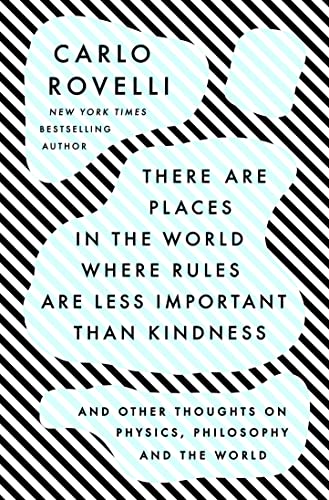
There Are Places in the World Where Rules Are Less Important Than Kindness: And Other Thoughts on Physics, Philosophy, and the World - Hardcover
Inhaltsangabe
A delightful intellectual feast from the bestselling author of Seven Brief Lessons on Physics and The Order of Time
One of the world’s most prominent physicists and fearless free spirit, Carlo Rovelli is also a masterful storyteller. His bestselling books have introduced millions of readers to the wonders of modern physics and his singular perspective on the cosmos. This new collection of essays reveals a curious intellect always on the move. Rovelli invites us on an accessible and enlightening voyage through science, literature, philosophy and politics.
Written with his usual clarity and wit, this journey ranges widely across time and space: from Newton's alchemy to Einstein's mistakes, from Nabokov’s epidopterology to Dante’s cosmology, from mind-altering psychedelic substances to the meaning of atheism, from the future of physics to the power of uncertainty. Charming, pithy and elegant, this book is the perfect gateway to the universe of one of the most influential minds of our age.
Die Inhaltsangabe kann sich auf eine andere Ausgabe dieses Titels beziehen.
Über die Autorin bzw. den Autor
Carlo Rovelli is a theoretical physicist who has made significant contributions to the physics of space and time. He has worked in Italy and the United States, and is currently directing the Quantum Gravity research group of the Centre de Physique Théorique in Marseille, France. His books Seven Brief Lessons on Physics, Reality Is Not What It Seems, and The Order of Time are international bestsellers that have been translated into over forty languages.
Auszug. © Genehmigter Nachdruck. Alle Rechte vorbehalten.
Aristotle the Scientist
October 19, 2015
Do objects of different weight fall at the same speed? At school we are told that, by letting balls drop from the Tower of Pisa, Galileo Galilei had demonstrated that the correct answer is yes. For the preceding two millennia, on the other hand, everyone had been blinded to the fact by the dogma of Aristotle, according to which the heavier the object, the faster it falls. Curiously, according to this story, it seems never to have occurred to anyone to test whether this was actually true before Francis Bacon and his contemporaries began observing nature and freed themselves from the straitjacket of Aristotelian dogmatism.
It's a good story, but there's a problem with it. Try dropping a glass marble and a paper cup from a balcony. Contrary to what this beautiful story says, it is not at all true that they hit the ground at the same time: the heavier marble falls much faster, just as Aristotle says.
No doubt at this point someone will object that this happens because of air, the medium through which the things fall. True, but Aristotle did not write that things would fall at different speeds if we took out all the air. He wrote that things fall at different speeds in our world, where there is air. He was not wrong. He observed nature attentively. Better than generations of teachers and students who are prone to take things on trust, without testing them for themselves.
Aristotle's physics has had a lot of bad press. It has come to be thought of as built upon a priori assumptions, disengaged from observation, patently wrongheaded. This is substantially unjust. Aristotle's physics remained a reference point for Mediterranean civilization for so long not because it was dogmatic, but because it actually works. It provides a good description of reality, and a conceptual framework so effective that no one was able to better it for two thousand years.
The essence of the theory is the idea that, in the absence of other influences, every object moves toward its "natural place": lower down for earth, a little higher for water, higher again for air, and higher still for fire; the speed of "natural movement" increases with weight and decreases according to the density of the medium in which the object is immersed. It's a simple, comprehensive theory that provides an elegant account of a great variety of phenomena—why smoke rises, for instance, and why a piece of wood drops down in air but floats upward in water. As a theory it is obviously not perfect, but then we should remember that nothing in modern science is perfect either.
The bad reputation that has become attached to Aristotle's physics is partly the fault of Galileo, who in his writings launches a scathing all-out attack upon Aristotelian theory, portraying its adherents as fools. He did so for rhetorical reasons. But the bad reputation of Aristotle's physics is also due to the silly gulf that has opened up between scientific culture and humanist-philosophical discourse. Those who study Aristotle generally know little about physics, and those who are engaged in physics have little interest in Aristotle. The scientific brilliance of books by Aristotle such as his On the Heavens and Physics—the work from which the very discipline derives its name—is all too readily overlooked.
There is also another, more significant factor that explains our blindness to his scientific brilliance: the idea that it is impossible to compare the thought produced by cultural universes so distant from each other as those of Aristotle and of modern physics, and that therefore we should not even try. Many historians today express horror at the idea of seeing Aristotelian physics as an approximation of Newtonian physics. To understand the original Aristotle, they argue, we must study him in the light of his context, and not through the conceptual frameworks of subsequent centuries. This may be true if we want to improve our understanding of Aristotle, but if we are interested in understanding today's knowledge, how it emerged from the past, it is precisely the relations between distant worlds that counts.
Philosophers and historians of science such as Karl Popper and Thomas Kuhn, who have had a strong influence on contemporary thought, have emphasized the importance of points of rupture in the course of the development of knowledge. Examples of such "scientific revolutions," where an old theory is abandoned, include the move from Aristotle to Newton, and from Newton to Einstein. According to Kuhn, in the course of such passages a radical restructuring of thought takes place, to such a degree that the preceding ideas become irrelevant, incomprehensible even. They are "incommensurable" with the subsequent theory, according to Kuhn. Popper and Kuhn deserve credit for having focused on this evolutive aspect of science and the importance of breaks, but their influence has also led to an absurd devaluation of the cumulative aspects of knowledge. Worse still is the failure to recognize the logical and historical relations between theories prior to and after every significant step forward. Newton's physics is perfectly recognizable as an approximation of Einstein's general relativity; Aristotle's theory is perfectly recognizable as an approximation contained within the theory of Newton.
This is not all, for within Newton's theory it is possible to recognize features of Aristotelian physics. For instance, the great idea of distinguishing the "natural" motion of a body from that which has been "forced" remains intact in Newtonian physics, as it does later in Einstein's theory. What changes is the role of gravity: it is the cause of forced motion in Newton (where natural motion is uniformly rectilinear), while it is an aspect of natural motion in Aristotle as well as, curiously, in Einstein (where natural motion, termed "geodesic," returns to being that of an object in free fall, as in Aristotle). Scientists do not advance either as a result of mere accumulation of knowledge or by means of absolute revolutions in which everything is thrown out and we begin again from zero. They advance instead, as in a wonderful analogy first made by Otto Neurath and frequently cited by Quine, "like sailors who must rebuild their ship on the open sea, never able to start afresh from the bottom. Where a beam is taken away a new one must at once be put there, and for this the rest of the ship is used as support. In this way the ship can be shaped entirely anew, but only by gradual reconstruction." In the great ship of modern physics we can still recognize its ancient structures—such as the distinction between natural and forced motion—as first laid out in the old ship of Aristotelian thought.
Let's go back to bodies falling through air or water and see what actually happens. The fall is neither at a constant speed and dependent on weight, as Aristotle maintained, nor at constant acceleration and independent of weight, as Galileo argued (not even if we ignore friction!). When an object falls, it goes through an initial stage during which it accelerates, then stabilizes at a constant speed which is greater for heavier bodies. This second stage is well described by Aristotle. The first stage, on the other hand, is usually very brief, difficult to observe, and as a result of this had escaped his notice. The existence of this initial stage had already been noted in antiquity: in the third century bce, for example, Strato of Lampsacus observed that a falling stream of water breaks into drops, indicating that the drops accelerate on falling, just like a line of traffic that breaks up as the vehicles accelerate.
To study this initial phase, which is difficult to observe...
„Über diesen Titel“ kann sich auf eine andere Ausgabe dieses Titels beziehen.
Suchergebnisse für There Are Places in the World Where Rules Are Less...

Beispielbild für diese ISBN
There Are Places in the World
Anbieter: World of Books (was SecondSale), Montgomery, IL, USA
Verkäuferbewertung 5 von 5 Sternen

Zustand: Very Good. Item in very good condition! Textbooks may not include supplemental items i.e. CDs, access codes etc. Artikel-Nr. 00109432014
Gebraucht kaufen
EUR 4,05
Versand gratis
Versand innerhalb von USA
Versand innerhalb von USA
Anzahl: 1 verfügbar
Beispielbild für diese ISBN
There Are Places in the World
Anbieter: World of Books (was SecondSale), Montgomery, IL, USA
Verkäuferbewertung 5 von 5 Sternen
Zustand: Good. Item in good condition. Textbooks may not include supplemental items i.e. CDs, access codes etc. Artikel-Nr. 00106981601
Gebraucht kaufen
EUR 4,05
Versand gratis
Versand innerhalb von USA
Versand innerhalb von USA
Anzahl: 3 verfügbar
Beispielbild für diese ISBN
There Are Places in the World
Anbieter: World of Books (was SecondSale), Montgomery, IL, USA
Verkäuferbewertung 5 von 5 Sternen
Zustand: Good. Good condition ex-library book with usual library markings and stickers. Artikel-Nr. 00109613626
Gebraucht kaufen
EUR 4,05
Versand gratis
Versand innerhalb von USA
Versand innerhalb von USA
Anzahl: 1 verfügbar
Beispielbild für diese ISBN
There Are Places in the World Where Rules Are Less Important Than Kindness: And Other Thoughts on Physics, Philosophy and the World
Anbieter: ThriftBooks-Atlanta, AUSTELL, GA, USA
Verkäuferbewertung 5 von 5 Sternen
Hardcover. Zustand: Very Good. No Jacket. Former library book; May have limited writing in cover pages. Pages are unmarked. ~ ThriftBooks: Read More, Spend Less. Artikel-Nr. G059319215XI4N10
Gebraucht kaufen
EUR 5,98
Versand gratis
Versand innerhalb von USA
Versand innerhalb von USA
Anzahl: 1 verfügbar
Beispielbild für diese ISBN
There Are Places in the World Where Rules Are Less Important Than Kindness: And Other Thoughts on Physics, Philosophy and the World
Anbieter: ThriftBooks-Dallas, Dallas, TX, USA
Verkäuferbewertung 5 von 5 Sternen
Hardcover. Zustand: Very Good. No Jacket. Missing dust jacket; May have limited writing in cover pages. Pages are unmarked. ~ ThriftBooks: Read More, Spend Less. Artikel-Nr. G059319215XI4N01
Gebraucht kaufen
EUR 5,98
Versand gratis
Versand innerhalb von USA
Versand innerhalb von USA
Anzahl: 1 verfügbar
Beispielbild für diese ISBN
There Are Places in the World Where Rules Are Less Important Than Kindness: And Other Thoughts on Physics, Philosophy and the World
Anbieter: ThriftBooks-Atlanta, AUSTELL, GA, USA
Verkäuferbewertung 5 von 5 Sternen
Hardcover. Zustand: Good. No Jacket. Former library book; Pages can have notes/highlighting. Spine may show signs of wear. ~ ThriftBooks: Read More, Spend Less. Artikel-Nr. G059319215XI3N10
Gebraucht kaufen
EUR 5,98
Versand gratis
Versand innerhalb von USA
Versand innerhalb von USA
Anzahl: 1 verfügbar
Beispielbild für diese ISBN
There Are Places in the World Where Rules Are Less Important Than Kindness: And Other Thoughts on Physics, Philosophy and the World
Anbieter: ThriftBooks-Phoenix, Phoenix, AZ, USA
Verkäuferbewertung 5 von 5 Sternen
Hardcover. Zustand: Very Good. No Jacket. Former library book; May have limited writing in cover pages. Pages are unmarked. ~ ThriftBooks: Read More, Spend Less. Artikel-Nr. G059319215XI4N10
Gebraucht kaufen
EUR 5,98
Versand gratis
Versand innerhalb von USA
Versand innerhalb von USA
Anzahl: 1 verfügbar
Beispielbild für diese ISBN
There Are Places in the World Where Rules Are Less Important Than Kindness: And Other Thoughts on Physics, Philosophy and the World
Anbieter: ThriftBooks-Dallas, Dallas, TX, USA
Verkäuferbewertung 5 von 5 Sternen
Hardcover. Zustand: Very Good. No Jacket. Former library book; May have limited writing in cover pages. Pages are unmarked. ~ ThriftBooks: Read More, Spend Less. Artikel-Nr. G059319215XI4N10
Gebraucht kaufen
EUR 5,98
Versand gratis
Versand innerhalb von USA
Versand innerhalb von USA
Anzahl: 2 verfügbar
Beispielbild für diese ISBN
There Are Places in the World Where Rules Are Less Important Than Kindness: And Other Thoughts on Physics, Philosophy and the World
Anbieter: ThriftBooks-Dallas, Dallas, TX, USA
Verkäuferbewertung 5 von 5 Sternen
Hardcover. Zustand: Good. No Jacket. Former library book; Pages can have notes/highlighting. Spine may show signs of wear. ~ ThriftBooks: Read More, Spend Less. Artikel-Nr. G059319215XI3N10
Gebraucht kaufen
EUR 5,98
Versand gratis
Versand innerhalb von USA
Versand innerhalb von USA
Anzahl: 1 verfügbar
Beispielbild für diese ISBN
There Are Places in the World Where Rules Are Less Important Than Kindness: And Other Thoughts on Physics, Philosophy and the World
Anbieter: ThriftBooks-Reno, Reno, NV, USA
Verkäuferbewertung 5 von 5 Sternen
Hardcover. Zustand: Very Good. No Jacket. Former library book; May have limited writing in cover pages. Pages are unmarked. ~ ThriftBooks: Read More, Spend Less. Artikel-Nr. G059319215XI4N10
Gebraucht kaufen
EUR 5,98
Versand gratis
Versand innerhalb von USA
Versand innerhalb von USA
Anzahl: 1 verfügbar