
Verwandte Artikel zu Stonewall: The Definitive Story of the LGBTQ Rights...
Inhaltsangabe
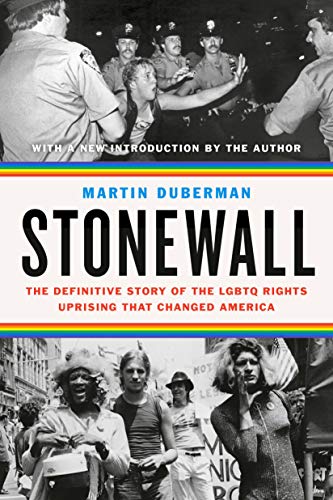
The definitive account of the Stonewall Riots, the first gay rights march, and the LGBTQ activists at the center of the movement.
“Martin Duberman is a national treasure.”—Masha Gessen, The New Yorker
On June 28, 1969, the Stonewall Inn, a gay bar in New York's Greenwich Village, was raided by police. But instead of responding with the typical compliance the NYPD expected, patrons and a growing crowd decided to fight back. The five days of rioting that ensued changed forever the face of gay and lesbian life.
In Stonewall, renowned historian and activist Martin Duberman tells the full story of this pivotal moment in history. With riveting narrative skill, he re-creates those revolutionary, sweltering nights in vivid detail through the lives of six people who were drawn into the struggle for LGBTQ rights. Their stories combine to form an unforgettable portrait of the repression that led up to the riots, which culminates when they triumphantly participate in the first gay rights march of 1970, the roots of today's pride marches.
Fifty years after the riots, Stonewall remains a rare work that evokes with a human touch an event in history that still profoundly affects life today.
Die Inhaltsangabe kann sich auf eine andere Ausgabe dieses Titels beziehen.
Über die Autorin bzw. den Autor
Martin Duberman is Distinguished Professor of History Emeritus at City University of New York, where he founded and directed the Center for Lesbian and Gay Studies. He is the author of more than twenty-five biographies, memoirs, essays, plays, and novels. He is a recipient of the Bancroft Prize, multiple Lambda Literary Awards, and the Lifetime Achievement Award from the American Historical Association, and he has been a finalist for the Pulitzer Prize and the National Book Award. In 2012 Duberman received an honorary Doctor of Humane Letters from Amherst College and in 2017 an honorary Doctor of Letters from Columbia University.
Auszug. © Genehmigter Nachdruck. Alle Rechte vorbehalten.
CRAIG
Marion Rodwell had been reluctantly boarding out her young son, Craig, during the week. Divorced and working in Chicago as a low-paid secretary, Marion hadn't known what else to do; she couldn't afford to stay home and she didn't have enough money to hire a competent babysitter. For several years, Craig lived during the week-Marion reclaiming him on weekends-with Mrs. Ryberg, a kindly woman who took in a number of neighborhood children. As soon as he was old enough, Mrs. Ryberg gave him chores to do, including the job of kneading yellow coloring into the margarine to make it look more like butter (this was wartime, with butter unavailable). Craig liked Mrs. Ryberg so much that he hadn't minded the work, though it was strenuous and he was little more than a toddler.
But when Craig was five, Marion decided he should be in a more stimulating environment, and she turned to an inexpensive day-care center on Chicago's North Side. But it quickly became apparent that the low rates reflected the minimal individual attention given. Marion felt at her wit's end when a Mrs. Merkle, who sometimes worked at the day-care center and had taken a shine to Craig, told her that she would board the boy full-time if Marion would pay her a small sum each week. Marion agreed, hoping Mrs. Merkle would be able to give Craig the daily affection and attention he needed.
Attention he got, but very little affection. Mrs. Merkle also took in laundry to piece out an income, and she put Craig to work running sheets and towels through a mangle, watching hawk-eyed to make sure the five-year-old didn't slack off. Craig worked in constant terror of getting his fingers caught in the mangle, and he soon grew to hate Mrs. Merkle. But she found the arrangement profitable and began to play with the idea of adopting Craig as her own son (or indentured servant). Word of Mrs. Merkle's intention reached Marion and threw her into a panic. Mrs. Merkle had a husband, and Marion feared the courts might equate that with "having a stable home." Desperate, she confided in her boss. A devout Christian Scientist, he had connections with the church-affiliated Chicago Junior School for "problem" boys, and before long he had arranged for Craig to be admitted there free of charge.
Craig never forgot that fall day in 1947 when his mother drove him out to Chicago Junior. At age six, he didn't entirely understand what was happening to him, but his fright was palpable. The school was located some fifty miles outside of Chicago, set deep in the country between the towns of Dundee and Elgin. A complex of old, marginally maintained buildings, Chicago Junior was surrounded by woods and sealed off by a chain-link fence. Before leaving Craig off, Marion did her best to comfort him, assuring her son that with some forty other boys as playmates, he would be happy at the school. She promised that she would unfailingly come to see him on the third Sunday of every month, the only day visitors were allowed on the grounds.
But Craig had not been reassured. During his first month at the school, he cried himself to sleep every night. And every morning at breakfast, he threw up the unfamiliar hot cereal. A housemother cured him of the crying by sternly lecturing him about how unhappy his mother would be should she learn of his "bad" behavior. Another housemother cured him of the vomiting by picking him up by the neck from the breakfast table, marching him into the bathroom and forcing him to stand over the toilet and eat the vomit.
The housemothers came in two basic varieties: the stern ones who mechanically kept to the rules (and kept the boys at arms' length), and the warm surrogate mothers. Mrs. Wilkins, the music teacher, who doubled as a substitute housemother, quickly became Craig's favorite. The students lived in three dormitories, twelve to fifteen boys in each, and a housemother slept in a small room adjoining each dorm. Whenever Mrs. Wilkins was in charge, she let the boys do pretty much as they liked-make noise, and stay up past their bedtime-and usually refrained from checking up on them in the middle of the night.
She would also read them stories. Craig had two favorites. One was about a pair of boys who wanted to be brothers so badly, they pricked each other's fingers and formed a "blood bond." The other was "The Happy Prince." As Craig retells that story, it took place in a poor middle-European city that had a richly jeweled statue of Prince Somebody or Other in its main square. One day, a pigeon sitting on the Prince's shoulder noticed that a tear had formed in his eye. When the bird asked the Prince why he was unhappy, the Prince explained that the people in the city were starving because of poor crops, and he urged the pigeon to take the emerald embedded in his eye and sell it to buy the people food.
On and on the story went: The Prince would cry, would encourage the pigeon to sell the diamonds on his sword handle, the rubies on his breastplate-and so on-to provide coal for the people's stoves, warm clothing to put on their backs-and so on. At the story's close, all the jewels are gone, but the Prince is happy in the knowledge that the people no longer suffer. Craig adored the story and contended in later years that it had taught him important lessons about the need to share worldly goods with those less fortunate. (He also learned in later years that the story was written by Oscar Wilde.)
There were only two men on staff at the Chicago Junior School. One was Mr. Lazarus, who had himself been a student there and who in summer months would take some of the boys out for a midnight swim in the ancient concrete pool on the grounds and then astonish them by diving underwater, pulling off his bathing suit, and letting his ass shine naked in the moonlight. No one, so far as Craig knew, was ever invited to touch it.
The only other man at the school was its superintendent, the hated Mr. Kilburn. He enjoyed pitting the boys against each other in competition for his favor and each night would award the most "deserving" student the supreme honor of carrying a huge dinner tray to him and his wife in their apartment on the top of the classroom building; the bearer's reward was a Baby Ruth candy bar. Craig never once got to carry the tray. For after getting over his initial fright and settling into the school's routines, he had quickly become something of a rebel-the boy who challenged authority and "sassed" back.
That would alone have earned Kilburn's dislike. What intensified it was his conviction that Craig was a sissy. Two hours of sports were mandated at Chicago Junior for every student every day of the year. Craig, as the tallest boy in his group, was good at basketball, but inept in baseball-scandalously so, in Kilburn's view. Deciding he would teach Craig how to throw the baseball "like a real boy," Kilburn made him trudge a mile to the baseball field after dinner each night to get the appropriate coaching.
What convinced Kilburn that Craig's prospects in life were dim was his discovery that Craig had been sending away for autographed pictures of movie stars, had managed to collect several dozen, and-scandalously, again-had been sharing them with the other boys. Kilburn promptly confiscated the collection and thereafter opened all of Craig's incoming mail to make sure it contained no offending material. To underscore the horrendous nature of Craig's crime, Kilburn meted out his favorite punishment: Craig was given "one hundred burdock"-that is, assigned to dig up a hundred of the burdock plants that dotted the grounds; the burdock had long, deep roots, and to kill it one had to laboriously dig out every last piece.
This was but one of several Dickensian features of the school. Corporal punishment, including paddling, was commonplace; one teacher's favorite method was to beat offending students with an electric cord....
„Über diesen Titel“ kann sich auf eine andere Ausgabe dieses Titels beziehen.
Suchergebnisse für Stonewall: The Definitive Story of the LGBTQ Rights...

Beispielbild für diese ISBN
Stonewall
Anbieter: World of Books (was SecondSale), Montgomery, IL, USA
Verkäuferbewertung 5 von 5 Sternen

Paperback. Zustand: Good. The definitive account of the Stonewall Riots, the first gay rights march, and the LGBTQ activists at the center of the movement. "Martin Duberman is a national treasure."-Masha Gessen,The New Yorker On June 28, 1969, the Stonewall Inn, a gay bar in New York's Greenwich Village, was raided by police. But instead of responding with the typical compliance the NYPD expected, patrons and a growing crowd decided to fight back. The five days of rioting that ensued changed forever the face of gay and lesbian life. In Stonewall, renowned historian and activist Martin Duberman tells the full story of this pivotal moment in history. With riveting narrative skill, he re-creates those revolutionary, sweltering nights in vivid detail through the lives of six people who were drawn into the struggle for LGBTQ rights. Their stories combine to form an unforgettable portrait of the repression that led up to the riots, which culminates when they triumphantly participate in the first gay rights march of 1970, the roots of today's pride marches. Fifty years after the riots, Stonewall remains a rare work that evokes with a human touch an event in history that still profoundly affects life today. Artikel-Nr. 00109765135
Gebraucht kaufen
EUR 8,90
Versand gratis
Versand innerhalb von USA
Versand innerhalb von USA
Anzahl: 2 verfügbar
Beispielbild für diese ISBN
Stonewall: The Definitive Story of the LGBTQ Rights Uprising that Changed America
Anbieter: WorldofBooks, Goring-By-Sea, WS, Vereinigtes Königreich
Verkäuferbewertung 5 von 5 Sternen
Paperback. Zustand: Very Good. The book has been read, but is in excellent condition. Pages are intact and not marred by notes or highlighting. The spine remains undamaged. Artikel-Nr. GOR010273242
Gebraucht kaufen
EUR 13,01
EUR 6,59 Versand
Versand von Vereinigtes Königreich nach USA
Versand von Vereinigtes Königreich nach USA
Anzahl: 1 verfügbar
Beispielbild für diese ISBN
Stonewall: The Definitive Story of the LGBTQ Rights Uprising that Changed America
Verlag:
Penguin Publishing Group, 2019
ISBN 10: 0593083989
ISBN 13: 9780593083987
Gebraucht
paperback
Anbieter: Sell Books, Elland, YORKS, Vereinigtes Königreich
Verkäuferbewertung 5 von 5 Sternen
paperback. Zustand: Acceptable. Please see the condition note after this for details, if this is missing please consider Acceptable to mean poor quality that could include major staining, water damage, writing, missing dustjacket, etc etc. Our books are dispatched from a Yorkshire former cotton mill. We list via barcode/ISBN so please note that the images are stock images and may not be the exact copy you receive, furthermore the details about edition and year might not be accurate as many publishers reuse the same ISBN for multiple editions and as we simply scan a barcode or enter an ISBN we do not check the validity of the edition data when listing. If you're looking for an exact edition please don't order (at least not without checking with us first, although we don't always have time to check). We aim to dispatch prompty, the service used will depend on order value and book size. We can ship to most countries, see our shipping policies. Payment is via Abe only. Artikel-Nr. mon0000144476
Gebraucht kaufen
EUR 9,18
EUR 14,30 Versand
Versand von Vereinigtes Königreich nach USA
Versand von Vereinigtes Königreich nach USA
Anzahl: 1 verfügbar
Beispielbild für diese ISBN
Stonewall
Anbieter: PBShop.store UK, Fairford, GLOS, Vereinigtes Königreich
Verkäuferbewertung 5 von 5 Sternen
PAP. Zustand: New. New Book. Shipped from UK. Established seller since 2000. Artikel-Nr. EB-9780593083987
Neu kaufen
EUR 19,02
EUR 4,89 Versand
Versand von Vereinigtes Königreich nach USA
Versand von Vereinigtes Königreich nach USA
Anzahl: 6 verfügbar
Beispielbild für diese ISBN
Stonewall: The Definitive Story of the Lgbtq Rights Uprising That Changed America
Anbieter: Revaluation Books, Exeter, Vereinigtes Königreich
Verkäuferbewertung 5 von 5 Sternen
Paperback. Zustand: Brand New. reprint edition. 384 pages. 8.25x5.50x0.78 inches. In Stock. Artikel-Nr. __0593083989
Neu kaufen
EUR 16,44
EUR 11,77 Versand
Versand von Vereinigtes Königreich nach USA
Versand von Vereinigtes Königreich nach USA
Anzahl: 2 verfügbar
Beispielbild für diese ISBN
Stonewall: The Definitive Story of the LGBTQ Rights Uprising that Changed America
Anbieter: Majestic Books, Hounslow, Vereinigtes Königreich
Verkäuferbewertung 4 von 5 Sternen

Zustand: New. pp. 432. Artikel-Nr. 370942917
Neu kaufen
EUR 21,55
EUR 7,65 Versand
Versand von Vereinigtes Königreich nach USA
Versand von Vereinigtes Königreich nach USA
Anzahl: 1 verfügbar
Beispielbild für diese ISBN
Stonewall: The Definitive Story of the LGBTQ Rights Uprising that Changed America
Anbieter: Ria Christie Collections, Uxbridge, Vereinigtes Königreich
Verkäuferbewertung 5 von 5 Sternen
Zustand: New. In English. Artikel-Nr. ria9780593083987_new
Neu kaufen
EUR 23,19
EUR 11,03 Versand
Versand von Vereinigtes Königreich nach USA
Versand von Vereinigtes Königreich nach USA
Anzahl: 20 verfügbar
Beispielbild für diese ISBN
Stonewall: The Definitive Story of the Lgbtq Rights Uprising That Changed America
Anbieter: Revaluation Books, Exeter, Vereinigtes Königreich
Verkäuferbewertung 5 von 5 Sternen
Paperback. Zustand: Brand New. reprint edition. 384 pages. 8.25x5.50x0.78 inches. In Stock. Artikel-Nr. xr0593083989
Neu kaufen
EUR 22,80
EUR 11,77 Versand
Versand von Vereinigtes Königreich nach USA
Versand von Vereinigtes Königreich nach USA
Anzahl: 2 verfügbar
Beispielbild für diese ISBN
Stonewall: The Definitive Story of the Lgbtq Rights Uprising That Changed America
Anbieter: Revaluation Books, Exeter, Vereinigtes Königreich
Verkäuferbewertung 5 von 5 Sternen
Paperback. Zustand: Brand New. reprint edition. 384 pages. 8.25x5.50x0.78 inches. In Stock. Artikel-Nr. xi0593083989
Neu kaufen
EUR 22,80
EUR 11,77 Versand
Versand von Vereinigtes Königreich nach USA
Versand von Vereinigtes Königreich nach USA
Anzahl: 2 verfügbar
Beispielbild für diese ISBN
Stonewall
Anbieter: Kennys Bookstore, Olney, MD, USA
Verkäuferbewertung 5 von 5 Sternen
Zustand: New. 2019. Paperback. . . . . . Books ship from the US and Ireland. Artikel-Nr. V9780593083987
Neu kaufen
EUR 26,12
EUR 9,33 Versand
Versand innerhalb von USA
Versand innerhalb von USA
Anzahl: 1 verfügbar