
Verwandte Artikel zu The Divider: Trump in the White House, 2017-2021
Inhaltsangabe
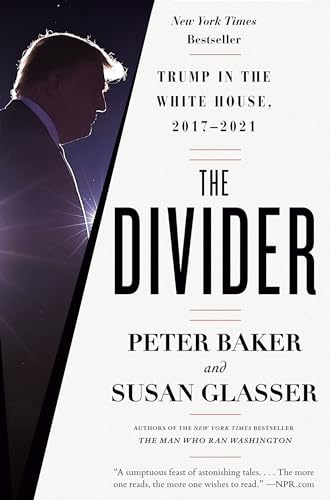
NEW YORK TIMES BESTSELLER • "The most comprehensive and detailed account of the Trump presidency yet published."—The Washington Post • A Best Book of the Year: The New Yorker and Financial Times • "The book everyone is talking about."—Politico
The inside story of the four years when Donald Trump went to war with Washington, from the chaotic beginning to the violent finale, told by revered journalists Peter Baker of The New York Times and Susan Glasser of The New Yorker—an ambitious and lasting history of the full Trump presidency that also contains dozens of exclusive scoops and stories from behind the scenes in the White House, from the absurd to the deadly serious.
"A sumptuous feast of astonishing tales...The more one reads, the more one wishes to read."—NPR.com • "A beautifully written, utterly dispiriting history of the man who attacked democracy." —The Guardian
The bestselling authors of The Man Who Ran Washington argue that Trump was not just lurching from one controversy to another; he was learning to be more like the foreign autocrats he admired.
The Divider brings us into the Oval Office for countless scenes both tense and comical, revealing how close we got to nuclear war with North Korea, which cabinet members had a resignation pact, whether Trump asked Japan’s prime minister to nominate him for a Nobel Prize and much more. The book also explores the moral choices confronting those around Trump—how they justified working for a man they considered unfit for office, and where they drew their lines.
The Divider is based on unprecedented access to key players, from President Trump himself to cabinet officers, military generals, close advisers, Trump family members, congressional leaders, foreign officials and others, some of whom have never told their story until now.
Die Inhaltsangabe kann sich auf eine andere Ausgabe dieses Titels beziehen.
Über die Autorin bzw. den Autor
PETER BAKER is the chief White House correspondent for The New York Times, a political analyst for MSNBC, and the author of Days of Fire and The Breach. SUSAN GLASSER is a staff writer for The New Yorker and author of its weekly "Letter from Trump's Washington," as well as a CNN global affairs analyst. Their first assignment as a married couple was as Moscow bureau chiefs for The Washington Post, after which they wrote Kremlin Rising. They also coauthored The Man Who Ran Washington, a New York Times bestseller. They live in Washington, D.C., with their son.
Auszug. © Genehmigter Nachdruck. Alle Rechte vorbehalten.
CHAPTER 1
Ready, Set, Tweet
On the afternoon of January 20, 2017, just hours after taking the oath of office, Donald John Trump strode into the Oval Office for the first time as the forty-fifth president of the United States. In that profound moment of transition, he was not moved to comment about the history of the room or the burden he had just assumed. He did not ruminate out loud about the weighty decisions that had been made there nor his ambitions for the next four years.
Instead, the first thing that struck him as he looked around the storied space once occupied by Roosevelt and Kennedy and Reagan was the fantastic illumination.
“How do they get the lighting to do that?” he wondered.
Then he invited his daughter Ivanka Trump and his son-in-law, Jared Kushner, to take pictures with him.
Trump, America’s first reality television star turned president, had long fixated on lighting. Wherever he expected to be photographed, he evaluated the angles and shadows and brightness of the sun or artificial bulbs that would frame the shot. As he entered the White House, he did not know much about government or health care policy or foreign affairs. But he knew a lot about lighting.
Trump preferred not to allow artificial illumination when cameras were on him. The harsh light changed the ever-shifting color of his hair and highlighted the caked-on makeup that gave his skin an orange tint. He hated artificial lighting so much that news photographers were reproached for using a flash in his presence. Trump’s preference for natural lighting would soon lead him to hold many of his encounters with reporters outside on the White House’s South Lawn on the way to his helicopter. Never mind that the roar of the rotor blades made it hard to hear what he was saying—it was the visual that counted. He studied iPad images of himself before television interviews to check the best angle, preferring to be shot from his right side so the part in his hair did not show. And if he did not like a picture on the front page of the newspaper, he sometimes called the photographer to complain. “That made me look horrible,” he would grouse.
All presidents are image conscious. But Trump was something different, the first president for whom the shaping of reality to fit his demands became the preoccupation of his presidency. He would spend exhaustive amounts of time each morning combing and twisting the long strands of his awkwardly colored hair into place, a three-step process that “required a flop up of the hair from the back of his head, followed by the flip of the resulting overhang on his face back on his pate, and then the flap of his combover on the right side,” as his lawyer Michael Cohen once explained. Trump cemented it with TRESemmé TRES TWO hair spray (extra hold). An aide carried a travel-size can everywhere they went. When the wind was strong, Trump wore one of the red Make America Great Again baseball caps that had become a signature of his improbable candidacy. When his hair was not done, it fell over the right side of his head below the shoulder, making him look “like a balding Allman Brother or strung out old ’60s hippie,” as Cohen put it. Trump cut it himself with giant scissors, like the kind used at shopping mall ribbon cuttings.
Trump was also sensitive about his weight. He did not like being photographed from below, fearing that would make him look heavier than the 236 pounds he claimed to weigh. Hope Hicks, his communications adviser, had issued an edict during the campaign barring news cameras from the buffer zone in front of the stage beneath Trump; only after vociferous complaints did she finally allow photographers there for just a few minutes. For that matter, Trump did not like being shot from above either. The angle had to be on the same plane as he was, because he felt it looked better on television.
Whatever the circumstances, he almost always appeared in public in a dark suit with a tie knotted all the way to the top and hanging below his belt in a way that he thought was slimming—not for him the casual bomber jacket and blue jeans that George W. Bush and Barack Obama donned for photo ops. Even in Florida, in hundred-degree heat, Trump kept the suit on, usually an off-the-rack Brioni costing several thousand dollars and worn extra-baggy so that the pants flopped around his legs. The only time he did not wear the suit jacket typically was on the golf course, but even then he tried to stymie photographers from recording that image, ordering palm trees planted to block the view on his Florida golf course after television networks managed to shoot too many pictures of him there. Perhaps even more important than the suit was what aides called “the stare.” Trump did not smile often for the cameras; he preferred an intense, slightly menacing glare, which he thought made him look more imposing. “How’s the look?” he would ask aides.
It was all part of maintaining his own cartoonish mythology. In Trump’s telling, the new occupant of the Oval Office was an American superman—physically strong, mentally gifted, healthy as a horse, rich as sin, and a magnet for beautiful women. He worked around the clock and barely slept. He was not fat, his hair was natural, his skin color perfectly normal, his hands were not small and neither was any other part of his anatomy. The fact that he had an uncle who had taught at the Massachusetts Institute of Technology meant that he too must be brilliant. “It’s in my blood,” Trump once said. “I’m smart.” The fact that he went to an Ivy League university attested to his erudition. “I’m very highly educated,” he assured supporters. “I know words. I have the best words.” During the campaign, he secretly ordered up a much lampooned letter that he got his personal doctor to issue under his own name declaring that Trump’s “physical strength and stamina are extraordinary” and predicting he “will be the healthiest individual ever elected to the presidency.”
No one was to admit anything to the contrary. In the West Wing, it became clear that aides should never acknowledge any human frailties on the part of the president even to each other, much less to the American public.
“He looks exhausted,” a worried Madeleine Westerhout, Trump’s executive assistant, told Hope Hicks one day.
Hicks promptly corrected her. “Donald Trump is never tired,” she said, “and he is never sick.”
From his first day in office, the new president wanted to project himself as the hero America had been waiting for, a strong man for troubled times. Even those working for him were not entirely sure what to make of it. Were these merely the weird quirks of a vain septuagenarian? Or the menacing affectations of an aspiring dictator?
After his upset victory, many in Washington simply refused to believe that Trump could be as self-absorbed, ignorant, untruthful, and dangerous as he had made himself out to be in the 2016 campaign. An American president who admired Vladimir Putin and declared NATO “obsolete”? A businessman who would flout the rules that applied to the rest of the federal government and take payments from foreign governments and lobbyists while in the White House? It was unthinkable, and therefore easier somehow to deny that it was actually happening. He was an accidental president but, it was assumed, he would learn. And if he did not, well, this was what checks and balances were for. Congress would push back; the courts would push back; the media would push back.
A few days after the inauguration, Trump sat down for the first time with his national security team in...
„Über diesen Titel“ kann sich auf eine andere Ausgabe dieses Titels beziehen.
Weitere beliebte Ausgaben desselben Titels

Suchergebnisse für The Divider: Trump in the White House, 2017-2021

Beispielbild für diese ISBN
The Divider Trump in the White
Anbieter: World of Books (was SecondSale), Montgomery, IL, USA
Verkäuferbewertung 5 von 5 Sternen

Zustand: Good. Item in good condition. Textbooks may not include supplemental items i.e. CDs, access codes etc. Artikel-Nr. 00105196759
Gebraucht kaufen
EUR 5,83
Versand gratis
Versand innerhalb von USA
Versand innerhalb von USA
Anzahl: 2 verfügbar
Beispielbild für diese ISBN
The Divider: Trump in the White House, 2017-2021
Anbieter: ThriftBooks-Atlanta, AUSTELL, GA, USA
Verkäuferbewertung 5 von 5 Sternen
Paperback. Zustand: Fair. No Jacket. Readable copy. Pages may have considerable notes/highlighting. ~ ThriftBooks: Read More, Spend Less. Artikel-Nr. G0593082966I5N00
Gebraucht kaufen
EUR 5,84
Versand gratis
Versand innerhalb von USA
Versand innerhalb von USA
Anzahl: 1 verfügbar
Beispielbild für diese ISBN
The Divider: Trump in the White House, 2017-2021
Anbieter: ThriftBooks-Dallas, Dallas, TX, USA
Verkäuferbewertung 5 von 5 Sternen
Paperback. Zustand: Good. No Jacket. Pages can have notes/highlighting. Spine may show signs of wear. ~ ThriftBooks: Read More, Spend Less. Artikel-Nr. G0593082966I3N00
Gebraucht kaufen
EUR 5,84
Versand gratis
Versand innerhalb von USA
Versand innerhalb von USA
Anzahl: 1 verfügbar
Beispielbild für diese ISBN
The Divider : Trump in the White House, 2017-2021
Verlag:
Knopf Doubleday Publishing Group, 2023
ISBN 10: 0593082966
ISBN 13: 9780593082966
Gebraucht
Softcover
Anbieter: Better World Books, Mishawaka, IN, USA
Verkäuferbewertung 5 von 5 Sternen
Zustand: Good. Pages intact with minimal writing/highlighting. The binding may be loose and creased. Dust jackets/supplements are not included. Stock photo provided. Product includes identifying sticker. Better World Books: Buy Books. Do Good. Artikel-Nr. 51533747-6
Gebraucht kaufen
EUR 8,50
Versand gratis
Versand innerhalb von USA
Versand innerhalb von USA
Anzahl: 1 verfügbar
Beispielbild für diese ISBN
The Divider : Trump in the White House, 2017-2021
Verlag:
Knopf Doubleday Publishing Group, 2023
ISBN 10: 0593082966
ISBN 13: 9780593082966
Gebraucht
Softcover
Anbieter: Better World Books: West, Reno, NV, USA
Verkäuferbewertung 5 von 5 Sternen
Zustand: Very Good. Pages intact with possible writing/highlighting. Binding strong with minor wear. Dust jackets/supplements may not be included. Stock photo provided. Product includes identifying sticker. Better World Books: Buy Books. Do Good. Artikel-Nr. 52656247-6
Gebraucht kaufen
EUR 8,50
Versand gratis
Versand innerhalb von USA
Versand innerhalb von USA
Anzahl: 2 verfügbar
Foto des Verkäufers
The Divider: Trump in the White House, 2017-2021
Verlag:
Knopf Doubleday Publishing Group, 2023
ISBN 10: 0593082966
ISBN 13: 9780593082966
Gebraucht
Softcover
Anbieter: WeBuyBooks, Rossendale, LANCS, Vereinigtes Königreich
Verkäuferbewertung 5 von 5 Sternen
Zustand: Very Good. Most items will be dispatched the same or the next working day. A copy that has been read, but is in excellent condition. Pages are intact and not marred by notes or highlighting. The spine remains undamaged. Artikel-Nr. rev3753528120
Gebraucht kaufen
EUR 12,81
EUR 9,59 Versand
Versand von Vereinigtes Königreich nach USA
Versand von Vereinigtes Königreich nach USA
Anzahl: 1 verfügbar
Beispielbild für diese ISBN
The Divider: Trump in the White House, 2017-2021
Anbieter: Ria Christie Collections, Uxbridge, Vereinigtes Königreich
Verkäuferbewertung 5 von 5 Sternen
Zustand: New. In. Artikel-Nr. ria9780593082966_new
Neu kaufen
EUR 23,51
EUR 14,01 Versand
Versand von Vereinigtes Königreich nach USA
Versand von Vereinigtes Königreich nach USA
Anzahl: 7 verfügbar
Beispielbild für diese ISBN
The Divider: Trump in the White House, 2017-2021
Anbieter: Revaluation Books, Exeter, Vereinigtes Königreich
Verkäuferbewertung 5 von 5 Sternen
Paperback. Zustand: Brand New. 768 pages. 9.00x6.00x1.25 inches. In Stock. Artikel-Nr. __0593082966
Neu kaufen
EUR 24,41
EUR 17,55 Versand
Versand von Vereinigtes Königreich nach USA
Versand von Vereinigtes Königreich nach USA
Anzahl: 2 verfügbar
Beispielbild für diese ISBN
Divider
Anbieter: Kennys Bookstore, Olney, MD, USA
Verkäuferbewertung 5 von 5 Sternen
Zustand: New. 2023. paperback. . . . . . Books ship from the US and Ireland. Artikel-Nr. V9780593082966
Neu kaufen
EUR 32,97
EUR 9,06 Versand
Versand innerhalb von USA
Versand innerhalb von USA
Anzahl: 7 verfügbar
Foto des Verkäufers
The Divider
Verlag:
Knopf Doubleday Publishing Group, 2023
ISBN 10: 0593082966
ISBN 13: 9780593082966
Neu
Softcover
Anbieter: moluna, Greven, Deutschland
Verkäuferbewertung 5 von 5 Sternen
Zustand: New. PETER BAKER is the chief White House correspondent for The New York Times, a political analyst for MSNBC, and the author of Days of Fire and The Breach. SUSAN GLASSER is a staff writer for The New Yorker and author of its weekly . Artikel-Nr. 898334299
Neu kaufen
EUR 26,89
EUR 48,99 Versand
Versand von Deutschland nach USA
Versand von Deutschland nach USA
Anzahl: 5 verfügbar