
Verwandte Artikel zu The Song of Names (Movie Tie-In Edition)
Inhaltsangabe
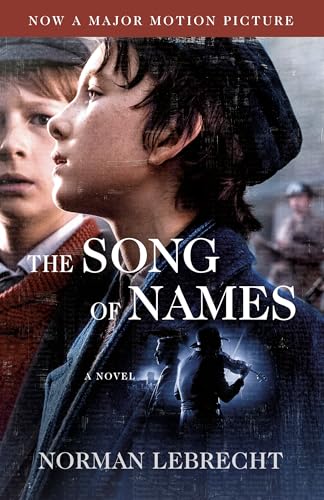
Now a major motion picture
Martin Simmonds&; father tells him, &;Never trust a musician when he speaks about love.&; The advice comes too late. Martin already loves Dovidl Rapoport, an eerily gifted Polish violin prodigy whose parents left him in the Simmonds&;s care before they perished in the Holocaust. For a time the two boys are closer than brothers. But on the day he is to make his official debut, Dovidl disappears. Only 40 years later does Martin get his first clue about what happened to him.
In this ravishing novel of music and suspense, Norman Lebrecht unravels the strands of love, envy and exploitation that knot geniuses to their admirers. In doing so he also evokes the fragile bubble of Jewish life in prewar London; the fearful carnival of the Blitz, and the gray new world that emerged from its ashes. Bristling with ideas, lambent with feeling, The Song of Names is a masterful work of the imagination.
Die Inhaltsangabe kann sich auf eine andere Ausgabe dieses Titels beziehen.
Über die Autorin bzw. den Autor
Norman Lebrecht is one of the most widely-read modern commentators on music, culture, and politics. His Wednesday column in the (London) Evening Standard and on the internet has been described as &;required reading&;. His BBC Radio 3 show, &;Lebrecht Live&;, attracts web-listeners from Buenos Aires to Budapest. His many books include The Maestro Myth, When the Music Stops, Mahler Remembered, and Covent Garden: The Untold Story. The Song of Names is his first novel.
Auszug. © Genehmigter Nachdruck. Alle Rechte vorbehalten.
1
Time Out
Swimming in a double-breasted suit against the Monday morning incoming tide, I feel a double misfit. The whole working world is flooding into town while I am heading out, and for no good reason. What is more, I am just about the only man on the forecourt in a respectable suit. Times have changed, and chinos are worn to work.
Or whatever they call work. Sitting at a flickering screen, hunting and gathering data, strikes me as a poor substitute for the thrill of the chase, the joy of the kill, the kiss of conquest. There is no romance, no mortal struggle, in digitised so-called work. It is a virtual pursuit, without real vice or virtue. Mine, on the other hand, is a people profession, hence almost obsolescent.
It would not do to enquire too closely into the purpose of my trip. 'Is your journey really necessary?' nagged the railway hoardings during the war. No, not enough to convince the auditors, who will slash my expenses claim on seeing the negligible returns. Nor to satisfy Myrtle, who will raise a quizzical eyebrow and register a connubial debt. There is no pot of gold at the end of my trail nor, truth be told, enough profit to interest a Sunday boot-saler--which is not, of course, what I tell the accountants ('must keep in touch with consumer trends'), or Myrtle ('meeting a familiar face can make all the difference when money's tight'). What matters is that I know why I am going, and I don't have to make excuses to myself. Escape, or the illusion of it, is what keeps me alive and my business more or less solvent.
Survival instinct propels me through the Euston crowds towards a reserved first-class seat on the nine-oh-three Intercity Express, my chest pounding with unaccustomed effort and an absurd anticipation of adventure. Absurd, because previous expeditions have attested beyond reasonable doubt that any prospect of adventure will get scotched at source by my innate reserve and speckless propriety--attributes that are bound to be mentioned in my none-too-distant obsequies, alongside the Dear Departed's musical expertise, mordant wit and discreet philanthropy.
Adventure is, in any case, antithetical to my nature and inadvisable in my state of health. Furred arteries and a fear of bypass surgery have imposed severe restraints. I am limited to six lengths of the health-club pool and half a mile on the electronic treadmill; excitement is strenuously avoided; conjugality is conducted rarely and with the circumspection of porcupines. 'Take care of yourself,' are Myrtle's parting words and, for her sake, I do try. In the absence of marital ardour, it's the least I can do.
Yet, even a rackety, unbypassed old heart can be stirred by departure fantasy. As I board the train, my pulse picks up ten points in fake anticipation. I look ahead breathlessly, with a reassuring sense of déjà vu. It's like watching televised football highlights on a Saturday night when you've already heard the classified results on the radio. The programme may reveal some fine points of form and skill, but any tension has been ruled out by an incontrovertible foreknowledge of the outcome.
Watching stale soccer from the snug of a prized deco armchair is the limit of my permitted thrills--a sad comedown for one who was groomed to make things happen. Sad to have slipped from motivator to spectator, from the wings of great stages to a piece of high-winged furniture. Still, there are compensations. By staying out of the thick of things, I have acquired an aura of what, in small-business circles, passes for timeless wisdom.
Lifelong prudence has reaped its rewards. My town house has a heated indoor pool, I holiday winter and summer in wickedly overpriced Swiss resorts and my pension arrangements are structured to keep me in comfort for three lifetimes. 'Comfort ye, comfort ye, my people,' said the prophet Isaiah--so we made it the tribal aspiration. What greater calm can a man find on earth than the quiet rustling of gilt-edged assets?
At Rotary and Bnai Brith you cannot tell me apart from the rest of the Lodge, and that is how I like it; none of the other brothers has, to my certain knowledge, been invaded by genius and ruined by its defection. Forget I mentioned that: not many people are meant to know about it. 'Mustn't grumble,' my father used to say, when asked how he was; and so do I. Normality is my nirvana. Only within, deep within, at the clotted edge of irreparable loss, do I feel the need for an unnecessary journey that will allow me to avoid devastating self-contemplation and the acceleration of inherited arteriosclerosis.
I wouldn't be surprised if the railways were mostly run for people like me, half-wrecked psyches in perpetual flight from the missing part. I can just see a Development Director springing his brainwave initiative at a board meeting. 'Why don't we run extra Monday-morning services to the boondocks?' he proposes brightly. 'There must be thousands of useless deadweights, dog-ends and waiting-for-godders who are just dying to get away.'
Settling in my window seat I pop two pills, a brand-name sedative and a homoeopathic palliative, shutting my eyes for ten minutes of yogic meditation. My Harley Street consultant (the cardiologist, not the naturopath) advises daily exercise and the avoidance of agitation. Being of a responsible disposition, I eat warily and carry a kidney-donor card. If I see a pretty girl or a police chase, I look away. In Michelin-starred restaurants, I order steamed fish. I have many friends but no recent lovers, vague interests but no driving passions.
Myrtle, my partner in life, has a life largely of her own. A large-boned lady of healthy appetites, she lunches sparingly in good causes and plays bridge for her metropolitan borough. She took it up in her thirties, after having children, discerning in the pastime an outlet for her formidable memory and jugular instincts. Myrtle can remember the seating plan at every chicken-schnitzel wedding we have attended, the Order of Service at Her Majesty's Coronation, the universal symbols of the periodic table and the entire line-up of the Hungarian football team that inflicted England's first home defeat, 3-6, in the aforementioned Coronation Year, which was also the year of our marriage. Many's the time I have urged her to apply her remarkable mental powers to a worthier object than a pack of cards. But Myrtle's tolerance for ladies who lunch on behalf of the starving and homeless is limited.
Our two sons have grown up and apart from us, triumphs of private schooling and canny marriages. One is a Kensington obstetrician with a trophy wife, the other a libel lawyer with a traditional spouse. Over dinner, I prefer the barrister's scurrilous gossip to the manicured sanctimony of a society abortionist. But I feel no satisfying patrimony when, on Friday nights, we play a charade of happy families around a table groaning with murderously poly-saturated fats. Monastically picking at my wife's heedlessly prepared dietary dynamite, I retire dyspeptically to bed with a glass of camomile tea and the Spectator,a lifelong habit, while coffee is taken in the lounge. My apologies are accepted with a wince of scepticism. Some in the family, I suspect, ascribe my medical condition to chronic hypochondria.
A decent Omm-trance is pretty much unattainable on a train that starts and lurches through a thicket of signals, then spurts past outer suburbs like a runaway horse. Once the speed settles to a steady rocking, incomprehensible announcements splutter forth about the whereabouts of the refreshment car and would the chief steward please make his way to first class, thank you.
Giving up the quest for inner peace and undistracted by the silvered February landscape, my...
„Über diesen Titel“ kann sich auf eine andere Ausgabe dieses Titels beziehen.
Suchergebnisse für The Song of Names (Movie Tie-In Edition)

Beispielbild für diese ISBN
The Song of Names (Movie Tie-in Edition)
Verlag:
Knopf Doubleday Publishing Group, 2019
ISBN 10: 0593082486
ISBN 13: 9780593082485
Gebraucht
Softcover
Anbieter: Better World Books, Mishawaka, IN, USA
Verkäuferbewertung 5 von 5 Sternen

Zustand: Good. Former library copy. Pages intact with minimal writing/highlighting. The binding may be loose and creased. Dust jackets/supplements are not included. Includes library markings. Stock photo provided. Product includes identifying sticker. Better World Books: Buy Books. Do Good. Artikel-Nr. 45721561-6
Gebraucht kaufen
EUR 6,56
Versand gratis
Versand innerhalb von USA
Versand innerhalb von USA
Anzahl: 1 verfügbar
Beispielbild für diese ISBN
The Song of Names (Movie Tie-in Edition)
Verlag:
Knopf Doubleday Publishing Group, 2019
ISBN 10: 0593082486
ISBN 13: 9780593082485
Gebraucht
Softcover
Anbieter: Better World Books, Mishawaka, IN, USA
Verkäuferbewertung 5 von 5 Sternen
Zustand: Good. Pages intact with minimal writing/highlighting. The binding may be loose and creased. Dust jackets/supplements are not included. Stock photo provided. Product includes identifying sticker. Better World Books: Buy Books. Do Good. Artikel-Nr. 38794635-6
Gebraucht kaufen
EUR 6,56
Versand gratis
Versand innerhalb von USA
Versand innerhalb von USA
Anzahl: 1 verfügbar
Beispielbild für diese ISBN
The Song of Names (Movie Tie-In Edition)
Anbieter: ThriftBooks-Atlanta, AUSTELL, GA, USA
Verkäuferbewertung 5 von 5 Sternen
Paperback. Zustand: Very Good. No Jacket. May have limited writing in cover pages. Pages are unmarked. ~ ThriftBooks: Read More, Spend Less. Artikel-Nr. G0593082486I4N00
Gebraucht kaufen
EUR 8,01
Versand gratis
Versand innerhalb von USA
Versand innerhalb von USA
Anzahl: 1 verfügbar
Beispielbild für diese ISBN
The Song of Names (Movie Tie-In Edition)
Anbieter: ThriftBooks-Dallas, Dallas, TX, USA
Verkäuferbewertung 5 von 5 Sternen
Paperback. Zustand: Very Good. No Jacket. Former library book; May have limited writing in cover pages. Pages are unmarked. ~ ThriftBooks: Read More, Spend Less. Artikel-Nr. G0593082486I4N10
Gebraucht kaufen
EUR 8,01
Versand gratis
Versand innerhalb von USA
Versand innerhalb von USA
Anzahl: 1 verfügbar
Beispielbild für diese ISBN
The Song of Names
Anbieter: WorldofBooks, Goring-By-Sea, WS, Vereinigtes Königreich
Verkäuferbewertung 5 von 5 Sternen
Paperback. Zustand: Very Good. The book has been read, but is in excellent condition. Pages are intact and not marred by notes or highlighting. The spine remains undamaged. Artikel-Nr. GOR011950462
Gebraucht kaufen
EUR 8,70
EUR 6,65 Versand
Versand von Vereinigtes Königreich nach USA
Versand von Vereinigtes Königreich nach USA
Anzahl: 1 verfügbar
Foto des Verkäufers
The Song of Names
Anbieter: WeBuyBooks, Rossendale, LANCS, Vereinigtes Königreich
Verkäuferbewertung 5 von 5 Sternen
paperback. Zustand: Like New. Most items will be dispatched the same or the next working day. An apparently unread copy in perfect condition. Dust cover is intact with no nicks or tears. Spine has no signs of creasing. Pages are clean and not marred by notes or folds of any kind. Artikel-Nr. rev8893328923
Gebraucht kaufen
EUR 11,00
EUR 6,09 Versand
Versand von Vereinigtes Königreich nach USA
Versand von Vereinigtes Königreich nach USA
Anzahl: 1 verfügbar