
Verwandte Artikel zu Probable Impossibilities: Musings on Beginnings and...
Inhaltsangabe
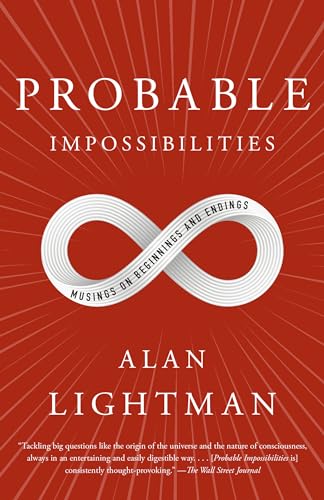
The acclaimed author of Einstein’s Dreams tackles "big questions like the origin of the universe and the nature of consciousness ... in an entertaining and easily digestible way” (Wall Street Journal) with a collection of meditative essays on the possibilities—and impossibilities—of nothingness and infinity, and how our place in the cosmos falls somewhere in between.
Can space be divided into smaller and smaller units, ad infinitum? Does space extend to larger and larger regions, on and on to infinity? Is consciousness reducible to the material brain and its neurons? What was the origin of life, and can biologists create life from scratch in the lab?
Physicist and novelist Alan Lightman, whom The Washington Post has called “the poet laureate of science writers,” explores these questions and more—from the anatomy of a smile to the capriciousness of memory to the specialness of life in the universe to what came before the Big Bang.
Probable Impossibilities is a deeply engaged consideration of what we know of the universe, of life and the mind, and of things vastly larger and smaller than ourselves.
Die Inhaltsangabe kann sich auf eine andere Ausgabe dieses Titels beziehen.
Über die Autorin bzw. den Autor
ALAN LIGHTMAN is the author of seven novels, including the international best seller Einstein’s Dreams and The Diagnosis, a finalist for the National Book Award. He has taught at Harvard and at MIT, where he was the first person to receive a dual faculty appointment in science and the humanities. He is the host of the public television series Searching: Our Quest for Meaning in the Age of Science. He is a professor of the practice of the humanities at MIT.
Von der hinteren Coverseite
Can space be divided into smaller and smaller units, ad infinitum? Does space extend to larger and larger regions, on and on to infinity? Is consciousness reducible to the material brain and its neurons? What was the origin of life, and can biologists create life from scratch in the lab?
Physicist and novelist Alan Lightman, whom The Washington Post has called "the poet laureate of science writers," explores these questions and more--from the anatomy of a smile to the capriciousness of memory to the specialness of life in the universe to what came before the Big Bang.
Probable Impossibilities is a deeply engaged consideration of what we know of the universe, of life and the mind, and of things vastly larger and smaller than ourselves.
Auszug. © Genehmigter Nachdruck. Alle Rechte vorbehalten.
Probable Impossibilities
I will tell you a thing that is both impossible and true. You were born from a tiny seed within your mother. And she was born from a tiny seed within her mother. And she from her mother. And so on, back and back through the dim hallways of time until we arrive at a particular cave in Africa, a hundred thousand years in the past, with a particular woman sitting by a fire. That woman knew nothing of cities or automobiles or electricity. But if we could follow her daughters through time, we would eventually arrive at you. If each of those daughters of daughters had pressed an inky thumb on a large piece of parchment, one following the other, there would today be several thousand thumbprints on that parchment, leading from that ancestral woman a hundred thousand years ago to your thumbprint today.
If this story does not seem impossible, or at least incomprehensible, let’s go further back in time. According to modern analysis of the DNA of fossil animals, your ancestral mother descended from more primitive creatures, and those from more primitive, until we reach single-celled organisms squirming and gyrating in a primeval sea. And those first living organisms emerged from the billions of random collisions of lifeless molecules, by chance forming things that could spawn more of themselves and tap energy from the roiling sea. And before that, the ancient air of Earth—methane and ammonia and water vapor and nitrogen—blew over the seething volcanoes. And before, the gases swirled and condensed from a cloud in the primeval solar system.
I will tell one final story. Every atom in your body except for hydrogen and helium was made in stars long ago and blown into space when those stars exploded—much later to be tossed into the air and soil and oceans of Earth and eventually incorporated into your body. How do we know? Evidence supports the Big Bang theory, which holds that our universe began in a state of extremely high density and temperature and has been expanding and cooling since. In the first moments after t = 0, the universe was far too hot for atoms to hold together. During the first three minutes, the universe cooled enough for the simplest atomic nuclei, hydrogen and helium, to form, but was thinning out too rapidly to make carbon and oxygen and nitrogen and all the other atoms our bodies are made of. According to nuclear physicists, the formation of those atoms occurred hundreds of millions of years later, when gravity was able to pull together large masses of gas to form stars. The temperatures and densities at the centers of those masses again began to mount, starting nuclear reactions, which fused the existing hydrogen and helium atoms into the other atoms in our bodies. Some of those stars exploded, seeding space with the newly forged atoms. With our telescopes, we have seen exploding stars and analyzed the chemical composition of their debris. We have confirmed the theory. If you could tag all the atoms in your body and follow them backward in time, every atom, except for hydrogen and helium, would return to a star. We are as certain of this story as we are that the continents were once joined.
Less certain but supported by compelling calculations are the infinities, the infinity of the small and the infinity of the large. The unending world of ever smaller things within the atom, and the unending world of ever larger things, beyond our telescopes. Between these two endpoints of the imagination are we human beings, fragile and brief, clutching our thin slice of reality.
Between Nothingness and Infinity
In a lifetime, most people travel no farther than five hundred miles from home. During that limited exploration of the physical world, we record memories of nearby objects and experiences—people, houses, trees, local lakes and rivers, sounds of birds, clouds—all funneled into our brains by our eyes and ears. And yet think what we are able to imagine. Take, for example, Homer’s epic tale of the voyage of Ulysses. At one point, Ulysses and his men are captured by the Cyclops, a thirty-foot-tall man with a single eye in the middle of his forehead, who immediately eats two of the crew and imprisons the rest in his cave for future meals. On the seas again after his escape, Ulysses ties himself to the ship’s mast so that he can resist the call of the Sirens, creatures with the bodies of birds and the heads of women, whose beautiful song lures men to their doom on the reefs. Or consider Salvador Dalí’s famous painting The Persistence of Memory, in which rubbery clocks droop over tree branches and tables like pizzas melting in the Sun. Horses with wings, rivers of gold, wooden puppets that come to life. In our minds, we have the power to combine things that we’ve seen in our paltry experience to create spectacular apparitions never before encountered, and even things that do not exist.
Imagination in the arts is familiar. Imagination in science not so familiar, yet breathtaking in its daring and frequent validation. Following the logical trail of his equations, James Clerk Maxwell imagined waves of electromagnetic energy traveling through space—X-rays and radio waves invisible to the eye. Einstein imagined that clocks moving past each other would tick at different rates, although such a preposterous phenomenon had never been observed. (To measure the effect, highly sensitive instruments are required, or relative speeds approaching the speed of light.)
The ancient Greeks hypothesized invisible atoms, minuscule things too small to see, indestructible, indivisible, the presumed building blocks of the material world—another leap of the imagination. Two thousand years later, a Frenchman named Blaise Pascal (1623–1662) imagined much further. Mathematician, physicist, inventor, essayist, and theologian, Pascal conjectured the existence of things infinitely small and infinitely large. From his Pensées:
The whole visible world is only an imperceptible atom in the ample bosom of nature . . . We may enlarge our conceptions beyond all imaginable space; we only produce atoms in comparison to the reality of things. It is an infinite sphere, the center of which is everywhere, the circumference nowhere . . . What is man in the infinite? But to show him another prodigy equally astonishing, let him examine the most delicate things that he knows. Let a mite be given him, with its minute body parts and parts incomparably more minute. Dividing these last things again, let him exhaust his powers of conception and let the last object at which he can arrive be now that of our discourse. Perhaps he will think that here is the smallest point of nature. I will let him see therein a new abyss . . . For who will not be astounded at the fact that our body, which a little while ago was imperceptible in the universe . . . is now a colossus, a world, or rather a whole in respect of the nothingness which we cannot reach? He who regards himself in this light will be afraid of himself, and observing himself sustained in the body given him by nature between these two abysses of the Infinite and Nothing will tremble at the sight of these marvels . . . [Man] is equally incapable of seeing the Nothing from which he was made, and the Infinite in which he is swallowed up.
At the time that Pascal wrote this remarkable passage, the first crude microscopes had only recently been invented, and the greatest distance measured was that to the Sun. In particular, the size of the crystalline “heavenly sphere,” on which hung the stars, was completely unknown. Working in a cold and dimly lit house on the outskirts of Paris, at a time when...
„Über diesen Titel“ kann sich auf eine andere Ausgabe dieses Titels beziehen.
Suchergebnisse für Probable Impossibilities: Musings on Beginnings and...

Beispielbild für diese ISBN
Probable Impossibilities: Musings on Beginnings and Endings
Anbieter: World of Books (was SecondSale), Montgomery, IL, USA
Verkäuferbewertung 5 von 5 Sternen

Paperback. Zustand: Fair. The acclaimed author of Einstein's Dreams tackles "big questions like the origin of the universe and the nature of consciousness . in an entertaining and easily digestible way" (Wall Street Journal) with a collection of meditative essays on the possibilities--and impossibilities--of nothingness and infinity, and how our place in the cosmos falls somewhere in between. Can space be divided into smaller and smaller units, ad infinitum? Does space extend to larger and larger regions, on and on to infinity? Is consciousness reducible to the material brain and its neurons? What was the origin of life, and can biologists create life from scratch in the lab? Physicist and novelist Alan Lightman, whom The Washington Post has called "the poet laureate of science writers," explores these questions and more--from the anatomy of a smile to the capriciousness of memory to the specialness of life in the universe to what came before the Big Bang. Probable Impossibilities is a deeply engaged consideration of what we know of the universe, of life and the mind, and of things vastly larger and smaller than ourselves. Artikel-Nr. 00110099446
Gebraucht kaufen
EUR 4,53
Versand gratis
Versand innerhalb von USA
Versand innerhalb von USA
Anzahl: 1 verfügbar
Beispielbild für diese ISBN
Probable Impossibilities: Musings on Beginnings and Endings
Anbieter: BooksRun, Philadelphia, PA, USA
Verkäuferbewertung 5 von 5 Sternen
Paperback. Zustand: Fair. The item might be beaten up but readable. May contain markings or highlighting, as well as stains, bent corners, or any other major defect, but the text is not obscured in any way. Artikel-Nr. 0593081323-7-1
Gebraucht kaufen
EUR 4,53
Versand gratis
Versand innerhalb von USA
Versand innerhalb von USA
Anzahl: 1 verfügbar
Beispielbild für diese ISBN
Probable Impossibilities: Musings on Beginnings and Endings
Anbieter: ThriftBooks-Atlanta, AUSTELL, GA, USA
Verkäuferbewertung 5 von 5 Sternen
Paperback. Zustand: Very Good. No Jacket. May have limited writing in cover pages. Pages are unmarked. ~ ThriftBooks: Read More, Spend Less. Artikel-Nr. G0593081323I4N00
Gebraucht kaufen
EUR 6,13
Versand gratis
Versand innerhalb von USA
Versand innerhalb von USA
Anzahl: 1 verfügbar
Beispielbild für diese ISBN
Probable Impossibilities: Musings on Beginnings and Endings
Anbieter: ThriftBooks-Reno, Reno, NV, USA
Verkäuferbewertung 5 von 5 Sternen
Paperback. Zustand: Good. No Jacket. Pages can have notes/highlighting. Spine may show signs of wear. ~ ThriftBooks: Read More, Spend Less. Artikel-Nr. G0593081323I3N00
Gebraucht kaufen
EUR 6,13
Versand gratis
Versand innerhalb von USA
Versand innerhalb von USA
Anzahl: 1 verfügbar
Beispielbild für diese ISBN
Probable Impossibilities: Musings on Beginnings and Endings
Anbieter: ThriftBooks-Atlanta, AUSTELL, GA, USA
Verkäuferbewertung 5 von 5 Sternen
Paperback. Zustand: Good. No Jacket. Pages can have notes/highlighting. Spine may show signs of wear. ~ ThriftBooks: Read More, Spend Less. Artikel-Nr. G0593081323I3N00
Gebraucht kaufen
EUR 6,13
Versand gratis
Versand innerhalb von USA
Versand innerhalb von USA
Anzahl: 1 verfügbar
Beispielbild für diese ISBN
Probable Impossibilities: Musings on Beginnings and Endings
Anbieter: ThriftBooks-Atlanta, AUSTELL, GA, USA
Verkäuferbewertung 5 von 5 Sternen
Paperback. Zustand: Fair. No Jacket. Readable copy. Pages may have considerable notes/highlighting. ~ ThriftBooks: Read More, Spend Less. Artikel-Nr. G0593081323I5N00
Gebraucht kaufen
EUR 6,13
Versand gratis
Versand innerhalb von USA
Versand innerhalb von USA
Anzahl: 1 verfügbar
Beispielbild für diese ISBN
Probable Impossibilities: Musings on Beginnings and Endings
Anbieter: ThriftBooks-Dallas, Dallas, TX, USA
Verkäuferbewertung 5 von 5 Sternen
Paperback. Zustand: Good. No Jacket. Pages can have notes/highlighting. Spine may show signs of wear. ~ ThriftBooks: Read More, Spend Less. Artikel-Nr. G0593081323I3N00
Gebraucht kaufen
EUR 6,13
Versand gratis
Versand innerhalb von USA
Versand innerhalb von USA
Anzahl: 1 verfügbar
Beispielbild für diese ISBN
Probable Impossibilities: Musings on Beginnings and Endings
Anbieter: ThriftBooks-Phoenix, Phoenix, AZ, USA
Verkäuferbewertung 5 von 5 Sternen
Paperback. Zustand: Good. No Jacket. Pages can have notes/highlighting. Spine may show signs of wear. ~ ThriftBooks: Read More, Spend Less. Artikel-Nr. G0593081323I3N00
Gebraucht kaufen
EUR 6,13
Versand gratis
Versand innerhalb von USA
Versand innerhalb von USA
Anzahl: 1 verfügbar
Beispielbild für diese ISBN
Probable Impossibilities : Musings on Beginnings and Endings
Verlag:
Knopf Doubleday Publishing Group, 2022
ISBN 10: 0593081323
ISBN 13: 9780593081327
Gebraucht
Softcover
Anbieter: Better World Books, Mishawaka, IN, USA
Verkäuferbewertung 5 von 5 Sternen
Zustand: Good. Pages intact with minimal writing/highlighting. The binding may be loose and creased. Dust jackets/supplements are not included. Stock photo provided. Product includes identifying sticker. Better World Books: Buy Books. Do Good. Artikel-Nr. 48612488-6
Gebraucht kaufen
EUR 6,60
Versand gratis
Versand innerhalb von USA
Versand innerhalb von USA
Anzahl: 1 verfügbar
Beispielbild für diese ISBN
Probable Impossibilities: Musings on Beginnings and Endings
Anbieter: Books From California, Simi Valley, CA, USA
Verkäuferbewertung 4 von 5 Sternen

paperback. Zustand: Very Good. Artikel-Nr. mon0004203535
Gebraucht kaufen
EUR 6,25
EUR 4,47 Versand
Versand innerhalb von USA
Versand innerhalb von USA
Anzahl: 2 verfügbar