
Verwandte Artikel zu And It Don't Stop: The Best American Hip-Hop Journalism...
Inhaltsangabe
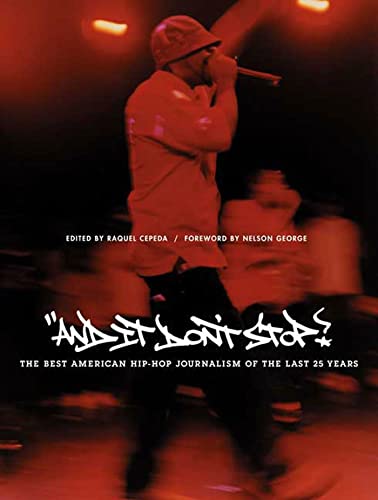
In September 1979, there was a cosmic shift that went unnoticed by the majority of mainstream America. This shift was triggered by the release of the Sugarhill Gang's single, Rapper's Delight. Not only did it usher rap music into the mainstream's consciousness, it brought us the word "hip-hop." And It Don't Stop, edited by the award winning journalist Raquel Cepeda, with a foreword from Nelson George is a collection of the best articles the hip-hop generation has produced. It captures the indelible moments in hip-hop's history since 1979 and will be the centerpiece of the twenty-fifth-anniversary celebration.
This book epitomizes the media's response by taking the reader on an engaging and critical journey, including the very first pieces written about hip-hop for publications like The Village Voice--controversial articles that created rifts between church and state, the artist and journalist, and articles that recorded the rise and tragic fall of the art form's appointed heroes, such as Tupac Shakur, Eazy-E, and the Notorious B.I.G. The list of contributors includes Toure, Kevin Powell, dream hampton, Harry Allen, Cheo Hodari Coker, Greg Tate, Bill Adler, Hilton Als, Danyel Smith, and Joan Morgan.
Die Inhaltsangabe kann sich auf eine andere Ausgabe dieses Titels beziehen.
Über die Autorin bzw. den Autor
Raquel Cepeda, former Editor-in-Chief of OneWorld Magazine, is an award-winning journalist. She has contributed to MTV News, The Village Voice, Source, Vibe, Essence, Jalouse, and many other publications. She lives in New York City.
Auszug. © Genehmigter Nachdruck. Alle Rechte vorbehalten.
And It Don't Stop!
1980s:
Looking for the Perfect Beat
In the 1970s, hip-hop culture arose in and out of the Bronx--where Kurtis Blow claimed the people were fresh, by way of its innovative B-boys, rappers, DJs, and graffiti maestros cultivating their art. Its proud adoptive father Afrika Bambaataa eventually christened the culture hip-hop, a term that first appeared in print in an article written by Steven Hager, "Afrika Bambaataa's Hip-Hop," etching Bambaataa's place in the testament of the movement.
By the time the multiplatinum classic record "Rapper's Delight" by the Sugarhill Gang proved commercially viable in 1979, a rainbow coalition of journalists, photographers, filmmakers, producers, fashionistas, and promoters was conspiring in documenting and defining the art form. When the general public got a whiff of just how funky the B-boy (and B-girl) was, he became the media darling and an essential prop to any fresh party. The graffiti documentaryStyle Wars, and films like Wild Style, the Hollywood co-opted Flashdance, Beat Street, Breakin', Breakin' 2: Electric Boogaloo, and later, the Russell Simmons--producedkrush Groove, propelled break-dancers, graffiti artists, and rappers to celebrity status not just in the States, but all over the world.
Their global popularity soon led to a demand for a showcasing of the culture on foreign ground, which was met when the first international "rap tour," plucking a group of talented young blacks and Latinos from the streets of New York City, journeyed to Europe's hot spots. Attempting to re-create in writing the booming club scene abroad, writer and editor David Hershkovits accompanied the tour only to end up documenting the cultural divide that gaped between the entertainers and their global audience, and at the same time the universality of the music and the dancer, in his article "London Rocks, Paris Burns, and the B-Boys Break a Leg," for the now defunctSunday News Magazine insert for the New York Daily News.
Hershkovits, a fixture in the psychedelic melting pot of the downtown New York scene in the 1980s where the art world and B-boys would collide harmoniously on the dance floor, was also an editor who encouraged other writers, like Steven Hager, to pursue their curiosity about the burgeoning hip-hop scene. Along with Hager, Bill Adler, dance critic Sally Banes, Nelson George, and other early journalistic pioneers, Hershkovits made the first attempts to truly define what hip-hop culture was and its potential as an international force with which to be reckoned. What particularly defined this nascent hip-hop culture in the 1980s was the club and party scene. One of the most popular attractions in the Bronx, other than the zoo, was Sal Abbatiello's Disco Fever. Some fifteen subway stops north of Studio 54, Disco Fever, as Bill Adler wrote in 1983 in his article "The South Bronx Was Getting a Bad Rap Until a Club Called Disco Fever Came Along," had "emerged as the headquarters of rap music." So important were the DJs at the Fever that if they didn't spin your record, felt Russell Simmons, your joint was just wack. And who would know better than Simmons, who was already being touted a mogul byThe Wall Street Journal at twenty-seven, as reported by Nelson George in his article "Rappin' with Russell."
Simmons would eventually be responsible for making rap music equal big business, and the bigger the business the more dire the need for competent and accurate coverage. This need for coverage soon cemented an unprecedented closeness between the artists and those who wrote about them. Hip-hop personalities weren't as accessible or on the World Wide Web, and the genre wasn't synonymous with pop culture at this time, so journalists covering this insular scene had to parlay in the cut with the artists they wanted to write about.
Signaling the possibilities of this new relationship between hip-hop artists, their handlers, and the writers who covered them, Bill Adler went from writing about the art form and participants like Russell Simmons to becoming someone to be covered himself. Nelson George was soon writing about his journalistic peer, and his lifelong contribution to hip-hop, as Adler morphed from hip-hop writer to director of publicity for Rush Artist Management and Def Jam Recordings in 1984, becoming Simmons's second full-time employee. Adleralso has the distinction of being the only writer of this period to still be almost exclusively immersed in hip-hop culture, penning an authorized Run-D.M.C. biography, and founding a New York City--based gallery devoted to showcasing hip-hop photography.
By the mid-eighties, rap was becoming bigger business, giving those who wrote about it much more to do. Graffiti art and breaking gave way to rapping with the crossover success of artists like Run-D.M.C., whose collaboration with Aerosmith on "Walk This Way" in 1986 marked rap's arrival on Music Television, better known as MTV, exposed rap to an audience of rock enthusiasts, and led to the debut ofYO! MTV Raps in 1988. L.L. Cool J, the Beastie Boys, Slick Rick, EPMD, and 3rd Bass then muscled aside the pioneers with their mainstream appeal and corporate sponsorship.
By the mid-eighties seminal groups like KRS-One's Boogie Down Productions and the controversial Public Enemy, like no other collectives before (or since), also began using rap music not only as a method to entertain, but to educate the masses--"edutainment," as described by KRS-One, ironically paving the way for both the innate anger in the rap expression of South Central, Los Angeles, and the pan-Afrocentric Native Tongues Movement. Public Enemy's Chuck D became a media obsession because of his brutally honest depictions of life in the inner cities at the mercy of policemen and other social ills, and the contradictions that plagued his group. John Leland, who began writing about hip-hop in 1982, had a special relationship, if you will, with Chuck D. Giving us a hint about what would become a running theme of tension between artists and the writers who critiqued their music, Leland managed to tick Chuck D off with a record review he had penned forThe Village Voice, which resulted in threats. The article featured in this section represented the first time the two had met since the one-sided war of words had begun.
While the dance and graffiti art of hip-hop became less popular as the hybrid sound of A Tribe Called Quest, De La Soul, Jungle Brothers, Black Sheep, Brand Nubian, Queen Latifah, and others was embraced, rap music's colorful, sometimes erratic creators were by the late eighties proving to be the stuff great stories were made of, both in print and in the films of young directors likeSpike Lee, and later John Singleton and Albert and Allen Hughes. By the end of the decade, journalists, and those aspiring to be, had found the perfect beat to coverin hip-hop.
However, there would not have been a platform to set it off had it not been for the trailblazing efforts of the journalists with the vision, who announced to the world that this wild child had been born. And because of their efforts, featured in the following pages, everybody knew its name was hip-hop.
Physical Graffiti
Breaking Is Hard to Do
SALLY BANES
Chico and Tee and their friends from 175th Street in the High Times crew were breaking in the subway and the cops busted them for fighting.
"We're not fighting. We're dancing!" they claimed. At the precinct station, one kid demonstrated certain moves: a head spin, ass spin,...
„Über diesen Titel“ kann sich auf eine andere Ausgabe dieses Titels beziehen.
Suchergebnisse für And It Don't Stop: The Best American Hip-Hop Journalism...

Beispielbild für diese ISBN
And It Don't Stop: The Best American Hip-hop Journalism of the Last Twenty-five Years
Anbieter: World of Books (was SecondSale), Montgomery, IL, USA
Verkäuferbewertung 5 von 5 Sternen

Paperback. Zustand: Fair. In September 1979, there was a cosmic shift that went unnoticed by the majority of mainstream America. This shift was triggered by the release of the Sugarhill Gang's single, Rapper's Delight. Not only did it usher rap music into the mainstream's consciousness, it brought us the word "hip-hop." And It Don't Stop, edited by the award winning journalist Raquel Cepeda, with a foreword from Nelson George is a collection of the best articles the hip-hop generation has produced. It captures the indelible moments in hip-hop's history since 1979 and will be the centerpiece of the twenty-fifth-anniversary celebration. This book epitomizes the media's response by taking the reader on an engaging and critical journey, including the very first pieces written about hip-hop for publications like The Village Voice--controversial articles that created rifts between church and state, the artist and journalist, and articles that recorded the rise and tragic fall of the art form's appointed heroes, such as Tupac Shakur, Eazy-E, and the Notorious B.I.G. The list of contributors includes Toure, Kevin Powell, dream hampton, Harry Allen, Cheo Hodari Coker, Greg Tate, Bill Adler, Hilton Als, Danyel Smith, and Joan Morgan. Artikel-Nr. 00099110801
Gebraucht kaufen
EUR 5,35
Versand gratis
Versand innerhalb von USA
Versand innerhalb von USA
Anzahl: 1 verfügbar
Beispielbild für diese ISBN
And It Don't Stop: The Best American Hip-Hop Journalism of the Last 25 Years
Verlag:
Farrar, Straus and Giroux (edition First Edition), 2004
ISBN 10: 0571211593
ISBN 13: 9780571211593
Gebraucht
Paperback
Erstausgabe
Anbieter: BooksRun, Philadelphia, PA, USA
Verkäuferbewertung 5 von 5 Sternen
Paperback. Zustand: Very Good. First Edition. It's a well-cared-for item that has seen limited use. The item may show minor signs of wear. All the text is legible, with all pages included. It may have slight markings and/or highlighting. Artikel-Nr. 0571211593-8-1
Gebraucht kaufen
EUR 5,36
Versand gratis
Versand innerhalb von USA
Versand innerhalb von USA
Anzahl: 1 verfügbar
Beispielbild für diese ISBN
And It Don't Stop (FABER & FABER)
Verlag:
Farrar, Straus and Giroux, 2004
ISBN 10: 0571211593
ISBN 13: 9780571211593
Gebraucht
Softcover
Anbieter: Wonder Book, Frederick, MD, USA
Verkäuferbewertung 5 von 5 Sternen
Zustand: Good. Good condition. With remainder mark. A copy that has been read but remains intact. May contain markings such as bookplates, stamps, limited notes and highlighting, or a few light stains. Artikel-Nr. X05I-00791
Gebraucht kaufen
EUR 6,35
Versand gratis
Versand innerhalb von USA
Versand innerhalb von USA
Anzahl: 1 verfügbar
Beispielbild für diese ISBN
And It Don't Stop: The Best American Hip-Hop Journalism of the Last 25 Years
Verlag:
Farrar, Straus and Giroux, 2004
ISBN 10: 0571211593
ISBN 13: 9780571211593
Gebraucht
Paperback
Anbieter: ThriftBooks-Atlanta, AUSTELL, GA, USA
Verkäuferbewertung 5 von 5 Sternen
Paperback. Zustand: Good. No Jacket. Pages can have notes/highlighting. Spine may show signs of wear. ~ ThriftBooks: Read More, Spend Less. Artikel-Nr. G0571211593I3N00
Gebraucht kaufen
EUR 6,82
Versand gratis
Versand innerhalb von USA
Versand innerhalb von USA
Anzahl: 1 verfügbar
Beispielbild für diese ISBN
And It Don't Stop : The Best American Hip-Hop Journalism of the Last 25 Years
Verlag:
Farrar, Straus & Giroux, 2004
ISBN 10: 0571211593
ISBN 13: 9780571211593
Gebraucht
Softcover
Anbieter: Better World Books, Mishawaka, IN, USA
Verkäuferbewertung 5 von 5 Sternen
Zustand: Good. Former library copy. Pages intact with minimal writing/highlighting. The binding may be loose and creased. Dust jackets/supplements are not included. Includes library markings. Stock photo provided. Product includes identifying sticker. Better World Books: Buy Books. Do Good. Artikel-Nr. 2386062-6
Gebraucht kaufen
EUR 7,30
Versand gratis
Versand innerhalb von USA
Versand innerhalb von USA
Anzahl: 1 verfügbar
Beispielbild für diese ISBN
And It Don't Stop : The Best American Hip-Hop Journalism of the Last 25 Years
Verlag:
Farrar, Straus & Giroux, 2004
ISBN 10: 0571211593
ISBN 13: 9780571211593
Gebraucht
Softcover
Anbieter: Better World Books, Mishawaka, IN, USA
Verkäuferbewertung 5 von 5 Sternen
Zustand: Very Good. Pages intact with possible writing/highlighting. Binding strong with minor wear. Dust jackets/supplements may not be included. Stock photo provided. Product includes identifying sticker. Better World Books: Buy Books. Do Good. Artikel-Nr. 3948939-75
Gebraucht kaufen
EUR 7,30
Versand gratis
Versand innerhalb von USA
Versand innerhalb von USA
Anzahl: 1 verfügbar
Beispielbild für diese ISBN
And It Don't Stop: The Best American Hip-Hop Journalism of the Last 25 Years
Anbieter: Magers and Quinn Booksellers, Minneapolis, MN, USA
Verkäuferbewertung 5 von 5 Sternen
paperback. Zustand: Very Good. May have light to moderate shelf wear and/or a remainder mark. Complete. Clean pages. Artikel-Nr. 1467382
Gebraucht kaufen
EUR 5,89
EUR 3,52 Versand
Versand innerhalb von USA
Versand innerhalb von USA
Anzahl: 3 verfügbar
Beispielbild für diese ISBN
And It Don't Stop
Verlag:
Farrar, Straus and Giroux, 2004
ISBN 10: 0571211593
ISBN 13: 9780571211593
Gebraucht
Softcover
Anbieter: medimops, Berlin, Deutschland
Verkäuferbewertung 5 von 5 Sternen
Zustand: good. Befriedigend/Good: Durchschnittlich erhaltenes Buch bzw. Schutzumschlag mit Gebrauchsspuren, aber vollständigen Seiten. / Describes the average WORN book or dust jacket that has all the pages present. Artikel-Nr. M00571211593-G
Gebraucht kaufen
EUR 16,10
EUR 10,00 Versand
Versand von Deutschland nach USA
Versand von Deutschland nach USA
Anzahl: 2 verfügbar
Beispielbild für diese ISBN
And It Don't Stop: The Best American Hip-hop Journalism of the Last Twenty-five Years
Anbieter: Sell Books, Elland, YORKS, Vereinigtes Königreich
Verkäuferbewertung 5 von 5 Sternen
paperback. Zustand: Good. Our good condition books are generally good for reading but not for gifting or collecting. They could have imperfections such as creasing, fanning, inscriptions, margin notes, yellowing, staining on edge or cover or pages, bumps, scuffs, etc etc (sometimes multiple of these). It's a wide category that encompasses anything that isn't almost-new down to anything that is slightly better than poor. We would NOT recommend gifting Good books - these should be considered reading copies. Our books are dispatched from a Yorkshire former cotton mill. We list via barcode/ISBN so please note that the images are stock images and may not be the exact copy you receive, furthermore the details about edition and year might not be accurate as many publishers reuse the same ISBN for multiple editions and as we simply scan a barcode or enter an ISBN we do not check the validity of the edition data when listing. If you're looking for an exact edition please don't order (at least not without checking with us first, although we don't always have time to check). We aim to dispatch prompty, the service used will depend on order value and book size. We can ship to most countries, see our shipping policies. Payment is via Abe only. Artikel-Nr. P-BHO00233-MIX-20230904-G
Gebraucht kaufen
EUR 13,37
EUR 14,17 Versand
Versand von Vereinigtes Königreich nach USA
Versand von Vereinigtes Königreich nach USA
Anzahl: 1 verfügbar
Beispielbild für diese ISBN
And It Don't Stop: The Best American Hip-Hop Journalism of the Last 25 Years
Anbieter: Ria Christie Collections, Uxbridge, Vereinigtes Königreich
Verkäuferbewertung 5 von 5 Sternen
Zustand: New. In English. Artikel-Nr. ria9780571211593_new
Neu kaufen
EUR 27,58
EUR 13,17 Versand
Versand von Vereinigtes Königreich nach USA
Versand von Vereinigtes Königreich nach USA
Anzahl: Mehr als 20 verfügbar