
Inhaltsangabe
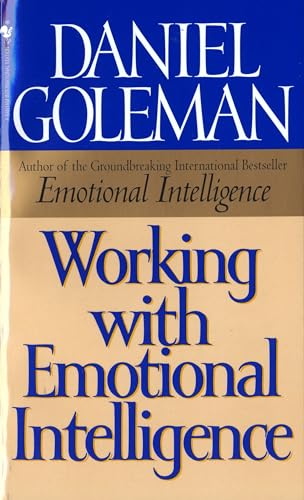
Daniel Goleman's bestselling Emotional Intelligence revolutionized the way we think about personal excellence. Now he brings his insight into the workplace, in a book sure to change the shape of business for decades to come.
In Working with Emotional Intelligence, Goleman reveals the skills that distinguish star performers in every field, from entry-level jobs to top executive positions. He shows that the single most important factor is not IQ, advanced degrees, or technical expertise, but the quality Goleman calls emotional intelligence. Self-awareness, self-confidence, and self-control; commitment and integrity; the ability to communicate and influence, to initiate and accept change—these competencies are at a premium in today's job market. The higher up the leadership ladder you go, the more vital these skills become, often influencing who is hired or fired, passed over or promoted. As Goleman shows, we all possess the potential to improve our emotional intelligence—at any stage in our career. He provides guidelines for cultivating these capabilities—and also explains why corporate training must change if it is to be effective.
Die Inhaltsangabe kann sich auf eine andere Ausgabe dieses Titels beziehen.
Über die Autorin bzw. den Autor
Daniel Goleman, PH.D. is also the author of the worldwide bestseller Working with Emotional Intelligence and is co-author of Primal Leadership: Learning to Lead with Emotional Intelligence, written with Richard Boyatzis and Annie McKee.
Dr. Goleman received his Ph.D. from Harvard and reported on the brain and behavioral sciences for The New York Times for twelve years, where he was twice nominated for the Pulitzer Prize. He was awarded the American Psychological Association's Lifetime Achievement Award and is currently a Fellow of the American Association for the Advancement of Science His other books include Destructive Emotions, The Meditative Mind, The Creative Spirit, and Vital Lies, Simple Truths.
Auszug. © Genehmigter Nachdruck. Alle Rechte vorbehalten.
The New Yardstick
The rules for work are changing. We're being judged by a new yardstick: not just by how smart we are, or by our training and expertise, but also by how well we handle ourselves and each other. This yardstick is increasingly applied in choosing who will be hired and who will not, who will be let go and who retained, who passed over and who promoted.
The new rules predict who is most likely to become a star performer and who is most prone to derailing. And, no matter what field we work in currently, they measure the traits that are crucial to our marketability for future jobs.
These rules have little to do with what we were told was important in school; academic abilities are largely irrelevant to this standard. The new measure takes for granted having enough intellectual ability and technical know-how to do our jobs; it focuses instead on personal qualities, such as initiative and empathy, adaptability and persuasiveness.
This is no passing fad, nor just the management nostrum of the moment. The data that argue for taking it seriously are based on studies of tens of thousands of working people, in callings of every kind. The research distills with unprecedented precision which qualities mark a star performer. And it demonstrates which human abilities make up the greater part of the ingredients for excellence at work—most especially for leadership.
If you work in a large organization, even now you are probably being evaluated in terms of these capabilities, though you may not know it. If you are applying for a job, you are likely to be scrutinized through this lens, though, again, no one will tell you so explicitly. Whatever your job, understanding how to cultivate these capabilities can be essential for success in your career.
If you are part of a management team, you need to consider whether your organization fosters these competencies or discourages them. To the degree your organizational climate nourishes these competencies, your organization will be more effective and productive. You will maximize your group's intelligence, the synergistic interaction of every person's best talents.
If you work for a small organization or for yourself, your ability to perform at peak depends to a very great extent on your having these abilities—though almost certainly you were never taught them in school. Even so, your career will depend, to a greater or lesser extent, on how well you have mastered these capacities.
In a time with no guarantees of job security, when the very concept of a "job" is rapidly being replaced by "portable skills," these are prime qualities that make and keep us employable. Talked about loosely for decades under a variety of names, from "character" and "personality" to "soft skills" and "competence," there is at last a more precise understanding of these human talents, and a new name for them: emotional intelligence.
A Different Way of Being Smart
"I had the lowest cumulative grade point average ever in my engineering school," the codirector of a consulting firm tells me. "But when I joined the army and went to officer candidate school, I was number one in my class--it was all about how you handle yourself, get along with people, work in teams, leadership. And that's what I find to be true in the world of work."
In other words, what matters is a different way of being smart. In my book Emotional Intelligence, my focus was primarily on education, though a short chapter dealt with implications for work and organizational life.
What caught me by utter surprise—and delighted me—was the flood of interest from the business community. Responding to a tidal wave of letters and faxes, e-mails and phone calls, requests to speak and consult, I found myself on a global odyssey, talking to thousands of people, from CEOs to secretaries, about what it means to bring emotional intelligence to work.
* * *
This search has taken me back to research I participated in while a graduate student, and then faculty member, at Harvard University. That research was part of an early challenge to the IQ mystique—the false but widely embraced notion that what matters for success is intellect alone. This work helped spawn what has now become a mini-industry that analyzes the actual competencies that make people successful in jobs and organizations of every kind, and the findings are astonishing: IQ takes second position to emotional intelligence in determining outstanding job performance.
Analyses done by dozens of different experts in close to five hundred corporations, government agencies, and nonprofit organizations worldwide have arrived independently at remarkably similar conclusions, and their findings are particularly compelling because they avoid the biases or limits inherent in the work of a single individual or group. Their conclusions all point to the paramount place of emotional intelligence in excellence on the job—in virtually any job.
Some Misconceptions
As I've toured the world talking and consulting with people in business, I've encountered certain widespread misunderstandings about emotional intelligence. Let me clear up some of the most common at the outset. First, emotional intelligence does not mean merely "being nice." At strategic moments it may demand not "being nice," but rather, for example, bluntly confronting someone with an uncomfortable but consequential truth they've been avoiding.
Second, emotional intelligence does not mean giving free rein to feelings—"letting it all hang out." Rather, it means managing feelings so that they are expressed appropriately and effectively, enabling people to work together smoothly toward their common goals.
Also, women are not "smarter" than men when it comes to emotional intelligence, nor are men superior to women. Each of us has a personal profile of strengths and weaknesses in these capacities. Some of us may be highly empathic but lack some abilities to handle our own distress; others may be quite aware of the subtlest shift in our own moods, yet be inept socially.
It is true that men and women as groups tend to have a shared, gender-specific profile of strong and weak points. An analysis of emotional intelligence in thousands of men and women found that women, on average, are more aware of their emotions, show more empathy, and are more adept interpersonally. Men, on the other hand, are more self-confident and optimistic, adapt more easily, and handle stress better.
In general, however, there are far more similarities than differences. Some men are as empathic as the most interpersonally sensitive women, while some women are every bit as able to withstand stress as the most emotionally resilient men. Indeed, on average, looking at the overall ratings for men and women, the strengths and weaknesses average out, so that in terms of total emotional intelligence, there are no sex differences.
Finally, our level of emotional intelligence is not fixed genetically, nor does it develop only in early childhood. Unlike IQ, which changes little after our teen years, emotional intelligence seems to be largely learned, and it continues to develop as we go through life and learn from our experiences—our competence in it can keep growing. In fact, studies that have tracked people's level of emotional intelligence through the years show that people get better and better in these capabilities as they grow more adept at handling their own emotions and impulses, at motivating themselves, and at honing their empathy and social adroitness. There is an old-fashioned word for this growth in emotional intelligence:...
„Über diesen Titel“ kann sich auf eine andere Ausgabe dieses Titels beziehen.
Suchergebnisse für Working with Emotional Intelligence

Beispielbild für diese ISBN
Working with Emotional Intelli
Anbieter: World of Books (was SecondSale), Montgomery, IL, USA
Verkäuferbewertung 5 von 5 Sternen

Zustand: Very Good. Item in very good condition! Textbooks may not include supplemental items i.e. CDs, access codes etc. Artikel-Nr. 00085426904
Gebraucht kaufen
EUR 4,99
Versand gratis
Versand innerhalb von USA
Versand innerhalb von USA
Anzahl: 2 verfügbar
Beispielbild für diese ISBN
Working with Emotional Intelligence
Verlag:
Bantam Books (edition ), 1999
ISBN 10: 0553840231
ISBN 13: 9780553840230
Gebraucht
Paperback
Anbieter: BooksRun, Philadelphia, PA, USA
Verkäuferbewertung 5 von 5 Sternen
Paperback. Zustand: Very Good. It's a well-cared-for item that has seen limited use. The item may show minor signs of wear. All the text is legible, with all pages included. It may have slight markings and/or highlighting. Artikel-Nr. 0553840231-11-1
Gebraucht kaufen
EUR 5,00
Versand gratis
Versand innerhalb von USA
Versand innerhalb von USA
Anzahl: 1 verfügbar
Beispielbild für diese ISBN
Working with Emotional Intelligence
Anbieter: ThriftBooks-Reno, Reno, NV, USA
Verkäuferbewertung 5 von 5 Sternen
Paperback. Zustand: Very Good. No Jacket. May have limited writing in cover pages. Pages are unmarked. ~ ThriftBooks: Read More, Spend Less. Artikel-Nr. G0553840231I4N00
Gebraucht kaufen
EUR 5,87
Versand gratis
Versand innerhalb von USA
Versand innerhalb von USA
Anzahl: 1 verfügbar
Beispielbild für diese ISBN
Working with Emotional Intelligence
Anbieter: ThriftBooks-Atlanta, AUSTELL, GA, USA
Verkäuferbewertung 5 von 5 Sternen
Paperback. Zustand: Good. No Jacket. Pages can have notes/highlighting. Spine may show signs of wear. ~ ThriftBooks: Read More, Spend Less. Artikel-Nr. G0553840231I3N00
Gebraucht kaufen
EUR 5,89
Versand gratis
Versand innerhalb von USA
Versand innerhalb von USA
Anzahl: 1 verfügbar
Beispielbild für diese ISBN
Working with Emotional Intelligence
Anbieter: ThriftBooks-Atlanta, AUSTELL, GA, USA
Verkäuferbewertung 5 von 5 Sternen
Paperback. Zustand: Very Good. No Jacket. May have limited writing in cover pages. Pages are unmarked. ~ ThriftBooks: Read More, Spend Less. Artikel-Nr. G0553840231I4N00
Gebraucht kaufen
EUR 5,89
Versand gratis
Versand innerhalb von USA
Versand innerhalb von USA
Anzahl: 1 verfügbar
Beispielbild für diese ISBN
Working with Emotional Intelligence
Anbieter: ThriftBooks-Dallas, Dallas, TX, USA
Verkäuferbewertung 5 von 5 Sternen
Paperback. Zustand: Very Good. No Jacket. May have limited writing in cover pages. Pages are unmarked. ~ ThriftBooks: Read More, Spend Less. Artikel-Nr. G0553840231I4N00
Gebraucht kaufen
EUR 5,89
Versand gratis
Versand innerhalb von USA
Versand innerhalb von USA
Anzahl: 1 verfügbar
Beispielbild für diese ISBN
Working with Emotional Intelligence
Verlag:
Random House Publishing Group, 1999
ISBN 10: 0553840231
ISBN 13: 9780553840230
Gebraucht
Softcover
Anbieter: Better World Books, Mishawaka, IN, USA
Verkäuferbewertung 5 von 5 Sternen
Zustand: Fine. Used book that is in almost brand-new condition. May contain a remainder mark. Better World Books: Buy Books. Do Good. Artikel-Nr. 15854064-75
Gebraucht kaufen
EUR 6,19
Versand gratis
Versand innerhalb von USA
Versand innerhalb von USA
Anzahl: 1 verfügbar
Beispielbild für diese ISBN
Working with Emotional Intelligence
Verlag:
Random House Publishing Group, 1999
ISBN 10: 0553840231
ISBN 13: 9780553840230
Gebraucht
Softcover
Anbieter: Better World Books, Mishawaka, IN, USA
Verkäuferbewertung 5 von 5 Sternen
Zustand: Good. Pages intact with minimal writing/highlighting. The binding may be loose and creased. Dust jackets/supplements are not included. Stock photo provided. Product includes identifying sticker. Better World Books: Buy Books. Do Good. Artikel-Nr. 5081558-75
Gebraucht kaufen
EUR 6,24
Versand gratis
Versand innerhalb von USA
Versand innerhalb von USA
Anzahl: 1 verfügbar
Beispielbild für diese ISBN
Working with Emotional Intelligence
Verlag:
Random House Publishing Group, 1999
ISBN 10: 0553840231
ISBN 13: 9780553840230
Gebraucht
Softcover
Anbieter: Better World Books, Mishawaka, IN, USA
Verkäuferbewertung 5 von 5 Sternen
Zustand: Very Good. Pages intact with possible writing/highlighting. Binding strong with minor wear. Dust jackets/supplements may not be included. Stock photo provided. Product includes identifying sticker. Better World Books: Buy Books. Do Good. Artikel-Nr. 5561200-75
Gebraucht kaufen
EUR 6,24
Versand gratis
Versand innerhalb von USA
Versand innerhalb von USA
Anzahl: 2 verfügbar
Beispielbild für diese ISBN
Working with Emotional Intelligence
Anbieter: Wonder Book, Frederick, MD, USA
Verkäuferbewertung 5 von 5 Sternen
Zustand: Good. Good condition. A copy that has been read but remains intact. May contain markings such as bookplates, stamps, limited notes and highlighting, or a few light stains. Artikel-Nr. N18A-04812
Gebraucht kaufen
EUR 6,82
Versand gratis
Versand innerhalb von USA
Versand innerhalb von USA
Anzahl: 3 verfügbar