
Verwandte Artikel zu The First Lady of Fleet Street: The Life of Rachel...
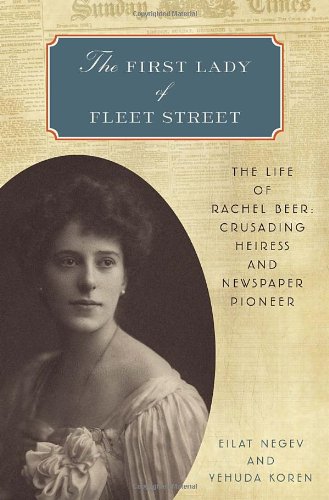
The First Lady of Fleet Street: The Life of Rachel Beer: Crusading Heiress and Newspaper Pioneer - Hardcover
Inhaltsangabe
A panoramic portrait of a remarkable woman and the tumultuous Victorian era on which she made her mark, The First Lady of Fleet Street chronicles the meteoric rise and tragic fall of Rachel Beer—indomitable heiress, social crusader, and newspaper pioneer.
Rich with period detail and drawing on a wealth of original material, this sweeping work of never-before-told history recounts the ascent of two of London’s most prominent Jewish immigrant families—the Sassoons and the Beers. Born into one, Rachel married into the other, wedding newspaper proprietor Frederick Beer, the sole heir to his father’s enormous fortune. Though she and Frederick became leading London socialites, Rachel was ambitious and unwilling to settle for a comfortable, idle life. She used her husband’s platform to assume the editorship of not one but two venerable Sunday newspapers—the Sunday Times and The Observer—a stunning accomplishment at a time when women were denied the vote and allowed little access to education. Ninety years would pass before another woman would take the helm of a major newspaper on either side of the Atlantic.
It was an exhilarating period in London’s history—fortunes were being amassed (and squandered), masterpieces were being created, and new technologies were revolutionizing daily life. But with scant access to politicians and press circles, most female journalists were restricted to issuing fashion reports and dispatches from the social whirl. Rachel refused to limit herself or her beliefs. In the pages of her newspapers, she opined on Whitehall politics and British imperial adventures abroad, campaigned for women’s causes, and doggedly pursued the evidence that would exonerate an unjustly accused French military officer in the so-called Dreyfus Affair. But even as she successfully blazed a trail in her professional life, Rachel’s personal travails were the stuff of tragedy. Her marriage to Frederick drove an insurmountable wedge between herself and her conservative family. Ultimately, she was forced to retreat from public life entirely, living out the rest of her days in stately isolation.
While the men of her era may have grabbed more headlines, Rachel Beer remains a pivotal figure in the annals of journalism—and the long march toward equality between the sexes. With The First Lady of Fleet Street, she finally gets the front page treatment she deserves.
Die Inhaltsangabe kann sich auf eine andere Ausgabe dieses Titels beziehen.
Über die Autorin bzw. den Autor
Partners in life and work, Eilat Negev and Yehuda Koren are respected writers and journalists whose work has been widely published in Israel, Britain, and Germany. Their previous biographies are In Our Hearts We Were Giants and Lover of Unreason, which received critical acclaim worldwide and were translated into ten languages.
Auszug. © Genehmigter Nachdruck. Alle Rechte vorbehalten.
CHAPTER ONE
Portraits and Personalities
In August 1893, the fashionable photographer Harry Bedford-Lemere spent several days at Rachel and Frederick Beer's mansion in Mayfair. Bedford-Lemere had made a name for himself photographing the opulent homes of the era. His work was commissioned by wealthy homeowners, architects, decorators and property agents, and it often appeared in society and lifestyle magazines. Through his still-existing photographs, it's possible to take a virtual tour of the Beers' home and to get a vivid sense of the life they shared together.
A water fountain gurgled in the marble-lined hall of 7 Chesterfield Gardens, and on a tall pedestal stood La Guerre, a statue created by the famous French sculptor Antoine Louis Barye. It was a small-scale reproduction of one of four figurative works carved in stone on the pavilion façades of the new Louvre in Paris. Frozen in bronze, a soldier sat on a crouched horse, about to unsheath his sword, as a young boy next to him raised a horn to his lips. Though impressive in its scale and execution, La Guerre hardly presented a pastoral image of welcome-instead, it created an undercurrent of unease. The Beers had eagerly acquired the statue just a few months earlier in Paris, shortly after it was cast and put on sale. Owning a piece by the most celebrated French sculptor of the Third Republic was both a statement of wealth and a projection of their sophisticated artistic taste.
Like the statue that graced their doorstep, the Beers' choice of architect was somewhat eccentric. The job went to the renowned C. J. Phipps, who had designed dozens of theaters all over Britain. Looking to the eighteenth century for inspiration, Phipps and Rachel cluttered the entertainment rooms of the house with mixed gilt French revival furniture in the Louis XVI style, colorful marbles, bronzes, crystal chandeliers, velvet drapes and Persian carpets. Heavy brocades and damasks upholstered the furniture and hung from the walls, nearly muting all sounds. Phipps's theatrical taste was clearly manifest in the house, and some of the rooms closely resembled stage settings. There was a "Moor-esque" smoking room for gentleman visitors, which suggested a harem with its draperies, poufs, hexagonal tables and hookahs.
All of Rachel and Frederick's possessions projected the image that they were widely traveled, interested in foreign affairs and world issues, and very fashionable. Their home, in all its extravagance, was the ultimate blending of Rachel's Eastern background, Frederick's adventures abroad and Victorian Englishness.
Rachel's nephew, the poet Siegfried Sassoon, spent many hours in his aunt's lavish home. He recalled sitting in the drawing room, where he and his family would wait for the chronically late Mrs. Beer. Siegfried and his brothers were dumbfounded not only by the splendor of their aunt and uncle's home, but also by the ceremonial rules by which the couple conducted their lives. Passing through the massive portico and the doors with their grille of gilded metalwork, they were "bowed to by the solemn but delighted butler." It must have felt very much like they were entering the domain of royalty, and they felt obliged to "converse in undertones."
Finally, Aunt Rachel would come bustling in, smelling of violets, fashionably dressed, with an enormous feathered hat on her head. Her ears would sparkle with sapphire earrings and her hands with diamond rings. Rather than hug or caress the boys, she would instead offer her cold, ivory cheek to each of them in turn. Responding to the beat of a gong, they would move into the dining room, which was reachable through a narrow passageway with mirrored walls and bamboo handrails down each side, suggesting a gently sloping bridge. Crowned with a metal-domed ceiling, the room was decorated in the oriental style, with blackened bamboo flooring, asymmetrical bamboo chairs, and objects from the Far East, including swords with ivory handles and a sentimental painting of two Japanese geishas.
Of all the unique decorative elements in Chesterfield Gardens, what young Siegfried remembered best was this mirrored passageway: "We always stopped to marvel at our multiplied and diminishing reflections, which couldn't be counted . . . 'I can see simply hundreds of myself!' my younger brother would exclaim. And I would outdo him with, 'I can see thousands and millions and trillions of myself, getting tinier and tinier all the time, like ancestors!' " he later wrote.
Rachel never tried to conceal her Eastern ancestry. The frequent costume balls she attended (and sometimes held) gave her a welcome opportunity to play up her exotic features by dressing as an oriental lady. These were also occasions to display a fraction of her treasure trove of diamonds, rubies and precious jewels. When she dressed in this style, she would wear several strings of pearls in various lengths, Indian-style, hanging nearly to her waist, a rope of pink coral crisscrossing her thighs, and several Indian gold and carved coral bracelets hugging her bare arms from the shoulder down.
Rachel loved this outfit and the image it projected so much that she displayed a photo of herself wearing it on the mantelpiece of her home. She also gave a copy to Theresa Sassoon, Siegfried's mother, who set it on her own mantelpiece next to a photo of Frederick Beer, his face adorned with a moustache and small whiskers, wearing a tweed tailcoat and a brown billycock, holding a stick, resting his foot on a rustic seat.
But while she was proud of her exotic roots, Rachel felt thoroughly English and wanted to be perceived as such. Having one's portrait painted by a leading artist was one way of acquiring an English provenance, and to this end, the Beers commissioned Henry Jones Thaddeus to paint separate portraits of each of them. Jones Thaddeus was well known in fashionable London circles and he charged exorbitant rates for his work. For her sittings, the thirty-one-year-old Rachel wore a dress of deep golden silk with a low décolletage-le dernier cri- and the newly fashionable high shoulder line. Her dark curly hair was worn "drawn simply back, revealing the ears, into a French pleat," and she chose to adorn herself with none of her exquisite jewels; instead, her only accessory was an ostrich feather fan on a tortoiseshell stick. The background chosen for the portrait was the verdant English countryside; it depicted this Bombay-born London dweller as if she were a member of the landed gentry.
Normally, portraitists tend to idealize their sitter's appearance, but the painting of Rachel reveals a lack of symmetry in her face. "It certainly shows a concern for veracity and 'likeness,'_" said Dr. Brendan Rooney, Jones Thaddeus's biographer. Far more subjective, Siegfried Sassoon thought that the portrait reflected his aunt's "dark loveliness and the faintly smiling sweetness of her un-departed youth." After Rachel's death, her devoted nurse and personal assistant, Miss Ross, bought the painting. She later sold it to Siegfried, who hung it over the large fireplace in his library.
Bedford-Lemere was allowed unlimited access to the Beers' home. The photographer even placed his tripod in Rachel's bedroom and study, capturing its silk-covered walls and ceiling. The French secretaire, where Rachel did most of her writing, was positioned close to her dressing table, and both faced the huge Jones Thaddeus portrait of Frederick, which loomed over the fireplace. Over the course of years, the painting has disappeared, and its image lives on only in Bedford- Lemere's photograph.
For two people who were individually characterized as being shy and introverted, the Beers spent a great deal of time out in society and hosting events in their home. Much of Frederick's time was spent enjoying his favorite pastimes of racquets, golf and billiards, or...
„Über diesen Titel“ kann sich auf eine andere Ausgabe dieses Titels beziehen.
Suchergebnisse für The First Lady of Fleet Street: The Life of Rachel...

Beispielbild für diese ISBN
The First Lady of Fleet Street: The Life of Rachel Beer: Crusading Heiress and Newspaper Pioneer
Verlag:
Bantam (edition First Edition), 2012
ISBN 10: 0553807439
ISBN 13: 9780553807431
Gebraucht
Hardcover
Erstausgabe
Anbieter: BooksRun, Philadelphia, PA, USA
Verkäuferbewertung 5 von 5 Sternen

Hardcover. Zustand: Very Good. First Edition. With dust jacket. It's a well-cared-for item that has seen limited use. The item may show minor signs of wear. All the text is legible, with all pages included. It may have slight markings and/or highlighting. Artikel-Nr. 0553807439-11-1-29
Gebraucht kaufen
EUR 6,14
Versand gratis
Versand innerhalb von USA
Versand innerhalb von USA
Anzahl: 1 verfügbar
Beispielbild für diese ISBN
The First Lady of Fleet Street: The Life of Rachel Beer: Crusading Heiress and Newspaper Pioneer
Verlag:
Bantam (edition First Edition), 2012
ISBN 10: 0553807439
ISBN 13: 9780553807431
Gebraucht
Hardcover
Erstausgabe
Anbieter: BooksRun, Philadelphia, PA, USA
Verkäuferbewertung 5 von 5 Sternen
Hardcover. Zustand: Fair. First Edition. With dust jacket. The item might be beaten up but readable. May contain markings or highlighting, as well as stains, bent corners, or any other major defect, but the text is not obscured in any way. Artikel-Nr. 0553807439-7-1-29
Gebraucht kaufen
EUR 6,30
Versand gratis
Versand innerhalb von USA
Versand innerhalb von USA
Anzahl: 1 verfügbar
Beispielbild für diese ISBN
The First Lady of Fleet Street: The Life of Rachel Beer: Crusading Heiress and Newspaper Pioneer
Anbieter: ThriftBooks-Dallas, Dallas, TX, USA
Verkäuferbewertung 5 von 5 Sternen
Hardcover. Zustand: Very Good. No Jacket. May have limited writing in cover pages. Pages are unmarked. ~ ThriftBooks: Read More, Spend Less. Artikel-Nr. G0553807439I4N00
Gebraucht kaufen
EUR 8,16
Versand gratis
Versand innerhalb von USA
Versand innerhalb von USA
Anzahl: 1 verfügbar
Beispielbild für diese ISBN
The First Lady of Fleet Street: The Life of Rachel Beer: Crusading Heiress and Newspaper Pioneer
Anbieter: ThriftBooks-Atlanta, AUSTELL, GA, USA
Verkäuferbewertung 5 von 5 Sternen
Hardcover. Zustand: Very Good. No Jacket. May have limited writing in cover pages. Pages are unmarked. ~ ThriftBooks: Read More, Spend Less. Artikel-Nr. G0553807439I4N00
Gebraucht kaufen
EUR 8,16
Versand gratis
Versand innerhalb von USA
Versand innerhalb von USA
Anzahl: 1 verfügbar
Beispielbild für diese ISBN
The First Lady of Fleet Street : The Life of Rachel Beer: Crusading Heiress and Newspaper Pioneer
Verlag:
Random House Publishing Group, 2012
ISBN 10: 0553807439
ISBN 13: 9780553807431
Gebraucht
Hardcover
Anbieter: Better World Books, Mishawaka, IN, USA
Verkäuferbewertung 5 von 5 Sternen
Zustand: Good. Former library copy. Pages intact with minimal writing/highlighting. The binding may be loose and creased. Dust jackets/supplements are not included. Includes library markings. Stock photo provided. Product includes identifying sticker. Better World Books: Buy Books. Do Good. Artikel-Nr. 657053-6
Gebraucht kaufen
EUR 8,53
Versand gratis
Versand innerhalb von USA
Versand innerhalb von USA
Anzahl: 1 verfügbar
Beispielbild für diese ISBN
The First Lady of Fleet Street : The Life of Rachel Beer: Crusading Heiress and Newspaper Pioneer
Verlag:
Random House Publishing Group, 2012
ISBN 10: 0553807439
ISBN 13: 9780553807431
Gebraucht
Hardcover
Anbieter: Better World Books, Mishawaka, IN, USA
Verkäuferbewertung 5 von 5 Sternen
Zustand: Very Good. Former library copy. Pages intact with possible writing/highlighting. Binding strong with minor wear. Dust jackets/supplements may not be included. Includes library markings. Stock photo provided. Product includes identifying sticker. Better World Books: Buy Books. Do Good. Artikel-Nr. 657054-75
Gebraucht kaufen
EUR 8,53
Versand gratis
Versand innerhalb von USA
Versand innerhalb von USA
Anzahl: 1 verfügbar
Beispielbild für diese ISBN
The First Lady of Fleet Street: The Life of Rachel Beer: Crusading Heiress and Newspaper Pioneer
Anbieter: Ammareal, Morangis, Frankreich
Verkäuferbewertung 5 von 5 Sternen
Hardcover. Zustand: Très bon. Edition 2012. Ammareal reverse jusqu'à 15% du prix net de cet article à des organisations caritatives. ENGLISH DESCRIPTION Book Condition: Used, Very good. Edition 2012. Ammareal gives back up to 15% of this item's net price to charity organizations. Artikel-Nr. F-748-174
Gebraucht kaufen
EUR 6,49
EUR 16,50 Versand
Versand von Frankreich nach USA
Versand von Frankreich nach USA
Anzahl: 1 verfügbar