
Verwandte Artikel zu Light of the Moon: A Novel
Inhaltsangabe
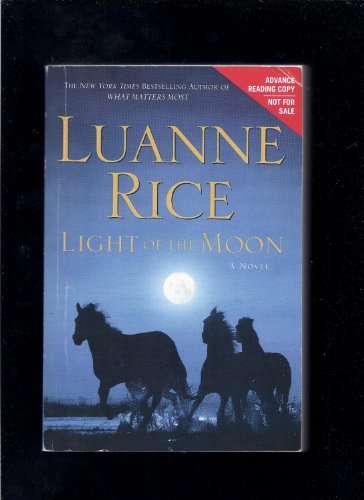
Feeling adrift in the wake of her mother's death and a failed love affair, anthropologist Susannah Connolly leaves Connecticut to travel to the French Camargue to see its fabled white horses and to investigate a saint linked to her family's history, but her life is changed forever by an encounter in the marshes with a lonely man and his wounded daughter
Die Inhaltsangabe kann sich auf eine andere Ausgabe dieses Titels beziehen.
Über die Autorin bzw. den Autor
Luanne Rice is the author of twenty-five novels, most recently Light of the Moon, What Matters Most, The Edge of Winter, Sandcastles, Summer of Roses, Summer’s Child, Silver Bells, and Beach Girls. She lives in New York City and Old Lyme, Connecticut.
Auszug. © Genehmigter Nachdruck. Alle Rechte vorbehalten.
ONE
Five Years Later
Air France 321, scheduled to leave Boston's Logan Airport at 7:50 that night, was full. Susannah Connolly sat in seat 22A; she had her tray table stowed, seat in the upright position, and carry-on bag tucked under the seat in front of her. She'd slipped her passport into her jacket pocket, and at this very moment, she was missing a surprise party—hers.
Her seat belt was tightly buckled. She had the window seat, and two strangers—a couple, whispering comfortably to each other—had the middle and aisle. She had a novel, a magazine, and a guidebook to read. She hoped the party guests were enjoying champagne and birthday cake. She couldn't think of many things she felt less equipped to do than pretend to be having fun at her own surprise party.
Every seat on the plane was taken. The captain's voice crackled over the loudspeaker, telling them they were third in line for takeoff. His French accent was soft, alluring, and sexy, but she barely noticed.
Staring out the window, she felt the plane begin to move, its wheels bumping slowly along the accessway. Susannah traveled a lot. Her passport had been stamped so often, the customs officials had to search for a clean page. Work had taken her away from home a hundred times in the last few years. But this was different—brand new territory: this was a journey for herself, to connect with her mother.
Her mother . . . Although she had died six months earlier, it still didn't seem real.
Susannah was a cultural anthropologist, on the fast track in a competitive field. She taught at Connecticut College, but this was a sabbatical year. Her specialty was cave paintings—specifically those with a spiritual bent—with a concentration on horse illustrations. Cave dwellers had looked to the sun, the sea, the great bear, the forest deer, the blue whale, the wild horse. They'd created saints before the birth of the church, and she'd always been impressed and moved by the inspiration they'd found in the world around them.
Susannah had traveled the world to crawl, wriggle, dive, and spelunk into the planet's deepest, most hidden crevasses—dark, usually slimy, frequently precarious holes, where other humans had gone before, to leave messages, stories, splashes of hope, despair, and beauty.
She had crawled deeper into caves than anyone else would dare to go. She'd lie on her stomach, inching forward as the rock walls closed in on her, fighting claustrophobia, knowing that if only she made it a few feet farther, she'd be rewarded with the sight of something no one had seen in thousands of years.
Ian had seemed to understand. He'd often traveled with her, but rarely entered the caves; he'd wait outside, review the data she sent back via the miracle of fiber optics. He'd had a phobia of being trapped, and no matter how hard he'd fought it, he couldn't overcome the fear—but it hadn't mattered; his analysis of the images had been without peer.
Susannah had met him when they were both grad students at Yale. They'd started out studying together; they took the same classes, had the same professors. The work was hard, so they encouraged each other. Susannah would get lost in her research, the love of her subject matter, and Ian would remind her to apply for grants, submit her work to journals.
Once they were studying in his room, and Susannah fell asleep on his bed. It was December, just before break, and an icy draft was coming through the old windows. She woke up to find him curled beside her, and she pressed against him for warmth. They lay there for a long time, and then he began to kiss her.
His arms were around her. She felt so cold and tired, and she knew she should stop him. But he stroked her hair, and whispered that he'd been feeling this way for so long. Susannah let him hold her, shivering in the cold. Her father had died not long before, and she'd buried herself in work, and she felt starved for closeness.
Susannah remembered that moment so well—the instant they'd gone from good friends and work partners to something confusing. They studied so well together, balanced each other out. She delved deeply into the raw subject matter, and he organized the material. They worked separately on their own dissertations, but coauthored several papers published in journals. Ian never missed a chance to publish. . . .
Ian gave her jade earrings for Christmas, red roses for Valentine's Day. Susannah had felt herself becoming part of a couple—almost by accident. She had so much in common with Ian. He was always there. Curious about her work, involved in her research, interested in her discoveries, sympathetic when they found her mother had lymphoma.
But was this love? He began talking about what they'd do after leaving Yale. There seemed to be an assumption that they'd be making decisions together. And since he had his mind set on Stanford, Susannah felt herself being pulled to the West Coast. She'd resisted at the time—told Ian she wanted to accept a position at Connecticut College.
He hadn't understood, but he also hadn't given up. Although they'd made their academic homes on opposite coasts, Ian kept trying to convince her they should be together. Years went by; they both advanced, working together on projects when they could. He kept up his campaign, telling her they already knew each other so well; they were passionate about the same field; and he'd spoken with the publisher of an academic press, who thought the idea of a couple visiting sites together could make a wonderful series of books.
Susannah's mother had tried not to laugh when she told her.
"Oh, darling," Susannah's mother said. "How romantic . . . he's courting you with a book deal!"
"Mom," Susannah had warned.
Margaret Connolly chuckled. She was thin and pale, her skin yellowed from the disease and treatment. But her eyes were as bright and blue as ever.
"Sweetheart, tell me your hopes and dreams . . ."
"About what, Mom?"
"About everything."
They were sitting in the oncologist's office on Temple Street, waiting for Margaret Connolly to be seen. Her lymphoma had come back. It had been in remission for years, but now it had returned and spread. Susannah sat by her side, waiting to hear the results of the latest radiation treatments. At that moment, she wanted never to leave Connecticut again. She wanted to be with her mother every second she had left.
"My hopes and dreams? To plant a garden, to walk on the beach, to ride again . . . on a beautiful white horse . . ."
"Those are mine, too," her mother whispered.
"We'll do them together," Susannah said.
"Okay," her mother said, smiling. "Maybe we'll finally take that trip together . . ."
"The Camargue!" Susannah exclaimed. "To see Sarah! Could we? Do you really think . . ."
Her mother just looked over, her gaze full of love and sadness.
"No," Susannah said, answering her own question. "No, we'll stay home instead. We'll garden, and walk on the beach . . ."
Her mother shook her head. "No, Susannah . . . that's not how it will be."
"What do you mean?"
"I mean that you're not going to stay home and wait. . . . I want you to take that trip."
"Mom. Not without you."
"Yes, sweetheart. And others, too. Your work takes you where you need to be, and that's how I want it."
"Not now, though," Susannah said. "I should cancel everything. Lascaux, Istanbul . . ."
"Listen to me. You're the best daughter anyone's ever had. I know you'd do anything you could to make me well. You'd find a cure for cancer if you could, and I know that. But that's not your work . . ."
"Work doesn't matter now," Susannah whispered.
"Yes," her mother said, nodding....
„Über diesen Titel“ kann sich auf eine andere Ausgabe dieses Titels beziehen.
Suchergebnisse für Light of the Moon: A Novel

Beispielbild für diese ISBN
Light of the Moon
Anbieter: World of Books (was SecondSale), Montgomery, IL, USA
Verkäuferbewertung 5 von 5 Sternen

Zustand: Acceptable. Item in acceptable condition! Textbooks may not include supplemental items i.e. CDs, access codes etc. Artikel-Nr. 00087359728
Gebraucht kaufen
EUR 3,78
Versand gratis
Versand innerhalb von USA
Versand innerhalb von USA
Anzahl: 2 verfügbar
Beispielbild für diese ISBN
Light of the Moon
Anbieter: World of Books (was SecondSale), Montgomery, IL, USA
Verkäuferbewertung 5 von 5 Sternen
Zustand: Very Good. Item in very good condition! Textbooks may not include supplemental items i.e. CDs, access codes etc. Artikel-Nr. 00087502707
Gebraucht kaufen
EUR 3,78
Versand gratis
Versand innerhalb von USA
Versand innerhalb von USA
Anzahl: 4 verfügbar
Beispielbild für diese ISBN
Light of the Moon
Anbieter: BooksRun, Philadelphia, PA, USA
Verkäuferbewertung 5 von 5 Sternen
Hardcover. Zustand: Very Good. 1. With dust jacket. It's a well-cared-for item that has seen limited use. The item may show minor signs of wear. All the text is legible, with all pages included. It may have slight markings and/or highlighting. Artikel-Nr. 0553805118-11-1-29
Gebraucht kaufen
EUR 4,68
Versand gratis
Versand innerhalb von USA
Versand innerhalb von USA
Anzahl: 1 verfügbar
Beispielbild für diese ISBN
Light of the Moon
Anbieter: BooksRun, Philadelphia, PA, USA
Verkäuferbewertung 5 von 5 Sternen
Hardcover. Zustand: Very Good. 1. With dust jacket. It's a well-cared-for item that has seen limited use. The item may show minor signs of wear. All the text is legible, with all pages included. It may have slight markings and/or highlighting. Artikel-Nr. 0553805118-11-18-29
Gebraucht kaufen
EUR 5,49
Versand gratis
Versand innerhalb von USA
Versand innerhalb von USA
Anzahl: 1 verfügbar
Beispielbild für diese ISBN
Light of the Moon
Anbieter: ThriftBooks-Atlanta, AUSTELL, GA, USA
Verkäuferbewertung 5 von 5 Sternen
Hardcover. Zustand: Good. No Jacket. Pages can have notes/highlighting. Spine may show signs of wear. ~ ThriftBooks: Read More, Spend Less. Artikel-Nr. G0553805118I3N00
Gebraucht kaufen
EUR 5,87
Versand gratis
Versand innerhalb von USA
Versand innerhalb von USA
Anzahl: 1 verfügbar
Beispielbild für diese ISBN
Light of the Moon
Anbieter: ThriftBooks-Atlanta, AUSTELL, GA, USA
Verkäuferbewertung 5 von 5 Sternen
Hardcover. Zustand: As New. No Jacket. Pages are clean and are not marred by notes or folds of any kind. ~ ThriftBooks: Read More, Spend Less. Artikel-Nr. G0553805118I2N00
Gebraucht kaufen
EUR 5,87
Versand gratis
Versand innerhalb von USA
Versand innerhalb von USA
Anzahl: 1 verfügbar
Beispielbild für diese ISBN
Light of the Moon
Anbieter: ThriftBooks-Atlanta, AUSTELL, GA, USA
Verkäuferbewertung 5 von 5 Sternen
Hardcover. Zustand: Very Good. No Jacket. Missing dust jacket; May have limited writing in cover pages. Pages are unmarked. ~ ThriftBooks: Read More, Spend Less. Artikel-Nr. G0553805118I4N01
Gebraucht kaufen
EUR 5,87
Versand gratis
Versand innerhalb von USA
Versand innerhalb von USA
Anzahl: 1 verfügbar
Beispielbild für diese ISBN
Light of the Moon
Anbieter: Wonder Book, Frederick, MD, USA
Verkäuferbewertung 5 von 5 Sternen
Zustand: Good. Good condition. Good dust jacket. A copy that has been read but remains intact. May contain markings such as bookplates, stamps, limited notes and highlighting, or a few light stains. Artikel-Nr. L18C-03573
Gebraucht kaufen
EUR 6,33
Versand gratis
Versand innerhalb von USA
Versand innerhalb von USA
Anzahl: 1 verfügbar
Beispielbild für diese ISBN
Light of the Moon
Anbieter: Wonder Book, Frederick, MD, USA
Verkäuferbewertung 5 von 5 Sternen
Zustand: As New. Like New condition. Like New dust jacket. A near perfect copy that may have very minor cosmetic defects. Artikel-Nr. V21E-02115
Gebraucht kaufen
EUR 6,33
Versand gratis
Versand innerhalb von USA
Versand innerhalb von USA
Anzahl: 1 verfügbar
Beispielbild für diese ISBN
Light of the Moon
Anbieter: Wonder Book, Frederick, MD, USA
Verkäuferbewertung 5 von 5 Sternen
Zustand: Very Good. Very Good condition. Very Good dust jacket. A copy that may have a few cosmetic defects. May also contain light spine creasing or a few markings such as an owner's name, short gifter's inscription or light stamp. Artikel-Nr. T13P-00584
Gebraucht kaufen
EUR 6,33
Versand gratis
Versand innerhalb von USA
Versand innerhalb von USA
Anzahl: 1 verfügbar