
Verwandte Artikel zu Last Citadel: A Novel of the Battle of Kursk
Inhaltsangabe
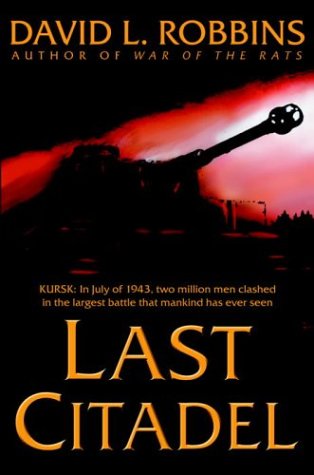
Soviet and German forces prepare for a vicious standoff with their powerful armored divisions, desperate for a victory that could determine the fate of the European theater of World War II, in an epic fictional account of the pivotal 1943 Battle of Kursk. By the author of War of the Rats.
Die Inhaltsangabe kann sich auf eine andere Ausgabe dieses Titels beziehen.
Über die Autorin bzw. den Autor
David L. Robbins is the author of Scorched Earth, The End of War, War of the Rats, and Souls to Keep. He lives in Richmond, Virginia, and teaches novel writing at Virginia Commonwealth University.
Aus dem Klappentext
One nation taking a desperate gamble of war.
Another fighting for survival.
Two armies locked in a bloody cataclysm that will decide history. . .
David L. Robbins has won widespread acclaim for his powerful and splendidly researched novels of World War II. Now he casts his brilliant vision on one of the most terrifying--and most crucial--battles of the war: the Battle of Kursk, Hitler s desperate gamble to defeat Russia, in the final German offensive on the eastern front.
Last Citadel
Spring 1943. In the west, Germany strengthens its choke hold on France. To the south, an Allied invasion looms imminent. But the greatest threat to Hitler s dream of a Thousand Year Reich lies east, where his forces are pitted in a death match with a Russian enemy willing to pay any price to defend the motherland. Hitler rolls the dice, hurling his best SS forces and his fearsome new weapon, the Mark VI Tiger tank, in a last-ditch summer offensive, code-named Citadel.
The Red Army around Kursk is a sprawling array of infantry, armor, fighter planes, and bombers. Among them is an intrepid group of women flying antiquated biplanes; they swoop over the Germans in the dark, earning their nickname, Night Witches. On the ground, Private Dimitri Berko gallops his tank, the Red Army s lithe little T-34, like a Cossack steed. In the turret above Dimitri rides his son, Valya, a Communist sergeant who issues his father orders while the war widens the gulf between them. In the skies, Dimitri s daughter, Katya, flies with the Night Witches, until she joins a ferocious band of partisans in the forests around Kursk. Like Russia itself, the Berko family is suffering the fury and devastation of history s most titanic tank battle while fighting to preserve what is sacred their land, their lives, and each other as Hitler flings against them his most potent armed force.
Inexorable and devastating, a company of Mark VI Tiger tanks is commanded by one extraordinary SS officer, a Spaniard known as la Daga, the Dagger. He d suffered a terrible wound at the hands of the Russians: now he has returned with a cold fury to exact his revenge. And above it all, one quiet man makes his own plan to bring Citadel crashing down and reshape the fate of the world.
A remarkable story of men and arms, loyalty and betrayal, Last Citadel propels us into the claustrophobic confines of a tank in combat, into the tension of guerrilla tactics, and across the smoking charnel of one of history s greatest battlefields. Panoramic, authentic, and unforgettable, it reverberates long after the last cannon sounds.
Auszug. © Genehmigter Nachdruck. Alle Rechte vorbehalten.
May 10, 1943
1440 hours
Reichs Chancellery
Berlin, Germany
The SS colonel eased shut the high, heavy door. The portal closed with a hiss and a soft tap. How many trees went into this, he wondered, lives sacrificed out of the forest to make one of Hitler’s castle gates? The black eagle emblem of wartime hung at eye-level against the carved wood. Colonel Abram Breit imagined this symbol of the Reich to be a spread-winged vulture. That’s what he left behind in the briefing room—a death scene, a picking apart, sinew by vessel, of Germany.
Breit walked several steps into the hall, striding across the same black eagle laid in mosaic in the floor. Bloodred banners trickled down the walls. He buttressed his back against one of them and lit a cigarette.
He exhaled smoke and stared into it, tired and sad. He replayed the voices of the briefing room, Hitler with his generals and advisers. Citadel—the looming, titanic battle for Kursk on the Eastern Front—consumed the hours. Since morning Breit had watched the little wars between the generals, battling over Hitler as if the Führer were a spot of high ground; candor fell in combat with flattery, reason was mauled by pride. Around and above the grand table, more banners festooned the room, great ebony swastikas circled like the buzzards of Breit’s imagination. Everywhere Hitler’s minions had hung the images of Hitler’s belief, to let no eye wander to another way of thinking, to any other allegiance, certainly to no thoughts of Germany’s welfare, only the Nazis’.
Breit ground the last of the cigarette into the sole of his boot. He pocketed the white shred and lit another. In the smoke he recalled Hitler’s eyes, gray and wavering. In the past month, Hitler had become obsessed with reading about Verdun, the meat-grinder battle of World War I France. Hitler had been a corporal on the Western Front. As a runner he was wounded and gassed. Breit saw in Hitler’s eyes the memory of the trenches, and the parallels to be drawn between the butchery of Verdun and what awaited Aryan manhood in the trenches of the Kursk bulge.
This was Germany’s third summer of campaigning in Russia. The Reds had yet to swoon the way these generals had promised Hitler before the invasion in ’41. Now the army lacked the resources for another major offensive in the East. Instead, their available forces were to concentrate on one smashing blow against the Kursk salient, a segment of the front line that ballooned westward into the German midsection.
The plan called for two immense forces to blast across the Russian defenses—Field Marshal von Kluge from the north, Field Marshal von Manstein out of the south—and converge in the center at the city of Kursk, pinching off the Soviet bulge. The operation was designed to surround massive Soviet formations and, more important, shorten German lines to free up men and machines desperately needed elsewhere. The Americans were sure to come to Italy this summer, and Il Duce, Mussolini, was ill-prepared to go it alone.
Hitler was going to commit every available soldier, gun, tank, and airplane to the action. This would be the largest buildup of German armed power of the war. If Citadel succeeded, it would be a loss of blood that Hitler could scarcely afford. If Citadel failed, the ruin of men and matériel would be even greater; worse still, Germany would be exposed to a Russian counterstrike. That could be fatal, the beginning of the end. Citadel would be the last German offensive of the war in the East.
The stakes for Hitler were higher today than at any time in the war. He was being asked to gamble, to throw the dice once on Citadel with everything riding on the table. There would be no second go-round, no backup plan. This was do or die.
The chief problem was that Citadel was obvious. A quick glance at the map of the Eastern Front lines presented the most elementary scenario to any war college student. The Kursk bulge was clearly the best place for an attack, a pincer action was the plain solution. Germany knew this. Russia knew this. The coming fight was going to be without surprise; once begun, it would be brute strength against strength, two behemoths pressing chests.
The Führer fretted aloud in the briefing room. He stabbed his finger at the maps spread across his conference table, aerial photos of Soviet defenses in the Kursk region. Even from three miles in the air, the groundworks dug by the Russians looked incredible; the amount of armaments and men flowing into them was monumental. And these defense works would be arrayed directly in the path of the planned German offensive. How could this be, Hitler wanted to know.
The buzzards flew from their perches then.
Field Marshal von Kluge spoke first, flapping to the table and sweeping a hand in the air over the foreboding maps. We will crush these pitiful defenses, the Field Marshal vowed, speaking in bald propagandistic phrases, the kind Hitler loved to hear. German ground forces have always penetrated enemy defenses and will do so in this case. Besides, look at the technological advantages we have, mein Führer. Look at our new tanks. Our Panthers and Tigers. Our tanks will make the difference, without fail.
Colonel Abram Breit had been brought to Berlin and was in the room to speak to this question of what impact the superior German armor will have on Citadel. Breit was the intelligence officer for the 1st SS Panzergrenadier Division Liebstandarte Adolf Hitler. His division was to be in the vanguard of the Citadel assault. Liebstandarte would enter the fight with thirteen of the new Tiger tanks. It was his job to predict how the battle would go. After von Kluge spoke, Hitler glanced at Breit.
Field Marshal von Manstein, the man whose proposals gave birth to Citadel, replaced von Kluge at the map table. Hitler smiled over at Breit. This was when Breit saw deeply into Hitler’s eyes, when Hitler with a look apologized for skipping over Breit. They were the eyes, he realized, of an ill man. Hitler’s physician had been treating him for constipation, prescribing ever more powerful laxatives. Hitler’s eyes were lusterless, their striking blue was clouded. The Field Marshal began his comments. He said we may have waited too long. The Reds are getting ready for us. We should have attacked them in April, just after the spring thaw, the Russian rasputitsa. Breit watched Hitler agree, the dull eyes growing duller in disappointment and pain. Hitler did not know what to do. He slumped beside the great table where Germany lay and watched his visions of conquest and empire be pecked at by his commanders who could not agree. His puffy face nodded; his chin sagged to his chest.
Field Marshal Keitel spoke next. We have to attack in Russia this summer, he said. For military as well as political purposes. Our allies demand that Germany not be passive in the East. The Italians need to see our resolve, as do the Finns and the Turks. Japan is concerned that we have not made sufficient progress against Russia. The German people require this, as well. The bombings and the failure at Stalingrad have taken their toll on morale. We must fight and win, Germany must retake the momentum. Our troops insist on a victory. Hitler listened and nodded, swayed again by whatever voice held the floor.
Breit backed quietly out of the room while Keitel talked. He came out here alone into the bannered hall and smoked.
The great door to the conference room slid open. Another black uniform with silver gleams and black leather strapping, the garb of the SS, slipped out. From the pack in his hand, Breit shook out the nub of another cigarette and held it up.
“Captain Thoma.”
The young SS officer...
„Über diesen Titel“ kann sich auf eine andere Ausgabe dieses Titels beziehen.
Suchergebnisse für Last Citadel: A Novel of the Battle of Kursk

Beispielbild für diese ISBN
Last Citadel: A Novel of the B
Anbieter: World of Books (was SecondSale), Montgomery, IL, USA
Verkäuferbewertung 5 von 5 Sternen

Zustand: Good. Item in good condition. Textbooks may not include supplemental items i.e. CDs, access codes etc. Artikel-Nr. 00109425684
Gebraucht kaufen
EUR 4,67
Versand gratis
Versand innerhalb von USA
Versand innerhalb von USA
Anzahl: 1 verfügbar
Beispielbild für diese ISBN
Last Citadel: A Novel of the B
Anbieter: World of Books (was SecondSale), Montgomery, IL, USA
Verkäuferbewertung 5 von 5 Sternen
Zustand: Good. Good condition ex-library book with usual library markings and stickers. Artikel-Nr. 00102316163
Gebraucht kaufen
EUR 4,67
Versand gratis
Versand innerhalb von USA
Versand innerhalb von USA
Anzahl: 1 verfügbar
Beispielbild für diese ISBN
Last Citadel: A Novel of the B
Anbieter: World of Books (was SecondSale), Montgomery, IL, USA
Verkäuferbewertung 5 von 5 Sternen
Zustand: Acceptable. Item in acceptable condition! Textbooks may not include supplemental items i.e. CDs, access codes etc. Artikel-Nr. 00106661872
Gebraucht kaufen
EUR 4,67
Versand gratis
Versand innerhalb von USA
Versand innerhalb von USA
Anzahl: 1 verfügbar
Beispielbild für diese ISBN
Last Citadel: A Novel of the Battle of Kursk
Anbieter: Wonder Book, Frederick, MD, USA
Verkäuferbewertung 5 von 5 Sternen
Zustand: Good. Good condition. Good dust jacket. A copy that has been read but remains intact. May contain markings such as bookplates, stamps, limited notes and highlighting, or a few light stains. Artikel-Nr. D08P-00547
Gebraucht kaufen
EUR 6,21
Versand gratis
Versand innerhalb von USA
Versand innerhalb von USA
Anzahl: 1 verfügbar
Beispielbild für diese ISBN
Last Citadel: A Novel of the Battle of Kursk
Anbieter: Wonder Book, Frederick, MD, USA
Verkäuferbewertung 5 von 5 Sternen
Zustand: Very Good. Very Good condition. Very Good dust jacket. A copy that may have a few cosmetic defects. May also contain light spine creasing or a few markings such as an owner's name, short gifter's inscription or light stamp. Artikel-Nr. Q05P-00594
Gebraucht kaufen
EUR 6,21
Versand gratis
Versand innerhalb von USA
Versand innerhalb von USA
Anzahl: 1 verfügbar
Beispielbild für diese ISBN
The Last Citadel : A Novel of the Battle of Kursk
Verlag:
Random House Publishing Group, 2003
ISBN 10: 0553801775
ISBN 13: 9780553801774
Gebraucht
Hardcover
Erstausgabe
Anbieter: Better World Books, Mishawaka, IN, USA
Verkäuferbewertung 5 von 5 Sternen
Zustand: Good. First Edition. Former library copy. Pages intact with minimal writing/highlighting. The binding may be loose and creased. Dust jackets/supplements are not included. Includes library markings. Stock photo provided. Product includes identifying sticker. Better World Books: Buy Books. Do Good. Artikel-Nr. GRP102121205
Gebraucht kaufen
EUR 6,29
Versand gratis
Versand innerhalb von USA
Versand innerhalb von USA
Anzahl: 1 verfügbar
Beispielbild für diese ISBN
The Last Citadel : A Novel of the Battle of Kursk
Verlag:
Random House Publishing Group, 2003
ISBN 10: 0553801775
ISBN 13: 9780553801774
Gebraucht
Hardcover
Erstausgabe
Anbieter: Better World Books: West, Reno, NV, USA
Verkäuferbewertung 5 von 5 Sternen
Zustand: Good. First Edition. Former library copy. Pages intact with minimal writing/highlighting. The binding may be loose and creased. Dust jackets/supplements are not included. Includes library markings. Stock photo provided. Product includes identifying sticker. Better World Books: Buy Books. Do Good. Artikel-Nr. GRP102121205
Gebraucht kaufen
EUR 6,29
Versand gratis
Versand innerhalb von USA
Versand innerhalb von USA
Anzahl: 1 verfügbar
Beispielbild für diese ISBN
The Last Citadel : A Novel of the Battle of Kursk
Verlag:
Random House Publishing Group, 2003
ISBN 10: 0553801775
ISBN 13: 9780553801774
Gebraucht
Hardcover
Erstausgabe
Anbieter: Better World Books: West, Reno, NV, USA
Verkäuferbewertung 5 von 5 Sternen
Zustand: Very Good. First Edition. Pages intact with possible writing/highlighting. Binding strong with minor wear. Dust jackets/supplements may not be included. Stock photo provided. Product includes identifying sticker. Better World Books: Buy Books. Do Good. Artikel-Nr. 6524850-6
Gebraucht kaufen
EUR 6,29
Versand gratis
Versand innerhalb von USA
Versand innerhalb von USA
Anzahl: 1 verfügbar
Beispielbild für diese ISBN
Last Citadel: A Novel of the Battle of Kursk
Anbieter: ThriftBooks-Dallas, Dallas, TX, USA
Verkäuferbewertung 5 von 5 Sternen
Hardcover. Zustand: Good. No Jacket. Pages can have notes/highlighting. Spine may show signs of wear. ~ ThriftBooks: Read More, Spend Less. Artikel-Nr. G0553801775I3N00
Gebraucht kaufen
EUR 7,09
Versand gratis
Versand innerhalb von USA
Versand innerhalb von USA
Anzahl: 1 verfügbar
Beispielbild für diese ISBN
Last Citadel: A Novel of the Battle of Kursk
Anbieter: ThriftBooks-Atlanta, AUSTELL, GA, USA
Verkäuferbewertung 5 von 5 Sternen
Hardcover. Zustand: Good. No Jacket. Missing dust jacket; Pages can have notes/highlighting. Spine may show signs of wear. ~ ThriftBooks: Read More, Spend Less. Artikel-Nr. G0553801775I3N01
Gebraucht kaufen
EUR 7,09
Versand gratis
Versand innerhalb von USA
Versand innerhalb von USA
Anzahl: 1 verfügbar