
Verwandte Artikel zu Sixty Days and Counting (Science in the Capital, Band...
Sixty Days and Counting (Science in the Capital, Band 3) - Softcover
Buch 3 von 3: Science in the Capital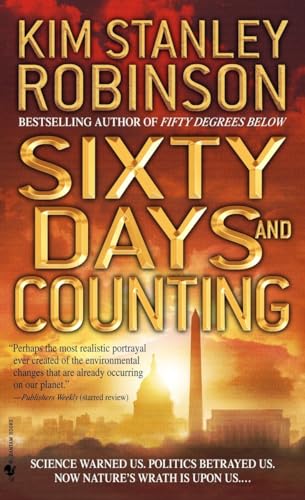
Inhaltsangabe
By the time Phil Chase is elected president, the world’s climate is far on its way to irreversible change. Food scarcity, housing shortages, diminishing medical care, and vanishing species are just some of the consequences. The erratic winter the Washington, D.C., area is experiencing is another grim reminder of a global weather pattern gone haywire: bone-chilling cold one day, balmy weather the next.
But the president-elect remains optimistic and doesn’t intend to give up without a fight. A maverick in every sense of the word, Chase starts organizing the most ambitious plan to save the world from disaster since FDR–and assembling a team of top scientists and advisers to implement it.
For Charlie Quibler, this means reentering the political fray full-time and giving up full-time care of his young son, Joe. For Frank Vanderwal, hampered by a brain injury, it means trying to protect the woman he loves from a vengeful ex and a rogue “black ops” agency not even the president can control–a task for which neither Frank’s work at the National Science Foundation nor his study of Tibetan Buddhism can prepare him.
In a world where time is running out as quickly as its natural resources, where surveillance is almost total and freedom nearly nonexistent, the forecast for the Chase administration looks darker each passing day. For as the last–and most terrible–of natural disasters looms on the horizon, it will take a miracle to stop the clock . . . the kind of miracle that only dedicated men and women can bring about.
Die Inhaltsangabe kann sich auf eine andere Ausgabe dieses Titels beziehen.
Über die Autorin bzw. den Autor
Kim Stanley Robinson is a winner of the Hugo, Nebula, and Locus Awards. He is the author of eleven previous books, including the bestselling Mars trilogy and the critically acclaimed Fifty Degrees Below, Forty Signs of Rain, The Years of Rice and Salt, and Antarctica–for which he was sent to the Antarctic by the U.S. National Science Foundation as part of their Antarctic Artists and Writers’ Program. He lives in Davis, California
Auszug. © Genehmigter Nachdruck. Alle Rechte vorbehalten.
Chapter One
By the time Phil Chase was elected president, the world’s climate was already far along the way to irrevocable change. There were already four hundred parts per million of carbon dioxide in the atmosphere, and another hundred parts would be there soon if civilization continued to burn its fossil carbon–and at this point there was no other option. Just as Franklin Delano Roosevelt was elected in the midst of a crisis that in some ways worsened before it got better, they were entangled in a moment of history when climate change, the destruction of the natural world, and widespread human misery were combining in a toxic and combustible mix. The new president had to contemplate drastic action while at the same time being constrained by any number of economic and politic factors, not least the huge public debt left deliberately by the administrations preceding him.
It did not help that the weather that winter careened wildly from one extreme to another, but was in the main almost as cold as the previous record-breaking year. Chase joked about it everywhere he went: “It’s ten below zero, aren’t you glad you elected me? Just think what it would have been like if you hadn’t!” He would end speeches with a line from the poet Percy Bysshe Shelley:
“O, Wind, if Winter comes, can Spring be far behind?”
“Maybe it can,” Kenzo pointed out with a grin. “We’re in the Youngest Dryas, after all.”
In any case, it was a fluky winter–above all windy–and the American people were in an uncertain state of mind. Chase addressed this: “The only thing we have to fear,” he would intone, “is abrupt climate change!”
He would laugh, and people would laugh with him, understanding him to be saying that there was indeed something real to fear, but that they could do something about it.
His transition team worked with an urgency that resembled desperation. Sea level was rising; temperatures were rising; there was no time to lose. Chase’s good humor and casual style were therefore welcomed, when they were not reviled–much as it had been with FDR in the previous century. He would say, “We got ourselves into this mess and we can get out of it. The problems create an opportunity to remake our relationship to nature, and create a new dispensation. So–happy days are here again! Because we’re making history, we are seizing the planet’s history, I say, and turning it to the good.”
Some scoffed; some listened and took heart; some waited to see what would happen.
As far as Frank Vanderwal’s personal feelings were concerned, there was something reassuring about the world being so messed up. It tended to make his own life look like part of a trend, and a small part at that. A hill of beans in this world. Perhaps even so small as to be manageable.
Although, to tell the truth, it didn’t feel that way. There were reasons to be very concerned, almost to the edge of fear. Frank’s friend Caroline had disappeared on election night, chased by armed agents of some superblack intelligence agency. She had stolen her husband’s plan to steal the election, and Frank had passed this plan to a friend at NSF with intelligence contacts, to what effect he could not be sure. He had helped her to escape her pursuers. To do that he had had to break a date with another friend, his boss and a woman he loved–although what that meant, given the passionate affair he was carrying on with Caroline, he did not know. There was a lot he didn’t know; and he could still taste blood at the back of his throat, months after his nose had been broken. He could not think for long about the same thing. He was living a life that he called parcellated, but others might call dysfunctional: i.e., semi-homeless in Washington, D.C. He could have been back home in San Diego by now, where his teaching position was waiting for him. Instead he was a temporary guest of the embassy of the drowned nation of Khembalung. But hey, everyone had problems! Why should he be any different?
Although brain damage would be a little more than different. Brain damage meant something like–mental illness. It was a hard phrase to articulate when thinking about oneself. But it was possible his injury had exacerbated a lifelong tendency to make poor decisions. It was hard to tell. He had thought all his recent decisions had been correct, after all, in the moment he had made them. Should he not have faith that he was following a valid line of thought? He wasn’t sure.
Thus it was a relief to think that all these personal problems were as nothing compared to the trouble all life on Earth now faced as a functioning biosphere. There were days in which he welcomed the bad news, and he saw that other people were doing the same. As this unpredictable winter blasted them with cold or bathed them in Carribbean balm, there grew in the city a shared interest and good cheer, a kind of solidarity.
Frank felt this solidarity also on the premises of the National Science Foundation, where he and many of his colleagues were trying to deal with the climate problem. To do so, they had to keep trying to understand the environmental effects of:
1)the so-far encouraging but still ambiguous results of their North Atlantic salting operation;
2)the equally ambiguous proliferation of a genetically modified “fast tree lichen” that had been released by the Russians in the Siberian forest;
3)the ongoing rapid detachment and flotation of the coastal verge of the Western Antarctic Ice Sheet;
4)the ongoing introduction of about nine billion tons of carbon dioxide into the atmosphere every year, ultimate source of many other problems;
5)the ensuing uptake of some three billion tons of carbon into the oceans;
6)the continuing rise of the human population by some hundred million people a year; and, lastly,
7)the cumulative impacts of all these events, gnarled together in feedback loops of all kinds.
It was a formidable list, and Frank worked hard on keeping his focus on it.
But he was beginning to see that his personal problems–especially Caroline’s disappearance, and the election-tampering scheme she had been tangled in–were not going to be things he could ignore. They pressed on his mind.
She had called the Khembali embassy that night, and left a message saying that she was okay. Earlier, in Rock Creek Park, she had told him she would be in touch as soon as she could.
He had therefore been waiting for that contact, he told himself. But it had not come. And Caroline’s ex, who had also been her boss, had been following her that night. Her ex had seen that Caroline knew he was following her, and had seen also that Caroline had received help in escaping from him. He also knew that Caroline’s help had thrown a big rock right at his head.
So now this man might very well still be looking for her, and might also be looking for that help she had gotten, as another way of hunting for her.
Or so it seemed. Frank couldn’t be sure. He sat at his desk at NSF, staring at his computer screen, trying to think it through. He could not seem to do it. Whether it was the difficulty of the problem, or the inadequacy of his mentation, he could not be sure; but he could not do it.
So he went to see Edgardo. He entered his colleague’s office and said, “Can we talk about the election result? What happened that night, and what might follow?”
“Ah! Well, that will take some time to discuss. And we were going to run today anyway. Let’s talk about it while en route.”
Frank...
„Über diesen Titel“ kann sich auf eine andere Ausgabe dieses Titels beziehen.
Suchergebnisse für Sixty Days and Counting (Science in the Capital, Band...

Beispielbild für diese ISBN
Sixty Days and Counting
Anbieter: World of Books (was SecondSale), Montgomery, IL, USA
Verkäuferbewertung 5 von 5 Sternen

Zustand: Fair. By the time Phil Chase is elected president, the world's climate is far on its way to irreversible change. Food scarcity, housing shortages, diminishing medical care, and vanishing species are just some of the consequences. The erratic winter the Washington, D.C., area is experiencing is another grim reminder of a global weather pattern gone haywire: bone-chilling cold one day, balmy weather the next. But the president-elect remains optimistic and doesn't intend to give up without a fight. A maverick in every sense of the word, Chase starts organizing the most ambitious plan to save the world from disaster since FDR-and assembling a team of top scientists and advisers to implement it. For Charlie Quibler, this means reentering the political fray full-time and giving up full-time care of his young son, Joe. For Frank Vanderwal, hampered by a brain injury, it means trying to protect the woman he loves from a vengeful ex and a rogue "black ops" agency not even the president can control-a task for which neither Frank's work at the National Science Foundation nor his study of Tibetan Buddhism can prepare him. In a world where time is running out as quickly as its natural resources, where surveillance is almost total and freedom nearly nonexistent, the forecast for the Chase administration looks darker each passing day. For as the last-and most terrible-of natural disasters looms on the horizon, it will take a miracle to stop the clock . . . the kind of miracle that only dedicated men and women can bring about. Artikel-Nr. 00074681476
Gebraucht kaufen
EUR 4,00
Versand gratis
Versand innerhalb von USA
Versand innerhalb von USA
Anzahl: 3 verfügbar
Beispielbild für diese ISBN
Sixty Days and Counting (Science in the Capital)
Verlag:
Spectra (edition Reissue), 2007
ISBN 10: 0553585827
ISBN 13: 9780553585827
Gebraucht
Mass Market Paperback
Anbieter: BooksRun, Philadelphia, PA, USA
Verkäuferbewertung 5 von 5 Sternen
Mass Market Paperback. Zustand: Fair. Reissue. The item might be beaten up but readable. May contain markings or highlighting, as well as stains, bent corners, or any other major defect, but the text is not obscured in any way. Artikel-Nr. 0553585827-7-1
Gebraucht kaufen
EUR 5,25
Versand gratis
Versand innerhalb von USA
Versand innerhalb von USA
Anzahl: 1 verfügbar
Beispielbild für diese ISBN
Sixty Days and Counting
Verlag:
Spectra Books, 2007
ISBN 10: 0553585827
ISBN 13: 9780553585827
Gebraucht
Mass Market Paperback
Anbieter: ThriftBooks-Atlanta, AUSTELL, GA, USA
Verkäuferbewertung 5 von 5 Sternen
Mass Market Paperback. Zustand: As New. No Jacket. Pages are clean and are not marred by notes or folds of any kind. ~ ThriftBooks: Read More, Spend Less. Artikel-Nr. G0553585827I2N00
Gebraucht kaufen
EUR 6,30
Versand gratis
Versand innerhalb von USA
Versand innerhalb von USA
Anzahl: 1 verfügbar
Beispielbild für diese ISBN
Sixty Days and Counting
Verlag:
Spectra Books, 2007
ISBN 10: 0553585827
ISBN 13: 9780553585827
Gebraucht
Mass Market Paperback
Anbieter: ThriftBooks-Dallas, Dallas, TX, USA
Verkäuferbewertung 5 von 5 Sternen
Mass Market Paperback. Zustand: Very Good. No Jacket. May have limited writing in cover pages. Pages are unmarked. ~ ThriftBooks: Read More, Spend Less. Artikel-Nr. G0553585827I4N00
Gebraucht kaufen
EUR 6,30
Versand gratis
Versand innerhalb von USA
Versand innerhalb von USA
Anzahl: 1 verfügbar
Beispielbild für diese ISBN
Sixty Days and Counting
Verlag:
Spectra Books, 2007
ISBN 10: 0553585827
ISBN 13: 9780553585827
Gebraucht
Mass Market Paperback
Anbieter: ThriftBooks-Atlanta, AUSTELL, GA, USA
Verkäuferbewertung 5 von 5 Sternen
Mass Market Paperback. Zustand: Fair. No Jacket. Readable copy. Pages may have considerable notes/highlighting. ~ ThriftBooks: Read More, Spend Less. Artikel-Nr. G0553585827I5N00
Gebraucht kaufen
EUR 6,30
Versand gratis
Versand innerhalb von USA
Versand innerhalb von USA
Anzahl: 1 verfügbar
Beispielbild für diese ISBN
Sixty Days and Counting
Verlag:
Spectra Books, 2007
ISBN 10: 0553585827
ISBN 13: 9780553585827
Gebraucht
Mass Market Paperback
Anbieter: ThriftBooks-Dallas, Dallas, TX, USA
Verkäuferbewertung 5 von 5 Sternen
Mass Market Paperback. Zustand: Good. No Jacket. Pages can have notes/highlighting. Spine may show signs of wear. ~ ThriftBooks: Read More, Spend Less. Artikel-Nr. G0553585827I3N00
Gebraucht kaufen
EUR 6,30
Versand gratis
Versand innerhalb von USA
Versand innerhalb von USA
Anzahl: 1 verfügbar
Beispielbild für diese ISBN
Sixty Days and Counting (Science in the Capital)
Anbieter: Wonder Book, Frederick, MD, USA
Verkäuferbewertung 5 von 5 Sternen
Zustand: Very Good. Very Good condition. A copy that may have a few cosmetic defects. May also contain light spine creasing or a few markings such as an owner's name, short gifter's inscription or light stamp. Artikel-Nr. Q22O-00652
Gebraucht kaufen
EUR 6,32
Versand gratis
Versand innerhalb von USA
Versand innerhalb von USA
Anzahl: 2 verfügbar
Beispielbild für diese ISBN
Sixty Days and Counting
Verlag:
Random House Publishing Group, 2007
ISBN 10: 0553585827
ISBN 13: 9780553585827
Gebraucht
Softcover
Anbieter: Better World Books, Mishawaka, IN, USA
Verkäuferbewertung 5 von 5 Sternen
Zustand: Good. Reprint. Former library copy. Pages intact with minimal writing/highlighting. The binding may be loose and creased. Dust jackets/supplements are not included. Includes library markings. Stock photo provided. Product includes identifying sticker. Better World Books: Buy Books. Do Good. Artikel-Nr. 5675512-75
Gebraucht kaufen
EUR 6,46
Versand gratis
Versand innerhalb von USA
Versand innerhalb von USA
Anzahl: 1 verfügbar
Beispielbild für diese ISBN
Sixty Days and Counting
Verlag:
Random House Publishing Group, 2007
ISBN 10: 0553585827
ISBN 13: 9780553585827
Gebraucht
Softcover
Anbieter: Better World Books, Mishawaka, IN, USA
Verkäuferbewertung 5 von 5 Sternen
Zustand: Good. Reprint. Pages intact with minimal writing/highlighting. The binding may be loose and creased. Dust jackets/supplements are not included. Stock photo provided. Product includes identifying sticker. Better World Books: Buy Books. Do Good. Artikel-Nr. 6465229-6
Gebraucht kaufen
EUR 6,46
Versand gratis
Versand innerhalb von USA
Versand innerhalb von USA
Anzahl: 3 verfügbar
Beispielbild für diese ISBN
Sixty Days and Counting
Verlag:
Bantam, New York, 2007
ISBN 10: 0553585827
ISBN 13: 9780553585827
Gebraucht
Paperback
Erstausgabe
Anbieter: Basically SF Books, Salem, OR, USA
Verkäuferbewertung 4 von 5 Sternen

Paperback. Zustand: Very Good. Dominic Harman (illustrator). First printing of this edition. Light cover wear, tiny creases on back. Spine is straight, not creased or curved. Pages are clean and unmarked. Bantam mass paperback, first printing Nov. 2007, ISBN: 9780553585827. 543 pages, cover art by Dominic Harman. 12mo (4.25" x 6.75") 3rd in series, preceded by Forty Signs of Rain, and Fifty Degrees Below. Artikel-Nr. 121021019780553585827vm
Gebraucht kaufen
EUR 13,55
EUR 4,83 Versand
Versand innerhalb von USA
Versand innerhalb von USA
Anzahl: 1 verfügbar