
Verwandte Artikel zu Beyond Pritikin: A Total Nutrition Program For Rapid...
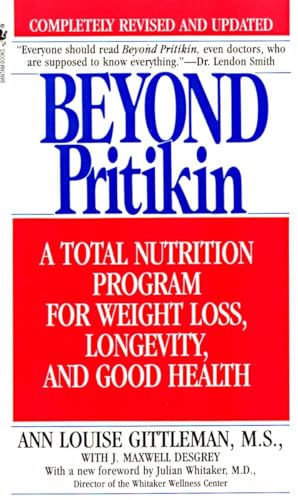
Beyond Pritikin: A Total Nutrition Program For Rapid Weight Loss, Longevity, & Good Health - Softcover
Inhaltsangabe
The proven natural way to a healthier, slimmer life!
Americans have never been more health- and diet-conscious, yet the percentage of overweight Americans is greater than ever before. Could the fat-free diet often promoted for weight loss and health actually be causing sugar cravings, weight gain, fatigue, and other serious problems?
Based on a revolutionary dietary model using healthful essential fats and lower carbohydrate intake, Beyond Pritikin is a complete lifestyle regimen for health, weight loss, and longevity. In this updated program, informed by the latest scientific research, Ann Louise Gittleman, former director of nutrition at the Pritikin Longevity Center, tells you how to lower cholesterol, revitalize your immune system, control weight, and slow the aging process—the major health concerns of our time.
Beyond Pritikin includes:
• The compete guide to the essential fats: how they work, and what foods and dietary supplements contain them
• How carbohydrates, when not balanced in the diet by sufficient protein and fat, stimulate insulin production—which promotes the storage of body fat
• Fat-burning nutrients—natural substances that boost the body’s ability to burn fat
• The original two-week “fat flush” to help detoxify your body and jump-start weight loss
• A 21-day eating program for natural weight loss—including balanced meal plans and delicious recipes to satisfy every taste
• Advice on how to purchase, store, and prepare foods on the Beyond Pritikin Diet Plan
• Plus vital information on the benefits of foods once considered “bad,” the dangers of some “heart-healthy” foods, and much more!
Die Inhaltsangabe kann sich auf eine andere Ausgabe dieses Titels beziehen.
Über die Autorin bzw. den Autor
Ann Louise Gittleman, PhD, CNS, is the award-winning author of the New York Times bestseller The Fat Flush Plan and a weight-loss expert with more than two decades of experience in public health and private practice. She holds a PhD in holistic nutrition, is a certified nutrition specialist, and has a master’s degree in nutrition education, and a naturopathic degree in drugless healing. With more than 3.5 million copies of her books in print, Ann Louise has counseled men and women from all walks of life and has appeared regularly on nationally syndicated radio and TV news shows, including Good Morning America, MSNBC, Fox News, The View, and Dr. Phil. She lives and works in Liberty Lake, Washington.
Auszug. © Genehmigter Nachdruck. Alle Rechte vorbehalten.
1
CURBING THOSE CRAZY CARBOHYDRATES
I know it is almost sacrilegious to criticize carbohydrates, but in light of so many negative effects from their imbalanced and excessive consumption, the time has come to take the carbohydrate craze to task. I am very concerned about the carbohydrate-related health problems so many of my clients are complaining about. Carbohydrate overloading tends to displace protein foods that the body needs for immunity, even blood sugar levels, proper hormonal functioning, and tissue repair. Plus the carbohydrates that everyone is eating, such as bread, pasta, and potatoes, are deficient in the essential fatty acids that control the cardiovascular, reproductive, and nervous systems. As a result, my clients are suffering from sugar cravings; lack of mental concentration; lack of energy; aging skin, hair, and nails; fluid retention; high triglycerides; weight problems; and the need for more and more sleep.
I realize carbohydrates are considered the preferred and cleanest-burning fuel source for human beings. But our national obsession with cutting the fat has produced a number of diet plans (for example, Dean Ornish’s, John McDougall’s, and Susan Powter’s) that are unusually high in carbohydrates and, therefore, deficient in essential fatty acids—which ultimately are the real keys to overall health. As fat expert Edward Siguel, M.D., Ph.D. points out, even the U.S. Department of Agriculture’s “Food Guide Pyramid” recommends that each day you eat from 6 to 11 servings of bread, cereal, rice, and potatoes—all foods that contain practically no essential fatty acids. Furthermore, if you decided to follow the government’s guidelines, you would consume fats and oils sparingly because, according to the USDA, these foods contribute basically only calories to the diet.
I had a glimpse of carbohydrate-related health concerns (such as gluten intolerance and yeast overgrowth) in my early years working at the Pritikin Longevity Center. I discuss those conditions in the chapter entitled “Pritikin Promises and Pitfalls” and now expand upon them with some new observations. Of all the low-fat, high–complex-carbohydrate diets on the market today, the Pritikin Eating Plan is probably the most well balanced and researched. There also have been efforts made by the Pritikin educators to alert participants to the “glycemic” or blood sugar effect of certain carbohydrates (which I discuss later in this chapter), an issue that I feel is of vital importance.
Yet what I saw in those early years is nothing compared to the extreme diet histories my clients are manifesting now that they have become so fat-phobic. Many individuals are cutting down on basic nutritional staples such as eggs, meat, and butter due to misguided concerns about cholesterol and fat. Unfortunately, they have been substituting sugar for the missing fat and protein calories. What is showing up on diet histories now are record numbers of fat-free jelly beans, honey- or fruit juice–sweetened cookies, and low-fat (but sugar-rich) frozen yogurt.
All studies show that Americans are eating less fat today. The U.S. Department of Agriculture has reported a 14-pound drop in red meat consumption between 1980 and 1990. In the past 20 years, butter intake has dropped by a whopping 25 percent. But at the same time, the per capita ingestion of sugar has increased by 20 pounds per person per year. Those overweight have hit record numbers not because of increased fat intake but because Americans are overdoing the sugar and carbohydrates, which can, of course, turn to fat.
The popular diet mantras of “Eat more, weigh less” and “Stop the insanity” convey the faulty message that you can eat whatever you want, whenever you want, as long as the food is fat-free and full of fiber. Even the government has climbed on the “all fat is bad” bandwagon with the publication of the “Food Guide Pyramid.” According to the Food and Drug Administration’s new food labeling guidelines, in an average 2,000-calorie-a-day diet, more than half the calories should be from carbohydrates. (That’s 300 grams a day!) Many diet gurus have joined the federal government and are now promoting a 70-percent carbohydrate diet. Consequently, there are a lot of people out there filling up on no-fat foods that contain up to 75 percent sugar.
So many people believe that nonfat means non-fattening that sales of no-fat and low-fat cookies have skyrocketed 70 percent during the last year, and the Number One cookie sold in America is no longer Oreos but fat-free SnackWells. But all those fat-free cookies and fat-free yogurts and muffins add up in carbohydrates and are usually loaded with sugar. Too much sugar can depress the immune system, feed yeast problems, and wreak havoc with blood sugar functioning. High sugar intake is linked to higher insulin levels, extreme hunger, and consequently, overeating and weight gain.
Speaking of high insulin levels, it seems that a growing number of Americans, maybe even 25 percent of all adults and an even larger percentage of the obese, have a problem with carbohydrate metabolism due to a resistance to insulin. Insulin is a hormone that metabolizes glucose from carbohydrates into energy. Insulin resistance is a condition in which body cells resist the action of insulin and the body overproduces insulin because of an excess of sugary and simple carbohydrate foods.
Fat phobia has spawned the carbohydrate craze that in turn has resulted in widespread insulin resistance and a whole new generation of carbohydrate addicts and carbohydrate sensitives. The term “carbohydrate addict” was first popularized by Mount Sinai Hospital researchers Drs. Richard and Rachel Heller in a book called The Carbohydrate Addict’s Diet (Signet Books, 1993). The Hellers identified a disorder they called carbohydrate addiction and believe that nearly 75 percent of all overweight individuals may suffer from it. Individuals who have this condition have imbalanced insulin levels and are constantly hungry and crave carbohydrate-rich foods. In his book Dr. Atkins’ New Diet Revolution (Evans, 1992), Robert Atkins, M.D., devotes an entire chapter, “Insulin—The Hormone That Makes You Fat,” to insulin-related food cravings and weight problems.
Biochemist Barry Sears, Ph.D., has reported that high blood insulin levels promote fat storage and the inability to access stored fat because they activate the enzyme adipose tissue lipoprotein-lipase (AT-LPL). This enzyme acts like a master key to fat storage. Individuals who consistently eat foods that generate a high-insulin response, therefore, are promoting fat storage.
The term “carbohydrate toxicity” was coined by obesity specialist Dr. Wayne Calloway of George Washington University, who is equally critical of and concerned about carbohydrate preoccupation. In a New York Times article, he stated: “Chronic dieters often gain weight on high-carbohydrate diets because they have lost the ability to get rid of fluid.”
The New York Times covered the completely ignored but very basic scientific information about the insulin connection to overweight conditions in its February 8, 1995, article entitled “So It May Be True After All: Eating Pasta Makes You Fat.” The article quotes Dr. Artemis P. Simopoulos, former chairwoman of the nutritional coordinating committee of the National Institutes of Health and current president of the Center for Genetics Nutrition and Health in Washington. She said: “Insulin resistance is associated with obesity, and for many years it was thought to follow obesity....
„Über diesen Titel“ kann sich auf eine andere Ausgabe dieses Titels beziehen.
Suchergebnisse für Beyond Pritikin: A Total Nutrition Program For Rapid...

Beispielbild für diese ISBN
Beyond Pritikin: A Total Nutrition Program For Rapid Weight Loss, Longevity, & Good Health
Anbieter: World of Books (was SecondSale), Montgomery, IL, USA
Verkäuferbewertung 5 von 5 Sternen

Zustand: Acceptable. Item in acceptable condition including possible liquid damage. As well, answers may be filled in. Lastly, may be missing components, e.g. missing DVDs, CDs, Access Code, etc. Artikel-Nr. 00031536405
Gebraucht kaufen
EUR 4,36
Versand gratis
Versand innerhalb von USA
Versand innerhalb von USA
Anzahl: 1 verfügbar
Beispielbild für diese ISBN
Beyond Pritikin: A Total Nutrition Program For Rapid Weight Loss, Longevity, & Good Health
Verlag:
Bantam (edition Reprint), 1996
ISBN 10: 0553574000
ISBN 13: 9780553574005
Gebraucht
Mass Market Paperback
Anbieter: BooksRun, Philadelphia, PA, USA
Verkäuferbewertung 5 von 5 Sternen
Mass Market Paperback. Zustand: Very Good. Reprint. It's a well-cared-for item that has seen limited use. The item may show minor signs of wear. All the text is legible, with all pages included. It may have slight markings and/or highlighting. Artikel-Nr. 0553574000-8-1
Gebraucht kaufen
EUR 4,36
Versand gratis
Versand innerhalb von USA
Versand innerhalb von USA
Anzahl: 1 verfügbar
Beispielbild für diese ISBN
Beyond Pritikin: A Total Nutrition Program for Rapid Weight Loss, Longevity, & Good Health
Anbieter: ThriftBooks-Atlanta, AUSTELL, GA, USA
Verkäuferbewertung 5 von 5 Sternen
Mass Market Paperback. Zustand: As New. No Jacket. Pages are clean and are not marred by notes or folds of any kind. ~ ThriftBooks: Read More, Spend Less. Artikel-Nr. G0553574000I2N00
Gebraucht kaufen
EUR 6,10
Versand gratis
Versand innerhalb von USA
Versand innerhalb von USA
Anzahl: 1 verfügbar
Beispielbild für diese ISBN
Beyond Pritikin: A Total Nutrition Program For Rapid Weight Loss, Longevity, & Good Health
Anbieter: Wonder Book, Frederick, MD, USA
Verkäuferbewertung 5 von 5 Sternen
Zustand: Very Good. Very Good condition. A copy that may have a few cosmetic defects. May also contain light spine creasing or a few markings such as an owner's name, short gifter's inscription or light stamp. Artikel-Nr. Q22A-05386
Gebraucht kaufen
EUR 6,21
Versand gratis
Versand innerhalb von USA
Versand innerhalb von USA
Anzahl: 1 verfügbar
Beispielbild für diese ISBN
Beyond Pritikin : A Total Nutrition Program for Rapid Weight Loss, Longevity, and Good Health
Verlag:
Random House Publishing Group, 1996
ISBN 10: 0553574000
ISBN 13: 9780553574005
Gebraucht
Softcover
Anbieter: Better World Books: West, Reno, NV, USA
Verkäuferbewertung 5 von 5 Sternen
Zustand: Very Good. Pages intact with possible writing/highlighting. Binding strong with minor wear. Dust jackets/supplements may not be included. Stock photo provided. Product includes identifying sticker. Better World Books: Buy Books. Do Good. Artikel-Nr. 38476722-6
Gebraucht kaufen
EUR 9,77
Versand gratis
Versand innerhalb von USA
Versand innerhalb von USA
Anzahl: 1 verfügbar
Beispielbild für diese ISBN
Beyond Pritikin: a Total Nutrition Program for Rapid Weight Loss, Longevity and Good Health
Anbieter: AwesomeBooks, Wallingford, Vereinigtes Königreich
Verkäuferbewertung 5 von 5 Sternen
Mass Market Paperback. Zustand: Very Good. Beyond Pritikin: a Total Nutrition Program for Rapid Weight Loss, Longevity and Good Health This book is in very good condition and will be shipped within 24 hours of ordering. The cover may have some limited signs of wear but the pages are clean, intact and the spine remains undamaged. This book has clearly been well maintained and looked after thus far. Money back guarantee if you are not satisfied. See all our books here, order more than 1 book and get discounted shipping. Artikel-Nr. 7719-9780553574005
Gebraucht kaufen
EUR 6,15
EUR 4,81 Versand
Versand von Vereinigtes Königreich nach USA
Versand von Vereinigtes Königreich nach USA
Anzahl: 2 verfügbar
Beispielbild für diese ISBN
Beyond Pritikin: a Total Nutrition Program for Rapid Weight Loss, Longevity and Good Health
Anbieter: Bahamut Media, Reading, Vereinigtes Königreich
Verkäuferbewertung 5 von 5 Sternen
Mass Market Paperback. Zustand: Very Good. This book is in very good condition and will be shipped within 24 hours of ordering. The cover may have some limited signs of wear but the pages are clean, intact and the spine remains undamaged. This book has clearly been well maintained and looked after thus far. Money back guarantee if you are not satisfied. See all our books here, order more than 1 book and get discounted shipping. Artikel-Nr. 6545-9780553574005
Gebraucht kaufen
EUR 6,20
EUR 8,14 Versand
Versand von Vereinigtes Königreich nach USA
Versand von Vereinigtes Königreich nach USA
Anzahl: 2 verfügbar
Beispielbild für diese ISBN
Beyond Pritikin: A Total Nutrition Program For Rapid Weight Loss, Longevity, & Good Health
Anbieter: Sell Books, Elland, YORKS, Vereinigtes Königreich
Verkäuferbewertung 5 von 5 Sternen
mass_market. Zustand: Very Good. Most of our very good books have only minor imperfections such as shelf wear consistent with a new book that's sat on a bookshop shelf for a year or two. Occasionally we may miss other minor imperfections as we have to grade books at speed. Our books are dispatched from a Yorkshire former cotton mill. We list via barcode/ISBN so please note that the images are stock images and may not be the exact copy you receive, furthermore the details about edition and year might not be accurate as many publishers reuse the same ISBN for multiple editions and as we simply scan a barcode or enter an ISBN we do not check the validity of the edition data when listing. If you're looking for an exact edition please don't order (at least not without checking with us first, although we don't always have time to check). We aim to dispatch prompty, the service used will depend on order value and book size. We can ship to most countries, see our shipping policies. Payment is via Abe only. Artikel-Nr. L-BIF01234-RAG-20250910-VG
Gebraucht kaufen
EUR 4,06
EUR 14,18 Versand
Versand von Vereinigtes Königreich nach USA
Versand von Vereinigtes Königreich nach USA
Anzahl: 1 verfügbar