
Verwandte Artikel zu Ten Second Staircase: A Peculiar Crimes Unit Mystery...
Ten Second Staircase: A Peculiar Crimes Unit Mystery (Bryant & May: Peculiar Crimes Unit Mystery, 4) - Softcover
Buch 4 von 18: Peculiar Crimes Unit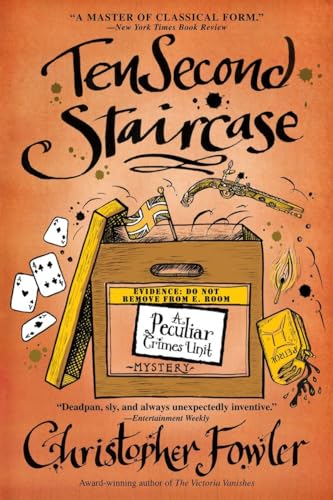
Inhaltsangabe
It’s a crime tailor-made for the Peculiar Crimes Unit: a controversial artist is murdered and displayed as part of her own outrageous installation. No suspects, no motive, no evidence—but this time they do have an eyewitness. A twelve-year-old claims the killer was a cape-clad highwayman atop a black stallion. Whoever the killer really is, he seems intent on killing off enough minor celebrities to become one himself. As “Highwayman Fever” grips London, Bryant and May, along with the newest member of the Unit, May’s agoraphobic granddaughter, April, find themselves sorting out a case involving artistic rivalries, sleazy sex affairs, the Knights Templars, feuding street gangs, and a decades-old crime spree that split up their partnership once before—and threatens to end it again…with murder.
Die Inhaltsangabe kann sich auf eine andere Ausgabe dieses Titels beziehen.
Über die Autorin bzw. den Autor
Christopher Fowler was the acclaimed author of the award-winning Peculiar Crimes Unit mysteries: Full Dark House, The Water Room, Seventy-Seven Clocks, Ten Second Staircase, White Corridor, The Victoria Vanishes, Bryant & May on the Loose, Bryant & May off the Rails, The Memory of Blood, The Invisible Code, Bryant & May and the Bleeding Heart, Bryant & May and the Burning Man, Bryant & May: Strange Tide, Bryant & May: Wild Chamber, Bryant & May: Hall of Mirrors, Bryant & May: The Lonely Hour, Bryant & May: Oranges & Lemons, Bryant & May: London Bridge Is Falling Down, and Bryant & May: Peculiar London. In 2015 Fowler won the coveted Crime Writers’ Association Dagger in the Library Award in recognition for his body of work. Christopher Fowler died in 2023.
Auszug. © Genehmigter Nachdruck. Alle Rechte vorbehalten.
Chapter One
Cradle to Grave
MEMORANDUM
PRIVATE AND CONFIDENTIAL
Attachments Supplied: 3458SD, 19904KT
To: Leslie Faraday, Senior Home Office Liaison Officer
From: Raymond Land, Acting Head, PCU, London NW1 3BL
Date: Monday, 17 October
Dear Mr Faraday,
Thank you for your correspondence of 26 September requesting further details concerning my tenure at the North London Peculiar Crimes Unit.
If I understand you correctly, you wish me to outline the recent problems I have experienced at this unit from a personal perspective. While I am loath to commit myself in writing over such a delicate matter, and dislike 'telling tales' on staff members despite their extreme lack of co-operation over the last few months, I feel the time has come to unburden myself to someone in a position of greater authority. In short, Mr Faraday, I can no longer maintain my silence. I have simply reached the end of my tether.
I appreciate that, as the 'new broom' at HO Special Services Liaison, taking over from HMCO Liaison DCI Stanley Marsden, you must have a great deal of background material to study. I shall therefore attempt to save you some work by summarising our current situation.
The Peculiar Crimes Unit was founded, along with a handful of other specialist departments, soon after the outbreak of World War II, as part of a government initiative to ease the burden on London's overstretched Metropolitan Police Force, by tackling high-profile cases which had the capacity to compound social problems in urban areas. The crimes falling within its remit were often of a politically sensitive nature, or could potentially cause social panics and general public malaise. The division's civilian counterpart at that time was the Central Therapy Unit, set up to help the bereaved and the homeless cope with the psychological stress of war. This unit closed after just eleven months because bombed-out residents continued turning to their neighbours for support rather than visiting qualified specialists. There was also, if memory serves, an experimental propaganda division called the Central Information Service (later to become the COI), which provided positive, uplifting news items to national newspapers in order to combat hearsay and harmful disinformation spread about our overseas forces, and to fill the void left by the blanket news blackouts. The PCU proved more successful than either of these, and remained in operation through the war.
I am led to believe that the title 'peculiar' was originally meant in the sense of 'particular,' as the government's plan was that the new unit should handle those cases deemed uniquely sensitive and a high risk to public morale. To head this division, several extremely young and inexperienced students were recruited. One must remember that this was a time of desperation, when most able-bodied men had been taken into the armed forces, and a great many experimental ideas were proposed by the Churchill government.
A number of successful prosecutions were brought by the Peculiar Crimes Unit in the years that followed, with the result that the unit continued its work into peacetime. The rebuilding of Britain required the suppression of those prosecutions deemed too negative for public knowledge (a fifty-year embargo being placed on sensitive war reports), and many cases handled by the PCU at this time remainedsub judice.
In order to provide continuity, the sons and daughters of original staff members were recruited, so that the founding team was largely replaced with new employees, but two gentlemen remained in their old positions. I refer, of course, to Mr Arthur Bryant and Mr John May (see attached file 3458SD). This is where the problem starts, for both of them, despite their advanced age, are still here at the unit. They stayed on because the unit granted them a high degree of autonomy, and their specialist knowledge, plus their refusal to accept promotion, continuing instead to tackle crime at street level, won them the allegiance of young incoming staff in the Metropolitan Police Force. In years to come, as their supporters moved to positions of power, these loyalties proved useful to the detectives.
I know that the PCU has lately had some success in solving crimes that have come to the attention of the general public. I am also aware that its most senior detectives are highly respected and can offer an enormous amount of experience between them, but their manner is disruptive and their behaviour--certainly in terms of efficient, modern crime management--is unorthodox, and damaging to the image of the national policing network.
Their long-running investigation into the murders of young women committed by the so-called Leicester Square Vampire, last sighted in 1975, brought the PCU into disrepute. Their working practises proved questionable, and the case remains unsolved to this day. The unit's brief is admittedly unusual; their cases rarely provide the opportunity to follow direct leads and name suspects, but their methodology is regarded as altogether too vague, intellectual, socialist, and downright arty by those who work on the 'coal face' of crime, an image the detectives have sought to foster rather than disabuse.
Heaven knows I am no intellectual, but even I can tell that these gentlemen would be better employed as academics than as police officers. Mr May once told me that he could be loosely termed a follower of Jean-Jacques Rousseau, the rational progressive who sometimes placed feeling over reason, but Mr Bryant's philosophical attitude towards criminal investigation is more complex and troubling; although enlightened and well-read, a 'cold fish' who rarely empathises with victims of crime, he is quite prepared to resort to the kind of Counter-Enlightenment mysticism that allows some rationalists to believe in ley lines and crystal healing when it suits them. Simply stated, Mr Bryant and Mr May are completely out of touch with the problems of today's youth. Elderly people rarely commit crimes; how can Mr Bryant and Mr May possibly hope to understand what is happening on the streets of London anymore?
The general public must be able to feel that their lives are in safe hands. As you know, not long ago Mr Bryant accidentally blew up his own unit. Subsequently he managed to get himself shut in a sewer, and nearly died. His partner has had one heart attack, and flagrantly defies doctor's orders to lead a less stressful working life. Nor does Mr May help our image by conducting a very public affair with a married woman. The pair keep irregular hours, behave and dress oddly, and encourage everyone else in their employ to do the same. Detective Sergeant Janice Longbright seems to model herself on Diana Dors, the fifties Rank starlet, and comes to work in the most extraordinarily provocative outfits. I sometimes wonder if we're running a police unit or an escort agency.
Neither Mr Bryant nor Mr May believes in traditional hierarchy. They speak to their colleagues as equals, and frequently ask advice from the most inexperienced members of staff. Obviously, this will not do. Mr Bryant took his exams a very long time ago, and is unwilling to entertain the idea of modern police procedure. He's always touching things; it's only luck that prevents half his cases from being thrown out of court due to cross-contamination of evidence. The criminal world has altered drastically since his time. Even constables are required to pass exams in criminal law, traffic law, and general police duties, but Mr Bryant has somehow been granted immunity from evaluation tests. He has repeatedly refused to take his Objective Structured Performance Related Examination, and deliberately falsifies results from his continuous appraisals.
Of course, the national police force now operates under a regime of openness...
„Über diesen Titel“ kann sich auf eine andere Ausgabe dieses Titels beziehen.
Suchergebnisse für Ten Second Staircase: A Peculiar Crimes Unit Mystery...

Beispielbild für diese ISBN
Ten Second Staircase A Peculia
Verlag:
Random House Publishing Group, 2008
ISBN 10: 0553385569
ISBN 13: 9780553385564
Gebraucht
Softcover
Anbieter: World of Books (was SecondSale), Montgomery, IL, USA
Verkäuferbewertung 5 von 5 Sternen

Zustand: Very Good. Item in very good condition! Textbooks may not include supplemental items i.e. CDs, access codes etc. Artikel-Nr. 00109847275
Gebraucht kaufen
EUR 6,26
Versand gratis
Versand innerhalb von USA
Versand innerhalb von USA
Anzahl: 1 verfügbar
Beispielbild für diese ISBN
Ten Second Staircase: A Peculiar Crimes Unit Mystery
Anbieter: Wonder Book, Frederick, MD, USA
Verkäuferbewertung 5 von 5 Sternen
Zustand: Good. Good condition. A copy that has been read but remains intact. May contain markings such as bookplates, stamps, limited notes and highlighting, or a few light stains. Artikel-Nr. V08B-07724
Gebraucht kaufen
EUR 6,27
Versand gratis
Versand innerhalb von USA
Versand innerhalb von USA
Anzahl: 1 verfügbar
Beispielbild für diese ISBN
Ten Second Staircase : A Peculiar Crimes Unit Mystery
Verlag:
Random House Publishing Group, 2008
ISBN 10: 0553385569
ISBN 13: 9780553385564
Gebraucht
Softcover
Anbieter: Better World Books: West, Reno, NV, USA
Verkäuferbewertung 5 von 5 Sternen
Zustand: Good. Reprint. Pages intact with minimal writing/highlighting. The binding may be loose and creased. Dust jackets/supplements are not included. Stock photo provided. Product includes identifying sticker. Better World Books: Buy Books. Do Good. Artikel-Nr. 655699-75
Gebraucht kaufen
EUR 6,41
Versand gratis
Versand innerhalb von USA
Versand innerhalb von USA
Anzahl: 1 verfügbar
Beispielbild für diese ISBN
Ten Second Staircase : A Peculiar Crimes Unit Mystery
Verlag:
Random House Publishing Group, 2008
ISBN 10: 0553385569
ISBN 13: 9780553385564
Gebraucht
Softcover
Anbieter: Better World Books: West, Reno, NV, USA
Verkäuferbewertung 5 von 5 Sternen
Zustand: Good. Reprint. Former library copy. Pages intact with minimal writing/highlighting. The binding may be loose and creased. Dust jackets/supplements are not included. Includes library markings. Stock photo provided. Product includes identifying sticker. Better World Books: Buy Books. Do Good. Artikel-Nr. 5626275-6
Gebraucht kaufen
EUR 6,41
Versand gratis
Versand innerhalb von USA
Versand innerhalb von USA
Anzahl: 1 verfügbar
Beispielbild für diese ISBN
Ten Second Staircase : A Peculiar Crimes Unit Mystery
Verlag:
Random House Publishing Group, 2008
ISBN 10: 0553385569
ISBN 13: 9780553385564
Gebraucht
Softcover
Anbieter: Better World Books, Mishawaka, IN, USA
Verkäuferbewertung 5 von 5 Sternen
Zustand: Good. Reprint. Pages intact with minimal writing/highlighting. The binding may be loose and creased. Dust jackets/supplements are not included. Stock photo provided. Product includes identifying sticker. Better World Books: Buy Books. Do Good. Artikel-Nr. 655699-75
Gebraucht kaufen
EUR 6,41
Versand gratis
Versand innerhalb von USA
Versand innerhalb von USA
Anzahl: 1 verfügbar
Beispielbild für diese ISBN
Ten Second Staircase: Ten Second Staircase: A Peculiar Crimes Unit Mystery
Anbieter: ThriftBooks-Reno, Reno, NV, USA
Verkäuferbewertung 5 von 5 Sternen
Paperback. Zustand: Good. No Jacket. Former library book; Pages can have notes/highlighting. Spine may show signs of wear. ~ ThriftBooks: Read More, Spend Less. Artikel-Nr. G0553385569I3N10
Gebraucht kaufen
EUR 7,38
Versand gratis
Versand innerhalb von USA
Versand innerhalb von USA
Anzahl: 1 verfügbar
Beispielbild für diese ISBN
Ten Second Staircase: Ten Second Staircase: A Peculiar Crimes Unit Mystery
Anbieter: ThriftBooks-Dallas, Dallas, TX, USA
Verkäuferbewertung 5 von 5 Sternen
Paperback. Zustand: Fair. No Jacket. Readable copy. Pages may have considerable notes/highlighting. ~ ThriftBooks: Read More, Spend Less. Artikel-Nr. G0553385569I5N00
Gebraucht kaufen
EUR 7,38
Versand gratis
Versand innerhalb von USA
Versand innerhalb von USA
Anzahl: 2 verfügbar
Beispielbild für diese ISBN
Ten Second Staircase: Ten Second Staircase: A Peculiar Crimes Unit Mystery
Anbieter: ThriftBooks-Atlanta, AUSTELL, GA, USA
Verkäuferbewertung 5 von 5 Sternen
Paperback. Zustand: Good. No Jacket. Pages can have notes/highlighting. Spine may show signs of wear. ~ ThriftBooks: Read More, Spend Less. Artikel-Nr. G0553385569I3N00
Gebraucht kaufen
EUR 7,38
Versand gratis
Versand innerhalb von USA
Versand innerhalb von USA
Anzahl: 2 verfügbar
Beispielbild für diese ISBN
Ten Second Staircase: Ten Second Staircase: A Peculiar Crimes Unit Mystery
Anbieter: ThriftBooks-Reno, Reno, NV, USA
Verkäuferbewertung 5 von 5 Sternen
Paperback. Zustand: Fair. No Jacket. Readable copy. Pages may have considerable notes/highlighting. ~ ThriftBooks: Read More, Spend Less. Artikel-Nr. G0553385569I5N00
Gebraucht kaufen
EUR 7,38
Versand gratis
Versand innerhalb von USA
Versand innerhalb von USA
Anzahl: 1 verfügbar
Beispielbild für diese ISBN
Ten Second Staircase: Ten Second Staircase: A Peculiar Crimes Unit Mystery
Anbieter: ThriftBooks-Phoenix, Phoenix, AZ, USA
Verkäuferbewertung 5 von 5 Sternen
Paperback. Zustand: Fair. No Jacket. Readable copy. Pages may have considerable notes/highlighting. ~ ThriftBooks: Read More, Spend Less. Artikel-Nr. G0553385569I5N00
Gebraucht kaufen
EUR 7,38
Versand gratis
Versand innerhalb von USA
Versand innerhalb von USA
Anzahl: 1 verfügbar