
Verwandte Artikel zu The Grand Design
Inhaltsangabe
#1 NEW YORK TIMES BESTSELLER • “A whirlwind tour of fundamental physics and cosmology.”—The Wall Street Journal
“Fascinating . . . a wealth of ideas [that] leave us with a clearer understanding of modern physics in all its invigorating complexity.”—Los Angeles Times
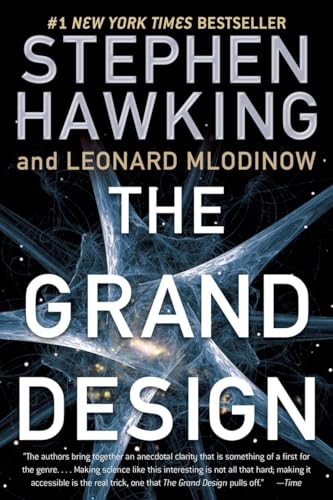
When and how did the universe begin? Why are we here? What is the nature of reality? Is the apparent “grand design” of our universe evidence of a benevolent creator who set things in motion—or does science offer another explanation? In The Grand Design, Stephen Hawking and Leonard Mlodinow present the most illuminating scientific thinking about these and other abiding mysteries of the universe, in nontechnical language marked by brilliance and simplicity.
According to quantum theory, the cosmos does not have just a single existence or history. The authors explain that we ourselves are the product of quantum fluctuations in the early universe and show how quantum theory predicts the “multiverse”—the idea that ours is just one of many universes that appeared spontaneously out of nothing, each with different laws of nature. They conclude with a riveting assessment of M-theory, an explanation of the laws governing our universe that is currently the only viable candidate for a “theory of everything”: the unified theory that Einstein was looking for, which, if confirmed, would represent the ultimate triumph of human reason.
A succinct, startling, and lavishly illustrated guide to discoveries that are altering our understanding and threatening some of our most cherished belief systems, The Grand Design is a book that will inform—and provoke—like no other.
Die Inhaltsangabe kann sich auf eine andere Ausgabe dieses Titels beziehen.
Über die Autorin bzw. den Autor
Stephen Hawking was the Lucasian Professor of Mathematics at the University of Cambridge for thirty years and the recipient of numerous awards and honors including the Presidential Medal of Freedom. His books for the general reader include My Brief History, the classic A Brief History of Time, the essay collection Black Holes and Baby Universes, The Universe in a Nutshell, and, with Leonard Mlodinow, A Briefer History of Time and The Grand Design. Stephen Hawking died in 2018.
Leonard Mlodinow received his doctorate in theoretical physics from the University of California at Berkeley, and teaches at Caltech. He is the New York Times bestselling author of The Drunkard’s Walk: How Randomness Rules our Lives, Subliminal: How Your Unconscious Mind Rules Your Behavior, War of the Worldviews: Science versus Spirituality (with Deepak Chopra), Feynman’s Rainbow: A Search for Beauty in Physics and in Life, and Euclid’s Window: The Story of Geometry from Parallel Lines to Hyperspace. He also wrote for Star Trek: The Next Generation. He lives in South Pasadena, California.
Auszug. © Genehmigter Nachdruck. Alle Rechte vorbehalten.
Chapter 1
We each exist for but a short time, and in that time explore but a small part of the whole universe. But humans are a curious species. We wonder, we seek answers. Living in this vast world that is by turns kind and cruel, and gazing at the immense heavens above, people have always asked a multitude of questions: How can we understand the world in which we find ourselves? How does the universe behave? What is the nature of reality? Where did all this come from? Did the universe need a creator? Most of us do not spend most of our time worrying about these questions, but almost all of us worry about them some of the time.
Traditionally these are questions for philosophy, but philosophy is dead. Philosophy has not kept up with modern developments in science, particularly physics. Scientists have become the bearers of the torch of discovery in our quest for knowledge. The purpose of this book is to give the answers that are suggested by recent discoveries and theoretical advances. They lead us to a new picture of the universe and our place in it that is very different from the traditional one, and different even from the picture we might have painted just a decade or two ago. Still, the first sketches of the new concept can be traced back almost a century.
According to the traditional conception of the universe, objects move on well-defined paths and have definite histories. We can specify their precise position at each moment in time. Although that account is successful enough for everyday purposes, it was found in the 1920s that this "classical" picture could not account for the seemingly bizarre behavior observed on the atomic and subatomic scales of existence. Instead it was necessary to adopt a different framework, called quantum physics. Quantum theories have turned out to be remarkably accurate at predicting events on those scales, while also reproducing the predictions of the old classical theories when applied to the macroscopic world of daily life. But quantum and classical physics are based on very different conceptions of physical reality.
Quantum theories can be formulated in many different ways, but what is probably the most intuitive description was given by Richard (Dick) Feynman, a colorful character who worked at the California Institute of Technology and played the bongo drums at a strip joint down the road. According to Feynman, a system has not just one history but every possible history. As we seek our answers, we will explain Feynman's approach in detail, and employ it to explore the idea that the universe itself has no single history, nor even an independent existence. That seems like a radical idea, even to many physicists. Indeed, like many notions in today's science, it appears to violate common sense. But common sense is based upon everyday experience, not upon the universe as it is revealed through the marvels of technologies such as those that allow us to gaze deep into the atom or back to the early universe.
Until the advent of modern physics it was generally thought that all knowledge of the world could be obtained through direct observation, that things are what they seem, as perceived through our senses. But the spectacular success of modern physics, which is based upon concepts such as Feynman's that clash with everyday experience, has shown that that is not the case. The naive view of reality therefore is not compatible with modern physics. To deal with such paradoxes we shall adopt an approach that we call model-dependent realism. It is based on the idea that our brains interpret the input from our sensory organs by making a model of the world. When such a model is successful at explaining events, we tend to attribute to it, and to the elements and concepts that constitute it, the quality of reality or absolute truth. But there may be different ways in which one could model the same physical situation, with each employing different fundamental elements and concepts. If two such physical theories or models accurately predict the same events, one cannot be said to be more real than the other; rather, we are free to use whichever model is most convenient.
In the history of science we have discovered a sequence of better and better theories or models, from Plato to the classical theory of Newton to modern quantum theories. It is natural to ask: Will this sequence eventually reach an end point, an ultimate theory of the universe, that will include all forces and predict every observation we can make, or will we continue forever finding better theories, but never one that cannot be improved upon? We do not yet have a definitive answer to this question, but we now have a candidate for the ultimate theory of everything, if indeed one exists, called M- theory. M-theory is the only model that has all the properties we think the final theory ought to have, and it is the theory upon which much of our later discussion is based.
M-theory is not a theory in the usual sense. It is a whole family of different theories, each of which is a good description of observations only in some range of physical situations. It is a bit like a map. As is well known, one cannot show the whole of the earth's surface on a single map. The usual Mercator projection used for maps of the world makes areas appear larger and larger in the far north and south and doesn't cover the North and South Poles. To faithfully map the entire earth, one has to use a collection of
maps, each of which covers a limited region. The maps overlap each other, and where they do, they show the same landscape.
M-theory is similar. The different theories in the M-theory family may look very different, but they can all be regarded as aspects of the same underlying theory. They are versions of the theory that are applicable only in limited ranges-for example, when certain quantities such as energy are small. Like the overlapping maps in a Mercator projection, where the ranges of different versions overlap, they predict the same phenomena. But just as there is no flat map that is a good representation of the earth's entire surface, there is no single theory that is a good representation of observations in all situations.
We will describe how M-theory may offer answers to the question of creation. According to M-theory, ours is not the only universe. Instead, M-theory predicts that a great many universes were created out of nothing. Their creation does not require the intervention of some supernatural being or god. Rather, these multiple universes arise naturally from physical law. They are a prediction of science. Each universe has many possible histories and many possible states at later times, that is, at times like the present, long after their creation. Most of these states will be quite unlike the universe we observe and quite unsuitable for the existence of any form of life. Only a very few would allow creatures like us to exist. Thus our presence selects out from this vast array only those universes that are compatible with our existence. Although we are puny and insignificant on the scale of the cosmos, this makes us in a sense the lords of creation.
To understand the universe at the deepest level, we need to know not only how the universe behaves, but why.
Why is there something rather than nothing?
Why do we exist?
Why this particular set of laws and not some other?
This is the Ultimate Question of Life, the Universe, and Everything. We shall attempt to answer it in this book. Unlike the answer given in The Hitchhiker's Guide to the Galaxy, ours won't be simply "42."
2
The Rule of Law
Skoll the wolf who shall scare the Moon
Till he flies to the Wood-of-Woe:
Hati the wolf, Hridvitnir's kin,
Who shall pursue the sun.
-"Grimnismal," The Elder Edda
n Viking mythology, Skoll and Hati chase the sun and the...
„Über diesen Titel“ kann sich auf eine andere Ausgabe dieses Titels beziehen.
Suchergebnisse für The Grand Design

Beispielbild für diese ISBN
The Grand Design
Anbieter: World of Books (was SecondSale), Montgomery, IL, USA
Verkäuferbewertung 5 von 5 Sternen

Zustand: Good. Item in good condition. Textbooks may not include supplemental items i.e. CDs, access codes etc. Artikel-Nr. 00093577220
Gebraucht kaufen
EUR 3,61
Versand gratis
Versand innerhalb von USA
Versand innerhalb von USA
Anzahl: 19 verfügbar
Beispielbild für diese ISBN
The Grand Design
Anbieter: World of Books (was SecondSale), Montgomery, IL, USA
Verkäuferbewertung 5 von 5 Sternen
Zustand: Acceptable. Item in acceptable condition! Textbooks may not include supplemental items i.e. CDs, access codes etc. Artikel-Nr. 00096987950
Gebraucht kaufen
EUR 3,61
Versand gratis
Versand innerhalb von USA
Versand innerhalb von USA
Anzahl: 4 verfügbar
Beispielbild für diese ISBN
The Grand Design
Anbieter: World of Books (was SecondSale), Montgomery, IL, USA
Verkäuferbewertung 5 von 5 Sternen
Zustand: Acceptable. Item in Acceptable condition. Textbooks may not include supplemental items i.e. CDs, access codes etc. Artikel-Nr. 00110211906
Gebraucht kaufen
EUR 3,61
Versand gratis
Versand innerhalb von USA
Versand innerhalb von USA
Anzahl: 1 verfügbar
Beispielbild für diese ISBN
The Grand Design
Verlag:
Bantam (edition Reprint), 2012
ISBN 10: 055338466X
ISBN 13: 9780553384666
Gebraucht
Paperback
Anbieter: BooksRun, Philadelphia, PA, USA
Verkäuferbewertung 5 von 5 Sternen
Paperback. Zustand: Very Good. Reprint. It's a well-cared-for item that has seen limited use. The item may show minor signs of wear. All the text is legible, with all pages included. It may have slight markings and/or highlighting. Artikel-Nr. 055338466X-11-6
Gebraucht kaufen
EUR 5,36
Versand gratis
Versand innerhalb von USA
Versand innerhalb von USA
Anzahl: 1 verfügbar
Beispielbild für diese ISBN
The Grand Design
Anbieter: ThriftBooks-Dallas, Dallas, TX, USA
Verkäuferbewertung 5 von 5 Sternen
Paperback. Zustand: Very Good. No Jacket. May have limited writing in cover pages. Pages are unmarked. ~ ThriftBooks: Read More, Spend Less. Artikel-Nr. G055338466XI4N00
Gebraucht kaufen
EUR 5,79
Versand gratis
Versand innerhalb von USA
Versand innerhalb von USA
Anzahl: 1 verfügbar
Beispielbild für diese ISBN
The Grand Design
Anbieter: ThriftBooks-Atlanta, AUSTELL, GA, USA
Verkäuferbewertung 5 von 5 Sternen
Paperback. Zustand: Very Good. No Jacket. May have limited writing in cover pages. Pages are unmarked. ~ ThriftBooks: Read More, Spend Less. Artikel-Nr. G055338466XI4N00
Gebraucht kaufen
EUR 5,79
Versand gratis
Versand innerhalb von USA
Versand innerhalb von USA
Anzahl: 1 verfügbar
Beispielbild für diese ISBN
The Grand Design
Anbieter: ThriftBooks-Atlanta, AUSTELL, GA, USA
Verkäuferbewertung 5 von 5 Sternen
Paperback. Zustand: Very Good. No Jacket. Former library book; May have limited writing in cover pages. Pages are unmarked. ~ ThriftBooks: Read More, Spend Less. Artikel-Nr. G055338466XI4N10
Gebraucht kaufen
EUR 5,79
Versand gratis
Versand innerhalb von USA
Versand innerhalb von USA
Anzahl: 1 verfügbar
Beispielbild für diese ISBN
The Grand Design
Verlag:
Random House Publishing Group, 2012
ISBN 10: 055338466X
ISBN 13: 9780553384666
Gebraucht
Softcover
Anbieter: Better World Books, Mishawaka, IN, USA
Verkäuferbewertung 5 von 5 Sternen
Zustand: Good. Reprint. Pages intact with minimal writing/highlighting. The binding may be loose and creased. Dust jackets/supplements are not included. Stock photo provided. Product includes identifying sticker. Better World Books: Buy Books. Do Good. Artikel-Nr. 3971107-6
Gebraucht kaufen
EUR 6,17
Versand gratis
Versand innerhalb von USA
Versand innerhalb von USA
Anzahl: 2 verfügbar
Beispielbild für diese ISBN
The Grand Design
Verlag:
Random House Publishing Group, 2012
ISBN 10: 055338466X
ISBN 13: 9780553384666
Gebraucht
Softcover
Anbieter: Better World Books, Mishawaka, IN, USA
Verkäuferbewertung 5 von 5 Sternen
Zustand: Good. Reprint. Former library copy. Pages intact with minimal writing/highlighting. The binding may be loose and creased. Dust jackets/supplements are not included. Includes library markings. Stock photo provided. Product includes identifying sticker. Better World Books: Buy Books. Do Good. Artikel-Nr. 5919709-6
Gebraucht kaufen
EUR 6,17
Versand gratis
Versand innerhalb von USA
Versand innerhalb von USA
Anzahl: 1 verfügbar
Beispielbild für diese ISBN
The Grand Design
Anbieter: Wonder Book, Frederick, MD, USA
Verkäuferbewertung 5 von 5 Sternen
Zustand: Very Good. Very Good condition. A copy that may have a few cosmetic defects. May also contain light spine creasing or a few markings such as an owner's name, short gifter's inscription or light stamp. Artikel-Nr. I13C-01563
Gebraucht kaufen
EUR 6,24
Versand gratis
Versand innerhalb von USA
Versand innerhalb von USA
Anzahl: 5 verfügbar