
Verwandte Artikel zu Testing Kate: A Novel
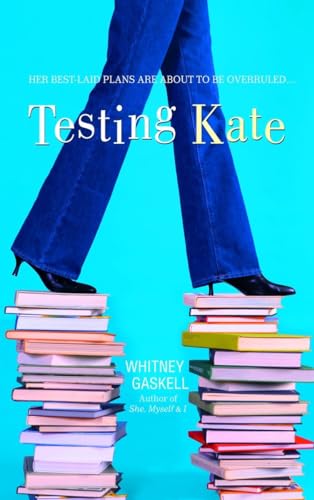
Inhaltsangabe
No one is better than Kate Bennett at playing by the rules–because no one has quite her knack for running into bad luck. Orphaned while in college, Kate handled her loss by graduating with honors and acquiring a secure job and a dependable boyfriend. But now, with her thirtieth birthday around the corner, Kate decides it’s time to shake things up. She quits her job, breaks up with her long-term boyfriend, and U-Hauls it across the country for her first year at Tulane Law School. Too bad nothing in the Big Easy is quite so easy….
Before she knows it, Kate finds her life turned upside down by a notoriously sadistic professor, a larger-than-life new boss–and two interested men who are sure that she’s The One…. But can either of the men in her life really know Kate, when she’s just getting to know herself? In a year of self-discovery, the most important lesson Kate may learn is that to change your luck, sometimes you have to change your mind–including what you thought was your dream.
Die Inhaltsangabe kann sich auf eine andere Ausgabe dieses Titels beziehen.
Über die Autorin bzw. den Autor
Whitney Gaskell grew up in Syracuse, New York. A graduate of Tulane Law School, she worked for several years as a reluctant lawyer before writing her first novel, Pushing 30, followed by True Love (and Other Lies), She, Myself & I, and Testing Kate. She lives in Stuart, Florida, with her husband and son, and is at work on her next novel.
Auszug. © Genehmigter Nachdruck. Alle Rechte vorbehalten.
Chapter One
When I was twelve years old, I froze right in the middle of the three-meter springboard diving competition.
I’d been taking diving classes at the local YMCA. When I’d stand at the edge of the rough board, my toes curled over the end, and stare down at the sprinklers spraying over the surface of the water, the whole world would go quiet. And then I’d take three steps back, turn, balance my shoulders over my hips and my hips over my feet, lift my arms out, and then it was three steps back again to the end of the board. With one final bounce, I’d leap straight up and then out, stretching my body into an arrow and slicing into the cold water, feeling like a mermaid.
At the end of the summer, the Y hosted a fun meet called Splash Day. The swimmers raced like a pack of sleek dolphins, and the synchronized swimmers spun around and fluttered their hands in time to a Christopher Cross song, and the divers sprang fearlessly from the board.
But when it was my turn to dive—a forward half-twist dive I’d been practicing for months—I stood at the edge of the springboard, staring out at the crowd, at my parents sitting side by side on the wooden bleachers, and smelling the chlorine in the air, and I just . . . froze. I don’t mean that I had a moment of anxiety, or even that I decided not to dive and retreated back down the ladder. Oh, no. I was incapable of movement. I just stood there in my navy blue Speedo suit, shivering a little, my arms wrapped around myself in a hug, and I listened to the crowd first grow quiet and then, becoming restless at the holdup, start to call out either encouragements or barbed jokes, their voices echoing over the water.
“You can do it, honey!” (My mother.)
“Just jump already!” (Mr. Hunt, father of Bobby, who for some inexplicable reason wore sweat bands on his wrists when he swam the hundred-meter freestyle.)
“Damn, that water must be really cold!” (Mindy’s dad, Mr. Camp, who thought—incorrectly—that he was hilarious.)
The voices just made it worse. I don’t know why. I don’t even know what it was that stopped me from making the same dive I’d completed hundreds of times in practice, the dive I’d been so sure would secure the blue ribbon. But even as I told my legs to jump now, they refused to obey.
In the end, Ms. Hadley, my coach—one of those sturdy, capable women with a square jaw and bushy brown hair cut in a severe bob—had to climb up onto the board, take my limp hand in hers, and lead me down and away. As soon as my bare feet hit the wet tiled pool deck, I dashed for the locker room—disobeying the sign that forbade poolside running—where I sat huddled on the wooden bench while hot tears of shame dripped down my cheeks. It was the most humiliating moment of my life.
Until now.
As I sat in my very first class on my very first day of law school, only one terrified thought had crystallized in my mind:
Which one of us will he call on first?
Actually two thoughts, the other being: Please, please, please, God, please don’t let it be me.
Law schools are infamous for their use of the Socratic Method, where the professor singles out a student and questions him or her on the finer points of case law. And despite my performance anxiety that had been lingering since the diving incident seventeen years earlier, I hadn’t worried about the Socratic Method when I first applied to law schools.
Getting called on in class? Big deal, I’d thought, as I paged through the glossy admissions catalog.
But as I sat in the too-cold lecture hall for the first time, a queasy, oily fear slid through me. And I wasn’t the only one. Everyone around me was sitting a little too straight and rigid; heads were bowed over casebooks, eyes flickering around nervously.
Professor Richard Hoffman had finished his curt introduction to Criminal Law and stood leaning forward against the wood lectern, his flat gray eyes scanning row after row of students, all of whom did their best not to make eye contact with him.
Please don’t let it be me, I thought again. My hands tensed into two fists, the nails pressing into the tender skin of my palms. Please, please, please don’t let it be me. Not today, not when I hadn’t done the reading assignment, or even bought my casebook, for that matter. Not the one day of my academic career when I was completely and totally unprepared.
“The sixth row to the right. The young woman who didn’t seem to think it necessary to bring her textbook to class,” Professor Hoffman said.
Which row was I in? One, two, three, four . . . shit, shit, shit. He couldn’t possibly be . . . was he really? . . . oh, God . . . he was. . . .
I looked up and saw that all of my new classmates had swiveled around to face me, a sea of strangers, their faces stamped with relief that they hadn’t been singled out as the first member of our class to be called on.
Dumb fucking luck, I thought.
You know those people who fill out a sweepstakes entry form on a lark and end up winning a new flat-panel television, or who always manage to make it to the gate just in time when they’re running late for a flight, or who find priceless antiques for next-to-nothing in the back room of a dusty thrift store?
I’m not one of them.
I step in wads of gum the first time I wear a pair of shoes, and get stuck in traffic when I have an appointment I can’t be late for, and my first and only new car was dinged by a hit-and-run driver less than half an hour after I drove it off the car lot.
So it really shouldn’t have surprised me that I was the very first person to get called on by the professor on the very first day of class. It was just more of the freaky bad luck that had been hanging over me since the day I was born (which just happened to be right in the middle of one of the worst blizzards to hit central New York in forty years).
“Your name?” Hoffman asked.
My skin felt very hot and very tight stretched over the bones of my face, and my throat closed up. “Kate. Kate Bennett,” I croaked.
“Ms. Bennett, please stand.”
“Ex-excuse me?”
Hoffman sighed dramatically. “If you are not capable of speaking loudly enough for the rest of the class to hear you, you must stand. Up. Now,” he said. He raised his hand, with the palm facing up.
But all I could do was gape back at the professor, while the eyes of my classmates burned into me. And just like that, I was twelve years old again, frozen at the end of the diving board.
Twenty minutes earlier, I’d been standing on the Freret Street sidewalk and staring up at the imposing three-story brick facade of John Giffen Weinmann Hall. The morning sun cut down at a sharp angle, and I had to hold my hand up for shade to get a good look at the building that housed the Tulane School of Law, where I was now officially enrolled as a first-year law student.
I was sweating. Heavily.
Perspiration beaded up on my forehead, rinsing away the tinted moisturizer I’d so carefully applied that morning, and my white cotton T-shirt dampened under my armpits in two wet crescents.
Great, I thought, shifting my black leather knapsack on my shoulder and plucking the thin cotton of the shirt away from my skin. Nothing like making an elegant first impression.
It was only...
„Über diesen Titel“ kann sich auf eine andere Ausgabe dieses Titels beziehen.
Suchergebnisse für Testing Kate: A Novel

Beispielbild für diese ISBN
Testing Kate A Novel
Anbieter: World of Books (was SecondSale), Montgomery, IL, USA
Verkäuferbewertung 5 von 5 Sternen

Zustand: Good. Item in good condition. Textbooks may not include supplemental items i.e. CDs, access codes etc. Artikel-Nr. 00040850170
Gebraucht kaufen
EUR 4,49
Versand gratis
Versand innerhalb von USA
Versand innerhalb von USA
Anzahl: 5 verfügbar
Beispielbild für diese ISBN
Testing Kate: A Novel
Anbieter: BooksRun, Philadelphia, PA, USA
Verkäuferbewertung 5 von 5 Sternen
Paperback. Zustand: Very Good. It's a well-cared-for item that has seen limited use. The item may show minor signs of wear. All the text is legible, with all pages included. It may have slight markings and/or highlighting. Artikel-Nr. 0553383140-8-1
Gebraucht kaufen
EUR 4,50
Versand gratis
Versand innerhalb von USA
Versand innerhalb von USA
Anzahl: 1 verfügbar
Beispielbild für diese ISBN
Testing Kate : A Novel
Verlag:
Random House Publishing Group, 2006
ISBN 10: 0553383140
ISBN 13: 9780553383140
Gebraucht
Softcover
Anbieter: Better World Books, Mishawaka, IN, USA
Verkäuferbewertung 5 von 5 Sternen
Zustand: Good. Pages intact with minimal writing/highlighting. The binding may be loose and creased. Dust jackets/supplements are not included. Stock photo provided. Product includes identifying sticker. Better World Books: Buy Books. Do Good. Artikel-Nr. 654730-6
Gebraucht kaufen
EUR 6,11
Versand gratis
Versand innerhalb von USA
Versand innerhalb von USA
Anzahl: 1 verfügbar
Beispielbild für diese ISBN
Testing Kate
Anbieter: ThriftBooks-Phoenix, Phoenix, AZ, USA
Verkäuferbewertung 5 von 5 Sternen
Paperback. Zustand: Very Good. No Jacket. May have limited writing in cover pages. Pages are unmarked. ~ ThriftBooks: Read More, Spend Less. Artikel-Nr. G0553383140I4N00
Gebraucht kaufen
EUR 6,28
Versand gratis
Versand innerhalb von USA
Versand innerhalb von USA
Anzahl: 1 verfügbar
Beispielbild für diese ISBN
Testing Kate
Anbieter: ThriftBooks-Atlanta, AUSTELL, GA, USA
Verkäuferbewertung 5 von 5 Sternen
Paperback. Zustand: Very Good. No Jacket. May have limited writing in cover pages. Pages are unmarked. ~ ThriftBooks: Read More, Spend Less. Artikel-Nr. G0553383140I4N00
Gebraucht kaufen
EUR 6,30
Versand gratis
Versand innerhalb von USA
Versand innerhalb von USA
Anzahl: 1 verfügbar