
Verwandte Artikel zu The Doctor's Guide to Weight Loss Surgery: How...
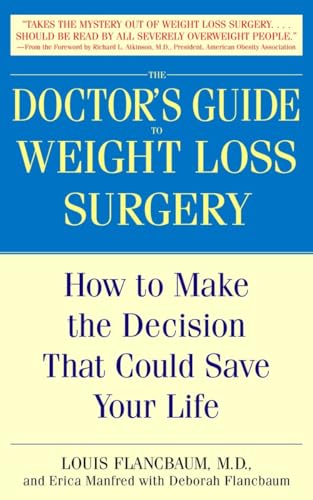
The Doctor's Guide to Weight Loss Surgery: How to Make the Decision That Could Save Your Life - Softcover
Inhaltsangabe
Whether you’re already planning to have weight-loss surgery or are still trying to decide, here is what you need to know about the operation that could save your life
If you are considering weight-loss surgery, you are not alone. Obesity is the most common chronic disease in the U.S. today, affecting one out of every four Americans. In this indispensable resource, Dr. Louis Flancbaum, one of the world’s foremost experts on weight-loss surgery, takes you through the entire process, from presurgical evaluation to postop care. You’ll find everything you need to know to get the most out of the latest groundbreaking procedures available that can radically improve your health--and your quality of life.
You’ll discover:
• Why WLS is the safest treatment for patients with clinically severe or morbid obesity
• How to determine if you’re a candidate for WLS
• What to look for when choosing a surgeon
• How to choose the surgical procedure that’s right for you
• What to expect pre-, peri-, and postsurgery
• Common side effects and what they can mean for you
• Diet and nutritional guidelines after WLS
Plus: what to do if your insurance policy excludes obesity treatment, how to determine when you can resume normal activities and return to work, healthful recipes, patient success stories, support groups . . . and much more
Including detailed charts and tables, helpful resources, and websites, this is the only sourcebook on weight-loss surgery you’ll ever need.
Die Inhaltsangabe kann sich auf eine andere Ausgabe dieses Titels beziehen.
Aus dem Klappentext
Whether you re already planning to have weight-loss surgery or are still trying to decide, here is what you need to know about the operation that could save your life
If you are considering weight-loss surgery, you are not alone. Obesity is the most common chronic disease in the U.S. today, affecting one out of every four Americans. In this indispensable resource, Dr. Louis Flancbaum, one of the world s foremost experts on weight-loss surgery, takes you through the entire process, from presurgical evaluation to postop care. You ll find everything you need to know to get the most out of the latest groundbreaking procedures available that can radically improve your health--and your quality of life.
You ll discover:
Why WLS is the safest treatment for patients with clinically severe or morbid obesity
How to determine if you re a candidate for WLS
What to look for when choosing a surgeon
How to choose the surgical procedure that s right for you
What to expect pre-, peri-, and postsurgery
Common side effects and what they can mean for you
Diet and nutritional guidelines after WLS
Plus: what to do if your insurance policy excludes obesity treatment, how to determine when you can resume normal activities and return to work, healthful recipes, patient success stories, support groups . . . and much more
Including detailed charts and tables, helpful resources, and websites, this is the only sourcebook on weight-loss surgery you ll ever need.
Auszug. © Genehmigter Nachdruck. Alle Rechte vorbehalten.
CHAPTER ONE
1
OBESITY: AMERICA'S DISEASE
"I've been fat since I was a baby. My entire family is fat. Who knows if it's our genes or our eating habits or a combination of both. I just know that being fat is a horrible way to have to live."
Sara P., 43, 360 lbs. pre-op; 200 lbs. 2 years post-op
"When I walk around at the mall with my kids, I have to admit that I look at people who are obese. It reminds me of how I looked and felt before the operation. It's amazing how many people there are out there suffering from this when there is something that can be done about it."
Tim W., 50, 400 lbs. pre-op; 230 lbs. 18 months post-op
Disease (noun)-a specific illness or disorder characterized by a recognizable set of signs and symptoms, attributable to heredity, infection, diet, or environment. (Mosby's Medical, Nursing, and Allied Health Dictionary, Fifth Edition)
Contrary to popular opinion, obesity is not a personality disorder
resulting from a lack of individual willpower or self-control. Rather, it is a chronic disease characterized by the accumulation of excess body fat, which can be detrimental to health. Obesity is distinguished from overweight, which does not take body composition into consideration. Many athletes are overweight, but because their excess weight is predominantly comprised of muscle, not fat tissue, they are not obese.
SOME FACTS ABOUT OBESITY
The worldwide incidence of obesity is increasing. In 1998, the World Health Organization published Obesity: Preventing and Managing the Global Epidemic, which classified obesity as a growing epidemic. In the United States, obesity is the most common chronic disease, affecting one-third of all Americans, including children, and its prevalence has been steadily increasing for the past twenty years. In Europe, Australia, New Zealand, the Middle East, and the remaining portions of the Americas, the occurrence of obesity appears to be increasing and is now between 10 and 20 percent. The prevalence of obesity is still fairly low in China, Japan, and many countries in Africa.
During the 1970s, the National Center for Health Statistics found that approximately 45 percent of all adult Americans were overweight and 14 percent were obese. These figures stayed relatively constant for over a decade. Armed with this information at the beginning of the 1990s, the Department of Health and Human Resources published Healthy People 2000, a policy statement outlining our national public-health priorities and goals as we entered the new millennium. The initiatives recommended included: reducing the incidence of overweight and obesity by 20 percent; improving the diagnosis and treatment of several obesity-related conditions, such as diabetes, coronary artery disease (hardening of the arteries), hypertension (high blood pressure), and hyperlipidemia (elevated serum cholesterol and blood lipids); and increasing the amount of regular aerobic exercise engaged in by adults and children.
When the National Center for Health Statistics repeated its survey in the mid-1990s, it found that the prevalence of overweight had increased from 47 percent to 54 percent (57 million people), with the prevalence of obesity increasing from 15 to 22 percent (40 million people). Moreover, the prevalence of severe obesity rose from 4.5 percent to 8 percent of the population (Table 1-1). In 1995, the Institute of Medicine, in its publication Weighing the Options, referred to obesity as an epidemic. It is currently estimated that there are approximately 127 million overweight or obese adults in the United States. Of these, 30 million are obese with a Body Mass Index of 30 to 34, 23 million are severely obese, with a Body Mass Index of 35 to 39, and 10 million suffer from morbid or clinically severe obesity, with a Body Mass Index above 40. (We will discuss the Body Mass Index, or BMI, in Chapter 2.)
Among American youth, the prevalence of obesity has sky-rocketed during the past two decades, from just under 4 percent in children (six to eleven years) and 6 percent in teenagers (twelve
to nineteen years) to 15 percent in children and 15 percent in
adolescents. The prevalence of overweight is also extremely high among youth, being 40 percent in Native Americans, 30 percent in African Americans and Hispanics, 25 percent in whites, and 20 percent in Asian-Americans. As with adults, obesity in youth is associated with a number of medical problems, including type II diabetes, hypertension, asthma, sleep apnea, orthopedic problems, psychological problems, and negative social stigmata.
The exact cause of obesity remains unknown, but multiple factors, genetic and environmental, appear to contribute. Afflicting individuals of all ages, genders, races, and ethnic groups, obesity is associated with numerous medical problems and can have a relatively benign or malignant course. Obesity increases steadily with age in both men and women, and it is more common in women than men. It affects African-American and Mexican-American women more than Caucasians or Asian-Americans. A strong genetic linkage exists among the Pima Indians, who live in the Southwestern United States.
Children born to obese parents are more likely to become obese than children born to thin parents. Studies of adopted children have shown that their tendency toward obesity is more related to the weight of their birth parents than their adoptive parents. Furthermore, in studies of twins who were raised separately, the ultimate weight of each sibling tended to be more similar to each other than to that of their nonbiological, adopted family members. Nevertheless, it is likely that these genetic factors merely predispose individuals to obesity but do not guarantee its development. The disease becomes manifest only in the presence of the proper environmental triggers, which are related to several factors, including culture, diet, and physical activity.
Over the past few centuries, Western industrialized societies have placed a progressively greater value on thinness. Television and magazine advertisements equate beauty with thinness. By contrast, the robust bodies of the women glorified in masterpieces throughout the Middle Ages and Renaissance would be considered obese by our standards. On the other hand, in poorer, underdeveloped cultures, where famine is common, obesity is perceived as a sign of wealth and is therefore associated with greater sexual attractiveness.
Diet and exercise also affect the onset and development of obesity. High-fat diets, which are prevalent in wealthier, Western cultures, increase the prevalence of obesity. Modernization of society and the development of ever more advanced technology have led to a progressive decrease in physical activity. Inventions such as the automobile, elevator, escalator, remote control, and wireless communication all decrease the amount of physical activity we perform daily. Similarly, children reared on television, video games, and computers are more likely to become obese than those who exercise regularly.
Table 1-1: Increase in the Prevalence of Overweight and Obesity
in the United States
Weight Number
Category* 1976-1980 1988-1994 1999-2000 Americans
Overweight 32 percent 32 percent 34 percent 64 million
Obese 10...
„Über diesen Titel“ kann sich auf eine andere Ausgabe dieses Titels beziehen.
Suchergebnisse für The Doctor's Guide to Weight Loss Surgery: How...

Beispielbild für diese ISBN
The Doctor's Guide to Weight Loss Surgery: How to Make the Decision That Could Save Your Life
Anbieter: World of Books (was SecondSale), Montgomery, IL, USA
Verkäuferbewertung 5 von 5 Sternen

Zustand: Good. Good condition ex-library book with usual library markings and stickers. Artikel-Nr. 00107233117
Gebraucht kaufen
EUR 5,35
Versand gratis
Versand innerhalb von USA
Versand innerhalb von USA
Anzahl: 1 verfügbar
Beispielbild für diese ISBN
The Doctor's Guide to Weight Loss Surgery: How to Make the Decision That Could Save Your Life
Anbieter: ThriftBooks-Dallas, Dallas, TX, USA
Verkäuferbewertung 5 von 5 Sternen
Paperback. Zustand: Very Good. No Jacket. May have limited writing in cover pages. Pages are unmarked. ~ ThriftBooks: Read More, Spend Less. Artikel-Nr. G0553382462I4N00
Gebraucht kaufen
EUR 5,87
Versand gratis
Versand innerhalb von USA
Versand innerhalb von USA
Anzahl: 1 verfügbar
Beispielbild für diese ISBN
The Doctor's Guide to Weight Loss Surgery: How to Make the Decision That Could Save Your Life
Anbieter: ThriftBooks-Atlanta, AUSTELL, GA, USA
Verkäuferbewertung 5 von 5 Sternen
Paperback. Zustand: Very Good. No Jacket. Former library book; May have limited writing in cover pages. Pages are unmarked. ~ ThriftBooks: Read More, Spend Less. Artikel-Nr. G0553382462I4N10
Gebraucht kaufen
EUR 5,87
Versand gratis
Versand innerhalb von USA
Versand innerhalb von USA
Anzahl: 1 verfügbar
Beispielbild für diese ISBN
The Doctor's Guide to Weight Loss Surgery: How to Make the Decision That Could Save Your Life
Anbieter: ThriftBooks-Dallas, Dallas, TX, USA
Verkäuferbewertung 5 von 5 Sternen
Paperback. Zustand: Fair. No Jacket. Readable copy. Pages may have considerable notes/highlighting. ~ ThriftBooks: Read More, Spend Less. Artikel-Nr. G0553382462I5N00
Gebraucht kaufen
EUR 5,87
Versand gratis
Versand innerhalb von USA
Versand innerhalb von USA
Anzahl: 1 verfügbar
Beispielbild für diese ISBN
The Doctor's Guide to Weight Loss Surgery : How to Make the Decision That Could Save Your Life
Verlag:
Random House Publishing Group, 2003
ISBN 10: 0553382462
ISBN 13: 9780553382464
Gebraucht
Softcover
Anbieter: Better World Books, Mishawaka, IN, USA
Verkäuferbewertung 5 von 5 Sternen
Zustand: Good. Former library copy. Pages intact with minimal writing/highlighting. The binding may be loose and creased. Dust jackets/supplements are not included. Includes library markings. Stock photo provided. Product includes identifying sticker. Better World Books: Buy Books. Do Good. Artikel-Nr. 41788865-6
Gebraucht kaufen
EUR 9,82
Versand gratis
Versand innerhalb von USA
Versand innerhalb von USA
Anzahl: 1 verfügbar