
Verwandte Artikel zu Baby Hearts: A Guide to Giving Your Child an Emotional...
Inhaltsangabe
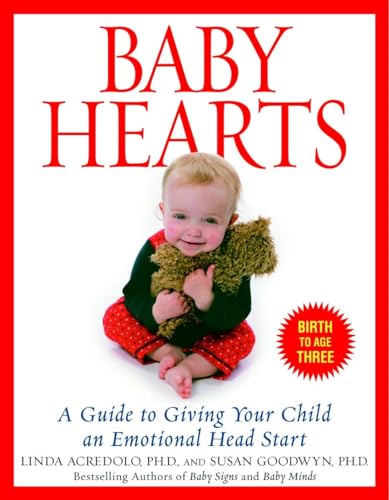
Who says your baby can’t “talk” about his or her feelings? In fact, babies’ actions often speak louder than words! Understanding those actions–and responding appropriately to them–is the key to giving your child a head start to a healthy and happy future. Now the authors of the bestselling Baby Minds and Baby Signs translate the latest research on the rich inner life of babies into practical, fun activities that will foster your child’s emotional skills during the most critical period–between birth and age three. This comprehensive guide will help you help your child express emotions effectively, develop empathy, form healthy friendships, and cope with specific challenges. Learn how to:
•Talk with your child about emotions in order to help him recognize and control his own
•Use face-to-face interaction, tone of voice, song, and touch to make your infant feel safe and secure
•Start a gratitude journal to help your child appreciate the good things in life
•Nurture self-esteem with “try, try again” activities and simple chores
•Create a “What are they feeling” deck of cards to help your child understand and practice emotions
•Use games and songs to help your child practice self-control
•Overcome temper tantrums, aggression, shyness, separation anxiety, and other challenges
Whether your child is as easy to raise as a sunflower, as difficult as the prickly holly bush, requires the patience of the delicate orchid, or is as active as the exuberant dandelion, Baby Hearts helps you provide the
emotional support that may be the most important gift a parent can give.
Die Inhaltsangabe kann sich auf eine andere Ausgabe dieses Titels beziehen.
Über die Autorin bzw. den Autor
Linda Acredolo, Ph.D. is emeritus professor of psychology at the University of California, Davis. Dr. Acredolo received her Ph.D. from the Institute of Child Development at the University of Minnesota. She has served as an editor of Child Development and as an officer of the prestigious Society for Research in Child Development.
Susan Goodwyn, Ph.D. is professor of Psychology and Child Development at California State University, Stanislaus, where she has served as Project Director for several longitudinal research projects. Dr. Goodwyn earned her Ph.D. as a Developmental Psychologist at the University of California, Davis.
Drs. Acredolo and Goodwyn have received numerous research grants, most notably from the National Institutes of Child Health and Development. They have published over 50 scholarly articles and have presented at over 75 national and international research meetings. Their pioneering research into infant and toddler development led them to co-author the 400,000-copy bestselling book Baby Signs (Contemporary Books, 1996, revised edition 2002) and Baby Minds (Bantam, 2000), as well as to found Baby Signs, Inc. in 2001. BABY HEARTS will be the third volume in the series.
Von der hinteren Coverseite
Who says your baby can't "talk" about his or her feelings? In fact, babies' actions often speak louder than words! Understanding those actions-and responding appropriately to them-is the key to giving your child a head start to a healthy and happy future. Now the authors of the bestselling "Baby Minds and "Baby Signs translate the latest research on the rich inner life of babies into practical, fun activities that will foster your child's emotional skills during the most critical period-between birth and age three. This comprehensive guide will help you help your child express emotions effectively, develop empathy, form healthy friendships, and cope with specific challenges. Learn how to:
-Talk with your child about emotions in order to help him recognize and control his own
-Use face-to-face interaction, tone of voice, song, and touch to make your infant feel safe and secure
-Start a gratitude journal to help your child appreciate the good things in life
-Nurture self-esteem with "try, try again" activities and simple chores
-Create a "What are they feeling" deck of cards to help your child understand and practice emotions
-Use games and songs to help your child practice self-control
-Overcome temper tantrums, aggression, shyness, separation anxiety, and other challenges
Whether your child is as easy to raise as a sunflower, as difficult as the prickly holly bush, requires the patience of the delicate orchid, or is as active as the exuberant dandelion, "Baby Hearts helps you provide the
emotional support that may be the most important gift a parent can give.
Auszug. © Genehmigter Nachdruck. Alle Rechte vorbehalten.
1
Nature’s Contribution: The Biology of Emotions
NEWS FLASH!
There’s More to “Mothering” Than Meets the Eye, Scientists Discover
New York, New York. What happens when Mommy Rat runs away from home, leaving her litter of pups to fend for themselves? They get hungry—very hungry. No surprise there. But according to Columbia University professor Myron Hofer, there’s a lot more than that going wrong when Mom “turns tail” and runs. In fact, hunger is one of the least of the abandoned rat pups’ problems. Like a harp that stays silent without someone plucking at its strings, rat pups left without the cuddling, licking, and delicious smells and rhythms that constitute mothering in their world lack the ability to maintain many critical biological functions, the control of which is necessary for life itself. Their body temperatures drop, their heart rates increase, their breathing becomes erratic, their sleep-wake cycles are disrupted, their growth and stress hormones go haywire. In short, the result is true biological chaos, a level of disorganization that can kill.
Researchers studying human mothering say there’s an important lesson in all of this for us. Like the rat pup, the human infant may look like an independent little unit (especially in those identical little maternity ward cribs), but that’s a serious, even deadly, misperception. The newborn human baby is dependent on our tender loving care for much more than food and diaper changes. Just like rat pups, human babies require proximity to a warm body—one that breathes with regularity, strokes and cuddles, smiles and smells—to keep their biological systems in line. Or one could say, like the silent harp, human babies need their parents’ love to create the sweet, concordant rhythms that make for the beautiful music that is healthy life.
Biological Regulation: An Evolutionary Gamble
Myron Hofer’s work with rat pups is both exciting and exceedingly important. Instead of seeing motherhood through a veil of sentimentality, he has proved that what parents routinely do (or should do) with their babies is absolutely critical for their survival. There were earlier clues, of course, particularly in the many tragic cases of failure-to-thrive syndrome in orphanages, where food was plentiful, beds were clean, but anything approaching mothering was considered too expensive, too time-consuming, and totally unnecessary. These babies literally withered and died. And now we know why.
Both the problem and the strength of the human baby is that she is a work in progress. If human babies were prewired upon entry into the world, there would be no capacity to change, to adapt to different environments, to learn. In other words, if human babies were only a product of “nature” rather than equally dependent on “nurture,” human progress would have ground to a halt a long time ago. Instead, evolution took a chance, sending us newborn babies that are far from ready-wired, trusting that it could also nudge the big humans around these helpless creatures into providing them the attention needed to get their immature biological systems up and running in an organized, self-sufficient way.
Parents as the “Gelatin Molds” of Early Development
Human babies may arrive totally dependent on their parents to keep their biological rhythms working right, but they don’t stay that way. Over the first nine months of life, the infant gradually becomes able to exert his own control over his breathing, heart rate, sleep-wake cycles, stress reactions, growth hormones, and the like. But it doesn’t happen automatically. Again, this progress is not prewired. The active support parents provide the baby during those early months helps shape his own control mechanisms. Feeling the parent’s breath go in and out sets a pace for the baby’s breathing. Hearing the parent’s voice stimulates synchronized body movements. Being predictably roused from sleep and soothed back into it stabilizes sleep-wake cycles. The warmth of the parent’s body and stroking of the baby’s skin regulates his temperature. Touching the baby’s face stimulates sucking. On and on it goes. But if that parental support is itself erratic or disorganized, then the baby’s developing ability to regulate himself will be compromised accordingly.
When we explain the gradual development of biological regulation and the important role played by parents to our undergraduate students, we like to use the metaphor of the gelatin mold. The function of a gelatin mold is to contain the liquid gelatin until it slowly solidifies enough to hold its own shape once the mold is removed. Typically, the shape that results is a lovely, rippled mound with a flat spot on top for a dollop of whipped cream. But the shape the gelatin finally assumes won’t be so pretty if one or all of the following things go wrong: (a) the mold itself is bizarrely shaped, (b) the mold is removed before solidification is complete, or (c) the mold itself is too flexible to provide a consistent shape.
In this metaphor, babies, of course, are represented by the gelatin, with parental interactions, daily routines, and physical closeness acting as the mold that holds the gelatin together until it can solidify. Without the mold, the gelatin simply runs all over the place, achieving no coherent shape as it hardens, just as a baby’s biological rhythms disintegrate into chaos without the strength and warmth of a parent’s arms to hold them in place. That one person’s breathing, heartbeat, and nearness might exert such power over another person’s behavior may at first seem far-fetched—but notice what happens the next time you find yourself close to someone who yawns!
Individual Differences in the Gelatin
Children differ in many ways, including how much support they need early on to regulate their biological systems. Continuing the metaphor, they differ in how solid their gelatin is to start with. Although some babies seem to develop reasonable sleep-wake cycles within weeks, for other babies the process can take months. Similarly, some babies will be soothed quickly when upset, while others require rocking for what may seem like hours. And some babies can sleep through the sound of the vacuum cleaner, while other babies flinch at the sound of a car door closing outdoors. Such differences can be genetic in origin and can run in families. In other cases, particular characteristics of the prenatal environment (the amount of maternal stress, for example) may be playing a role. Whatever their source, these individual differences in the newborn baby’s gelatin contribute significantly to differences in infant temperament apparent from Day 1, the topic we turn to next.
Inborn Temperament: Variety Is the Spice of Life
What a boring world this would be if we were all alike, if we were all cut with the same cookie cutter. How would those of us who are shy be wooed into joining the action? How would those of us who jump in with both feet be persuaded to look before we leap? Fortunately, nature has guaranteed that we aren’t all alike, even at the very beginning.
Sudden Infant Death Syndrome (SIDS)
On a very serious note, there is good evidence that some babies need more help than others to keep their breathing regular, particularly when they are asleep. These babies, it is hypothesized, are the ones at most risk from dying of sudden infant death syndrome, or SIDS. As evidence, researchers note the young age at which most SIDS cases occur (before four months) and an impressively lower incidence of SIDS in cultures where baby and mother routinely sleep together, proximity that presumably provides the child...
„Über diesen Titel“ kann sich auf eine andere Ausgabe dieses Titels beziehen.
Suchergebnisse für Baby Hearts: A Guide to Giving Your Child an Emotional...

Beispielbild für diese ISBN
Baby Hearts: A Guide to Giving Your Child an Emotional Head Start
Anbieter: World of Books (was SecondSale), Montgomery, IL, USA
Verkäuferbewertung 5 von 5 Sternen

Paperback. Zustand: Good. Who says your baby can't "talk" about his or her feelings? In fact, babies' actions often speak louder than words! Understanding those actions-and responding appropriately to them-is the key to giving your child a head start to a healthy and happy future. Now the authors of the bestselling Baby Minds and Baby Signs translate the latest research on the rich inner life of babies into practical, fun activities that will foster your child's emotional skills during the most critical period-between birth and age three. This comprehensive guide will help you help your child express emotions effectively, develop empathy, form healthy friendships, and cope with specific challenges. Learn how to: *Talk with your child about emotions in order to help him recognize and control his own *Use face-to-face interaction, tone of voice, song, and touch to make your infant feel safe and secure *Start a gratitude journal to help your child appreciate the good things in life *Nurture self-esteem with "try, try again" activities and simple chores *Create a "What are they feeling" deck of cards to help your child understand and practice emotions *Use games and songs to help your child practice self-control *Overcome temper tantrums, aggression, shyness, separation anxiety, and other challenges Whether your child is as easy to raise as a sunflower, as difficult as the prickly holly bush, requires the patience of the delicate orchid, or is as active as the exuberant dandelion, Baby Hearts helps you provide the emotional support that may be the most important gift a parent can give. Artikel-Nr. 00019975888
Gebraucht kaufen
EUR 3,87
Versand gratis
Versand innerhalb von USA
Versand innerhalb von USA
Anzahl: 4 verfügbar
Beispielbild für diese ISBN
Baby Hearts: A Guide to Giving Your Child an Emotional Head Start
Verlag:
Bantam (edition unknown), 2005
ISBN 10: 0553382209
ISBN 13: 9780553382204
Gebraucht
Paperback
Anbieter: BooksRun, Philadelphia, PA, USA
Verkäuferbewertung 5 von 5 Sternen
Paperback. Zustand: Very Good. unknown. It's a well-cared-for item that has seen limited use. The item may show minor signs of wear. All the text is legible, with all pages included. It may have slight markings and/or highlighting. Artikel-Nr. 0553382209-11-1
Gebraucht kaufen
EUR 5,87
Versand gratis
Versand innerhalb von USA
Versand innerhalb von USA
Anzahl: 1 verfügbar
Beispielbild für diese ISBN
Baby Hearts: A Guide to Giving Your Child an Emotional Head Start
Anbieter: ThriftBooks-Atlanta, AUSTELL, GA, USA
Verkäuferbewertung 5 von 5 Sternen
Paperback. Zustand: As New. No Jacket. Pages are clean and are not marred by notes or folds of any kind. ~ ThriftBooks: Read More, Spend Less. Artikel-Nr. G0553382209I2N00
Gebraucht kaufen
EUR 5,95
Versand gratis
Versand innerhalb von USA
Versand innerhalb von USA
Anzahl: 1 verfügbar
Beispielbild für diese ISBN
Baby Hearts: A Guide to Giving Your Child an Emotional Head Start
Anbieter: ThriftBooks-Dallas, Dallas, TX, USA
Verkäuferbewertung 5 von 5 Sternen
Paperback. Zustand: Very Good. No Jacket. May have limited writing in cover pages. Pages are unmarked. ~ ThriftBooks: Read More, Spend Less. Artikel-Nr. G0553382209I4N00
Gebraucht kaufen
EUR 5,95
Versand gratis
Versand innerhalb von USA
Versand innerhalb von USA
Anzahl: 1 verfügbar
Beispielbild für diese ISBN
Baby Hearts : A Guide to Giving Your Child an Emotional Head Start
Verlag:
Random House Publishing Group, 2005
ISBN 10: 0553382209
ISBN 13: 9780553382204
Gebraucht
Softcover
Anbieter: Better World Books, Mishawaka, IN, USA
Verkäuferbewertung 5 von 5 Sternen
Zustand: Very Good. Pages intact with possible writing/highlighting. Binding strong with minor wear. Dust jackets/supplements may not be included. Stock photo provided. Product includes identifying sticker. Better World Books: Buy Books. Do Good. Artikel-Nr. 4568696-6
Gebraucht kaufen
EUR 6,34
Versand gratis
Versand innerhalb von USA
Versand innerhalb von USA
Anzahl: 1 verfügbar
Beispielbild für diese ISBN
Baby Hearts : A Guide to Giving Your Child an Emotional Head Start
Verlag:
Random House Publishing Group, 2005
ISBN 10: 0553382209
ISBN 13: 9780553382204
Gebraucht
Softcover
Anbieter: Better World Books: West, Reno, NV, USA
Verkäuferbewertung 5 von 5 Sternen
Zustand: Good. Pages intact with minimal writing/highlighting. The binding may be loose and creased. Dust jackets/supplements are not included. Stock photo provided. Product includes identifying sticker. Better World Books: Buy Books. Do Good. Artikel-Nr. 2383094-6
Gebraucht kaufen
EUR 6,34
Versand gratis
Versand innerhalb von USA
Versand innerhalb von USA
Anzahl: 1 verfügbar
Beispielbild für diese ISBN
Baby Hearts : A Guide to Giving Your Child an Emotional Head Start
Verlag:
Random House Publishing Group, 2005
ISBN 10: 0553382209
ISBN 13: 9780553382204
Gebraucht
Softcover
Anbieter: Better World Books, Mishawaka, IN, USA
Verkäuferbewertung 5 von 5 Sternen
Zustand: Good. Pages intact with minimal writing/highlighting. The binding may be loose and creased. Dust jackets/supplements are not included. Stock photo provided. Product includes identifying sticker. Better World Books: Buy Books. Do Good. Artikel-Nr. 2383094-6
Gebraucht kaufen
EUR 6,34
Versand gratis
Versand innerhalb von USA
Versand innerhalb von USA
Anzahl: 1 verfügbar
Beispielbild für diese ISBN
Baby Hearts : A Guide to Giving Your Child an Emotional Head Start
Verlag:
Random House Publishing Group, 2005
ISBN 10: 0553382209
ISBN 13: 9780553382204
Gebraucht
Softcover
Anbieter: Better World Books: West, Reno, NV, USA
Verkäuferbewertung 5 von 5 Sternen
Zustand: Very Good. Pages intact with possible writing/highlighting. Binding strong with minor wear. Dust jackets/supplements may not be included. Stock photo provided. Product includes identifying sticker. Better World Books: Buy Books. Do Good. Artikel-Nr. 4568696-6
Gebraucht kaufen
EUR 6,34
Versand gratis
Versand innerhalb von USA
Versand innerhalb von USA
Anzahl: 3 verfügbar
Beispielbild für diese ISBN
Baby Hearts : A Guide to Giving Your Child an Emotional Head Start
Verlag:
Random House Publishing Group, 2005
ISBN 10: 0553382209
ISBN 13: 9780553382204
Gebraucht
Softcover
Anbieter: Better World Books Ltd, Dunfermline, Vereinigtes Königreich
Verkäuferbewertung 5 von 5 Sternen
Zustand: Good. Former library copy. Pages intact with minimal writing/highlighting. The binding may be loose and creased. Dust jackets/supplements are not included. Includes library markings. Stock photo provided. Product includes identifying sticker. Better World Books: Buy Books. Do Good. Artikel-Nr. 4780309-75
Gebraucht kaufen
EUR 8,90
EUR 5,96 Versand
Versand von Vereinigtes Königreich nach USA
Versand von Vereinigtes Königreich nach USA
Anzahl: 1 verfügbar
Beispielbild für diese ISBN
Baby Hearts: A Guide to Giving Your Child an Emotional Head Start
Anbieter: Revaluation Books, Exeter, Vereinigtes Königreich
Verkäuferbewertung 5 von 5 Sternen
Paperback. Zustand: Brand New. 336 pages. 9.00x7.00x0.75 inches. In Stock. Artikel-Nr. x-0553382209
Neu kaufen
EUR 27,21
EUR 14,89 Versand
Versand von Vereinigtes Königreich nach USA
Versand von Vereinigtes Königreich nach USA
Anzahl: 2 verfügbar