
Verwandte Artikel zu The War of the Saints
Inhaltsangabe
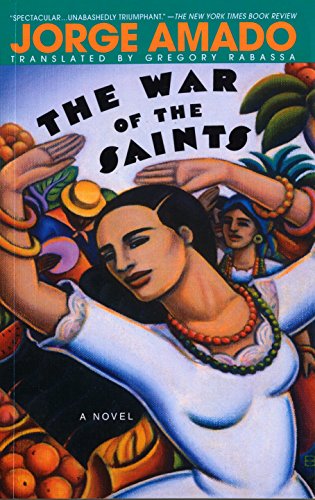
Jorge Amado has been called one of the great writers of our time. The joyfulness of his storytelling and his celebration of life's sensual pleasures have found him a loyal following. With The War Of The Saints, he has created an exuberant tale set among the flashing rhythms, intoxicating smells, and bewitching colors of the carnival. The holy icon of Saint Barbara of the Thunder is bound for the city of Bahia for an exhibition of holy art. As the boat the bears the image is docking, a miracle occurs and Saint Barbara comes to life, disappearing into the milling crowd on the quay. Somewhere in the city a young woman has fallen in love, and her prudish guardian aunt has locked her away--an act of intolerance that Saint Barbara must redress. And when she casts her spell over the city, no one's life will remain unchanged.
Die Inhaltsangabe kann sich auf eine andere Ausgabe dieses Titels beziehen.
Über die Autorin bzw. den Autor
Jorge Amado—novelist, journalist, lawyer—was born in 1912, the son of a cacao planter, in Ilheus, south of Salvador, the provincial capital of Gabriela, clavo y canela. His first novel, Cacao, was published when he was 19. It was an impassioned plea for social justice for the workers on Bahian cacao plantations; and his novels of the ’30s and ’40s would continue to dramatize class struggle. Not until the 1950s did he write his great literary comic novels—Gabriela, clavo y canela and Doña Flor y sus dos maridos—which take aim at the full spectrum of society even as they pay ebullient tribute to the region of his birth. One of the most renowned writers of the Latin American boom of the ’60s, Amado has been translated into more than 35 languages. A highly successful film version of Doña Flor was produced in Brazil in 1976. He died in 2001.
Von der hinteren Coverseite
Jorge Amado has been called one of the great writers of our time. The joyfulness of his storytelling and his celebration of life's sensual pleasures have found him a loyal following. With "The War Of The Saints, he has created an exuberant tale set among the flashing rhythms, intoxicating smells, and bewitching colors of the carnival. The holy icon of Saint Barbara of the Thunder is bound for the city of Bahia for an exhibition of holy art. As the boat the bears the image is docking, a miracle occurs and Saint Barbara comes to life, disappearing into the milling crowd on the quay. Somewhere in the city a young woman has fallen in love, and her prudish guardian aunt has locked her away--an act of intolerance that Saint Barbara must redress. And when she casts her spell over the city, no one's life will remain unchanged.
Aus dem Klappentext
has been called one of the great writers of our time. The joyfulness of his storytelling and his celebration of life's sensual pleasures have found him a loyal following. With The War Of The Saints, he has created an exuberant tale set among the flashing rhythms, intoxicating smells, and bewitching colors of the carnival. The holy icon of Saint Barbara of the Thunder is bound for the city of Bahia for an exhibition of holy art. As the boat the bears the image is docking, a miracle occurs and Saint Barbara comes to life, disappearing into the milling crowd on the quay. Somewhere in the city a young woman has fallen in love, and her prudish guardian aunt has locked her away--an act of intolerance that Saint Barbara must redress. And when she casts her spell over the city, no one's life will remain unchanged.
Auszug. © Genehmigter Nachdruck. Alle Rechte vorbehalten.
Chapter One
The Crossing
Casting Off
That day, though the hour was surprisingly late, the Sailor Without a Port was only just entering the far side of the Bay of All Saints, from upriver, under full sail–the sea, a blue mantle, the lover told his beloved. And strangely enough, in the wake of the wind, Maria Clara's voice was not to be heard trailing off in the throes of a love song.
If it happened that way it was simply because, in addition to the customary cargo of aromatic pineapples, cashews, and mangos, at Santo Amaro da Purificação the sloop had undertaken the responsibility–the mission, we should say–of transporting to the state capital a statue of Saint Barbara of the Thunder, famed for her eternal beauty and miraculous powers. Despite the evident displeasure of the vicar, the parish had agreed to loan the statue, to be displayed at a highly touted religious art exhibit that was being celebrated in prose and verse in the press and among intellectuals: "The cultural event of the year," as the newspapers proclaimed. In order to carry out this sacred commission, the sloop's captain, Master Manuel, had had to put off his habitual morning departure, delaying almost twelve hours, but he did it willingly: It would be worth the trouble, and besides, Dona Canô never requested favors, she gave orders.
The vicar felt less upset when he learned that a priest and a nun were also going along; he was young and modern, hair in disarray, wearing civilian clothes, while she was on in years, thin, pale, in a black habit. Divine providence, which never fails, had sent them to accompany the saint.
"Look after her during the crossing. Pay particular attention at the mouth of the river–the currents are tricky there, and the wind blows hard. God go with you."
Aided by the vicar, the sexton, and Dona Canô, amidst the prayers and applause of a fidgety gathering of church biddies, the priest and the nun proceeded with the embarkation ceremony. During the slippery descent, however, they preferred to entrust the litter that bore the figure on its pilgrimage into the seafaring hands of Master Manuel and his wife Maria Clara, who deposited it with reverential care in the stern of the sloop. There, standing erect, the majestic effigy of the Catholic saint looked like a ship's figurehead, a votive carving for the bow, a pagan and protective entity.
The Nun and the Priest
As the late afternoon breeze filled its proud sails, the sloop sped along with the saint. At the helm, Master Manuel smiled at the reverend father and the good sister: Don't be afraid, Saint Barbara's in no danger.
Sitting alongside the litter, Maria Clara saw to the stability of the saint, prevented the lurching of the sloop from upsetting its balance. "Don't you worry," she had added to reassure them, while she examined and praised the extravagance of the lining of the litter, made with all the refinements of brocade and ribbon, trimming and lace fashioned for the occasion by the devout ladies of the sisterhood of Our Lady of the Good Death in the neighboring town of Cachoeira, pious old women, first-rate artists. Oh, if it had been up to them, the saint would have traveled all covered with gold and silver, old gold, sterling silver, but the director of the museum had peremptorily turned them down. He'd even refused the sisterhood's reliquary–nasty man!
They had been trustworthy vows, those of the captain and his wife, yet the old nun, huddled in her worn and severe habit, trembled for the safety of the figure throughout the long voyage, because of the river currents or the rough seas of the gulf. But she didn't say a word, didn't let her concern show; only prayed, reciting over and over the beads of her rosary, until the breeze that fluttered about the carving came to comfort her bony hands. For her the trip was long and worrisome; she breathed easily only when the sloop headed in toward the market ramp. All had gone well, God be praised! she thought. The saint and her sack of thunder and lightning would soon be in the Museum of Sacred Art, where the director, a German monk with several advanced degrees, a scholar three times over, a renowned author, in his impeccable white cassock, awaited her impatiently. He'd developed a breathtakingly daring thesis concerning the origin and the artist of this famed piece of religious sculpture. Only then, delivered from her prison of fear, would Sister Maria Eunice close her eyes, let out a sigh of relief, and succumb at last to the soft enveloping breeze.
The priest, for his part, didn't look like a priest–how could anyone recognize him as a father when he was wearing blue jeans and a flowered shirt open to the wind, with no tonsure shaved into the center of his flowing hair? He was a good-looking fellow who drew women's stares. The habit doesn't make the monk, teaches a wise proverb that dates back quite a bit, to a time before such changes in costume and custom were common. In spite of the apparent disorder in his clothes and hair, his lack of cassock and tonsure, this was no hippie on his way to the peace and love colony in Arembepe, but an ordained priest, sincere in his vocation and his apostolate, devoted to his mission. In the distant parish that was his charge, the faithful were God's unfortunates, slaves of the rich, humbled by the age-old law of violence.
For him the trip had seemed longer, endless even, because he'd been living amid impunity and injustice and had every reason to believe he was being summoned to the capital for something besides praise or encouragement. He'd heard of provocations and threats, he'd read items in the papers denouncing and condemning the subversive activity of certain priests. His name, Father Abelardo Galvão, had appeared in the press, in twisted stories that turned facts upside down, invented things, slung mud, vilified him. That was all infamy and villainy, the priest pondered to himself. In truth, all he knew about Patrícia was the crystal tone of her voice, the enigma of her smile, the coquetry of her look. With these venomous insinuations, the bastards were trying to hide the corpses that lay rotting in the mangrove swamps among the guaiamu crabs. The priest was traveling with three dead men on his mind. He knew who had ordered them killed, everybody knew. It did no good to know, however; the ones who give orders to gunmen sail on, unsullied and inaccessible, beyond good and evil. The land has its owners, only a few, and they can be counted on the fingers of both hands–only a few, but they are implacable.
Some Modest Information Concerning Bahia
In spite of the fact that Maria Clara's soft voice, recalling oaths of love, joys, and sorrows, couldn't be heard, as she sat beside the figure of the saint she was actually humming little popular tunes, a special offering owed to saints and the enchanted. Her melodies didn't carry to the nun or the priest but summoned green swarms of water hyacinths that encircled the stout hull of the sloop. On their fleshy stems the newly opened blue flowers bowed, greeting Saint Barbara of the Thunder. The Paraguaçu River has the smell of tobacco and tastes like sugar; the vessel sailed between cane brakes and tobacco fields.
In the seas of the gulf, schools of fish greeted the sloop. A cortège of octopuses, rays, and skates accompanied its wake. The sun spread gold over the sky of the Bay of All Saints.
It is well known that the Bay of All Saints is the doorway to the world. Immeasurable, all other inlets in Brazil can fit into it, with space left over for the estuaries of Galicia and all the fleets in the universe. As for its beauty, there's no possible comparison, nor does the writer exist who is capable of describing it.
A flock of islands, each...
„Über diesen Titel“ kann sich auf eine andere Ausgabe dieses Titels beziehen.
Suchergebnisse für The War of the Saints

Beispielbild für diese ISBN
The War of the Saints
Verlag:
Random House Publishing Group, 1995
ISBN 10: 0553374400
ISBN 13: 9780553374407
Gebraucht
Softcover
Anbieter: World of Books (was SecondSale), Montgomery, IL, USA
Verkäuferbewertung 5 von 5 Sternen

Zustand: Good. Item in good condition. Textbooks may not include supplemental items i.e. CDs, access codes etc. Artikel-Nr. 00100543323
Gebraucht kaufen
EUR 4,02
Versand gratis
Versand innerhalb von USA
Versand innerhalb von USA
Anzahl: 6 verfügbar
Beispielbild für diese ISBN
The War of the Saints
Verlag:
Random House Publishing Group (edition Reprint), 1995
ISBN 10: 0553374400
ISBN 13: 9780553374407
Gebraucht
Paperback
Anbieter: BooksRun, Philadelphia, PA, USA
Verkäuferbewertung 5 von 5 Sternen
Paperback. Zustand: Very Good. Reprint. It's a well-cared-for item that has seen limited use. The item may show minor signs of wear. All the text is legible, with all pages included. It may have slight markings and/or highlighting. Artikel-Nr. 0553374400-11-6
Gebraucht kaufen
EUR 4,63
Versand gratis
Versand innerhalb von USA
Versand innerhalb von USA
Anzahl: 1 verfügbar
Beispielbild für diese ISBN
The War of the Saints
Anbieter: ThriftBooks-Dallas, Dallas, TX, USA
Verkäuferbewertung 5 von 5 Sternen
Paperback. Zustand: Very Good. No Jacket. May have limited writing in cover pages. Pages are unmarked. ~ ThriftBooks: Read More, Spend Less. Artikel-Nr. G0553374400I4N00
Gebraucht kaufen
EUR 5,93
Versand gratis
Versand innerhalb von USA
Versand innerhalb von USA
Anzahl: 1 verfügbar
Beispielbild für diese ISBN
The War of the Saints
Anbieter: ThriftBooks-Phoenix, Phoenix, AZ, USA
Verkäuferbewertung 5 von 5 Sternen
Paperback. Zustand: Very Good. No Jacket. May have limited writing in cover pages. Pages are unmarked. ~ ThriftBooks: Read More, Spend Less. Artikel-Nr. G0553374400I4N00
Gebraucht kaufen
EUR 5,93
Versand gratis
Versand innerhalb von USA
Versand innerhalb von USA
Anzahl: 1 verfügbar
Beispielbild für diese ISBN
The War of the Saints
Anbieter: ThriftBooks-Atlanta, AUSTELL, GA, USA
Verkäuferbewertung 5 von 5 Sternen
Paperback. Zustand: Very Good. No Jacket. May have limited writing in cover pages. Pages are unmarked. ~ ThriftBooks: Read More, Spend Less. Artikel-Nr. G0553374400I4N00
Gebraucht kaufen
EUR 5,93
Versand gratis
Versand innerhalb von USA
Versand innerhalb von USA
Anzahl: 1 verfügbar
Beispielbild für diese ISBN
The War of the Saints
Anbieter: ThriftBooks-Atlanta, AUSTELL, GA, USA
Verkäuferbewertung 5 von 5 Sternen
Paperback. Zustand: Good. No Jacket. Pages can have notes/highlighting. Spine may show signs of wear. ~ ThriftBooks: Read More, Spend Less. Artikel-Nr. G0553374400I3N00
Gebraucht kaufen
EUR 5,93
Versand gratis
Versand innerhalb von USA
Versand innerhalb von USA
Anzahl: 1 verfügbar
Beispielbild für diese ISBN
The War of the Saints
Anbieter: ThriftBooks-Dallas, Dallas, TX, USA
Verkäuferbewertung 5 von 5 Sternen
Paperback. Zustand: Good. No Jacket. Former library book; Pages can have notes/highlighting. Spine may show signs of wear. ~ ThriftBooks: Read More, Spend Less. Artikel-Nr. G0553374400I3N10
Gebraucht kaufen
EUR 5,93
Versand gratis
Versand innerhalb von USA
Versand innerhalb von USA
Anzahl: 1 verfügbar
Beispielbild für diese ISBN
The War of the Saints
Anbieter: ThriftBooks-Dallas, Dallas, TX, USA
Verkäuferbewertung 5 von 5 Sternen
Paperback. Zustand: Good. No Jacket. Pages can have notes/highlighting. Spine may show signs of wear. ~ ThriftBooks: Read More, Spend Less. Artikel-Nr. G0553374400I3N00
Gebraucht kaufen
EUR 5,93
Versand gratis
Versand innerhalb von USA
Versand innerhalb von USA
Anzahl: 1 verfügbar
Beispielbild für diese ISBN
The War of the Saints
Verlag:
Random House Publishing Group, 1995
ISBN 10: 0553374400
ISBN 13: 9780553374407
Gebraucht
Softcover
Anbieter: Better World Books, Mishawaka, IN, USA
Verkäuferbewertung 5 von 5 Sternen
Zustand: Good. Former library copy. Pages intact with minimal writing/highlighting. The binding may be loose and creased. Dust jackets/supplements are not included. Includes library markings. Stock photo provided. Product includes identifying sticker. Better World Books: Buy Books. Do Good. Artikel-Nr. 6380115-6
Gebraucht kaufen
EUR 5,96
Versand gratis
Versand innerhalb von USA
Versand innerhalb von USA
Anzahl: 1 verfügbar
Beispielbild für diese ISBN
The War of the Saints
Verlag:
Random House Publishing Group, 1995
ISBN 10: 0553374400
ISBN 13: 9780553374407
Gebraucht
Softcover
Anbieter: Better World Books, Mishawaka, IN, USA
Verkäuferbewertung 5 von 5 Sternen
Zustand: Good. Pages intact with minimal writing/highlighting. The binding may be loose and creased. Dust jackets/supplements are not included. Stock photo provided. Product includes identifying sticker. Better World Books: Buy Books. Do Good. Artikel-Nr. 2381363-6
Gebraucht kaufen
EUR 5,96
Versand gratis
Versand innerhalb von USA
Versand innerhalb von USA
Anzahl: 3 verfügbar