
Verwandte Artikel zu Lords Of The Sky (Bantam Spectra Book)
Inhaltsangabe
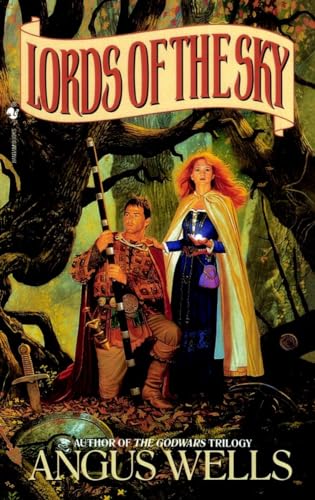
Angus Wells carved a place for himself on the shelves of hundreds of thousands of fantasy readers. Now, with Lords Of The Sky, it is clear that he has saved his most sweeping and imaginative tale for an epic more powerful than anything he has written before. For centuries, the Dhar have had to face the Ahn, fierce warriors who would lay claim to Dharbek, the land they call their ancestral home. Now, in fantastic airships powered by magic, the Ahn have begun their greatest campaign yet. In preparation for the coming onslaught, Storymen like Daviot travel the land collecting tales and sharing the history it's their responsibility to safeguard. But Daviot's travels show him the dark side of Dharbek, and inspire him to be a catalyst for change, to overcome doubt and fear, and pursue the one dream that has eluded Dharbek. Using his special gifts for storytelling and world-building, Angus Wells reaches new heights with a story as ambitious as it is broad in scope. Lords Of The Sky has all the action, adventure and magic a fantasy-lover could desire, and tackles social change, prejudice, the value of genuine friendship and the power of enduring love.
Die Inhaltsangabe kann sich auf eine andere Ausgabe dieses Titels beziehen.
Über die Autorin bzw. den Autor
Angus Wells was born in a small village in Kent, England. He worked as a publicist and as a science fiction and fantasy editor before becoming a full-time author. His works include The Books of the Kingdoms (Wrath of Ashar, The Usurper, The Way Beneath), The Godwars (Forbidden Magic, Dark Magic, Wild Magic), the standalone novel Lords of the Sky, and the two-book Exiles Saga: Exile’s Children and Exile’s Challenge. Angus Wells died in 2006.
Aus dem Klappentext
Angus Wells carved a place for himself on the shelves of hundreds of thousands of fantasy readers. Now, with Lords Of The Sky, it is clear that he has saved his most sweeping and imaginative tale for an epic more powerful than anything he has written before. For centuries, the Dhar have had to face the Ahn, fierce warriors who would lay claim to Dharbek, the land they call their ancestral home. Now, in fantastic airships powered by magic, the Ahn have begun their greatest campaign yet. In preparation for the coming onslaught, Storymen like Daviot travel the land collecting tales and sharing the history it's their responsibility to safeguard. But Daviot's travels show him the dark side of Dharbek, and inspire him to be a catalyst for change, to overcome doubt and fear, and pursue the one dream that has eluded Dharbek. Using his special gifts for storytelling and world-building, Angus Wells reaches new heights with a story as ambitious as it is broad in scope. Lords Of The Sky has all the action, adventure and magic a fantasy-lover could desire, and tackles social change, prejudice, the value of genuine friendship and the power of enduring love.
From the Paperback edition.
Auszug. © Genehmigter Nachdruck. Alle Rechte vorbehalten.
When I was in my twelfth year, I saw the Sky Lords.
I was born in Kellambek, in a village named Whitefish, for its chief source of food and revenue. It lay some seven leagues south of the river Cambar, on a cove shaded by cliffs where black pines grew and the wind blew warm off the Fend through all the long hot summers. Through childhood’s eyes I see the sky forever blue, the sea like rippled silk torn by the fishing boats, the hearthfire in winter merry, the shutters secure against the cold. Through those eyes taught in Durbrecht, I know this was not so: in summer, the air stank of fish and tar and sweat; in winter, draughts blew and the sea roared angry. Both memories are mine, and I think perhaps both are true.
My parents were fisherfolk. My father was named Aditus and owned a boat crewed by himself and two others, one my uncle, Battus, wed to my father’s sister, Lyrta; the other a taciturn man named Thorus, a widower, who seemed never to smile save when he held a cup or spoke with me. My mother was named Donia and, like my father, smiled a great deal, though I think that between the netting and the gutting of the fish and the tending of we children they had little enough, in reality, in which to find such good humor. But they did, and I suppose that is the way of simple folk who accept what is unquestioningly and lack that spark (or curse?) that looks for change. I had one brother, Tonium, and one sister, Delia, both younger by a descending year apiece.
I was a fisher-child. I played on the sand, amongst the beached boats or amongst the black pines. I hoarded shells and bird’s eggs. When the brille swarmed, I waded in, knee-deep, to haul the nets. I swung a sling and pulled girls’ hair; fought with other boys and listened to the stories of old men. On the cliff above the village I had a secret camp: a fortress great as the Lord Protector’s keep, from which I and Tellurin and Corum and all the rest defended Whitefish village against the Kho’rabi. Sometimes I was a Kho’rabi knight and with my bark-peeled blade wrought slaughter on my friends, though I always liked it better when I had the part of a Dhar warrior—a commur, or a jennym, even a pyke—for then I felt, with all the intensity of childhood’s fierce emotions, that I fought for Kellambek, to hold off those invaders the Sentinels could not prevent from crossing the waters of the Fend. Those were carefree days when, in the ignorance of childhood, I knew only that the dawn be sunny and I should go to play again.
What did I know then of the Comings?
Little enough: to me, the Kho’rabi knights, the kingdom of Ahn-feshang, they were legends. When I was very young—too young to laugh at the threat—my mother used to tell me that should I disobey her, a Kho’rabi knight should come and take my head. I spent some small time cowering beneath my blanket at that, but as I grew older, sneered. Kho’rabi knights—what were they to me? Creatures of legend, of no more account than the fabled dragons of the Forgotten Country, who had gone away before even my grandfather was born.
But then I saw the Sky Lords.
It was the end of summer, when the winds off the Fend shift and blow westward. The sky was a cloudless cobalt blue, hot and hard, the sun a sullen eye that challenged observation. The sea was still, unrippled. I was on the sand, passing my father the tools he needed to sew gashes in his nets. Battus and Thorus worked with him on the skein: they had decided to forgo the evening tide and spend the dusktime in repairing.
Thorus was the first to see the skyboat, dropping his needle as he sprang to his feet, shouting. My father and my uncle were no slower upright, the net forgotten on the warm sand. I followed them, staring to where they pointed, not sure what it was they pointed at or what set such fear in their eyes. I knew only that my father, who was afraid of nothing, was indeed afraid. I felt the fear, like the waft of sour sweat, or a drunkard’s breath. Battus shouted and ran from the beach toward the mantis’s cella.
I remember that Thorus said, “They come again,” and my father answered, “It is not the time,” and then told me to run homeward, to tell my mother that the Sky Lords came, and she would know what to do.
As all the men not at sea gathered, staring skyward, I lingered a moment, wondering what held them so, what set them so rigid, like the old, time-carved statues that guarded the entrance to the cella.
Against the knife-sharp brilliance of the sky, I saw a shape. It seemed in that moment like a maggot, a bloated grub taken up by the hot late-summer wind, a speck against the eye-watering azure, that drifted steadily toward me. I felt my skin grow chill with apprehension.
Then my father, knowing me, shouted again, and I ran to our cottage and yelled at my mother that the Sky Lords came.
I think that then, for the first time, I truly knew what terror they induced.
Tonium and Delia fashioned castles from the dirt of our yard, grubby in a manner I—the older—was too adult to entertain. My mother screamed at them, bringing them tearful to her arms, she so distraught she found only brief, hurried words to calm their wailing as she gathered them up. The bell that hung above the cella began to sound, sonorous in the late-afternoon air, its clanging soon augmented by a great shouting from all the women, and the old men, and the howling of confused and frightened children who, like me, knew only that something unfamiliar occurred to induce fear and near-panic in our parents. My mother snatched Delia’s and Tonium’s hands in hers, shouted at me to follow, and drew my siblings, trotting, away from the house toward the cella. The mantis stood atop the dome. The sinews in his fat arms stood out like cords from the effort of his bell-ringing, and his plump face, usually set in a smile, was grim, his head craned around to peer at the shape approaching across the sky. All around me I heard the single word Kho’rabi, said in tones of awe and terror, but for all the panic, I was fascinated. I watched as the mantis gathered up the skirts of his robe and slid ungainly down the sloping side of the dome. Robus, who owned the only horse in Whitefish village—a venerable gelding sometimes used to haul stricken boats from the winter surf, but more usually to drag a cart up the coast to Cambar town with catches of fish to sell—waited nervously. He had belted an ancient sword to his waist. All the men, and not a few of the women, carried weapons of one kind or another: fish knives, axes, mattocks. The mantis spoke urgently with Robus, and though I could not hear what was said, I perceived it had a great effect on Robus, for he dragged himself astride the old horse and slapped the gray flanks with his rusty blade, sending the animal into a startled, lumbering trot out of the village in the direction of the Cambar road. Then the mantis shouted that all should follow him and led the way to the cliff path, up through the pines to the fields beyond, where a track wound by dry-stone walls to a wood where caves ran down into the earth.
In the confusion I became separated from my mother, and as I watched the worried faces of those who passed me, I succumbed to childhood’s temptation.
I was afraid—how should I not be?—but I was also intrigued, fascinated to know the why of it. I felt a stone grind my foot, between my sole and my sandal, and I ducked clear of the throng to dislodge the annoyance. As I unlaced my sandal and shook out the pebble, I saw the last of the villagers go by, five grandfathers in rear...
„Über diesen Titel“ kann sich auf eine andere Ausgabe dieses Titels beziehen.
Suchergebnisse für Lords Of The Sky (Bantam Spectra Book)

Beispielbild für diese ISBN
Lords of the Sky
Anbieter: ThriftBooks-Dallas, Dallas, TX, USA
Verkäuferbewertung 5 von 5 Sternen

Paperback. Zustand: Fair. No Jacket. Readable copy. Pages may have considerable notes/highlighting. ~ ThriftBooks: Read More, Spend Less. Artikel-Nr. G0553373951I5N00
Gebraucht kaufen
EUR 6,88
Versand gratis
Versand innerhalb von USA
Versand innerhalb von USA
Anzahl: 1 verfügbar
Beispielbild für diese ISBN
Lords of the Sky
Anbieter: ThriftBooks-Dallas, Dallas, TX, USA
Verkäuferbewertung 5 von 5 Sternen
Paperback. Zustand: Good. No Jacket. Pages can have notes/highlighting. Spine may show signs of wear. ~ ThriftBooks: Read More, Spend Less. Artikel-Nr. G0553373951I3N00
Gebraucht kaufen
EUR 6,88
Versand gratis
Versand innerhalb von USA
Versand innerhalb von USA
Anzahl: 1 verfügbar
Beispielbild für diese ISBN
Lords of the Sky
Anbieter: ThriftBooks-Dallas, Dallas, TX, USA
Verkäuferbewertung 5 von 5 Sternen
Paperback. Zustand: Fair. No Jacket. Former library book; Readable copy. Pages may have considerable notes/highlighting. ~ ThriftBooks: Read More, Spend Less. Artikel-Nr. G0553373951I5N10
Gebraucht kaufen
EUR 6,88
Versand gratis
Versand innerhalb von USA
Versand innerhalb von USA
Anzahl: 1 verfügbar
Beispielbild für diese ISBN
Lords of the Sky: A Novel (Bantam Spectra Book)
Anbieter: Wonder Book, Frederick, MD, USA
Verkäuferbewertung 5 von 5 Sternen
Zustand: Good. Good condition. A copy that has been read but remains intact. May contain markings such as bookplates, stamps, limited notes and highlighting, or a few light stains. Artikel-Nr. R01L-01938
Gebraucht kaufen
EUR 8,30
Versand gratis
Versand innerhalb von USA
Versand innerhalb von USA
Anzahl: 1 verfügbar
Beispielbild für diese ISBN
Lords of the Sky: A Novel (Bantam Spectra Book)
Anbieter: Foggypaws, Sonoma, CA, USA
Verkäuferbewertung 4 von 5 Sternen

Paperback. Zustand: Very Good. Paperback in very good condition. All inside pages are in great shape. Minor shelf wear to the cover. Artikel-Nr. mon0000054542
Gebraucht kaufen
EUR 4,58
EUR 7,16 Versand
Versand innerhalb von USA
Versand innerhalb von USA
Anzahl: 1 verfügbar
Foto des Verkäufers
Lords of the Sky: A Novel (Bantam Spectra Book)
Anbieter: Southampton Books, Sag Harbor, NY, USA
Verkäuferbewertung 5 von 5 Sternen
Hardcover. Zustand: Like New. BOOK CLUB EDITION. Book Club Edition. Published by Spectra, 1994. Octavo. Hardcover. Book is like new. Dust jacket is like new. Artikel-Nr. 562210
Gebraucht kaufen
EUR 13,85
EUR 4,47 Versand
Versand innerhalb von USA
Versand innerhalb von USA
Anzahl: 1 verfügbar
Beispielbild für diese ISBN
Lords of the Sky
Verlag:
Bantam, New York, 1994
ISBN 10: 0553373951
ISBN 13: 9780553373950
Gebraucht
Softcover
Erstausgabe
Anbieter: Between the Covers-Rare Books, Inc. ABAA, Gloucester City, NJ, USA
Verkäuferbewertung 5 von 5 Sternen
Softcover. Zustand: Near Fine. First Edition. First edition. Near fine in wrappers. Review Copy. Review copy. Artikel-Nr. 215350
Gebraucht kaufen
EUR 18,01
EUR 4,93 Versand
Versand innerhalb von USA
Versand innerhalb von USA
Anzahl: 1 verfügbar
Beispielbild für diese ISBN
Lords of The Sky
Verlag:
Bantam, New York, 1994
ISBN 10: 0553373951
ISBN 13: 9780553373950
Gebraucht
Softcover
Erstausgabe
Anbieter: Between the Covers-Rare Books, Inc. ABAA, Gloucester City, NJ, USA
Verkäuferbewertung 5 von 5 Sternen
Softcover. Zustand: Near Fine. First edition. Near fine in wrappers. / Very good condition. Artikel-Nr. 240701
Gebraucht kaufen
EUR 18,46
EUR 4,93 Versand
Versand innerhalb von USA
Versand innerhalb von USA
Anzahl: 1 verfügbar