
Verwandte Artikel zu Food of the Gods: The Search for the Original Tree...
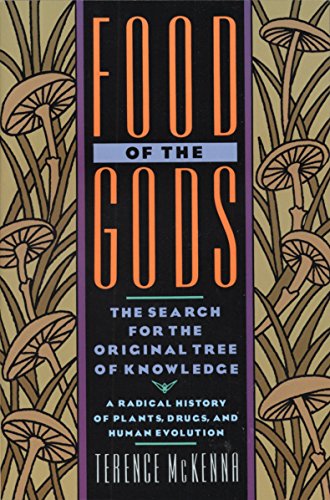
Food of the Gods: The Search for the Original Tree of Knowledge A Radical History of Plants, Drugs, and Human Evolution - Softcover
Inhaltsangabe
An exploration of humans' symbiotic relationships with plants and chemicals presents information on prehistoric partnership societies, the roles of spices and spirits in the rise of dominator societies; and the politics of tobacco, tea, coffee, opium, and alcohol.
Why, as a species, are humans so fascinated by altered states of consciousness? Can altered states reveal something to us about our origins and our place in nature? In Food of the Gods, ethnobotanist Terence McKenna’s research on man’s ancient relationship with chemicals opens a doorway to the divine, and perhaps a solution for saving our troubled world. McKenna provides a revisionist look at the historical role of drugs in the East and the West, from ancient spice, sugar, and rum trades to marijuana, cocaine, synthetics, and even television—illustrating the human desire for the “food of the gods” and the powerful potential to replace abuse of illegal drugs with a shamanic understanding, insistence on community, reverence for nature, and increased self-awareness.
Praise for Food of the Gods
“Deserves to be the modern classic on mind-altering drugs and hallucinogens.”—The Washington Post
“Terence McKenna is the most important—and most entertaining—visionary scholar in America.”—Tom Robbins
“The culture’s foremost spokesperson for the psychedelic experience . . . Those who know and enjoy Joseph Campbell’s work will almost certainly appreciate McKenna.”—L.A. Weekly
“An eloquent proposal for recovering something vital—a sense of the sacred, the transcendent, the Absolute—before it’s too late.”—Larry Dossey, M.D., author of Meaning & Medicine, Recovering the Soul, and Space, Time & Machine
Die Inhaltsangabe kann sich auf eine andere Ausgabe dieses Titels beziehen.
Über die Autorin bzw. den Autor
Terence McKenna, author and explorer, has traveled the world to work and live with shamans. He has added to their shared knowledge of rituals his own efforts to preserve the plants used in these ceremonies. Coauthor of The Invisible Landscape and Psilocybin: The Magic Mushroom Grower’s Guide, Terence mesmerizes his many lecture audiences with tales of science and shamanism. He lives in Occidental, California, and is co-manager of a botanical garden in Hawaii for endangered tropical plants.
Auszug. © Genehmigter Nachdruck. Alle Rechte vorbehalten.
1
SHAMANISM: SETTING THE STAGE
Raongi sat still in the fading light of the fire. He felt his body flex deep within in ways that reminded him of the gulping of an eel. As he formed this thought, an eel's head, oversized and bathed in electric blue, appeared obediently in the darkened space behind his eyelids.
"Mother spirit of the first waterfall ... "
"Grandmother of the first rivers ... "
"Show yourself, show yourself."
Responding to the voices, the darkened space behind the now slowly spinning eel apparition filled with sparks; waves oflight leaped higher and higher, accompanied by a roar of increasing intensity.
"It is the first maria." The voice is that of Mangi, the elder shaman of the village of Jarocamena. "It is strong. So strong."
Mangi is silent as the visions close over them. They are on the brink ofVentiui, the real world, the blue zone. The sound of falling rain outside is unrecognizable. There is the shuffling of dry leaves mingled with the sound of distant bells. Their tingling seems more like light than sound.
Until relatively recently, the practices of Mangi and her remote Amazonian tribe were typical of religious practice everywhere. Only in the last several millennia have theology and ritual graduated to more elaborate—and not necessarily more serviceable—forms.
SHAMANISM AND ORDINARY RELIGION
When I arrived in the Upper Amazon in early 1970, I had just spent several years living in Asian societies. Asia is a place where the shattered shells of castoff religious ontologies litter the dusty landscape like the carapaces of sand-scoured scarabs. I had traveled India in search of the miraculous. I had visited its temples and ashrams, its jungles and mountain retreats. But Yoga, a lifetime calling, the obsession of a disciplined and ascetic few, was not sufficient to carry me to the inner landscapes that I sought.
I learned in India that religion, in all times and places where the luminous flame of the spirit has guttered low, is no more than a hustle. Religion in India stares from world-weary eyes familiar with four millennia of priestcraft. Modern Hindu India to me was both an antithesis and a fitting prelude to the nearly archaic shamanism that I found in the lower Rio Putumayo of Colombia when I arrived there to begin studying the shamanic use of hallucinogenic plants. Shamanism is the practice of the Upper Paleolithic tradition of healing, divination, and theatrical performance based on natural magic developed ten to fifty thousand years ago. Mircea Eliade, author of Shamanism: Archaic Techniques of Ecstasy and the fore most authority on shamanism in the context of comparative religion, has shown that in all times and places shamanism maintains a surprising internal coherency of practice and belief. Whether the shaman is an Arctic-dwelling Inuit or a Witoto of the Upper Am azon, certain techniques and expectations remain the same. Most important of these invariants is ecstasy, a point my brother and I make in our book The Invisible Landscape:
The ecstatic part of the shaman's initiation is harder to analyze, for it is dependent on a certain receptivity to states of trance and ecstasy on the part of the novice; he may be moody, somewhat frail and sickly, predisposed to solitude, and may perhaps have fits of epilepsy or catatonia, or some other psychological aberrance (though not always as some writers on the subject have asserted). In any case, his psy chological predisposition to ecstasy forms only the starting point for his initiation: the novice, after a history of psy chosomatic illness or psychological aberration that may be more or less intense, will at last begin to undergo initiatory sickness and trances; he will lie as though dead or in deep trance for days on end. During this time, he is approached in dreams by his helping spirits, and may receive instruction from them. Invariably during this prolonged trance the nov ice will undergo an episode of mystical death and resurrec tion; he may see himself reduced to a skeleton and then clothed with new flesh; or he may see himself boiled in a caldron, devoured by the spirits, and then made whole again; or he may imagine himself being operated on by the spirits, his organs removed and replaced with "magical stones" and then sewn up again.
Eliade showed that, while the particular motifs may vary between cultures and even individuals, shamanism's general structure is clear: the neophyte shaman undergoes a symbolic death and res urrection, which is understood as a radical transformation into a superhuman condition. Henceforth, the shaman has access to the superhuman plane, is a master of ecstasy, can travel in the spirit realm at will, and most important, can cure and divine. As we noted in The Invisible Landscape:
In short, the shaman is transformed from a profane into a sacred state of being. Not only has he effected his own cure through this mystical transmutation, he is now invested with the power of the sacred, and hence can cure others as well. It is of the first order of importance to remember this, that the shaman is more than merely a sick man, or a madman; he is a sick man who has healed himself, who is cured, and who must shamanize in order to remain cured.
It should be noted that Eliade used the word "profane" delib erately with the intent of creating a clear split between the notion of the profane world of ordinary experience and the sacred world which is "Wholly Other."
„Über diesen Titel“ kann sich auf eine andere Ausgabe dieses Titels beziehen.
Suchergebnisse für Food of the Gods: The Search for the Original Tree...

Foto des Verkäufers
Food of the Gods: The Search for the Original Tree of Knowledge A Radical History of Plants, Drugs, and Human Evolution
Anbieter: Dream Books Co., Denver, CO, USA
Verkäuferbewertung 5 von 5 Sternen

Zustand: acceptable. This copy has clearly been enjoyedâ"expect noticeable shelf wear and some minor creases to the cover. Binding is strong, and all pages are legible. May contain previous library markings or stamps. Artikel-Nr. DBV.0553371304.A
Gebraucht kaufen
EUR 6,42
Versand gratis
Versand innerhalb von USA
Versand innerhalb von USA
Anzahl: 2 verfügbar
Foto des Verkäufers
Food of the Gods: The Search for the Original Tree of Knowledge A Radical History of Plants, Drugs, and Human Evolution
Anbieter: Dream Books Co., Denver, CO, USA
Verkäuferbewertung 5 von 5 Sternen
Zustand: good. Gently used with minimal wear on the corners and cover. A few pages may contain light highlighting or writing, but the text remains fully legible. Dust jacket may be missing, and supplemental materials like CDs or codes may not be included. May be ex-library with library markings. Ships promptly! Artikel-Nr. DBV.0553371304.G
Gebraucht kaufen
EUR 7,40
Versand gratis
Versand innerhalb von USA
Versand innerhalb von USA
Anzahl: 1 verfügbar
Beispielbild für diese ISBN
Food of the Gods: The Search for the Original Tree of Knowledge a Radical History of Plants, Drugs, and Human Evolution
Anbieter: ThriftBooks-Dallas, Dallas, TX, USA
Verkäuferbewertung 5 von 5 Sternen
Paperback. Zustand: Fair. No Jacket. Readable copy. Pages may have considerable notes/highlighting. ~ ThriftBooks: Read More, Spend Less. Artikel-Nr. G0553371304I5N00
Gebraucht kaufen
EUR 8,26
Versand gratis
Versand innerhalb von USA
Versand innerhalb von USA
Anzahl: 1 verfügbar
Beispielbild für diese ISBN
Food of the Gods: The Search for the Original Tree of Knowledge A Radical History of Plants, Drugs, and Human Evolution
Anbieter: Wonder Book, Frederick, MD, USA
Verkäuferbewertung 5 von 5 Sternen
Zustand: Very Good. Very Good condition. A copy that may have a few cosmetic defects. May also contain light spine creasing or a few markings such as an owner's name, short gifter's inscription or light stamp. Artikel-Nr. Q01H-01429
Gebraucht kaufen
EUR 9,88
Versand gratis
Versand innerhalb von USA
Versand innerhalb von USA
Anzahl: 1 verfügbar
Beispielbild für diese ISBN
Food of the Gods: The Search for the Original Tree of Knowledge A Radical History of Plants, Drugs, and Human Evolution
Anbieter: World of Books (was SecondSale), Montgomery, IL, USA
Verkäuferbewertung 5 von 5 Sternen
Paperback. Zustand: Good. "Deserves to be the modern classic on mind-altering drugs and hallucinogens."-The Washington Post Ethnobotanist Terence Mckenna, hailed by Tom Robbins as "the most important-and most entertaining-visionary scholar in America," explores humanity's symbiotic relationship withspirits, tobacco, marijuana, opium,psilocybin,and more, from prehistoric times to today. Why, as a species, are humans so fascinated by altered states of consciousness? Can altered states reveal something to us about our origins and our place in nature? In Food of the Gods, Terence McKenna's research on man's ancient relationship with chemicals opens a doorway to the divine, and perhaps a solution for saving our troubled world. McKenna provides a revisionist look at the historical role of drugs in the East and the West, from ancient spice, sugar, and rum trades to marijuana, cocaine, synthetics, and even television-illustrating the human desire for the "food of the gods" and the powerful potential to replace abuse of illegal drugs with a shamanic understanding, insistence on community, reverence for nature, and increased self-awareness. Artikel-Nr. 00108320239
Gebraucht kaufen
EUR 9,89
Versand gratis
Versand innerhalb von USA
Versand innerhalb von USA
Anzahl: 11 verfügbar
Beispielbild für diese ISBN
Food of the Gods: The Search for the Original Tree of Knowledge A Radical History of Plants, Drugs, and Human Evolution
Anbieter: World of Books (was SecondSale), Montgomery, IL, USA
Verkäuferbewertung 5 von 5 Sternen
Paperback. Zustand: Very Good. "Deserves to be the modern classic on mind-altering drugs and hallucinogens."-The Washington Post Ethnobotanist Terence Mckenna, hailed by Tom Robbins as "the most important-and most entertaining-visionary scholar in America," explores humanity's symbiotic relationship withspirits, tobacco, marijuana, opium,psilocybin,and more, from prehistoric times to today. Why, as a species, are humans so fascinated by altered states of consciousness? Can altered states reveal something to us about our origins and our place in nature? In Food of the Gods, Terence McKenna's research on man's ancient relationship with chemicals opens a doorway to the divine, and perhaps a solution for saving our troubled world. McKenna provides a revisionist look at the historical role of drugs in the East and the West, from ancient spice, sugar, and rum trades to marijuana, cocaine, synthetics, and even television-illustrating the human desire for the "food of the gods" and the powerful potential to replace abuse of illegal drugs with a shamanic understanding, insistence on community, reverence for nature, and increased self-awareness. Artikel-Nr. 00110556214
Gebraucht kaufen
EUR 9,89
Versand gratis
Versand innerhalb von USA
Versand innerhalb von USA
Anzahl: 4 verfügbar
Beispielbild für diese ISBN
Food of the Gods: The Search for the Original Tree of Knowledge A Radical History of Plants, Drugs, and Human Evolution
Anbieter: Weird Books, Napa, CA, USA
Verkäuferbewertung 5 von 5 Sternen
paperback. Zustand: Very Good. Very Good text and cover, minor reading wear to text and covers/edges. Fast shipping from Northern California via US MAIL. Most International orders shipped via DHL/Asendia. Additional postage may be required on oversize books and sets. Please, NO prison orders. Artikel-Nr. 2610040039
Gebraucht kaufen
EUR 5,07
EUR 4,92 Versand
Versand innerhalb von USA
Versand innerhalb von USA
Anzahl: 1 verfügbar
Beispielbild für diese ISBN
Food of the Gods : The Search for the Original Tree of Knowledge a Radical History of Plants, Drugs, and Human Evolution
Verlag:
Random House Publishing Group, 1993
ISBN 10: 0553371304
ISBN 13: 9780553371307
Gebraucht
Softcover
Anbieter: Better World Books: West, Reno, NV, USA
Verkäuferbewertung 5 von 5 Sternen
Zustand: Fine. Used book that is in almost brand-new condition. May contain a remainder mark. Better World Books: Buy Books. Do Good. Artikel-Nr. 3932114-6
Gebraucht kaufen
EUR 11,22
Versand gratis
Versand innerhalb von USA
Versand innerhalb von USA
Anzahl: 1 verfügbar
Beispielbild für diese ISBN
Food of the Gods: The Search for the Original Tree of Knowledge A Radical History of Plants, Drugs, and Human Evolution
Anbieter: Visible Voice Books, Cleveland, OH, USA
Verkäuferbewertung 5 von 5 Sternen
Paperback. Zustand: New. RANDOM HOUSE INC February 1993. Artikel-Nr. 86429
Neu kaufen
EUR 13,42
EUR 4,03 Versand
Versand innerhalb von USA
Versand innerhalb von USA
Anzahl: 1 verfügbar
Beispielbild für diese ISBN
Food of the Gods
Anbieter: PBShop.store UK, Fairford, GLOS, Vereinigtes Königreich
Verkäuferbewertung 5 von 5 Sternen
PAP. Zustand: New. New Book. Shipped from UK. Established seller since 2000. Artikel-Nr. FV-9780553371307
Neu kaufen
EUR 19,55
EUR 4,97 Versand
Versand von Vereinigtes Königreich nach USA
Versand von Vereinigtes Königreich nach USA
Anzahl: 10 verfügbar