
Verwandte Artikel zu Obsessive Love
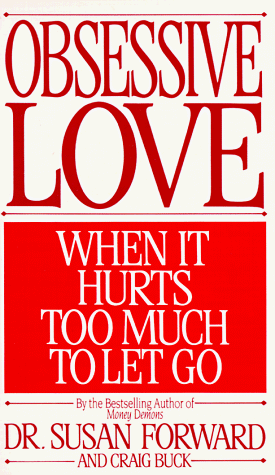
Inhaltsangabe
A guide to overcoming obsessive love presents case histories of men and women caught in the grip of obsessive passion and describes a step-by-step program that shows readers how to have healthy, lasting, pain-free relationships
Die Inhaltsangabe kann sich auf eine andere Ausgabe dieses Titels beziehen.
Über die Autorin bzw. den Autor
Susan Forward, Ph.D., is an internationally renowned therapist, lecturer, and author of the number one <i>New York Times</i> bestsellers <b>Toxic Parents</b> and <b>Men Who Hate Women and the Women Who Love Them</b>, as well as <b>Betrayal of Innocence: Incest and Its Devastation</b>, <b>Money Demons</b>, <b>Emotional Blackmail</b>, <b>When Your Lover Is a Liar</b>, and <b>Toxic In-Laws</b>. <br><br>In addition to her private practice, for five years she hosted a daily ABC talk-radio program. She has also served widely as a group therapist, instructor, and consultant in many southern California medical and psychiatric facilities, and she formed the first private sexual abuse treatment center in California. She lives in Los Angeles and has two grown children.<br><br>Dr.
Aus dem Klappentext
luable self-help guide, Dr. Susan Forward presents vivid case histories as well as the real-life voices of men and women caught in the grip of obsessive passion. Whether you're an obsessive lover or the target of such an obsession, here is a proven, step-by-step program that shows you how to recognize the "connection compulsion," what causes it, and how to break its hold on your life so that you can go on to build healthy, lasting, and pain-free relationships.
Auszug. © Genehmigter Nachdruck. Alle Rechte vorbehalten.
Chapter 1
The One Magic Person
I can’t believe I did all those things. The phone calls, the drive-bys, the letters, the tantrums, the threats ... it just wasn’t me. But it took me so long to get him out of my head. The way he looked, the way he smelled, the way he touched me ... he drove me crazy. — Margaret
It was Margaret’s last day of therapy. She had worked hard to break free from the painful obsessive patterns that had been plaguing her for the past three years, and she had largely succeeded. She was a very different woman from the depressed, desperate, volatile Margaret I had first met a year and a half earlier.
Margaret is a willowy, red-haired, thirty-four-year-old divorcée who works as a paralegal with a large law firm. She came to see me because her preoccupation with Phil — a lover who was clearly not interested in a monogamous relationship — was making her feel like she was losing control of both her personal and her professional life. She was becoming increasingly short-tempered with her ten-year-old son. She was making careless mistakes at work. And she was alienating her friends by avoiding them, not only because she wanted to be available in case Phil called, but also because her friends were virtually unanimous in their criticism of Phil.
The Thrill of a New Romance
Margaret met Phil about six years after she divorced her husband. She had been dating on and off but had been unable to find anyone with whom she was interested in establishing a serious relationship. After six years, she was getting pretty discouraged. She hated the bar scene. She had already met most of the single men her friends knew, but nothing had developed. She had even gone to a video dating service — both the dates she’d had as a result had been disappointing.
Margaret met Phil at the courthouse while she was assisting her boss in the defense of an embezzlement suspect. Phil was a police officer, testifying in a highly publicized murder case. Margaret first saw him in the cafeteria during the lunch break.
Margaret
This gorgeous hunk sat down across from me and it was lust at first sight, which hadn’t happened to me in years. We started talking and he asked me out that same night. I remember coming home after that date and as soon as I closed the door I broke into this little victory dance. Within a week we were seeing each other almost every night. It was an incredible high. During the day he’d call me at work and I’d get the most delicious butterflies in my stomach just hearing his voice. I was really in heaven.
Even though Margaret was describing the beginnings of what was to become an intensely obsessive relationship, there is nothing in her description that could not just as easily describe the beginnings of some healthy relationships. Most of us relish the giddy feelings that Margaret talked about. When we first fall in love, we feel like we’re walking on air. Flowers smell more fragrant, music sounds more beautiful, the sky seems bluer, our pulse quickens, our mood soars.
These heightened sensations are not just imaginary. Physical changes are triggered in our bodies by romantic feelings, hopes, and fantasies. Our heartbeat quickens, we become flushed, our adrenaline pumps, we experience hormonal changes, and our brains release endorphins — the body’s natural opiate. As a result of all this chemical activity, love is a physical state as well as a state of mind.
The Idealized Lover
In the thrill and passion of a new romance, it is only natural to see a lover through rose-colored glasses. We go out of our way to see only what we want to see, filtering our perceptions through romantic expectations and dreams. This optimistic filtering of reality is called “idealization.”
You can see idealization at work in Margaret’s description of Phil.
Margaret
After a couple weeks, he told me he was in love with me. I was ecstatic. He was so perfect. I felt like my life was finally rounding out. Not only did I have a job I liked, and my son seemed to be doing okay, but now, finally, I had this fantastic guy. The sex was great, the talk was great, he cooked these romantic meals, he even fixed my car for me. I felt totally safe with him, not just physically but emotionally. I’d finally found the man I was going to spend the rest of my life with. He made me feel like I was more than I’d ever been before, like I was finally a whole person. And I knew there was no one else on earth who could make me feel that way.
Margaret jumped to a lot of conclusions about Phil simply because he was a good lover and fun to be with. She really didn’t know much about him. It would have been impossible for her to have learned much about his character or his past relationships in the two short weeks of passion that they’d shared. Yet she was convinced that he was “perfect,” that he would make a lifetime commitment to her, and that he — and only he — had the power to make her feel like “a whole person.”
I certainly don’t mean to imply that Margaret did anything unusual. We all idealize. This is especially easy to do in the early stages of a relationship, since new lovers are typically on their best behavior. We all put on our best face when we are attracted to a new person. We make a special effort to be as alluring, charming, witty, sympathetic, flattering, and accommodating as we can. This is part of our mating ritual.
However, while this behavior might reveal certain facets of our personality, it can’t possibly tell the whole story. We all have our moody days, our petty jealousies, our knee-jerk reactions, our rigid opinions, and our unattractive habits. And we certainly don’t want to reveal any of these to a new lover.
In the heat of a new relationship, as we downplay our own shortcomings, we don’t give much thought to the fact that our lover is doing the same. Under these conditions idealization can’t help but thrive.
The One and Only
In healthy relationships, idealization helps lovers believe that — maybe — they have found the person of their dreams. But healthy lovers give themselves a safety net called reality. They hope their relationship will work out but also recognize that it may not.
Obsessive lovers, on the other hand, work without this net as they struggle for balance on the high wire of romantic expectations. In the heightened reality of obsessive passion there is no room for doubt. Obsessive lovers live by an unshakable credo:
This is the one — and only one — magic person who can meet all my needs.
Obsessive lovers truly believe — sometimes without realizing it — that their “One Magic Person” alone can make them feel happy and fulfilled, solve all their problems, give them the passion they’ve yearned for, and make them feel more wanted and loved than they’ve ever felt before. With all this power, the One Magic Person becomes more than a lover — he or she becomes a necessity of life.
There are no prerequisites for the One Magic Person. It is not necessary that he or she be especially attractive, intelligent, witty, or successful or possess any other qualities we usually associate with desirability.
In fact, some obsessors fall in love with deeply troubled or even addicted lovers. These obsessors are irresistibly drawn into relationships by a deep-seated need to be needed and a belief that they alone can save their lover (as we’ll see in Chapter Four).
Obsessors’ fantasies and expectations about their One Magic Person may have little to do with who...
„Über diesen Titel“ kann sich auf eine andere Ausgabe dieses Titels beziehen.
Suchergebnisse für Obsessive Love

Beispielbild für diese ISBN
Obsessive Love: When It Hurts Too Much to Let Go
Anbieter: World of Books (was SecondSale), Montgomery, IL, USA
Verkäuferbewertung 5 von 5 Sternen

Zustand: Good. Item in good condition. Textbooks may not include supplemental items i.e. CDs, access codes etc. Artikel-Nr. 00096613095
Gebraucht kaufen
EUR 3,62
Versand gratis
Versand innerhalb von USA
Versand innerhalb von USA
Anzahl: 3 verfügbar
Beispielbild für diese ISBN
Obsessive Love: When It Hurts Too Much to Let Go
Verlag:
Bantam (edition Reissue), 1992
ISBN 10: 0553296744
ISBN 13: 9780553296747
Gebraucht
Mass Market Paperback
Anbieter: BooksRun, Philadelphia, PA, USA
Verkäuferbewertung 5 von 5 Sternen
Mass Market Paperback. Zustand: Very Good. Reissue. It's a well-cared-for item that has seen limited use. The item may show minor signs of wear. All the text is legible, with all pages included. It may have slight markings and/or highlighting. Artikel-Nr. 0553296744-11-1
Gebraucht kaufen
EUR 4,61
Versand gratis
Versand innerhalb von USA
Versand innerhalb von USA
Anzahl: 2 verfügbar
Beispielbild für diese ISBN
Obsessive Love: When It Hurts Too Much to Let Go
Verlag:
Bantam Books, 1992
ISBN 10: 0553296744
ISBN 13: 9780553296747
Gebraucht
Mass Market Paperback
Anbieter: ThriftBooks-Phoenix, Phoenix, AZ, USA
Verkäuferbewertung 5 von 5 Sternen
Mass Market Paperback. Zustand: Very Good. No Jacket. May have limited writing in cover pages. Pages are unmarked. ~ ThriftBooks: Read More, Spend Less. Artikel-Nr. G0553296744I4N00
Gebraucht kaufen
EUR 5,96
Versand gratis
Versand innerhalb von USA
Versand innerhalb von USA
Anzahl: 1 verfügbar
Beispielbild für diese ISBN
Obsessive Love: When It Hurts Too Much to Let Go
Verlag:
Bantam Books, 1992
ISBN 10: 0553296744
ISBN 13: 9780553296747
Gebraucht
Mass Market Paperback
Anbieter: ThriftBooks-Atlanta, AUSTELL, GA, USA
Verkäuferbewertung 5 von 5 Sternen
Mass Market Paperback. Zustand: Very Good. No Jacket. May have limited writing in cover pages. Pages are unmarked. ~ ThriftBooks: Read More, Spend Less. Artikel-Nr. G0553296744I4N00
Gebraucht kaufen
EUR 5,98
Versand gratis
Versand innerhalb von USA
Versand innerhalb von USA
Anzahl: 1 verfügbar
Beispielbild für diese ISBN
Obsessive Love: When It Hurts Too Much to Let Go
Anbieter: Wonder Book, Frederick, MD, USA
Verkäuferbewertung 5 von 5 Sternen
Zustand: Very Good. Very Good condition. A copy that may have a few cosmetic defects. May also contain light spine creasing or a few markings such as an owner's name, short gifter's inscription or light stamp. Artikel-Nr. N00M-03974
Gebraucht kaufen
EUR 6,27
Versand gratis
Versand innerhalb von USA
Versand innerhalb von USA
Anzahl: 2 verfügbar
Beispielbild für diese ISBN
Obsessive Love : When It Hurts Too Much to Let Go
Verlag:
Random House Publishing Group, 1992
ISBN 10: 0553296744
ISBN 13: 9780553296747
Gebraucht
Softcover
Anbieter: Better World Books, Mishawaka, IN, USA
Verkäuferbewertung 5 von 5 Sternen
Zustand: Good. Reissue. Former library copy. Pages intact with minimal writing/highlighting. The binding may be loose and creased. Dust jackets/supplements are not included. Includes library markings. Stock photo provided. Product includes identifying sticker. Better World Books: Buy Books. Do Good. Artikel-Nr. GRP82558865
Gebraucht kaufen
EUR 6,41
Versand gratis
Versand innerhalb von USA
Versand innerhalb von USA
Anzahl: 1 verfügbar
Beispielbild für diese ISBN
Obsessive Love : When It Hurts Too Much to Let Go
Verlag:
Random House Publishing Group, 1992
ISBN 10: 0553296744
ISBN 13: 9780553296747
Gebraucht
Softcover
Anbieter: Better World Books, Mishawaka, IN, USA
Verkäuferbewertung 5 von 5 Sternen
Zustand: Good. Reissue. Pages intact with minimal writing/highlighting. The binding may be loose and creased. Dust jackets/supplements are not included. Stock photo provided. Product includes identifying sticker. Better World Books: Buy Books. Do Good. Artikel-Nr. GRP96948708
Gebraucht kaufen
EUR 6,41
Versand gratis
Versand innerhalb von USA
Versand innerhalb von USA
Anzahl: 1 verfügbar
Beispielbild für diese ISBN
Obsessive Love
Anbieter: AwesomeBooks, Wallingford, Vereinigtes Königreich
Verkäuferbewertung 5 von 5 Sternen
Mass Market Paperback. Zustand: Very Good. Obsessive Love This book is in very good condition and will be shipped within 24 hours of ordering. The cover may have some limited signs of wear but the pages are clean, intact and the spine remains undamaged. This book has clearly been well maintained and looked after thus far. Money back guarantee if you are not satisfied. See all our books here, order more than 1 book and get discounted shipping. Artikel-Nr. 7719-9780553296747
Gebraucht kaufen
EUR 4,78
EUR 4,80 Versand
Versand von Vereinigtes Königreich nach USA
Versand von Vereinigtes Königreich nach USA
Anzahl: 2 verfügbar
Beispielbild für diese ISBN
Obsessive Love
ISBN 10: 0553296744
ISBN 13: 9780553296747
Gebraucht
Paperback
Anbieter: WorldofBooks, Goring-By-Sea, WS, Vereinigtes Königreich
Verkäuferbewertung 5 von 5 Sternen
Paperback. Zustand: Very Good. The book has been read, but is in excellent condition. Pages are intact and not marred by notes or highlighting. The spine remains undamaged. Artikel-Nr. GOR003540341
Gebraucht kaufen
EUR 3,85
EUR 6,53 Versand
Versand von Vereinigtes Königreich nach USA
Versand von Vereinigtes Königreich nach USA
Anzahl: 1 verfügbar
Beispielbild für diese ISBN
Obsessive Love : When It Hurts Too Much to Let Go
Verlag:
Random House Publishing Group, 1992
ISBN 10: 0553296744
ISBN 13: 9780553296747
Gebraucht
Softcover
Anbieter: Better World Books Ltd, Dunfermline, Vereinigtes Königreich
Verkäuferbewertung 5 von 5 Sternen
Zustand: Good. Reissue. Pages intact with minimal writing/highlighting. The binding may be loose and creased. Dust jackets/supplements are not included. Stock photo provided. Product includes identifying sticker. Better World Books: Buy Books. Do Good. Artikel-Nr. GRP96948708
Gebraucht kaufen
EUR 5,63
EUR 5,83 Versand
Versand von Vereinigtes Königreich nach USA
Versand von Vereinigtes Königreich nach USA
Anzahl: 1 verfügbar